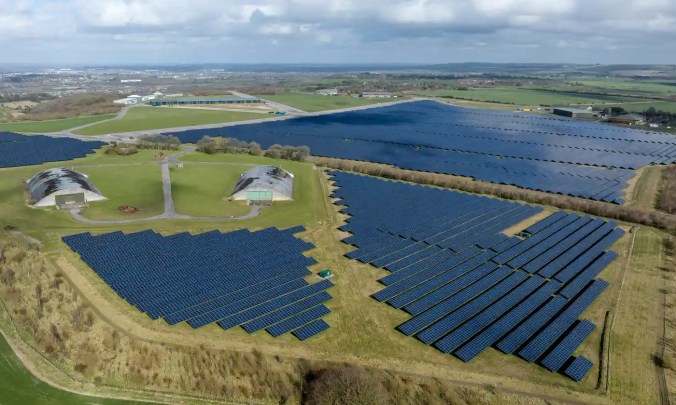
Solar farm in Wroughton, England. Planning permission for 23 solar farms has been refused across England, Wales and Scotland between January 2021 and July 2022. Photograph: Chris Gorman/Getty Images
Nature gets disrupted even by the most sensitively planned green solutions. Here is a parallel story to yesterday’s, with solar replacing wind and England replacing Western USA, illustrating the challenges facing renewable energy:
Exclusive: Projects which would have cut annual electricity bills by £100m turned down
Solar farms are being refused planning permission in Great Britain at the highest rate in five years, analysis has found, with projects which would have cut £100m off annual electricity bills turned down in the past 18 months.
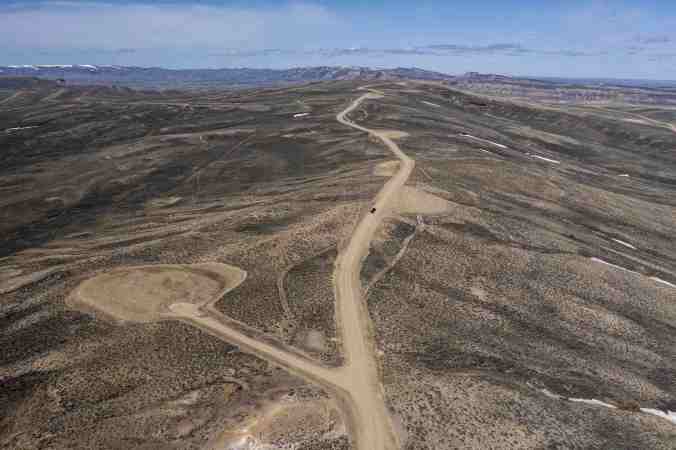
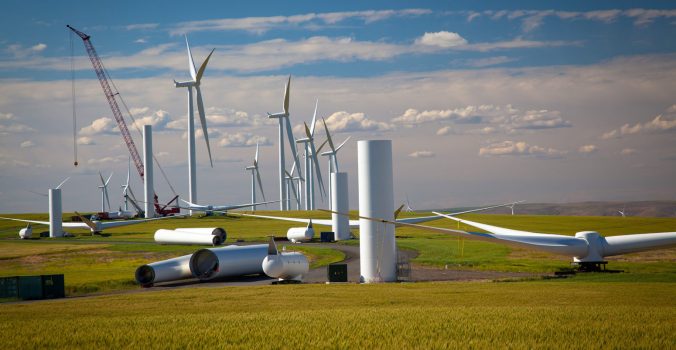
Pads have been cleared in preparation for massive wind turbines at Overland Trail Ranch. (Robert Gauthier / Los Angeles Times)
Wind power is part of our future. Full stop. But it is worth thinking about how the infrastructure for that power will change places of vast beauty and tradition.
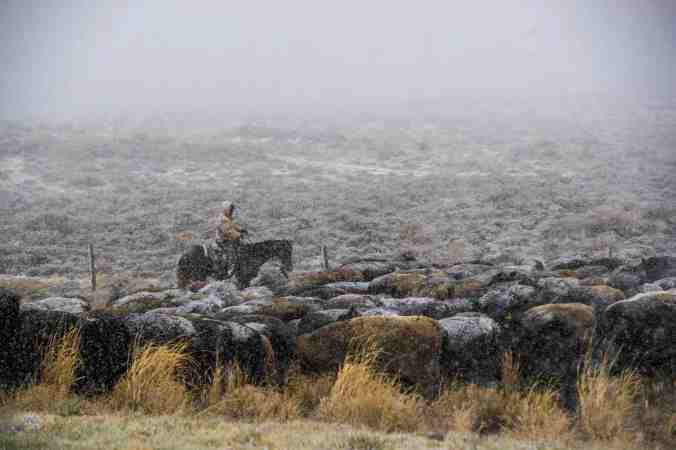
A worker herds cattle at Overland Trail Ranch as a snowstorm moves in. (Robert Gauthier / Los Angeles Times)
This article by Sammy Roth, with photography by Robert Gauthier, is a worthy thought piece on what we gain, what we give up, and who decides how and where wind energy comes to town:
PacifiCorp’s Ekola Flats wind farm has 63 turbines, most of them rated at 4.3 megawatts — almost six times as much power as some of the old steel-lattice wind towers in the California desert outside Palm Springs. (Robert Gauthier / Los Angeles Times)
I know the wind turbine blades aren’t going to kill me. At least, I’m pretty sure.
No matter how many times I watch the slender arms swoop down toward me — packing as much punch as 20 Ford F-150 pickup trucks — it’s hard to shake the feeling they’re going to knock me off my feet. They sweep within a few dozen feet of the ground before launching back toward the heavens, reaching nearly 500 feet above my head — higher than the highest redwood.
They’re eerily quiet, emitting only a low hum. But in the howling wind, the tips could be barreling past at 183 mph. Continue reading →
One of the world’s largest pumped hydropower projects, with an electricity storage capacity equivalent to 400,000 electric vehicles, is set to begin operations soon in the Swiss Alps. Continue reading →
Back in the 19th century, coal was the nation’s newfangled fuel source—and it faced the same resistance as wind and solar today
Steven Preister’s house in Washington, D.C. is a piece of American history, a gorgeous 110-year-old colonial with wooden columns and a front porch, perfect for relaxing in the summer. Continue reading →
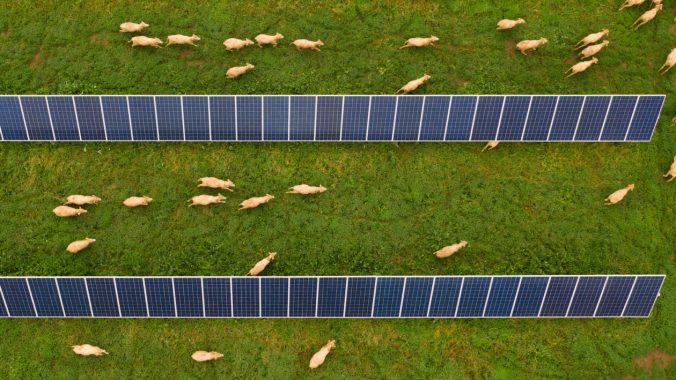
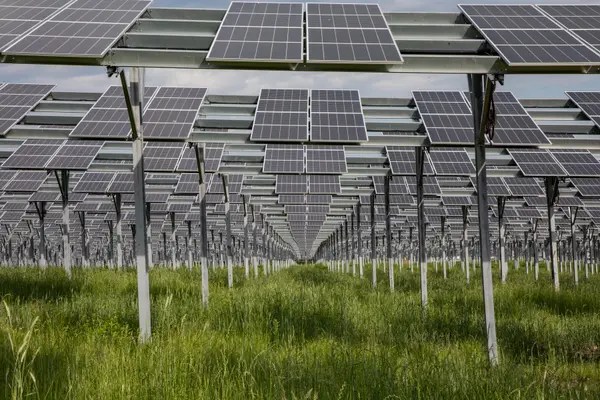
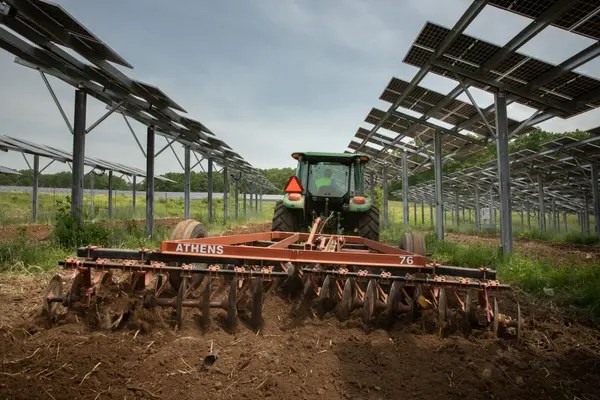
With the push for renewables leading to land-use conflicts, building highly efficient utility-scale solar farms on ever-smaller tracts of land has become a top priority. New approaches range from installing PV arrays that take up less space to growing crops between rows of panels.
Farmers grow hay between solar fences in Donaueschingen, Germany. NEXT2SUN
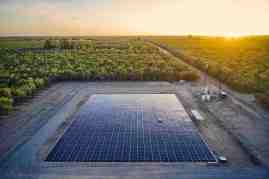
From the ground, the new solar farm shimmers like a mirage oasis on a hot summer day. Instead of row after slanting row of shiny panels stretching taller than corn, this array, mounted directly on the earth, lies flat as water. Continue reading →
The new mechanism (pictured) could replace traditional vapor-compression cooling technology, which has remained largely unchanged since the early 20th century.
Oddly, we have only mentioned air conditioning twice before in our pages since 2011. So much of the human population is in need of it, and its carbon footprint is so problematic, it presents a significant challenge to efforts to mitigate climate change. Here is reason to mention it again:
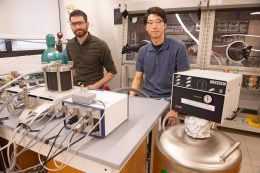
Assistant Professor of Chemistry Jarad Mason (left) and co-author Jinyoung Seo have developed a new class of solid-state refrigerants that could enable energy-efficient and emission-free cooling. Jon Chase/Harvard Staff Photographer
A summer dilemma worthy of Solomon: how to stay cool in days of high heat and humidity without turning to traditional air conditioning, which consumes vast amounts of electricity and emits potent climate-changing greenhouse gases.
The answer potentially involves a new class of solid-state refrigerants that could enable energy-efficient and emission-free cooling. Continue reading →
Solar panels on Paul Knowlton’s farm in Grafton, Mass. Cattle will graze below the panels, which rise to 14 feet above the ground. Tony Cenicola/The New York Times
The concept of agrivoltaics has been an occasional topic in our pages over the years, most recently as we have prepared to plant thousands of coffee saplings. Ellen Rosen focuses our attention on how the advances in technology, and entrepreneurship in this space, are addressing the challenges:
Companies like BlueWave are betting on it. But the technology has its critics.
Mr. Knowlton preparing the soil between the panels before he plants butternut squash and lettuce. Tony Cenicola/The New York Times
In its 150-year history, Paul Knowlton’s farm in Grafton, Mass., has produced vegetables, dairy products and, most recently, hay. The evolution of the farm’s use turned on changing markets and a variable climate. Recently, however, Mr. Knowlton added a new type of cash crop: solar power. Continue reading →
In February, Bank of America offered its employees a notable perk: If they had worked at the bank for at least three years, and made less than $250,000, then it would give them $4,000 to buy a new electric car. (Employees interested in merely leasing an EV could claim $2,000.) The move, attached to a company-wide round of salary increases, wasn’t the first time that the bank had made the offer; it had made a similar one in 2015, and again in 2020, although those incentives had also applied to gas-electric hybrids. Continue reading →
Wind turbines have increased local incomes by around 5% and house values by 2.6% in parts of the US, according to a new study.
The research, published in the journal Energy Policy, found benefits in terms of jobs, taxes and land payments associated with renewable energy. Continue reading →
Solar and wind power projects have been booming in California, like the Pine Tree Wind Farm and Solar Power Plant in the Tehachapi Mountains, but that doesn’t mean fossil fuels are fading away quickly. Irfan Khan/Los Angeles Times via Getty Images
Recovery from a long-term addiction to fossil fuels was never going to be easy. Necessary? Yes. But it will still be a long haul even with milestones like this one in the western USA. Thanks to National Public Radio (USA) for this news:
On a mild Sunday afternoon, California set a historic milestone in the quest for clean energy. The sun was shining, the wind was blowing and on May 8th, the state produced enough renewable electricity to meet 103% of consumer demand. That broke a record set a week earlier of 99.9%. Continue reading →
Can gravity, pressure, and other elemental forces save us from becoming a battery-powered civilization?
We need to vastly expand our energy-storage capacity if we’re to avoid climate catastrophe.
The German word Dunkelflaute means “dark doldrums.” It chills the hearts of renewable-energy engineers, who use it to refer to the lulls when solar panels and wind turbines are thwarted by clouds, night, or still air. On a bright, cloudless day, a solar farm can generate prodigious amounts of electricity; when it’s gusty, wind turbines whoosh neighborhoods to life. But at night solar cells do little, and in calm air turbines sit useless. These renewable energy sources stop renewing until the weather, or the planet, turns. Continue reading →
(Washington Post illustration; Demetrius Freeman/The Washington Post; iStock)
I am heading to Ithaca tomorrow for family reasons, so the third item described in the story that follows is of particular interest. But every one of the items is worth reflecting on, in a news world without enough such stories. Our thanks to the Washington Post Staff who put this list together:
Stories from the past six months that show what local and national policy change can look like
The most recent IPCC report makes it clear: There is no one silver bullet that can address global warming. Instead, nations, businesses, communities and individuals all have a role to play in helping to create a safer and more sustainable future. But without action from the world’s wealthiest countries, the nations and people who are least at fault for fueling climate change will be the ones who suffer the most, the scientists behind the report warn. Continue reading →
Experts say Wales has huge potential for generating renewable marine power, yet, so far, ambitious schemes have been ignored
South Stack lighthouse on Holy Island, north Wales: construction on the island’s tidal stream project has just begun. Photograph: Getty Images
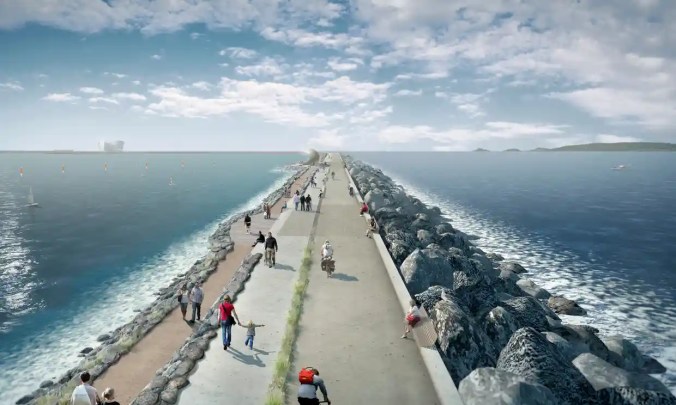
On the stunning and craggy coastline of Holy Island in north Wales, work has started on a construction project to generate energy from one of the world’s greatest untapped energy resources: tidal power.
The Morlais project, on the small island off the west of Anglesey has benefited from £31m in what is likely to be the last large grant for Wales from the European Union’s regional funding programme. It will install turbines at what will be one of the largest tidal stream energy sites in the world, covering 13 square miles of the seabed. Continue reading →
When I read about a promising new technology related to carbon sequestration, I am ambivalent based on the experience of many past false hopes. Carbon is a very large problem. Finding new methods of sequestration is a very challenging puzzle.
The only other newsletter I read regularly is Robinson Meyer’s newsletter for the Atlantic, called The Weekly Planet. Here is one of his worth reading for a bit of encouragement (when you click the hyperlink it will go to the current newsletter, which until April 20 is this one; after April 20 scroll to find this edition):
The world’s biggest tech companies are getting serious about carbon removal, the still-nascent technology wherein humanity can pull heat-trapping carbon dioxide out of the atmosphere. Yesterday, an alliance of prominent Silicon Valley companies—including Google, Meta, Shopify, and the payment company Stripe—announced that it is purchasing $925 million in carbon removal over the next eight years. In a world awash in overhyped corporate climate commitments, this is actually a big deal. Continue reading →
Wind turbines next to Argo Blockchain’s new facility in Dickens County, Texas. The site would be fueled mostly by wind and solar energy. Carter Johnston for The New York Times
First thought upon seeing the headline of the story below: when pigs fly. There is plenty of evidence to the contrary. If you read to the end of the story, published in the New York Times (click through to read it in full there), you will understand that some at the cutting edge of crypto want to change the name of what they do to “validators” from the less environmentally-friendly sounding “miners.” So, second thought: lipstick on pigs. But, at least they are acknowledging the complaint. Plus, the author of this story has a remarkable track record of reporting on issues we care about. So let’s read their latest claims with an open mind:
Facing intense criticism, the crypto mining industry is trying to change the view that its energy-guzzling computers are harmful to the climate.
Texas has become a hot spot for crypto mining, attracting more than two dozen companies, partly because of an unusual incentive structure with its power grid. Carter Johnston for The New York Times
Along a dirt-covered road deep in Texas farm country, the cryptocurrency company Argo Blockchain is building a power plant for the internet age: a crypto “mining” site stocked with computers that generate new Bitcoins. Continue reading →
An airborne wind turbine at the SkySails Power’s pilot site in Klixbüll, Germany. AXEL HEIMKEN / PICTURE ALLIANCE VIA GETTY IMAGES
Wind energy, as we have pictured it, was in a race between fixed and floating models. We did not know about the airborne model. Nicola Jones, writing in Yale e360, gives a clear picture of why it faltered and how it is recovering:
This long-exposure nighttime photograph shows the figure-eight flight pattern of Kitepower’s airborne wind system. KITEPOWER
Numerous companies are developing technologies, such as large kites, that can harvest wind energy up to a half-mile above ground. While still in its nascent stages, airborne wind power could potentially be used in remote locations or flying from barges far offshore.
Look up over the white sand beaches of Mauritius and you may see a gigantic sail, much like the kind used by paragliders or kite surfers but the size of a three-bedroom apartment, looping figure-eights overhead. Continue reading →
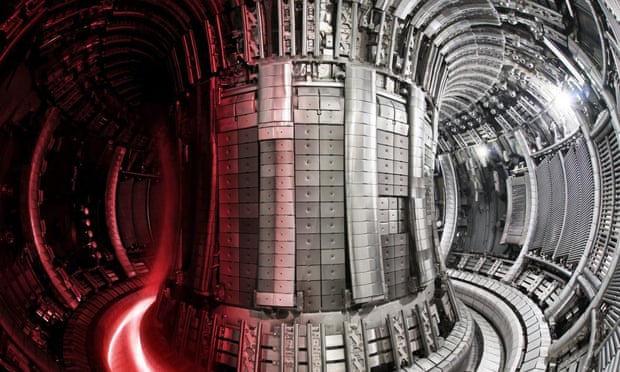
The interior of the JET, where an experiment generated 59 megajoules of heat, beating the 1997 record of 21.7 megajoules. Photograph: UKAEA
We have no expertise in this specific energy-related subject, but we know that new sources of energy are an important potential contributor to the reduction of global warming. So, we read this news about a new heat record from nuclear fusion as a qualified source of hope:
Oxfordshire scientists’ feat raises hopes of using reactions that power sun for low-carbon energy
The prospect of harnessing the power of the stars has moved a step closer to reality after scientists set a new record for the amount of energy released in a sustained fusion reaction. Continue reading →
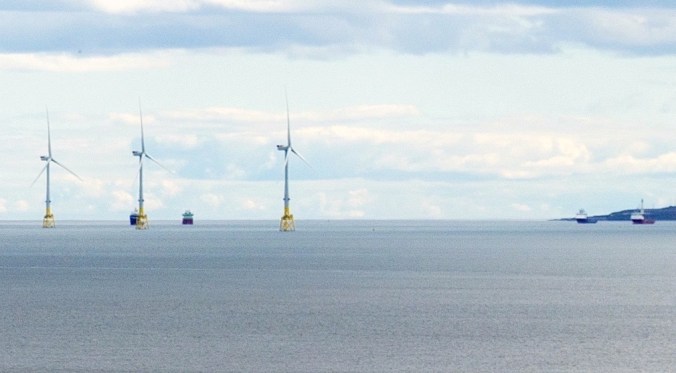
The Aberdeen Bay Wind Farm, an offshore wind demonstration facility off the coast of Aberdeenshire, in the North Sea, Scotland. ZANASZANAS VIA WIKIPEDIA
When big oil companies dismantle rigs and switch to building new turbines, it has the ring of something good. Our thanks to Yale E360 for this news brief:
Having won rights to develop wind farms off the coast of Scotland, Shell, Total, and BP are set to invest more in wind power than in oil and gas drilling in the North Sea in the years ahead, the latest evidence of oil majors changing tack on renewables to better navigate the energy transition. Continue reading →
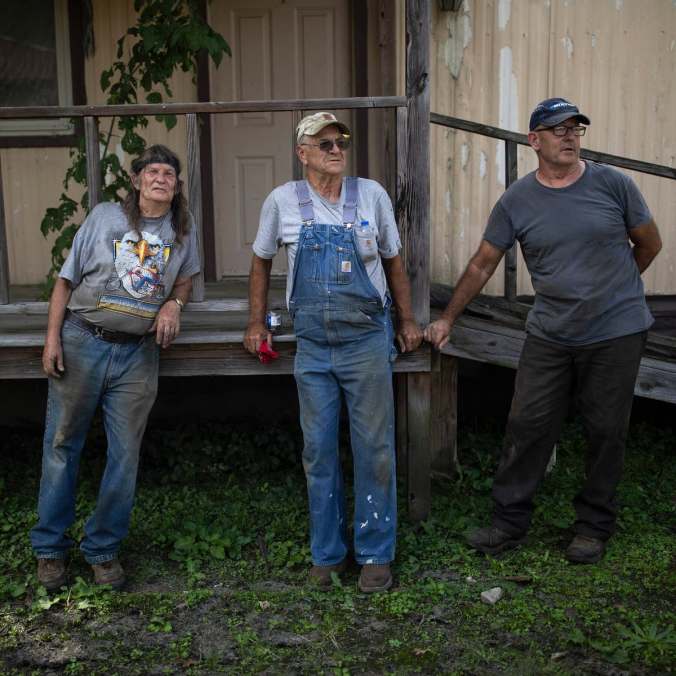
The former coal miner Gary Webb, right, with his cousins Darrell Davis and Ernie Dials, in Lovely, Ky. Mr. Webb supports the planned solar farm. “It’s good for climate change,” he said. “Anything that helps is good.” Maddie McGarvey for The New York Times
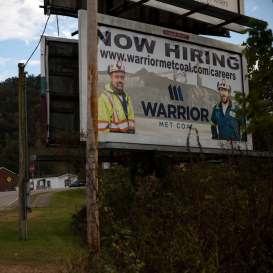
The photograph above speaks to the humanity of coal mining culture in a time when the world is trying to wind down its use of coal. It is not fair, in so many ways, that miners seem to have so few options; but a way forward will be found. The billboard in the photo below may suggest otherwise, but opportunities for those miners are not likely to include coal. Thanks to Cara Buckley for this vivid portrait of a place historically focused on extraction, its people who are in need of a better future, and the tensions that come with making that better future happen:
In Martin County, Ky., where coal production has flatlined, entrepreneurs are promising that a new solar farm atop a shuttered mine will bring green energy jobs.
A billboard advertising mining jobs in Inez, Ky. By last count, the county had just 26 miners left. Maddie McGarvey for The New York Times
MARTIN COUNTY, Ky. — For a mountain that’s had its top blown off, the old Martiki coal mine is looking especially winsome these days. With its vast stretches of emerald grass dotted with hay bales and ringed with blue-tinged peaks, and the wild horses and cattle that roam there, it looks less like a shuttered strip mine and more like an ad for organic milk.
The mountain is poised for another transformation. Hundreds of acres are set to be blanketed with solar panels in the coming year, installed by locals, many of them former miners. Continue reading →
While we were paying attention to many other things over the last decade, Spain transformed into a wind power house. How did we miss it with all the attention we paid to renewable energy? Thanks to El Pais for this news:
Renewable sources already cover almost half of the country’s consumption needs – so far this year, they have contributed almost 47% of the total compared to less than 30% a decade ago
Even if the wind stops blowing in the next three weeks, wind power will end the year as the leading source of electricity in Spain. Continue reading →














 Organikos