Community Income From Rewilding

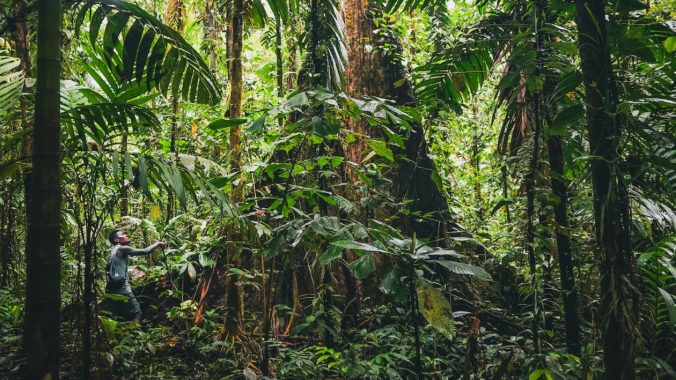
Rewilding Spain’s sustainable forest management support service helps municipalities generate income through activities such as resin extraction. NEIL ALDRIDGE

In the decade since we have been watching the work of Rewilding Europe we have seen income generation growing in importance:

Allowing trees to grow old in healthy ecosystems can help to lock up and store huge amounts of carbon.
JUAN CARLOS MUÑOZ ROBREDO /

Rewilding forest generates revenue for communities in the Iberian Highlands

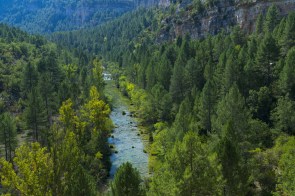
Rewilding Spain has signed its first agreement to protect an old-growth forest in the Iberian Highlands. A change in forest management will support natural regeneration, delivering benefits to both nature and people. With other owners of old-growth forests interested in signing similar agreements, there is significant scaling-up potential.

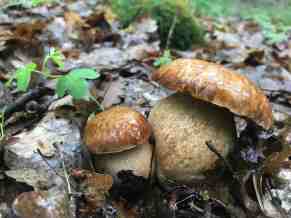
The old-growth forest protected by the new agreement is popular with mushroom pickers.
SEBASTIAN URSUTA

The importance of old-growth forests

Letting forests naturally regenerate is one of the most practical, immediate, and cost-effective ways of addressing our ecological and climate emergencies. As vital ecosystems that support millions of animals and plants, mature natural forests – or old-growth forests – lock up and store huge amounts of carbon. They are more resilient to climate change and disease than young tree plantations, with their diverse mix of native species allowing them to better adapt to a far wider range of conditions. Continue reading
Trillion Cicada Thrill

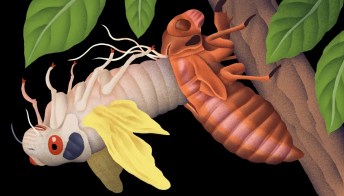
Illustration by Bjorn Lie

Cicadas were in our pages a few times a decade ago but now is the real time for celebrating them. This story by Rivka Galchen is as good as any:

The Peculiar Delights of the Enormous Cicada Emergence

As loud as leaf blowers, as miraculous as math, the insects are set to overtake the landscape.

Their parents passed away thirteen, or maybe seventeen, years ago. They grow up alone, hidden in tunnels of their own making, nursing from the rootlets of trees. Continue reading
The Light Eaters

Thanks to Hanna Rosin, an Atlantic writer whose podcast conversation with this author brought the book above to my attention:

If Plants Could Talk

Some scientists are starting to reopen a provocative debate: Are plants intelligent?

When I was a kid, my best friend’s mother had a habit of singing arias to her houseplants. Continue reading
English Apple Heritage

Today completes a trifecta of shared articles about trees, and Sam Knight gets extra thanks for the link with a part of food heritage our family is especially fond of (which led to finding the video above):

Illustration by Nicholas Konrad / The New Yorker

The English Apple Is Disappearing

As the country loses its local cultivars, an orchard owner and a group of biologists are working to record and map every variety of apple tree they can find in the West of England.

In June, 1899, Sabine Baring-Gould, an English rector, collector of folk songs, and author of a truly prodigious quantity of prose, was putting the finishing touches on “A Book of the West,” a two-volume study of Devon and Cornwall. Baring-Gould, who had fifteen children and kept a tame bat, wrote more than a thousand literary works, including some thirty novels, a biography of Napoleon, and an influential study of werewolves. Continue reading
How Much Communication Between Trees?

Baobab trees in Madagascar.
Photograph: Dave Carr/Getty Images

Ancient oak trees in Glastonbury, Somerset. Photograph: Eddie Linssen/Alamy

I acknowledge my enthusiasm for the idea that there is something going on between trees. I always want to hear more about it. Those who know me well joke that I am anti-woo-woo; but this one topic betrays a soft spot for the as-yet not fully explained. So I am thankful to Daniel Immerwahr for reminding me of the boundaries of what we know (so far):

A bristlecone pine tree, one of the oldest living organisms on Earth. Photograph: Piriya Photography/Getty Images

Mother trees and socialist forests: is the ‘wood-wide web’ a fantasy?

In the past 10 years the idea that trees communicate with and look after each other has gained widespread currency. But have these claims outstripped the evidence?

There are a lot of humans. Teeming is perhaps an unkind word, but when 8 billion people cram themselves on to a planet that, three centuries before, held less than a tenth of that number, it seems apt. Eight billion hot-breathed individuals, downloading apps and piling into buses and shoving their plasticky waste into bins – it is a stupefying and occasionally sickening thought. Continue reading

Honeybees & Salvation

Sarah Kliff

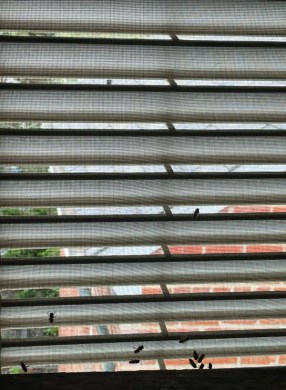
We had an experience with honeybees in our home in Costa Rica that echoes the one related below. We did get someone to help us extract the colony from under our roof and re-situate it as you can see in this photo. We were fortunate to find that man who did the extraction, but my takeaway was not that honeybees do not need saving. Read on:

Honeybees Invaded My House, and No One Would Help

Responding to fears of a “honeybee collapse,” 30 states have passed laws to protect the pollinators. But when they invaded my house, I learned that the honeybees didn’t need saving.

I noticed the first bee one afternoon as my dog gleefully chased it around the house. When the pest settled on a window by the stairwell, I swatted it with a cookbook and cleaned up the mess. Continue reading

Marshes Matter, And This One More Than Many

The outer edge of the Nartë lagoon in Vlorë, Albania. YURIY BRYKAYLO / ALAMY STOCK PHOTO

I have worked in some of Albania’s most important coastal and inland bird habitats, though not this one. My time working there is not my only reason for caring about this particular location. Read on–thanks as always to Fred Pearce–to understand why it matters so much. No offense intended to Jared Kushner, but this is not one of his better ideas. The destruction is not worth whatever it is he is hoping to accomplish:

Jared Kushner Has Big Plans for Delta of Europe’s Last Wild River

Albania’s Vjosë River is known as Europe’s last wild river, and its pristine delta is a haven for migratory birds. As plans for luxury developments there — spearheaded by Donald Trump’s son-in-law Jared Kushner — move ahead, conservationists are sounding the alarm.

It is the jewel of the Adriatic. Its shimmering waters feed a rare colony of Dalmatian pelicans, the world’s largest freshwater birds, sustain the endangered Albanian water frog, and host loggerhead turtles on its encircling dunes. Continue reading

Wind Farm Fishing

(Photo credit: Ionna22 / CC BY-SA 4.0 DEED)

Wind power has had reasonable detractors as well as those who resist for aesthetic reasons. Sometimes nimbyism gives way to pimbyism, and in this case it is people who fish that we can thank for the latter. Thanks to Yale Climate Connections for sharing this story:

Some anglers say Rhode Island’s Block Island wind farm has improved fishing

The bases of the turbines attract fish, survey respondents reported.

Off the coast of Rhode Island, anglers fish for striped bass, fluke, and mahi-mahi. Continue reading
The Most Important View, If Climate Change Interests You


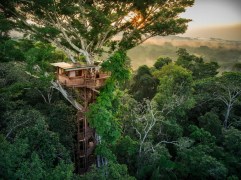
In a vulnerable, defendable part of the Amazon, the hundred-and-ten-foot-high tree house was built to attract wealthy tourists—and potential funders of conservation.Photograph courtesy Tamandua Expeditions

Tree house lodging is not new, but beyond beauty is impact. In that regard the accommodations with the most important view right now might be here:

The Highest Tree House in the Amazon

In 2023, conservationists and carpenters converged on Peru to build luxury accommodations in the rain-forest canopy.

Every day, empty logging trucks rumble into Puerto Lucerna, a small outpost on Peru’s Las Piedras River, which snakes through the lush Amazon rain forest. There, workers load them up with pyramids of freshly cut logs—cedar, quinilla, and, most important, ironwoods, which are prized for their hardness and rich color. Continue reading

Marsh Matters

Coastal marshlands exist in a precarious state: they need enough sediment to stay above water but not so much they get buried. In San Francisco Bay, the US Army Corps of Engineers and others are working to develop a less destructive way of giving marshes the mud they need. Photo by Aerial Archives/Alamy Stock Photo

For the record, marshes matter, so our thanks to Erica Gies, writing for Hakai:

Making a Marsh out of a Mud Pile

In San Francisco Bay, scientists are looking for a better way to rebuild flagging marshland.

The water in California’s San Francisco Bay could rise more than two meters by the year 2100. For the region’s tidal marshes and their inhabitants, such as the endangered Ridgway’s rail and the salt marsh harvest mouse, it’s a potential death sentence. Continue reading
Babatana Rainforest Conservation Project & High Integrity Carbon Credits

Sirebe tribal ranger Elijah Qalolilio Junior in the rainforest. DOUGLAS JUNIOR PIKACHA / NAKAU

A sign marks the boundary of protected Sirebe land. DOUGLAS JUNIOR PIKACHA / NAKAU

Of all the methods for addressing climate change, new incentives for protecting forests are among those we have most confidence in. Thanks to this article by Jo Chandler in Yale e360, if your introspection after reading this previous article had you down on carbon credits, there may be a way to restore your confidence:

The Sirebe forest at dusk. DOUGLAS JUNIOR PIKACHA / NAKAU

Solomon Islands Tribes Sell Carbon Credits, Not Their Trees

In a South Pacific nation ravaged by logging, several tribes joined together to sell “high integrity” carbon credits on international markets. The project not only preserves their highly biodiverse rainforest, but it funnels life-changing income to Indigenous landowners.

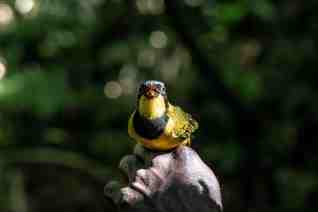
A male oriole whistler on a forest ranger’s hand. DOUGLAS JUNIOR PIKACHA / NAKAU

When head ranger Ikavy Pitatamae walks into the rainforest on Choiseul Island, the westernmost of the nearly 1,000 islands that make up the South Pacific archipelago of Solomon Islands, he surveys it with the heart of a tribal landowner and the eye of a forester. Continue reading

Assisted Evolution

Photo illustration by Lauren Peters-Collaer

If conservation failure is an option, then assisted evolution is a necessary consideration. Emily Anthes walks us through the idea:

When traditional conservation fails, science is using “assisted evolution” to give vulnerable wildlife a chance.

Scientists are trying to save lowland Leadbeater’s possums, tree-dwelling marsupials known as forest fairies, by crossbreeding them with possums from a separate highland population, a strategy known as genetic rescue.

For tens of millions of years, Australia has been a playground for evolution, and the land Down Under lays claim to some of the most remarkable creatures on Earth.

It is the birthplace of songbirds, the land of egg-laying mammals and the world capital of pouch-bearing marsupials, a group that encompasses far more than just koalas and kangaroos. (Behold the bilby and the bettong!) Nearly half of the continent’s birds and roughly 90 percent of its mammals, reptiles and frogs are found nowhere else on the planet.

Australia has also become a case study in what happens when people push biodiversity to the brink. Continue reading

Cambodian Mangrove Wonders

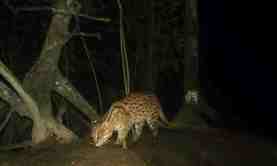
A fishing cat in Peam Krasop wildlife sanctuary. Photograph: Fauna & Flora/FCEE

Thanks to Robin McKie, now Science Editor at the Guardian, for this news from Cambodia:

‘We found 700 different species’: astonishing array of wildlife discovered in Cambodia mangroves

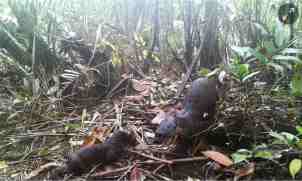
Smooth-coated otters in the mangroves. Photograph: Fauna & Flora/FCEE

Hairy-nosed otters and cats that catch fish are among the startling diversity of creatures making their home in threatened habitats

One of the most comprehensive biodiversity surveys ever carried out in a mangrove forest has revealed that an astonishing array of wildlife makes its home in these key, threatened habitats. Continue reading
Make Space For Weeds

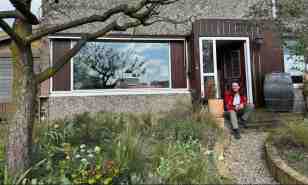
Tineke Menalda on her front doorstep in Amersfoort Photograph: Senay Boztas/Guardian

Weeds are part of nature, whether we like them or not. Thanks to Senay Boztas and the Guardian for this new take on weeds from Holland:

‘We need to accept the weeds’: the Dutch ‘tile whipping’ contest seeking to restore greenery

View image in fullscreen
A pile of ‘whipped’ paving stones in the village of Raalte.

National competition has goal of helping Netherlands reach environmental targets by removing garden paving

Tineke Menalda sits in the sun on her front step, nursing a cup of coffee and idly plucking out the odd weed. Three years ago, the front of her terrace house in Amersfoort was completely paved. But now, sitting in a lush garden of trees and green, she is an official ambassador for the strangest new sport in the Netherlands: tegelwippen, “tile whipping”, or “whipping away” the paving stones. Continue reading
South American Fishing Methods, And Choices

An open-net salmon farm on the Chilean side of the Beagle Channel. Photograph: Dani Casado

As we increase our awareness of the many choices we have when consuming fish (among other things), here is more food for thought:

Crabs, kelp and mussels: Argentina’s waters teem with life – could a fish farm ban do the same for Chile?

Puerto Almanza, on the Beagle Channel in Argentinian Tierra del Fuego, is one of the world’s most southerly settlements and best known for the local seafood, especially Patagonian king crabs.
Photograph: Visit Argentina

While the ecosystem is thriving off the coast of Argentina, the proliferation of salmon farms in Chile’s waters is threatening marine life, say critics

A rocky path, strewn with thick tree roots, leads from a dirt road down to a small green hut overlooking the choppy waters of the Beagle Channel, a strait between Chile and Argentina. The shack is home to Diane Mendez and her family but doubles as Alama Yagan, one of nine restaurants in the fishing village of Puerto Almanza. Continue reading

Drone Cowboys

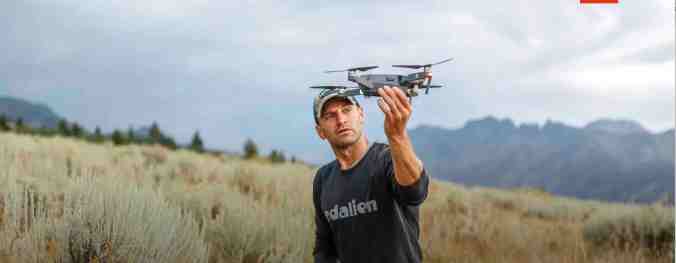
Daniel Anderson holds a drone on his family’s ranch in Montana’s Paradise Valley. Louise Johns/High Country News

High Country News is where a story like this gets assigned, and since they are a hyper-niche publication we thank The Atlantic for broadcasting it. If drones can unite these two constituencies, they are worth a moment of your time:

Illustration by Matteo Giuseppe Pani. Source: Getty.

Drones Could Unite Ranchers and Conservationists

Flying robots could offer a nonlethal way to keep wolves away from cattle.

In the summer of 2022, several researchers with USDA Wildlife Services held their breath as a drone pilot flew a large drone, equipped with a camera, toward a wolf standing in a pasture in southwestern Oregon. Continue reading

Orcas Reconsidered

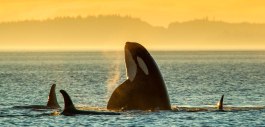
Although all the planet’s killer whales are currently considered a single species (Orcinus orca), some of the world’s leading experts are proposing to split them into three species. Photo by imagebroker.com/Alamy Stock Photo

Hakai is the go-to magazine for marine stories, and we hope to see more work of Craig Welch, the science journalist who wrote the article below, in the future:

Meet the Killer Whales You Thought You Knew

The iconic marine mammals may not belong to one species but several. Surprise!

Transient, or Bigg’s, killer whales, not only look, sound, and act differently than their resident killer whale neighbors, they might be an entirely different species. Danita Delimont Creative/Alamy Stock Photo

John Ford still recalls the first time he heard them. He’d been puttering around the Deserters Group archipelago, a smattering of spruce- and cedar-choked islands in Queen Charlotte Strait, between Vancouver Island and mainland British Columbia. He was piloting a small skiff and trailing a squad of six killer whales. Ford, then a graduate student, had been enamored with cetacean sounds since listening to belugas chirp while he worked part-time at the Vancouver Aquarium as a teenager. Now here he was, on August 12, 1980, tracking the underwater conversations of wild killer whales through a borrowed hydrophone. Continue reading

Ed Yong With Binoculars

Ed Yong has graced our pages for a decade and still finds new ways to communicate the wonders of nature:

When I Became a Birder, Almost Everything Else Fell Into Place

Last September, I drove to a protected wetland near my home in Oakland, Calif., walked to the end of a pier and started looking at birds. Throughout the summer, I had been breaking in my first pair of binoculars, a Sibley field guide and the Merlin song-identification app, but always while hiking or walking the dog. On that pier, for the first time, I had gone somewhere solely to watch birds. Continue reading

An Unappreciated Creature

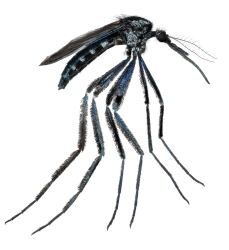
A macro image of a Costa Rican mosquito, Psorophora cilipes.

Living in, or even just visiting Costa Rica, inspires appreciation, and respect, for nature. But one creature defies this spirit:

Entomologist says there is much scientists don’t know about habitats, habits, impacts on their environments

A blood-sucking nuisance, mosquitoes are responsible for spreading diseases to hundreds of millions of people every year. True?

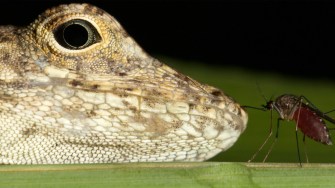
A Culex mosquito feeding from an invasive brown anole lizard in Florida. Photos courtesy of Lawrence Reeves

Yes, says entomologist Lawrence Reeves, but it’s also true that mosquitoes primarily feed on plant sugars, not blood. Only female mosquitoes consume blood, and only when they need it to complete their reproductive cycle. Also, it is possible some may serve as pollinators like bees, allowing plants to produce fruit, seeds, and more young plants. Continue reading

Breadfruit More Fully Appreciated

Wolfgang Kaehler / LightRocket / Getty

Our thanks to Zoë Schlanger for this corrective. Breadfruit has appeared more than once in our pages, but never with appreciation like this:

Too Few Americans Are Eating a Remarkable Fruit

Breadfruit is a staple in tropical places—and climate change is pushing its range north.

Someplace in the lush backroads of San Sebastián, in western Puerto Rico, my friend Carina pulled the car over. At a crest in the road stood a breadfruit tree, full of basketball-size, lime-green fruits, knobbled and prehistoric, like a dinosaur egg covered in ostrich leather. Continue reading