This guest opinion, written by Professor Robert Williams of the Indigenous Peoples Law and Policy Program at the University of Arizona, and published in the New York Times, should make you think twice about the safari that might be on your bucket list:
Over 600,000 tourists travel to Tanzania’s Ngorongoro Conservation Area each year, and many will catch a glimpse of the Great Migration: the famed trek of more than one million wildebeests and thousands of zebras, gazelles and other animals crossing over the Mara River into Kenya and back again. Continue reading →
People work to reforest Allegheny National Forest in Pennsylvania circa 1934. Photograph: Universal History Archive/Universal Images Group via Getty Images
Vast reforestation a major reason for ‘warming hole’ across parts of US where temperatures have flatlined or cooled
Civilian Conservation Corps workers plant 15,000,000 trees across the wastelands of southern Mississippi on 11 April 1940. They are part of the United Forest Service which will re-establish forests destroyed by logging and lumbering operations decades ago. Photograph: AP
Trees provide innumerable benefits to the world, from food to shelter to oxygen, but researchers have now found their dramatic rebound in the eastern US has delivered a further, stunning feat – the curtailing of the soaring temperatures caused by the climate crisis.
While the US, like the rest of the world, has heated up since industrial times due to the burning of fossil fuels, scientists have long been puzzled by a so-called “warming hole” over parts of the US south-east where temperatures have flatlined, or even cooled, despite the unmistakable broader warming trend. Continue reading →
The 11th cohort of global Clean200 leaves dirty energy investments in the dust
As You Sow and Corporate Knights today released their 11th update of the Carbon Clean200™, a list of 200 publicly traded companies worldwide leading the way among global peers to a clean energy present and future. These companies generated almost double the returns of the main fossil fuel index from July 1, 2016, to January 15, 2024, despite geopolitical tensions that have favored fossil fuel stocks in the past two years. Continue reading →
Water slides at the Thrill Island waterpark onboard the Icon of the Seas.Photographer: Eva Marie Uzcategui/Bloomberg
As massive ships like Royal Caribbean’s Icon of the Seas tack on more energy-intensive amenities, emissions from the cruise industry are climbing.
When Royal Caribbean’s Icon of the Seas embarks on its first official voyage on Jan. 27, the journey is sure to make waves. The world’s largest cruise ship, the Icon is over 1,000 feet long (360 meters) and weighs in around 250,000 gross registered tons. It boasts 20 different decks; 40 restaurants, bars and lounges; seven pools; six waterslides and a 55-foot waterfall. Royal Caribbean says its boat will usher in “a new era of vacations.” Continue reading →
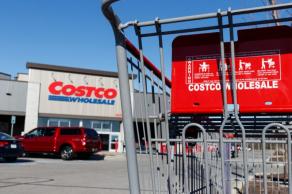
Wholesaler’s credit card issuer Citi is said to have a poor climate record
Costco Wholesale CEO Ron Vachris will receive a petition signed by 40,000 of its shoppers, shareholders and many climate activists on Jan. 17 urging the retailer to drop Citi as its credit card issuer due to the bank’s problematic climate record. Continue reading →
A leading proponent of vertical farming discusses how urban areas should adapt to a perilous environmental future.
Illustration by Daniele Castellano
In 2000, Dickson D. Despommier, then a professor of public health and microbiology at Columbia University, was teaching a class on medical ecology in which he asked his students, “What will the world be like in 2050?,” and a follow-up, “What would you like the world to be like in 2050?” As Despommier toldThe New Yorker’s Ian Frazier in 2017, his students “decided that by 2050 the planet will be really crowded, with eight or nine billion people, and they wanted New York City to be able to feed its population entirely on crops grown within its own geographic limit.” Continue reading →
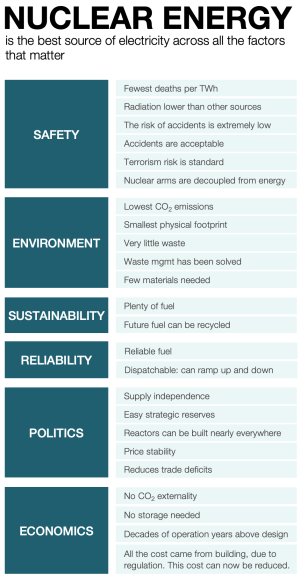
We have linked to articles about nuclear energy before, but this one is more like a cheat sheet for a yes opinion on the option than earlier articles we have read:
This article will convince you of that nuclear is the best source of energy.1 Don’t read it if you need your mind to remain anti-nuclear. If you are against nuclear, I recommend you to precisely write down your concerns and what it would take for you to be convinced that nuclear is great, otherwise you might move the goalposts subconsciously.
To do justice to the topic, the article had to cover all the important aspects of nuclear energy, and as a result is long. I chose to publish it in one piece despite that so all the relevant information is in one place, and I can update it over time and you can bookmark, reference, and share it. Continue reading →
The scientific journal Nature shows up in exactly one search result among thousands of posts here. And that one, because photos have such a wide audience. We have not linked to their articles because, since 1869, they are written by and oriented to highly credentialed scientists. A look at ten influential articles makes the point. And we can only respect what they do, even if we wish more of us could digest more of the science. Now that they offer some articles in audio version, this may make the science more accessible to those who hear better than they read. Judge for yourself, if you want to pay to play. The audio version of the article below (available on YouTube above) is free, but unless you have a subscription the written version is available for a small charge:
Rooftop solar panels in China. Tandem cells could boost power density in crowded urban areas. Credit: VCG/Getty
Firms commercializing perovskite–silicon ‘tandem’ photovoltaics say that the panels will be more efficient and could lead to cheaper electricity.
On the outskirts of Brandenburg an der Havel, Germany, nestled among car dealerships and hardware shops, sits a two-storey factory stuffed with solar-power secrets. It’s here where UK firm Oxford PV is producing commercial solar cells using perovskites: cheap, abundant photovoltaic (PV) materials that some have hailed as the future of green energy. Surrounded by unkempt grass and a weed-strewn car park, the factory is a modest cradle for such a potentially transformative technology, but the firm’s chief technology officer Chris Case is clearly in love with the place. “This is the culmination of my dreams,” he says.
Chris Skidmore said he could ‘no longer condone nor continue to support a government that is committed to a course of action that I know is wrong’. Photograph: Chris McAndrew/UK Parliament/PA
Former minister also resigns as an MP, which will trigger byelection in his Kingswood constituency
A former Conservative minister has announced he is resigning as an MP in protest at the party’s dash for oil and gas, setting up an awkward vote for the prime minister on the issue on Monday and an even more difficult byelection within weeks. Continue reading →
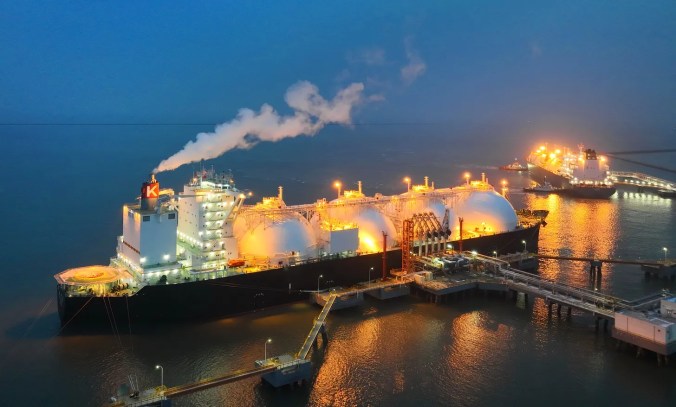
Not as cheerful as Mr. Grouse, but this week’s newsletter is important reading in the interest of progress of this looming LNG problem (a gentle way of putting it, since it is more a PROBLEM than a problem):
Helping Biden Help Himself–and the Planet–on Climate
We are, I think, edging towards a win on LNG exports, which would be a very good thing: a pause on the biggest fossil fuel expansion plan on earth. The question, I think, is if it will be the kind of win that makes it easier to boost the beleaguered presidential campaign of Joe Biden—which has got to be a central focus for anyone worried about the planet’s (and our democracy’s) future. And that is largely up to the White House. Continue reading →
A man rides an ebike in Hermosa Beach, California. Photograph: Mel Melcon/Los Angeles Times/Getty Images
From one point of view ebikes could be viewed as just one more form of entertainment drawing energy from the grid. But an argument can be made that this increase in load on the grid is decreasing other carbon footprints. On top of that, maybe more people on bikes is its own gain:
Sales surge as cities and states look to cut pollution from cars and improve options for Americans to get around
After several years of false starts, electric bikes are finally entering the American mainstream, amid booming sales of a multiplying number of models on offer and as more states offer incentives for people to ditch their cars and shift to two, motor-assisted, wheels. Continue reading →
A managed forest near Jokkmokk, Sweden. Humanity will not limit global heating to safe levels without forests and woodland. Photograph: Peter Essick/Aurora/Getty Images
The world has looked to offsetting schemes to protect forests, fund conservation and fight the climate crisis – but many fail to fulfil their promises. Here are five ways to keep our forests standing
Keeping the world’s remaining forests standing is one of the most important environmental challenges of the 21st century. Continue reading →
It only took 28 years. When Sultan Ahmed Al Jaber banged his gavel on the resolution text of COP28 in Dubai on Wednesday, it marked what has been widely called a historic achievement: the first time nearly every country on Earth agreed that oil and gas play a role in driving global warming, and the first time they nodded toward the need for a fossil fuel drawdown. Continue reading →
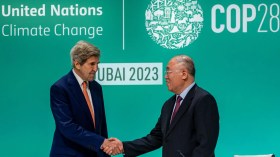
United States’ Special Presidential Envoy for Climate John Kerry(L) and China’s special envoy for climate change Xie Zhenhua (R) attend a press conference during the 2023 United Nations Climate Change Conference (COP28), in Dubai, United Arab Emirates, on December 13th, 2023. Martin Divisek/ZUMA
Some call the COP28 agreement “historic,” others call it weak. Here’s why.
Language on coal power was no stronger than that of Cop26 in 2021. Photograph: Maxim Shipenkov/EPA
The decision text from Cop28 has been greeted as “historic,” for being the first ever call by nations for a “transition away” from fossil fuels, and as “weak and ineffectual” and containing a “litany of loopholes” for the fossil fuel industry. An examination of the text helps to explain this contradiction.
Reducing Fossil Fuel Use
The text states the huge challenge with crystal clarity: Continue reading →
The technology to capture and bury carbon dioxide has struggled to ramp up and has real limits. But experts say it could play a valuable role.
World leaders at the annual United Nations climate talks have battled for years over whether they should “phase out” fossil fuels like coal or just phase them “down.” Continue reading →
Planes account for roughly two per cent of the world’s CO2 emissions—if all the world’s aircraft got together to form a country, they’d emit more than the vast majority of actual nations. Photograph by Kevin Dietsch / Getty
I have had precisely one direct experience with otherwise elusive alternative aviation fuel. It was during my first of multiple work trips to Paraguay. The fuel was made from sugarcane, and while I am still here to write about it, the experience was among the most harrowing of my lifetime. I only have time and space here to mention that I spent an unexpected night in the Chaco. I highly recommend visiting the Chaco, but I do not highly recommend traveling with experimental fuel. That said, read on:
The Treasury Department is about to announce tax credits for sustainable aviation fuel, which raises the question: What fuels are actually “sustainable”?
Sometime in the next few weeks, the Department of the Treasury is expected to decide who—or, really, what—will qualify for a new set of tax credits. Continue reading →
Vibing is a slang word that works well as a stand-in for greenwashing. Alex Simon, a co-founder of Synaps, an economic and environmental research center, shares additional perspective on the corruption built into Cop28:
On a recent trip to the United Arab Emirates, I felt as if I’d entered a fever dream of green exuberance. It was more than two months before COP28, the annual global climate meeting now in progress in Dubai, but the country was already awash in environmental hype. On the highway, banners for an event hosted by the Abu Dhabi National Oil Company, the fossil fuel behemoth known as Adnoc, read: “Decarbonizing. Faster. Together.” A placard in my hotel bathroom asked me to conserve water by using the two-tiered flush, although the flush had only one tier. A friend’s utility bill was labeled “green bill” — although U.A.E. households have some of the biggest carbon footprints in the world. Continue reading →
The energy transition will lead to wide-ranging transformations across economies. | MONTAGE ILLUSTRATION BY NIKO YAITANES/HARVARD MAGAZINE; PHOTOGRAPHS BY UNSPLASH
How the Bezos Earth Fund hopes to seed economic transformation
WHAT ARE THE BIGGEST economic obstacles to the needed rapid transition in energy supplies and the challenges of deforestation driven by climate change? Continue reading →
Ever wondered what the Cop in Cop1-28 means? The answer is not nearly as interesting as how it came to be that a country whose lifeblood is oil is hosting Cop28. Petrostates have been biding their time, gaining momentum, and now have corrupted the Cop system from within. Weekend reading, Thanksgiving edition, from Elizabeth Kolbert, explains the stakes:
The latest round of international climate negotiations is being held in a petrostate. What could go wrong?
Cop1 was held in 1995 in Berlin’s International Congress Center, a massive, metal-clad complex that looks like the set for a dystopian movie. Around nine hundred government delegates attended the weeklong negotiating session, along with about a thousand observers from non-governmental organizations. Daimler-Benz brought some electric cars to show off, while young activists brought a steamroller, to convey their opposition to cars. Delegates were invited to take a trip along the River Spree in a solar-powered boat. Continue reading →
The Tromsø sorting office of the Norwegian postal service Posten Bring is heated by heat pumps. The city is located almost 140 miles north of the Arctic Circle. Photograph: NurPhoto/Getty
Previous stories we have linked to about heat pumps have raised our expectations and hopes, but also raised the question of whether they will catch on. Here is the start to an answer:


















 Organikos