If You Happen To Be In London

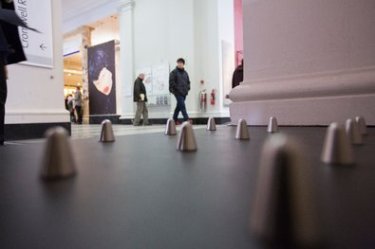
Peter Kelleher/Victoria and Albert Museum, London, 2015. Spike studs, used to keep people from sleeping near buildings, are part of the exhibition.

Peter Kelleher/Victoria and Albert Museum, London, 2015. Spike studs, used to keep people from sleeping near buildings, are part of the exhibition.

When we hear of civic-minded initiatives, museum shows are not the first thing that comes to mind. Schools, and libraries, and conservation initiatives come to mind.

Museums are civic institutions, of course, and we have posted more on this site about museums than almost any other topic.

But civic? We like the theme. This is a show we know will be worth seeing:

V&A Museum Returns to Its Civic-Minded Roots

“All of This Belongs to You,” an exhibition running through July 19 at the Victoria and Albert in London, seeks to stimulate debate about citizenship and the role of museums as public spaces.

Green, Greener, Greenest–Which City? Says Who? And How?

260cd679-e63d-417f-84b1-be816cf7f658-2060x1236

The Clifton Suspension Bridge in Bristol, 2015 Green Capital of Europe. Photograph: Destination Bristol.com/EPA

This is one of the environmentally-oriented rankings that many of us think about, from time to time, and then throw our hands in the air in frustration at the criteria used for judging green-ness, or what is often green-ish-ness. Thanks to the Guardian for asking the questions we want answered when it comes to rankings like this:

Where is the world’s greenest city?

Bristol is the ‘green capital’ of Europe, but its predecessor Copenhagen comes top in a Europe-wide index. Curitiba, San Francisco and Singapore all have strong eco-friendly claims too – so what’s the best way to compare cities’ greenness?

It’s easy to say we’d like our cities to be cleaner and greener. But what does that even mean? “Greenness” is a concept that’s hard to pin down – there’s no official list of the top 50 most eco-friendly cities, nor any widely agreed set of measurements for working out how green a city actually is.

Continue reading

Big Goals About Basic Things

In response to this successful project, the Gates Foundation recently approved a two-year grant to Kohler to design and fabricate five closed-loop flush toilet systems for field testing in developing world locations that do not have adequate sanitation. Kohler

Some of the things many of us take for granted in the “developed” world – access to toilets and clean drinking water among them, are daily challenges for many living in the “developing” world. India’s new prime minister set a challenge for a Clean India by 2019, which will include 100 million toilets across the country. The goals coincide well with the Bill and Melinda Gates Foundation’s Reinvent the Toilet Challenge, and Kohler’s production of a closed loop toilet system design created by Caltech University that is already coming on line in test areas in India. Continue reading

Clothing Past, Experienced In The Present

One of Hortense Mitchell Acton’s Callot Soeurs gowns in the Camera Verde of Villa La Pietra. The gold and silver lace at the neck, the apron skirt, and the five metallic rosettes across the chest recall the forms of a Gothic cathedral. The sleeves are made of metallic lace, now oxidized. PHOTOGRAPHS BY PARI DUKOVIC

One of Hortense Mitchell Acton’s Callot Soeurs gowns in the Camera Verde of Villa La Pietra. The gold and silver lace at the neck, the apron skirt, and the five metallic rosettes across the chest recall the forms of a Gothic cathedral. The sleeves are made of metallic lace, now oxidized. PHOTOGRAPHS BY PARI DUKOVIC

It is likely that the New Yorker is the publication we link to the most, between its magazine and its website. If so, there is a reason. They care about stories we care about, enough to put their best writers and photographers on the task:

PortfolioMARCH 23, 2015 ISSUE

Twenty-One Dresses

BY AND

A number of years ago, a young painting conservator entered a forgotten storeroom in a fifteenth-century Florentine villa and stumbled on a pile of Louis Vuitton steamer trunks. She opened them and discovered a collection of exquisite dresses, the kind usually seen only in movies, or inside protective vitrines in museums. Closer inspection revealed silk labels, hand-woven with the name “Callot Soeurs.” Continue reading

The Critic As Cold Water Splashed Refreshingly On The Face Of Modernity

Schjeldahl-Bjork-690

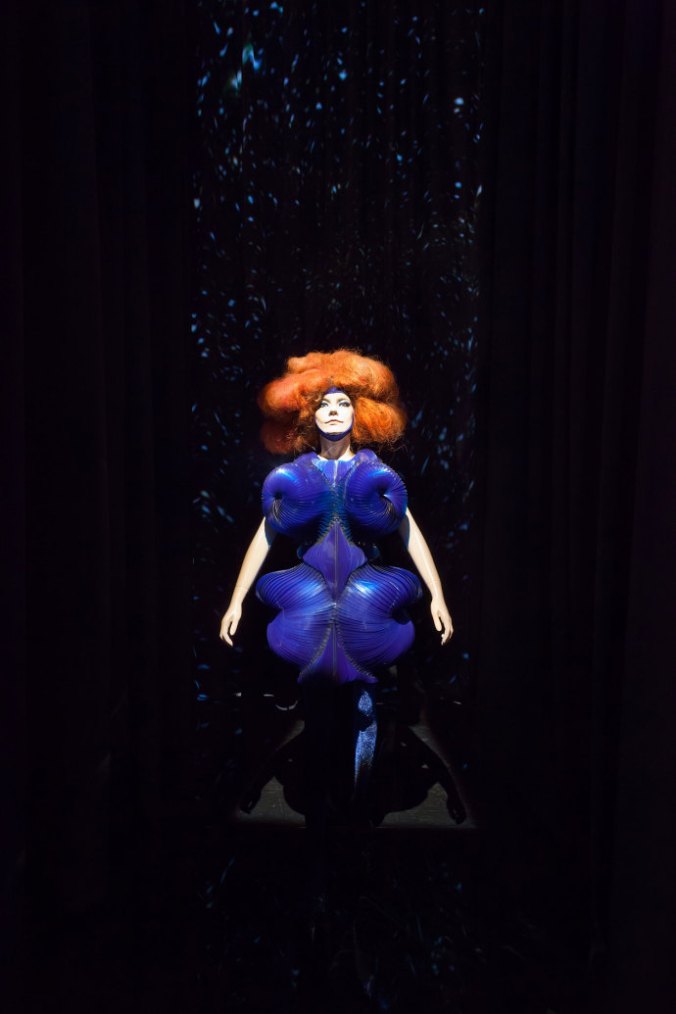
Björk is a restlessly experimental (and therefore fallible), tremendous creative force, not a tarnishable brand. CREDIT PHOTOGRAPH BY JONATHAN MUZIKAR


The opening paragraph of this brief review is worth the click, but the point we would like to bring to your attention is what follows. Sometimes an artist’s museum show can be taken down, critically speaking, with the museum bearing the brunt of the shame. And this point is directly linked to the now well-established concern that art in our age is as much a racket as it is an essential embodiment of culture. This reviewer, and his peers quoted in the opening paragraph, remind us of why we depend on critics for the insight that comes with an occupation whose singular focus is to help us decide whether a certain journey is worth making, or not:

…And yet Björk is unscathed. All the critics (now including me) hasten to acknowledge her musical genius and personal charisma. No detour into lousy taste—even at times her own, as in her partnership, lately ended, with the mercilessly pretentious Matthew Barney—can dent her authenticity. Her music videos (an oasis at the show, in a screening room) typically bring out the best in collaborating directors, musicians, designers, costumers (notably the late Alexander McQueen), and technicians. But if she chances to bring out the worst in star-struck curators, so what? Björk is a restlessly experimental (and therefore fallible) tremendous creative force, not a tarnishable brand. Continue reading

Memory Restoration

Normally we avoid posting on what can be viewed as corporate advertisement, but we have to applaud the use of technology to assist in the healing process after the devasting Tōhoku earthquake and subsequent tsumani in 2011. Thousands of lives were lost, and survivers suffered the additional trauma of losing their homes, including the photographic mementoes of their loved ones.

Ricoh used their expertise in office imaging equipment to coordinate an amazing effort of 518 employee volunteers to find, clean and digitize  418,721 photos, returning 90,128 pictures to the people who lost them.

Ricoh is now offering a glimpse of how this monumental effort was conducted for future reference. The company would be delighted “if this record is useful for improving awareness towards disaster prevention or reconstruction support activities after the event of a disaster,” it says. Continue reading

Offsetting The Perfect Burger

sfs_potato_vindaloo-13---cred-joe-keller_wide-5a785d2066759cd77d2ecb8b9f7d4789ce169255-s1300-c85

Tomato paste gives the Potato Vindaloo its “backbone,” “structure” and “depth,” says America’s Test Kitchen’s Jack Bishop. “‘You probably wouldn’t identify it in the finished dish, but leave it out and you would notice the difference.” Joe Keller/Courtesy of America’s Test Kitchen

Fresh Air, an interview program on National Public Radio (USA), interviewed these same two people originally in 2013, and some members of Raxa Collective can still remember the description, in the podcast version of that interview heard while driving through south India, of grilling the perfect summer burger. And it inspired us to develop the perfect burger for south India, one of the few places in India where beef is available (due to the particular cultural mix of Kerala, in particular).

In the spirit of full circle, we are delighted to announce that Derek, in between Munnar joy rides and beach bliss responsibilities, has accomplished one of the missions we gave him for his time in Kerala, and its name is the Tico Burger (more on which, soon). At the same time, and just in time, to balance out our diets after taste-testing Derek’s burgers the same folks who inspired us to build a better burger are now providing insights on how to offset the carbon and karmic footprints of those burgers with some vegetarian cooking insider magic:

Just because a meal is vegetarian doesn’t mean it can’t be “meaty.” One trick to heighten the depth of flavors in plant-based dishes? Use ingredients that offer a pop of umami, say Bridget Lancaster and Jack Bishop of America’s Test Kitchen, who have released the new cookbook The Complete Vegetarian Cookbook. Continue reading

Redefining Recycling

In the early years of this site we highlighted a concept of “the fourth r” – focusing on the restaurants and events planners who support a form of social entreprenuership by donating excess food to local shelters. On an annual basis huge amounts of prepared foods go to waste in all forms of venues, but the classic buffet-style cafeteria is a long-term culprit. But luckily creative solutions have gone hand-in-hand with awareness of the problem. At the time we used the term “recycled” when taking about the food programs. Kudos to the new voices who redefined at as “repurposed.”

Back in 2011 when I was a student at the University of Maryland in College Park I once noticed a massive pile of trash in front of a dining hall. A closer look revealed that it was mostly food — a half-eaten sandwich, a browning apple and what appeared to be the remains of the day’s lunch special.

The heap was gross, but intriguing. Turned out it was a stunt to get students thinking about how much food they throw out each day.

Nowadays, students are coming face to face with their food waste, and its environmental and social impact, a lot more often. They also have more opportunities do something about it. Continue reading

Hackers, Lentils & Love In A Flower Bed

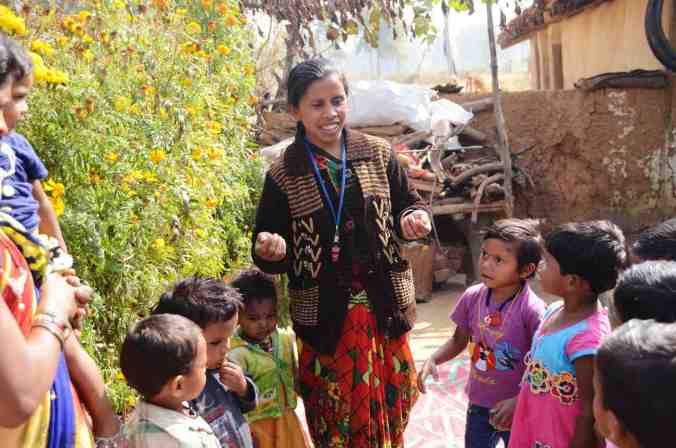
Nursery worker Shivkumari Pate leads children in a learning song. Pate works with the nonprofit Jan Swasthya Sahyog, which developed the first network of community nurseries. Ankita Rao for NPR

Nursery worker Shivkumari Pate leads children in a learning song. Pate works with the nonprofit Jan Swasthya Sahyog, which developed the first network of community nurseries. Ankita Rao for NPR

It would be remarkably easy to fill these pages with stories from India, from various places in Africa and Latin America where we also have projects, that give a strong sense that no matter how quickly solutions get hacked, there are more problems than can possibly be resolved; we spare you those most of the time. Instead, we point to stories like this one (thanks National Public Radio, USA):

…For decades, aid organizations tried to improve the health of moms and babies in Chhattisgarh. Little made a dent. But then a garden of flowers rose up in the state. Continue reading

Food To Come Home To, Ghana Edition

A joint expedition made up of two Zaina Lodge and two of our team members just concluded two weeks in Ethiopia sampling the best national parks, scouting for new locations in which to collaborate, and tasting foodways evolved over millennia. The Zaina duo at this moment are headed back to Ghana, and we can imagine they will appreciate this:

01mag-01eat.t_CA0-thumbStandardA Spicy Spinach Stew From Ghana

Ghanaians living within bunting distance of Yankee Stadium in the Bronx can have a taste of home with this dish.

Visual Acuity, And Other Talents, Ever Deployed To Good Ends

Processed with VSCOcam with 1 preset

Petrified wood. Las Cruces, New Mexico. PHOTOGRAPH BY SHANE LAVALETTE

Contributors to our blog come and go. We wonder from time to time how the talents we saw in India, or Costa Rica, or elsewhere are being deployed today and will be deployed tomorrow. That is how it is with interns, and volunteers, as much as with other types of team members. Above, this, and a few of the other photographs in this post remind us of Milo’s first year with a camera, and his sense of spontaneity combined with visual acuity; someone who is a natural with that tool, the camera, and is ever on the lookout to tell a story with a snapshot:

Last week, the photographer Shane Lavalette set out on a road trip from Austin, Texas, to Joshua Tree, California. Each day, he posted austere, poetic photographs of the region’s landscapes and people to the New Yorker photo department’s Instagram feed, using the photo-editing app VSCO Cam. Continue reading

Kerala Coconut Thatch Weaving

In my earlier posts, I wrote about the abundance of coconut trees in Kerala and their many uses from ingredients in typical foods to the construction of house boats. Another primary use is for roofing. Here at Marari Pearl, it is used unsparingly for most of the buildings from the restaurant to the 20 villas on site. Continue reading

If You Happen To Be Anywhere In the World…

Our interest in birds shouldn’t come as a surprise to readers of these pages. With contributors Seth and Justin on a Smithsonian Expedition in search of the Golden Swallow, over 3 years of our Bird of the Day feature from many talented photographers, and a plethora of posts about the subject, we assume it’s obvious.

Prior to 2013 the Great Backyard Bird Count focussed on North America, but that year it went global and the results were amazing! Continue reading

Transformative Practices For A Better World

Christophe Archambault/AFP/Getty Images

Students use tablets in a classroom in Mae Chan, a remote town in Thailand’s northern province. Christophe Archambault/AFP/Getty Images

Scanning the developing world, anywhere that poverty puts lives at risk, it is useful to have a short list of particularly transformative practices as in this four minute story podcast from National Public Radio (USA):

There are so many projects in global health that sometimes it’s hard to figure out which ones are the most important.

So Lawrence Berkeley National Laboratory set out to list the 50 breakthroughs that would most transform the lives of the poor, especially in sub-Saharan Africa and South Asia. Shashi Buluswar, an author of the study, spoke with Morning Edition‘s Renee Montagne. Here’s a sampling:

A low cost, fuel-free way to desalinate water. Many people in the world do not have enough fresh water to grow crops, and more and more fresh water runs off into oceans. Desalination creates usable water out of salty or brackish sources. “Right now it’s tremendously energy intensive and expensive,” Buluswar tells Montagne, “so trying to come up with a much more affordable, scalable and energy-efficient way of desalinating water would be tremendous.” Continue reading

Lighting Up Language

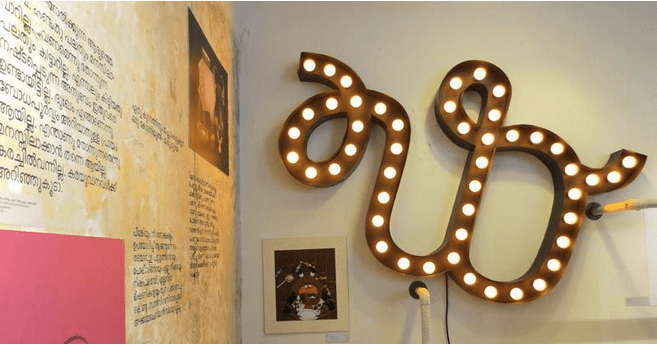
Malayalam Project at Kochi Biennale

Malayalam Project at Kochi Biennale

As a language, Malayalam is a perfect example of form as function: its “loopy” forms seem to roll off the speaker’s tongue. The word itself is even a palindrome, reading forward and backward in a never-ending loop. The high literacy rate in Kerala is evident in the newspapers found in tea stalls at every corner, not to mention the ubiquitous walls painted with verbal signage in both urban and rural settings, and those signs often feel more like murals due to the graphic nature of the language itself. The Kochi-Muziris Biennale ’14 is the perfect platform to express this concept:

Among the various internationally-acclaimed installations at the Kochi-Muziris Biennale ’14 is Malayalam Project that strives to draw the world’s attention towards the regional language and script.

A partner project at the Biennale, Malayalam Project is a collaborative forum that experiments with Malayalam letterform and typography. Kochi-based firms Thought Factory Design and Viakerala have put together this typography cum graphic design exhibition in collaboration with Riyas Komu, secretary of the Kochi Biennale.

“In the digital era, where imagery is used to communicate ideas, words become canvas of graphic. We are looking at how Malayalam, which is either a sound or a text enters the visual age we live in,” said the creative director Theresa Joseph George.

Pointing out that her firms have done lot of research into the field of Malayalam typography, Theresa, who is also a graphic designer, says, “Malayalam script with its loopy curves provides immense scope for experimentation.” Continue reading

A Reflection On My Summer In Kerala

Soka Instructional Garden, photo courtesy of Nina Boutin

Soka Instructional Garden, photo courtesy of Nina Boutin

It has been a little over 4 months since I finished my internship, which has given me a lot of time to integrate and reflect on what I learned at Raxa Collective. I spent my first month in Thekkady at Cardamom County and my second month in Cochin at Spice Harbour. I am deeply grateful for this experience because it has informed my personal growth and career path in ways that are hard to articulate, but- I will try.

The month before coming to India, I walked part of the Camino de Santiago, a pilgrimage in Spain. If that wasn’t exhausting enough, I promptly went to India, and when I got to Raxa Collective, I hit the ground running, trying to figure out how I could best be of service and learn as much as possible. I expected for it to be difficult, but I didn’t know how it would be (though I was forewarned about the monkeys).

I’m working towards an environmental studies liberal arts degree at Soka University. A liberal arts degree is interdisciplinary, therefore I’m always looking for the intersection between things people think are separate. Profit and conservation are definitely things people usually think are separate.

I got to look deeply into the way those can intersect when I interviewed Crist about the path they have taken up until now. That interview has been so valuable for me in planning a business model that incorporates environmental and cultural conservation. Now, I think I want to start a restaurant that incorporates my passion for local food, biodiversity, sustainability, agriculture, and community. Continue reading

Words Forming A Name, Becoming A Brand

Illustration by Paul Sahre

Illustration by Paul Sahre

We spent much of the first half of 2011 poring over dictionaries. Mostly Sanskrit to English dictionaries, but also Malayalam to English, and also just English dictionaries with the occasional thesaurus to inspire.

We thought a lot about a company that two of us had formed that had done a lot of projects relevant to, and some interestingly different from, the new enterprise that would re-brand the hospitality portfolio of a major business group based in Kerala, India. We recorded a few facts about that naming process at the time this blog went live. This article not only brings back memories of those days, weeks, months of name-pondering, but gets us thinking about the meaning of Raxa Collective now versus what we thought then:

The Weird Science of Naming New Products

To find the perfect brand, leave no word unturned.

Friends, Collaboration And Awesome Accomplishment

Yosemite climbers reach summit of El Capitan

Yosemite climbers reach summit of El Capitan

News feeds–especially those that give attention to adventure, and extreme sports and rock climbing in particular–are full of this story just now about two friends accomplishing one of the greatest challenges left in the small specialty sport. We are not at all devoted to the sport, but in the last year or two have developed a fascination, based on another climber’s feats and travails, mainly because of the collaboration component of climbing.

© AP Photo/Tom Evans, elcapreport In this Jan. 8, 2015 photo provided by Tom Evans, Kevin Jorgeson celebrates his finishing the climb of Pitch 15 while two photographers shoot video and stills from above…

© AP Photo/Tom Evans, elcapreport In this Jan. 8, 2015 photo provided by Tom Evans, Kevin Jorgeson celebrates his finishing the climb of Pitch 15 while two photographers shoot video and stills from above…

Today’s news brings the collaboration part back to the forefront, in this case not due to absolute requirement but due to friendship. It is touching, in that “feel good” sense related to hoping you would do the same thing in the circumstance described; but more than that, it is just awesome:

YOSEMITE NATIONAL PARK, Calif. (AP) — American rock climber Tommy Caldwell was first to pull himself atop a 3,000-foot sheer granite face in Yosemite National Park, followed minutes later by his longtime friend Kevin Jorgeson.

The pair embraced and then Jorgeson pumped his arm in the air and clapped his hands above his head. After years of practice, failed attempts and 19 grueling days scaling the vertical wall on El Capitan by their bloodied fingertips, the friends at last grasped success.

“That’s a deep, abiding, lifelong friendship, built over suffering on the wall together over six years,” said Caldwell’s mother, Terry, among some 200 people in the valley floor thousands of feet below who broke into cheers at the climbers’ historic feat Wednesday.

She said her son could have reached the top of the world’s largest granite monolith several days ago, but he waited for his friend to ensure they made it together. Continue reading

If You Happen To Be In Fort Kochi

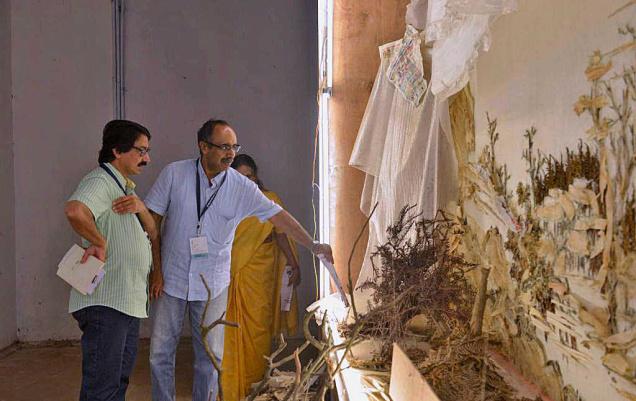
V. Venu, director-general of the National Museum in Delhi (in blue), viewing Xu Bing’s work at Aspinwall House  in Kochi on Sunday.

V. Venu, director-general of the National Museum in Delhi (in blue), viewing Xu Bing’s work at Aspinwall House in Kochi on Sunday.

If you are in town before the end of March, come see the show. We have mentioned the event in these pages more than once between its first iteration and this year’s; and if you follow Spice Harbour‘s social media you would have seen, among other things, that the formal opening of that property doubled as a fundraiser for KMB, as it is affectionately known to Raxa Collective. In today’s Hindu, an article reminds us that the event is not just for fancy folks, but serves a deeply important cultural education service for Indians of all backgrounds and education levels:

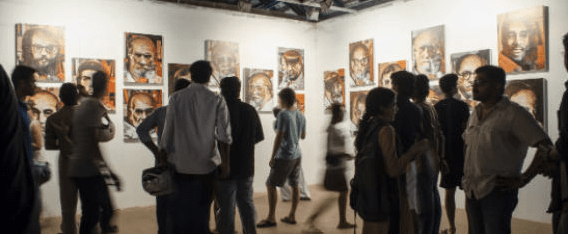
Prominent figures from the world of art, film personalities, art students, and the public turned up in large numbers at the Kochi Muziris Biennale on Sunday, even as the event completes a month on January 12.

Among the visitors to the contemporary art event on Sunday was V. Venu, director-general of the National Museum in Delhi. “The kind of consistent engagement by people from every walk is what makes the Biennale an unparalleled successful event in the country,” said Dr. Venu. Continue reading

If You Happen to be in Kochi

http://www.huffingtonpost.in/riyas-komu/kochimuziris-biennale-aga_b_6319218.html

The second edition of the Kochi-Muziris Biennale opened with typical Indian energy, with drums and enthusiasm. Fort Kochi and Mattanchery streets were alive with painters, working solo or in teams, adding finishing touches to murals and other installations.

Riyas Komus’ words resonate well with the RAXA Collective ethos of Community, Collaboration and Conservation.

The story of Kochi-Muziris Biennale, an artist initiative which derived its confidence from artists, art lovers, cultural organisations and the people of Kochi, is the story of taking on challenges to create an alternate space, of sacrifices and solidarity to build an art ecosystem for the new emerging India. Conducting the biennale in Kerala — a state that had the world’s second democratically elected communist government — complimented by the history of the land in the context of art was an organic achievement of its legacy. Our mission is to draw energy from the rich tradition of public action and political engagement in Kerala and build a new aesthetic that integrates both the past and the present…. Continue reading