Saving Birds With Mosquitoes

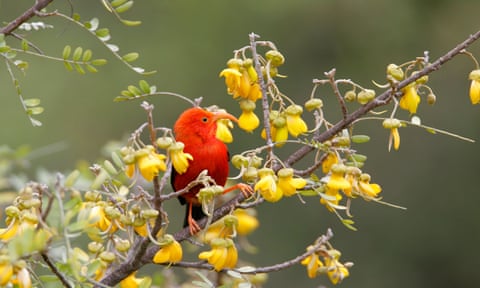
A small red bird on a branch with yellow flowers

The scarlet honeycreeper, or ‘i’iwi, has a 90% chance of dying if bitten by an infected mosquito. Thirty-three species of the bird are already extinct. Photograph: Photo Resource Hawaii/Alamy

We had not heard of such risk to birds before, but this may be the rare case of mosquitoes potentially serving a good purpose:

Millions of mosquitoes released in Hawaii to save rare birds from extinction

Conservationists hope insects carrying ‘birth control’ bacteria can save honeycreeper being wiped out by malaria

Millions of mosquitoes are being released from helicopters in Hawaii in a last-ditch attempt to save rare birds slipping into extinction. Continue reading

Tiny Creatures Also Need Climate Stability

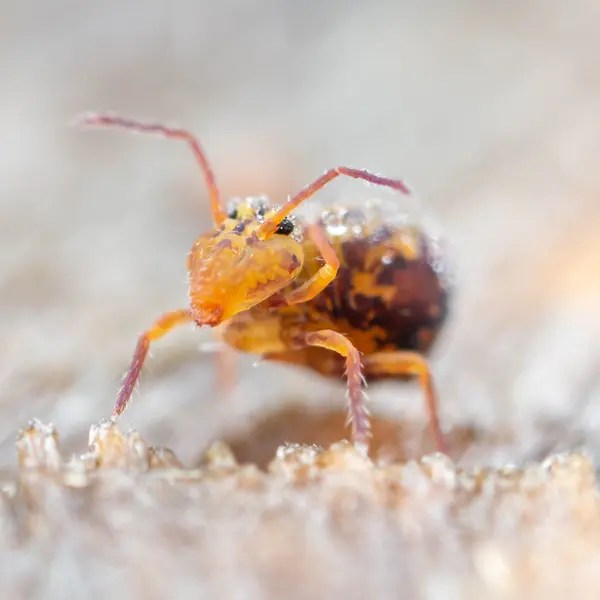
Scientists have identified about 9,000 species of springtails, but that number might represent just a fraction of their global species richness. Frank Ashwood

We have shared articles about the type of small creatures that we rarely think about, but which may be important to the wellbeing of the planet. Sofia Quaglia, an award-winning freelance science journalist (new to us), has written this story for the New York Times with exceptional photos by Frank Asherood:

Life in the Dirt Is Hard. And Climate Change Isn’t Helping.

Heat and drought are taking a toll on the tiny soil creatures that help to lock away planet-warming carbon, according to a new analysis.

They’re dirt-dwelling invertebrates, but, in a sense, they’re the real backbone of Earth’s carbon cycle.

Thousands of species of mites and springtails, living in soil all around the world, provide a crucial service by munching organic matter like fallen leaves and wood, transferring its planet-warming carbon into the ground and releasing nutrients that help new plants grow. Continue reading

Honeybee Facts & Figures

Illustration by Matteo Giuseppe Pani. Source: Getty.

We have done our part to share, perhaps erroneously, that honeybees are in trouble. We hope we have been wrong:

The Great Honeybee Fallacy

For years, people have understood them to be at imminent risk of extinction, despite evidence to the contrary. Why?

Everyone, for so long, has been worried about the honeybees. Continue reading

Trillion Cicada Thrill

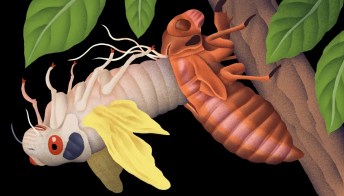
Illustration by Bjorn Lie

Cicadas were in our pages a few times a decade ago but now is the real time for celebrating them. This story by Rivka Galchen is as good as any:

The Peculiar Delights of the Enormous Cicada Emergence

As loud as leaf blowers, as miraculous as math, the insects are set to overtake the landscape.

Their parents passed away thirteen, or maybe seventeen, years ago. They grow up alone, hidden in tunnels of their own making, nursing from the rootlets of trees. Continue reading

Honeybees & Salvation

Sarah Kliff

We had an experience with honeybees in our home in Costa Rica that echoes the one related below. We did get someone to help us extract the colony from under our roof and re-situate it as you can see in this photo. We were fortunate to find that man who did the extraction, but my takeaway was not that honeybees do not need saving. Read on:

Honeybees Invaded My House, and No One Would Help

Responding to fears of a “honeybee collapse,” 30 states have passed laws to protect the pollinators. But when they invaded my house, I learned that the honeybees didn’t need saving.

I noticed the first bee one afternoon as my dog gleefully chased it around the house. When the pest settled on a window by the stairwell, I swatted it with a cookbook and cleaned up the mess. Continue reading

An Unappreciated Creature

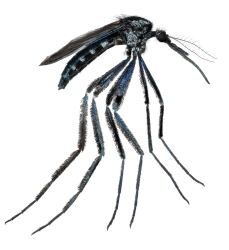
A macro image of a Costa Rican mosquito, Psorophora cilipes.

Living in, or even just visiting Costa Rica, inspires appreciation, and respect, for nature. But one creature defies this spirit:

Entomologist says there is much scientists don’t know about habitats, habits, impacts on their environments

A blood-sucking nuisance, mosquitoes are responsible for spreading diseases to hundreds of millions of people every year. True?

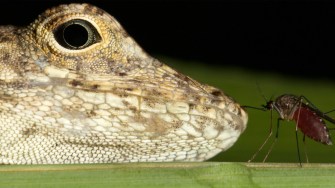
A Culex mosquito feeding from an invasive brown anole lizard in Florida. Photos courtesy of Lawrence Reeves

Yes, says entomologist Lawrence Reeves, but it’s also true that mosquitoes primarily feed on plant sugars, not blood. Only female mosquitoes consume blood, and only when they need it to complete their reproductive cycle. Also, it is possible some may serve as pollinators like bees, allowing plants to produce fruit, seeds, and more young plants. Continue reading

Ants & Us

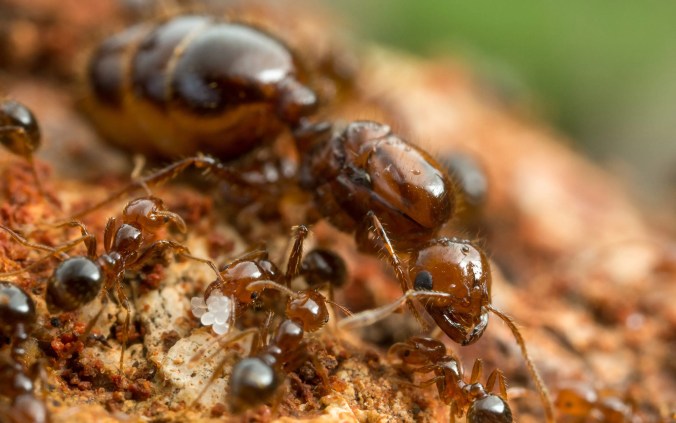
A queen Solenopsis invicta, an invasive fire ant. Photo by Alex Wild

John Whitfield, author of this article in Aeon, is a science journalist whose writing has appeared in Nature, among publications:

A polygyne population of red imported fire ants at Brackenridge Field. Austin, Texas, USA. Photo by Alexander Wild

Ant geopolitics

Over the past four centuries quadrillions of ants have created a strange and turbulent global society that shadows our own

It is a familiar story: a small group of animals living in a wooded grassland begin, against all odds, to populate Earth. At first, they occupy a specific ecological place in the landscape, kept in check by other species. Then something changes. The animals find a way to travel to new places. They learn to cope with unpredictability. They adapt to new kinds of food and shelter. They are clever. And they are aggressive. Continue reading

Melipona Bees, A Peruvian Wonder

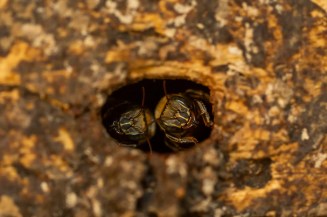
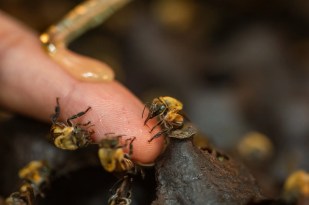
Melipona eburnea, a species of bee, is native to the Amazon. Unlike the more familiar but invasive honey bees from Africa and Europe that have spread through the Americas, these bees don’t sting. Ana Elisa Sotelo for National Geographic

The countless wonders of bees, as well as the many problems they now face, have made Melipona bees, also known as stingless bees, of particular interest to our daily scan for news stories:

Native to the tropics, these pollinators are taking a lead role in one of the latest efforts to conserve the Amazon rainforest.

Insects Love Solar Farms

A monarch caterpillar on a common milkweed leaf at a solar farm in Minnesota. LEE WALSTON / ARGONNE NATIONAL LABORATORY

We have already linked a couple of times to the multidimensional benefits of solar, and here is another dimension:

At Solar Farms Planted with Native Vegetation, Insects Flourish

To reach its climate goals, the U.S. will need to build solar arrays on some 15,000 square miles of land, an area larger than Maryland. Continue reading

More Honey & Bees, Also

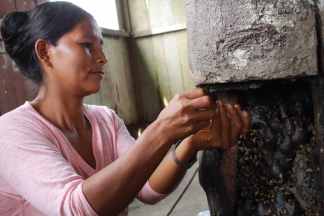
Tarkis Ríos Ushiñahua harvesting honey from stingless bees in a tree-trunk hive, at her home in Puerto Huamán in the Peruvian Amazon, 2019. [Hannah Hutchinson]

Along with anything else to get 2024 off to a good start, an article by Andrew Wingfield and Michael P. Gilmore that we missed from last year. The topic is one that we have only briefly touched on a couple times. The wider world of honey and the bees responsible for it are topics we hope to share more of this year.

To begin, let this bring some joy:

A Sweet and Potent Harvest

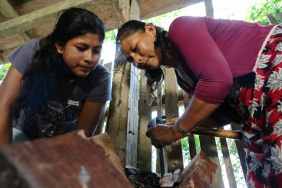
Tarkis Ríos Ushiñahua teaches her daughter to divide a hive, 2022. [Dylan Francis]

For the Maijuna of the Peruvian Amazon, harvesting honey from stingless bees is bringing prosperity and empowerment. Local beekeeping might also help preserve a vast ancestral forest.When Tarkis Ríos Ushiñahua collects honey from one of her beehives, she wears no protective clothing and uses just one tool, a large plastic syringe. 1 As she lifts the lid from the wooden box housing the hive, the bees swarm. They buzz around her face, land on her back, and settle in strands of her straight black hair, but they do no harm — these bees are stingless.

The bee yard of Loida Ríos Tamayo and Saúl Peterman Mosoline, 2021. [Enrique Redondo Navarro]

The slender tip of Ríos Ushiñahua’s syringe fits neatly inside the hive’s honeypots, brownish, papery-looking pouches that the bees have fashioned from wax and plant resins. Continue reading

Going The Extra Mile For Monarch Butterflies

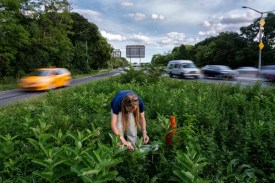
Ms. Elman collects butterfly eggs from milkweed plants growing wild along New York City’s highways. Karine Aigner

Some of the best stories are about people who go the extra mile for others:

To Save Monarch Butterflies, They Had to Silence the Lawn Mowers

An unlikely group of New Yorkers is winning small victories in the battle to protect butterfly habitats.

The small white dot under a milkweed plant is a monarch butterfly egg. Karine Aigner

The Long Island Expressway is not generally a place people linger, unless they’re stuck in traffic.

But during the summer, Robyn Elman can often be found walking alone near the highway’s shoulder, inspecting scraggly patches of overgrown milkweed. The plant is the only source of nutrition for monarch caterpillars before they transform into butterflies. Continue reading

CRISPR Silk

Spider silk fibres produced by silkworms. Junpeng Mi, Donghua University

This will be the fifth time for CRISPR in our pages. We suspend judgement each time we link to explanations of the technology, or new applications:

Silkworms genetically engineered to produce pure spider silk

Spider silk has been seen as a greener alternative to artificial fibres like nylon and Kevlar, but spiders are notoriously hard to farm. Now researchers have used CRISPR to genetically engineer silkworms that produce pure spider silk

Silkworms have been genetically engineered with CRISPR to produce pure spider silk for the first time. The worms could offer a scalable way to create things like surgical thread or bulletproof vests from spider silk, which is prized for its strength, flexibility and lightness. Continue reading

Fireflies At Risk

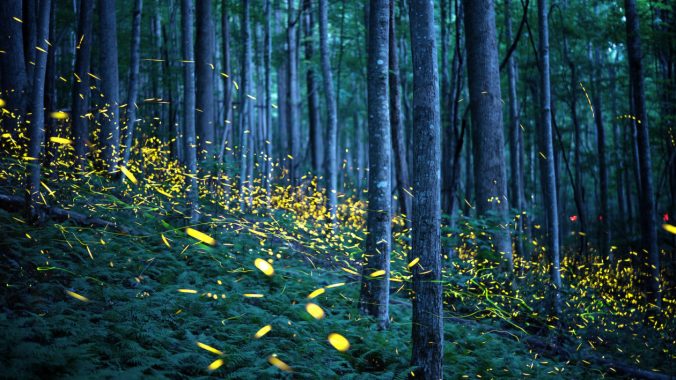
Fireflies in Great Smoky Mountains National Park. RADIM SCHREIBER

Fireflies being among the more charismatic insects, they and other glowing creatures have been covered in our pages second only to bees. Our thanks to Ted Williams, writing for Yale e360, for explaining their specific challenge:

A Summer Light Show Dims: Why Are Fireflies Disappearing?

Fireflies — whose shimmering, magical glows light up summer nights — are in trouble, threatened by habitat destruction, light pollution, and pesticide use. With 18 species now considered at risk of extinction in North America alone, recovery efforts are only just beginning.

For millions of people around the globe, fireflies have been a big part of the magic of spring and early summer nights. They certainly were in our family. When my children were young, our field in central Massachusetts blazed with fireflies. Continue reading

Insect Respect

Agronomist Caterina Luppa watches black soldier flies reproduce at Bugslife, a firm in Perugia, Italy, that is turning fly larvae into animal feed. LUIGI AVANTAGGIATO

We have featured this subject a few times over the years, especially once we started showcasing one such product. I acknowledge I am still not a total convert to an insect-centric diet, but every story like this draws me in, however slowly:

Edible Insects: In Europe, a Growing Push for Bug-Based Food

Marco Meneguz, an entomologist with BEF Biosystems in Casalnoceto, monitors black soldier flies as they mate. During mating, “the males gather in a courtship ritual characterized by fights and competitive displays,” he says. The blue light helps the flies see each other better. LUIGI AVANTAGGIATO

To rein in emissions, the E.U. is looking to insects as an alternate source of protein for livestock and people and is easing regulations and subsidizing makers of insect-derived food. In a photo essay, Luigi Avantaggiato explores the emerging bug food industry in northern Italy.

The European Union recognizes it has a meat problem. The bloc has no easy way to curb the climate impact of its livestock, which eat soybeans grown on deforested lands and belch heat-trapping gas. According to one estimate, Europe’s farm animals have a bigger carbon footprint than its cars.

Trent Barber, a technician at BEF Biosystems, vacuums up 200 pounds of fly larvae that are plump after two weeks of feeding on food scraps. The remaining food waste, now rich in excrement, will be sold as compost to farms. LUIGI AVANTAGGIATO

In this photo essay, Luigi Avantaggiato explores an unusual solution to this dilemma that is now gaining traction — feeding insects to livestock and, potentially, people. The European Commission says that insects could replace soy-based animal feed, helping to slow deforestation, or even supply an alternate source of protein for humans. Studies show that insects can furnish the same amount of protein as livestock while using as little as 10 percent of the land and producing as little as 1 percent of the emissions. Continue reading

Insect Oases

A small patch of native plants in Melbourne, Australia, draws native insects. MATA, ET AL.

Thanks to Yale e360 for this short story on small wonders:

Even a Small Patch of Native Greenery Can Give a Big Boost to Local Insects

In cities, a little native greenery can go a long way. Australian scientists found that, after adding native shrubs to a planting in Melbourne, the number of insect species at the site increased sevenfold. Continue reading

Bee Surprised, Again

Bees have long been held to be prophetic—messengers to another realm. Photographs by Alice Zoo for The New Yorker

When reading a couple of days ago that there could be such thing as too many beekeepers, the surprise was sufficient to make me go back through all earlier posts to see if I was merely forgetting having read this before. There were no previous mentions of too many, and if anything it was reasonable to assume from all my readings on colony collapse disorder that more beekeepers might be part of the solution. And now this article is full of more surprises, including the most fundamental question: Is Beekeeping Wrong?

Gareth John, a natural beekeeper, tending a hive.

Parasites and pesticides have brought chaos to bee colonies throughout the world. Natural beekeepers want to transform our relationship to the hive.

On a hot, pollen-dazed morning this summer, I stopped by the house of Gareth John, a retired agricultural ecologist, who lives on a quiet lane above a river in Oxfordshire, to take a look at his bees. In British beekeeping circles, John, who has a white beard and a sprightly, didactic manner, is well known as a “natural beekeeper,” although he acknowledged right off the bat that this was a problematic term. “It’s an oxymoron, right?” he said. John cares for perhaps half a million bees, but he does not think of himself as keeping anything. “I wouldn’t call myself a dog-keeper,” he said. “But I have a dog.” Continue reading

Honey Bee Dangers & Mythology

Gorazd Trusnovec inspects a beehive at the B&B Hotel Ljubljana Park in Ljubljana, Slovenia.

Thanks to this article by David Segal, with photographs and video by Ciril Jazbec, we realize now that even after our dozens of links to articles about bees, one key point was never on our radar. Our beekeeping/honey-making friends in Costa Rica inform us that the opposite is an issue here–in the entire country there are only 800 beekeepers and most of them are small scale hobbyists, and that a national authority (SENASA) controls the density of hives per area:

Mr. Trusnovec at home. “I would say that the best thing you could do for honey bees right now is not take up beekeeping,” he says.

In Slovenia and around the world, conservationists try — and mostly fail — to combat the widespread belief that honey bees are in danger.

When the B&B Hotel in Ljubljana, Slovenia, decided to reinvent itself as an eco-friendly destination in 2015, it had to meet more than 150 criteria to earn a coveted Travelife certificate of sustainability. But then it went step further: It hired a beekeeper to install four honey bee hives on the roof. Continue reading

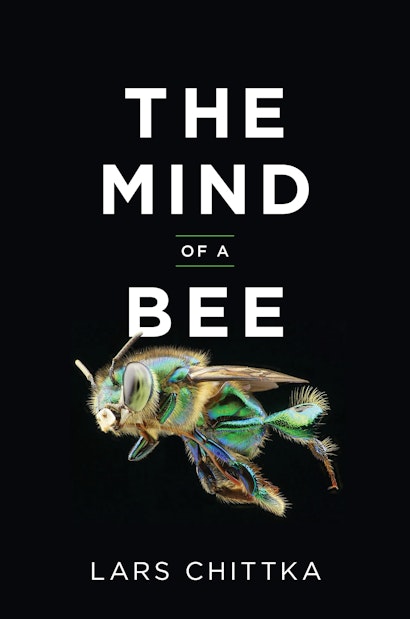
The Mind Of A Bee

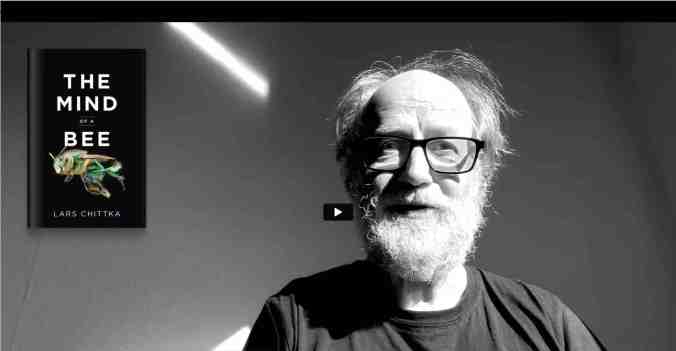
Bees’ brains are always of interest, and both the publisher below and the author above makes a good case for why this book matters:

Most of us are aware of the hive mind—the power of bees as an amazing collective. But do we know how uniquely intelligent bees are as individuals? In The Mind of a Bee, Lars Chittka draws from decades of research, including his own pioneering work, to argue that bees have remarkable cognitive abilities. He shows that they are profoundly smart, have distinct personalities, can recognize flowers and human faces, exhibit basic emotions, count, use simple tools, solve problems, and learn by observing others. They may even possess consciousness. Continue reading

The Diligence Of Local Bees

Native Bees Yield Hardier Flowers Than Honey Bees, Research Finds

Bees getting the scientific attention they deserve, our thanks to Yale e360 for summarizing and sharing these findings:

Native Bees Yield Hardier Flowers Than Honey Bees, Research Finds

Flowers pollinated by native bees produce fitter offspring than flowers pollinated by honey bees, according to a new study carried out in San Diego, California. Continue reading

California Bumble Bee Atlas

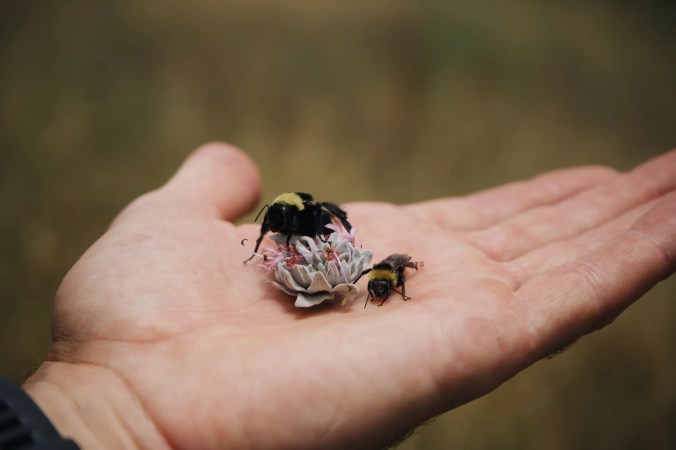
Leif Richardson examines a queen bee. Grace Widyatmajda/NPR

Bumble bees need help and the California Bumble Bee Atlas Project is on it. Thanks to National Public Radio (USA) for bringing it to our attention:

Krystle Hickman, a bee photographer and volunteer for the Bumble Bee Atlas Project, carefully places a bee onto a flower.
Grace Widyatmadja/NPR

Nets, coolers and courage: A day in the life of a volunteer bee conservationist

I never realized how fuzzy a bumble bee is until I got to hold one between my fingertips. It feels like a furry black and yellow bear, buzzing with its tiny body, wriggling with its legs.

The conservation biologist Leif Richardson, who handed me this bee a moment ago, has some advice for holding it. “You’re going to squeeze harder than you think you need to, but not so hard that you hurt him.” Continue reading