If You Can, Catch Pacita Abad At MoMA PS1

The work at the center is the nearly 17-foot-tall “Marcos and His Cronies,” which features a dragon demon surrounded by 18 fearsome masked figures.

Installation view of “Pacita Abad” at MoMA PS1. From left: “Waiting in Washington” (1990), “Marcos and His Cronies” (1985-1995) and “Subali” (1983/1990). Kris Graves/MoMA PS1

Pacita Abad has not only not appeared in our pages before, but her work was rejected by plenty of institutions who probably should have known better. Now, if given the chance, most of us will choose not to miss the opportunity to experience her work:

Stitch by Stitch, Pacita Abad Crossed Continents and Cultures

The Filipino American artist is having her first retrospective at MoMA PS1 as the mainstream art world finally catches up to her work. “You will regret missing it,” our critic says.

A row of five colorful paintings depicting masks from various cultures, from left, “Oceania Mask,” “Hopi Mask,” “African Mephisto,” “Mayan Mask,” and “African Mask” with a Kongo figure.

From left, “Oceania Mask (Dancing Demon),” 1983/1990; “Hopi Mask,” 1990; “African Mephisto,” 1981; “Mayan Mask,” 1990; and “African Mask (Kongo),” 1990, on view at MoMA PS1. Kris Graves/MoMA PS1

About a year before she died of cancer, in 2004, at the age of 58, the artist Pacita Abad and a team painted a pedestrian bridge that crosses the Singapore River with exuberant colors and more than 2,000 circles. Surrounded by ho-hum hotels and apartment buildings, it radiates joy. Abad’s work is in museums throughout Asia, and in Manila, where she grew up, the National Museum’s holdings include a painfully lucid 1980 painting of two wary children, Cambodian refugees, holding each other. Continue reading

Inca Woven Masterpiece

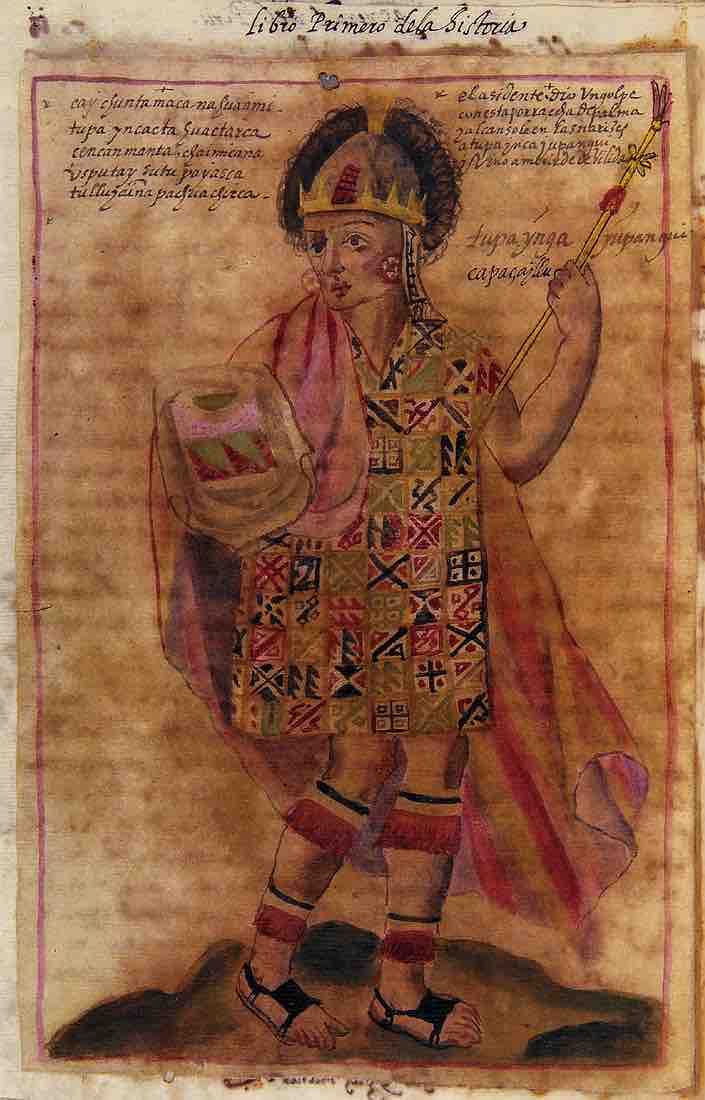
Illustration of Tupac Inca Yupanqui (an Inca emperor) c. 1590, by an unknown artist. | USED WITH PERMISSION / PRIVATE COLLECTION

In this article by Max J. Krupnick we are given reason to rethink the notion that the Incas had no written language. There is plenty of evidence that they were capable of advanced communication aesthetically:

A Royal Tunic

Unraveling an Inca masterpiece’s secrets

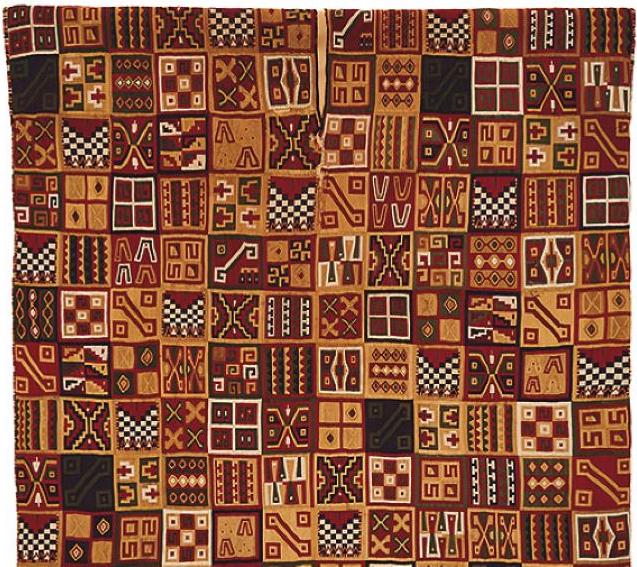
WITH STITCHES as dense as an iPad’s pixels, this woven tunic represents the pinnacle of Inca artistry. The brutal Spanish conquest and the unforgiving march of time have destroyed most Inca textiles, but the tunic now at Dumbarton Oaks in Washington, D.C., survived. Although its symbols captivate visitors and scholars alike, much is left to be learned about the garment. Who made it? Who wore it? Is it truly authentic?

Tunic | ©DUMBARTON OAKS, PRE-COLUMBIAN, WASHINGTON, D.C.

Robert Bliss, who cofounded Dumbarton Oaks, Harvard’s center for Byzantine, Pre-Columbian, and landscape studies, purchased the tunic for his personal collection, so its acquisition history is not well documented. Added to the institute’s holdings in 1963, the tunic attracted scholarly attention as researchers attempted to decode its symbols, which they believed comprised a written language, despite evidence that the Incas did not write. Continue reading

If You Happen To Be In Venice

Work by Yuku Mohri at Japan’s pavilion. Moisture from the rotting fruit on display is converted into electric signals, which generate sounds or turn on suspended lightbulbs. Matteo de Mayda for The New York Times

It is the end of the standard work week for many, so here is an art concept to take them into the weekend, thanks to the New York Times art critics:

Given the Venice Biennale’s reputation as “the Olympics of the art world” — set in a spectacular city, no less — artists and curators here often favor grand, weighty gestures. This year’s Japan Pavilion wonderfully eschews gravitas for modesty and play, while still getting at something profound.

Mohri’s work was inspired by the rough and ready materials used to fix leaks in Tokyo’s subway. Matteo de Mayda for The New York Times

For her exhibition “Compose,” curated by Sook-Kyung Lee, the artist Yuko Mohri has created two installations of contraptions-slash-sculptures from local materials. One set, inspired by the D.I.Y. methods for fixing leaks in the Tokyo subway system, features tubes and everyday objects — like pans, rubber gloves and coat racks — rigged together and dangling through the air. The systems catch and recirculate water seeping into the pavilion, sometimes activating chimes in the process. Continue reading

Give Earth A Chance, & Other EcoPosters

A poster from 1970 by Milton Glaser. via Poster House

If you happen to be in New York City and enjoy graphic design related to conservation you might enjoy this:

Told Ya So: The Prescient Posters of the Environmental Movement

Graphic artists have been helping call attention to climate change for decades, and a new exhibition charts the evolution of their pleas.

Last year was the warmest in recorded history. The graphic artists of the environmental movement tried to warn us. Their posters aimed to scare people straight with pictures of ecological ruin, or glorified nature, clean air and water, sunshine and verdure. Some offered earworm-y slogans and haunting visuals. Whatever their approach — bright, witty, somber, blunt, even sexy — they sought an image, a phrase, that could change enough minds to literally save the world. Continue reading

Natural History Anew

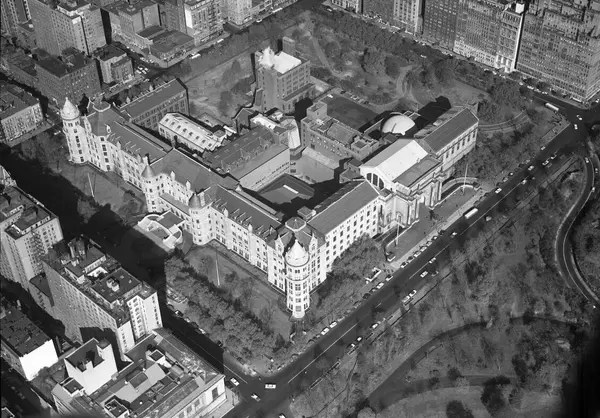
An image from 1957, when the cross and square design was still legible. American Museum of Natural History

We have featured so many natural history museums in our pages over the years that one more might have been redundant; but no:

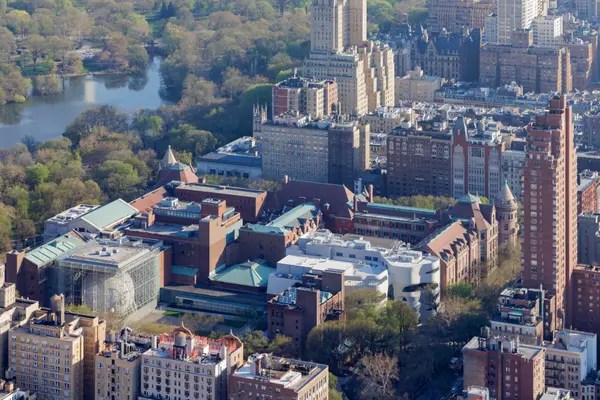
A new aerial photo shows the museum today, as a crazy quilt of buildings from many eras, with Gilder on the right. Iwan Baan

The article below, by Michael Kimmelman with photographs and video by Peter Fisher, allows us to imagine the experience of a new view on natural history in New York City.

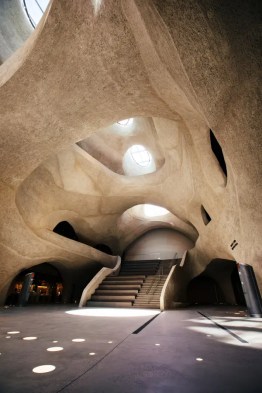
The view at the entrance toward the monumental staircase with bleacher seats.

We are ready to be awed:

The stunning $465 million Richard Gilder Center for Science, designed like a canyon, is destined to become a colossal attraction.

When plans for it first surfaced, I wondered if the new Gilder Center at the Natural History museum might end up looking overcooked.

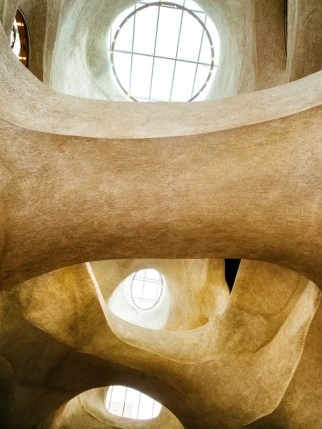
From the outside it’s a white-pink granite cliff with yawning windows shaped a little like the openings to caves, nestling the museum’s wonderful Romanesque Revival addition from the turn of the last century. Past the front doors, that cliff face morphs. It becomes an atrium in the guise of a towering canyon, a city block deep.

Skylights and balconies in the atrium of the new Richard Gilder Center for Science, Education and Innovation.

For its architects, Jeanne Gang and her team, Gilder was clearly a gamble and leap of faith, bucking today’s innocuous norms, almost begging for charges of starchitectural self-indulgence.

Now that it’s built, I love it.

I wouldn’t go so far as to equate it with the curvaceous genius of Gaudi or with Saarinen’s groovy TWA Terminal, but it’s in the family. Like them, Gilder is spectacular: a poetic, joyful, theatrical work of public architecture and a highly sophisticated flight of sculptural fantasy. New Yorkers live to grouse about new buildings. This one seems destined to be an instant heartthrob and colossal attraction. Continue reading

The Birds Of Australia, Interactive Exhibition Of John & Elizabeth Gould’s Illustrations

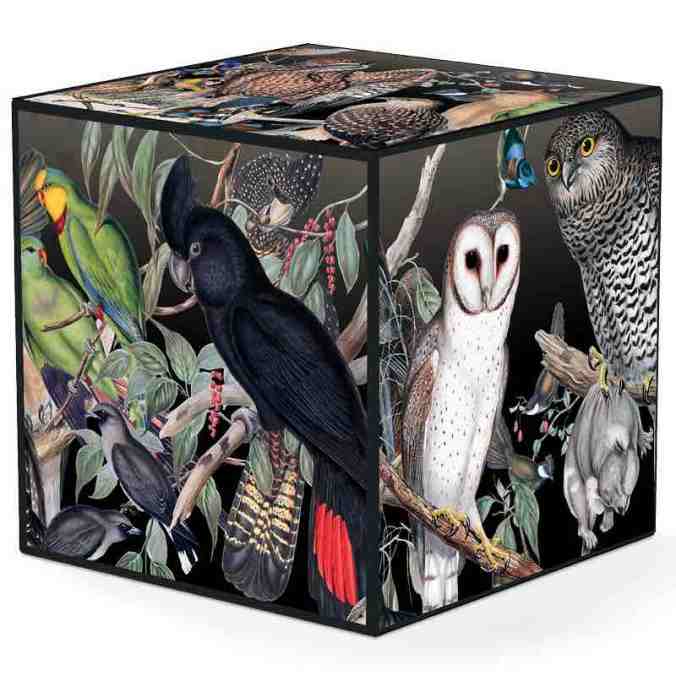
A new exhibition showcasing the incredible world of Australia’s birdlife will launch in Newcastle. Presented on STORYBOX, an interactive storytelling cube, The Birds of Australia, brings to life the iconic bird illustrations of John and Elizabeth Gould together with First Nations storytelling and knowledges.

We have linked to stories about both John Gould and his wife Elizabeth, and now there is a museum exhibition honoring both together, so if you happen to be in Australia:

Touring exhibition: The Birds of Australia

Trace the journey of English ornithologist John Gould and his wife Elizabeth, as they travelled across New South Wales in the 1800s on one of the most significant birding expeditions in history, helping inform contemporary knowledge and conservation of Australian birds. The Goulds described and illustrated over 300 birds that were completely new to science, including the Pied Butcherbird (Cracticus nigrogularis) and the now extinct Paradise Parrot (Psephotellus pulcherrimus). It was an astonishing record of observation and sustained hard work. Continue reading

Origami At The American Museum Of Natural History

D. Finnin/© AMNH

Folding paper was a frequent topic for us starting in 2011, but origami specifically has been featured only a few times. This holiday season at the American Museum of Natural History we add to the mentions:

The Making of the Origami Holiday Tree

One 13-Foot Tree, 1,000 Origami Models: A Spectacular Museum Tradition

M. Shanley/© AMNH

Early each year, as the days begin to get a bit longer and the first signs of spring crop up in Central Park, Ros Joyce and Talo Kawasaki, volunteers from OrigamiUSA and the designers of the Museum’s Origami Holiday Tree start planning for the year ahead.

M. Shanley/© AMNH

They begin combing the Museum’s halls in search of inspiration—going from floor to floor to decide on a perfect theme and to find just the right exhibits to re-create as origami models on the tree. Continue reading

The Parthenon Marbles, Back Where They Belong

The Parthenon in 1875.

The Parthenon in 1875. Interfoto/Alamy

The Elgin Room of the British Museum in an undated photograph taken during the Victorian era.

The Elgin Room of the British Museum in an undated photograph taken during the Victorian era. Keasbury-Gordon Photograph Archive, via Alamy

The original Parthenon marbles belong back in Athens, in the museum built for them. With all due respect to my British friends, my opinion is informed partly by my mother being from Greece, but mostly by an impartial logic.

That logic is expressed in the article below, which also happens to lay out an interesting sideshow:

Robots at the Marmi di Carra marble workshop in Italy carved a replica of a horse head, the original of which sits in the British Museum in London.

Robots at the Marmi di Carra marble workshop in Italy carved a replica of a horse head, the original of which sits in the British Museum in London.

Few cultural disputes inflame British passions more than the disposition of the Parthenon Marbles. Public debate about the statuary has raged since the early 1800s, when the sculptures and bas-reliefs, which date from 447 B.C. to 432 B.C., were stripped from the Parthenon and other Classical Greek temples on the Acropolis of Athens by agents of Thomas Bruce, a Scottish statesman and seventh earl of Elgin. The marbles were purchased — some say looted — by Elgin during his time as ambassador to the Ottoman Empire, the occupying power; they have resided in the British Museum since 1817. Continue reading

If You Happen To Be In New York City

If you have are in New York City with some time on your hands, immerse yourself in The Orchid Show: Jeff Leatham’s Kaleidoscope .

We who live in Costa Rica, or other places where orchids are abundant, are fortunate but can only dream of this sort of abundance on display in one location:

February 26 – May 1, 2022

10 a.m. – 6 p.m. | At the Garden

Experience Famed Designer Jeff Leatham’s Bold and Colorful Vision

The dazzling floral creations of Jeff Leatham, famed artistic director of the Four Seasons Hotel George V in Paris and floral designer to the stars, return for The Orchid Show’s 19th year. Continue reading

If You Happen To Be In London

Museum number: BP.1079
© Victoria and Albert Museum, London, courtesy Frederick Warne & Co Ltd.

Do you have the inclination of switching from city life to rural? I, for one, made the switch and have no inclination to ever live in a city again. Occasional visits are fine. But as the theme song from a tv show of my youth had it “…keep Manhattan, just give me that country life…”.

My reason for thinking about this today is related to the book on the right. Whether or not you are a fan of her books, you might find the case of Beatrix Potter’s life choices worthy of consideration. Rizzoli has published this book to accompany an exhibition at the Victoria & Albert Museum. Our appreciation to Anna Russell for describing both, and adding plenty of detail about the author’s life, in this article:

The Secret Life of Beatrix Potter

A new book and an exhibition on Potter, who wrote “The Tale of Peter Rabbit,” use letters, sketches, and a coded journal to capture an author who delighted in the detail and humor of the natural world.

Many teen-agers will go to great lengths to keep their diaries private—I kept a little key for mine in a wooden jewelry box, which I guarded jealously—but the children’s book author Beatrix Potter took it to an extreme. Continue reading

Expo 2020’s Pavilion Of Irony

Credit: Michele Nastasi

For a second day, the story that stands out as worth sharing here is one with irony written all over it. Nevermind that this event with 2020 in its name is just being reported on now. We all know that last year’s events got postponed for good reason.  It is a story about too little too late, without saying so. Reported from a region of the world made wealthy by the proliferation of plastic and other petrochemical product, there is not a hint of irony in this story. Needless to say, architecture rethinking building materials is a topic we care about. Even without being snarky, the irony of this story is hard to miss:

Italy’s eco-friendly Expo pavilion is made using orange peel and coffee grounds

Italy’s pavilion features a facade of nautical ropes, made with 2 million recycled plastic bottles. Credit: Michele Nastasi

With three full-size, seaworthy boat hulls as its roof and a facade of nautical ropes made from recycled plastic, Italy’s pavilion at Dubai Expo 2020 embraces the concept of reusable design.

Favored by an excellent placement within the Expo site — between the “Opportunity” and “Sustainability” thematic areas and with uninterrupted front and side views — the pavilion attracted a fifth of the overall visitors to the event in the opening weeks, making it one of the most successful. Continue reading

Smithsonian Craft Show

Some of the crafts we carry seem museum quality to us, but we offer them in the context of commerce.

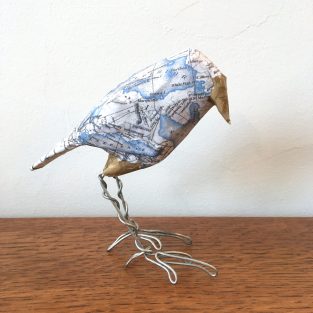
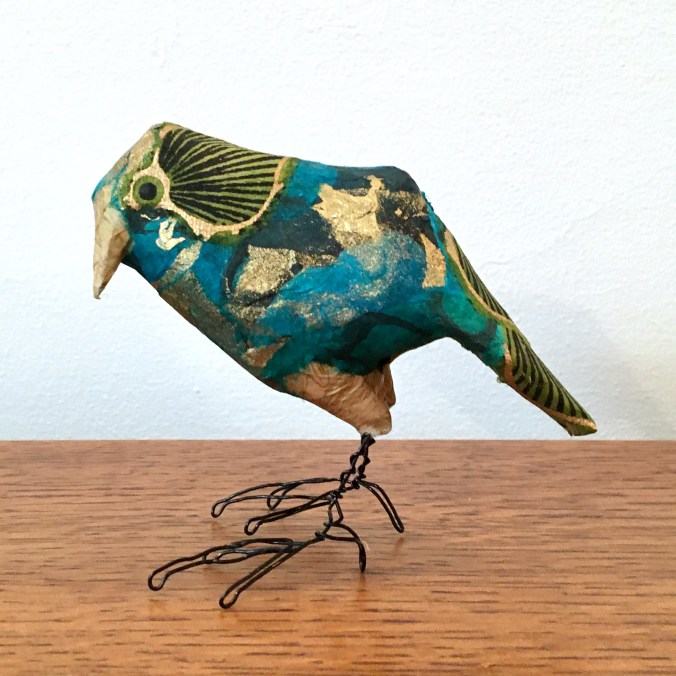
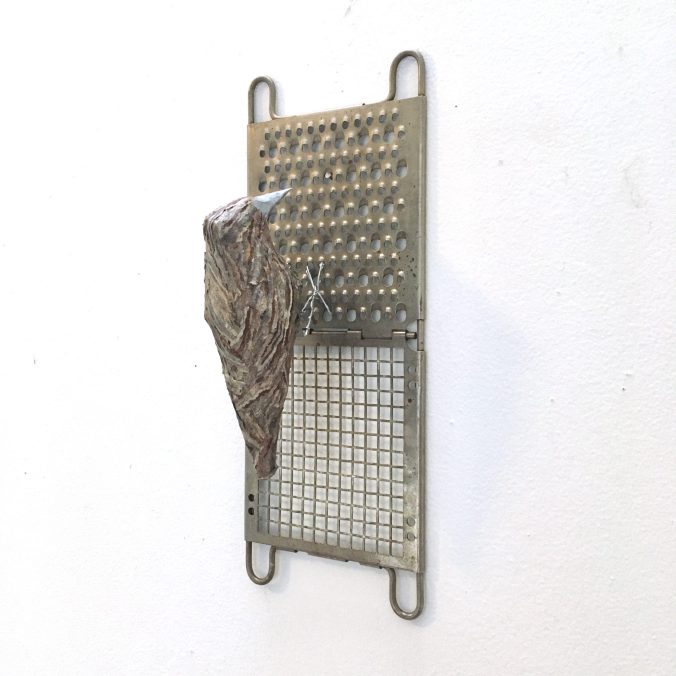
We would love to attend this show at the Smithsonian, primarily to see the work of Jessica Beels, whose work is showing in the Mixed Media and Paper section of the Show. Her website is full of reasons to see more of her work.

Nowhere on that site do  we see works like these three bird figures. We favor birds in art, wherever it may be, and when the medium stretches boundaries as these do, all the more interesting.

If You Happen To Be In Berlin

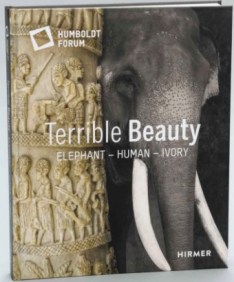
The phased opening of Humboldt Forum, a museum in Berlin, includes this exhibit, and of course a beautiful book to boot.

An interesting feature, in the form of an editorial on the museum’s website can help put this exhibit in context. The goal of this museum is anti-colonial, among other things, according to the museum’s editorial:

According to the people behind the project, the partial reconstruction of Berlin’s historic palace was an expression of the power to mend, to repair the urban fabric and the historical associations enshrined in the space it occupies.

Which is unusual for a well-funded museum in a wealthy country to say. So, this book looks interesting from multiple angles, and the text describing the book is a hint at that:

The elephant is an admired but also endangered animal. In all times and cultures, the ivory of its tusks has been sought after. What kind of material is it, how is it used in history and the present, and what can be done today to protect the largest land mammals from poaching? This richly illustrated volume undertakes a cultural-historical journey and a current positioning. Ivory fascinates  and polarises. Continue reading

The Youthful Insights Behind ‘Black Histories, Black Futures’

Jadon Smith is one of six teen curators for “Black Histories, Black Futures,” the first exhibition at the Museum of Fine Arts, Boston, curated entirely by high school students. photo credit: Melanie Stetson Freeman/Staff

Although the exhibit highlighted here began in January (notably directly following the holiday honoring MLK), we have the CS Monitor to thank for bringing it to our attention.  The museum is currently closed due to the coronavirus outbreaks, but the making of video on the MFA website shows some highlights, and we can only hope that there will be opportunity to visit it in person before the end date of June 20th.

“The teen curators—fellows from youth empowerment organizations Becoming a Man (BAM), The BASE, and the Bloomberg Arts Internship Boston program managed by EdVestors—used skills they developed as paid interns in a pilot internship program at the MFA to research, interpret, and design the exhibition. Their work highlights areas of excellence within the Museum’s collection and lays foundations for the future.”

What if curators were teens? Museums try it.

Jadon Smith steps closer to his favorite painting by Archibald Motley, carefully examining the details he’s looked at many times before, a smile from ear to ear. At the center of the piece, five elegant women dressed in their Sunday best sit in a restaurant. One woman, hidden in the background, catches his attention.

The John Axelrod Collection/Frank B. Bemis Fund, Charles H. Bayley Fund, and the Heritage Fund for a Diverse Collection/Courtesy of The MFA “Cocktails” by Archibald Motley is an oil on canvas painting from about 1926. Motley was known for depicting the blossoming of black social life.

“Women are the centerpiece of the whole entire painting,” says Jadon, a junior at John D. O’Bryant School of Mathematics and Science, during a visit to Boston’s Museum of Fine Arts in early March. “They’re supposed to be there to be seen. Don’t ignore them. Notice that they’re there, appreciate the fact that they’re there.”

Jadon is one of six local teens selected to craft “Black Histories, Black Futures” – the museum’s first exhibition curated entirely by high school students. The MFA’s exhibition, the culmination of a partnership with local youth empowerment organizations, reflects a growing trend, one that has museums working to engage and represent a more diverse population within the field of fine art. Including young people in the curation process not only trains the next generation of curators, say museum staffers, but it also helps aging institutions display refreshing and inclusive exhibitions inspired by the young curators’ own experiences.

“This institution is 150 years old. And so what does that mean for young people? Where do young people belong in such an old institution?” says Layla Bermeo, an associate curator at the MFA. “This project really tried to argue that young people belong in the center.”.. Continue reading

Mexico, Mapping Memory

Blanton Museum of Art, for one more day, offers this:

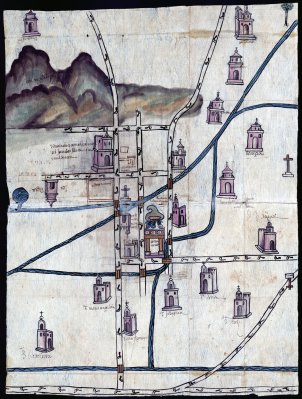
Exactly 500 years ago, in August of 1519, an expedition led by the Spanish explorer Hernando Cortés began marching inland into Mexican territory. Just two years later, what today is Mexico City fell to an ethnically diverse army composed of both Spanish and local peoples from other cities, starting a long period of European colonization. This exhibition aims to expand our perspective on these events by featuring a selection of maps, known as Mapas de las Relaciones Geográficas, created by Indigenous artists around 1580. These unique documents show some of the visual strategies used by native communities for the endurance and perseverance of their cultures throughout the so-called colonial period and well beyond.

To learn more about the map click Teozacoalco Map. Thanks to National Public Radio (USA) for bringing this to our attention:

1.-meztitl-n_custom-76d71392f43cf17eb677f3a356088e82632e53ce-s1400-c85.jpg

The Mapping Memory exhibition in at the Blanton Museum of Art in Austin, Texas, displays maps made in the late 1500s of what is now Mexico. They were created by indigenous peoples to help Spanish invaders map occupied lands. This watercolor and ink map of Meztitlán was made in 1579 by Gabriel de Chavez. Blanton Museum of Art

440 Years Old And Filled With Footprints, These Aren’t Your Everyday Maps

4.-culhuac-n_custom-a07202fd250a7d6dc16ed2124d2c4e0adf01ec99-s1400-c85.jpg

Pedro de San Agustín created this watercolor map of Culhuacán in 1580. He was a judge — a powerful figure in the town. “Before the conquest, nobles were the only ones trained as painters,” exhibit curator Rosario Granados explains. She notes that this map is made on bark paper, the traditional material used before the Spaniards arrived. Blanton Museum of Art

At the Blanton Museum of Art in Austin, Texas, 19 maps, nearly 440 years old, are on display — and they look spectacular. “Works on paper are delicate so we’re only allowed to put them on display for nine months out of 10 years,” says Blanton Museum communications director Carlotta Stankiewicz.

The Mapping Memory exhibition contains work by indigenous mapmakers from the late 1500s. The maps demonstrate a very different sense of space than maps drawn by Europeans. They’re not drawn to scale; instead, they’re deeply utilitarian.

A map of Culhuacán, for example, shows rivers running straight, with tiny arrows in the middle, indicating which way they flow. The pathways curve like snakes, with footprints or hoofprints indicating whether the paths can be walked or ridden. Continue reading

New Zealand’s Minister of Conservation Shares Surprising Good News

When the Minister of Conservation speaks, we listen:

orange-fronted-parakeet-chick.jpg

We came to this news through the story below by National Public Radio (USA):

Rare New Zealand Parakeet Population Doubles After ‘Epic’ Breeding Season

orange-fronted-parakeet-chick-with-transmitter-doc-c9811c0f185647851facaa77fc88d87cd8614f8f-s1200-c85.jpg

The small bird was believed to have gone extinct but after a bumper crop of beech seeds this year, conservationists estimate the orange-fronted parakeet population has likely doubled.
Department of Conservation

One of the rarest birds in New Zealand is having its best breeding season in decades, potentially doubling the population.

The orange-fronted parakeet, known locally as the kākāriki karaka, is in the midst of a prolonged mating season due to a beech seed bonanza, Conservation Minister Eugenie Sage said in a statement on Wednesday.

“It is great news that this year there are more than three times the number of nests compared to previous years,” Sage said.

She added that at least 150 wild-born chicks have been born so far this season…

Read the whole story here.

Aana Art Equaling Life-Sized Conservation

Elephants have held highest honors in our family for decades, as symbols for the importance of Nature Conservation, and later infused with the power of Ganesh when we lived in India.

Elephant conservation has taken many forms over the years. When writing about the recent Real Elephant Collective collaboration exhibit that took place in Cochin a few months ago, I realized that art installations using elephants as symbols for big picture conservation have existed for some time.

Having been unable to attend the exhibit personally, Anoodha and the Curiouser team make me feel that I was there.


Mass Transit Morphing

Weeks 297, 2008 - Photo by Stephen Mallon.jpg

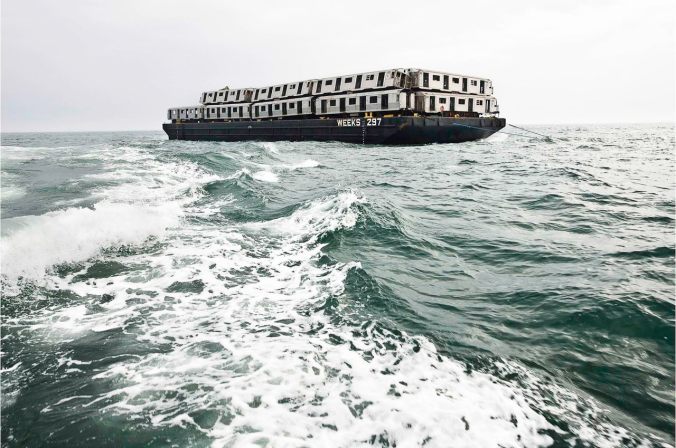
Subway cars set sail on a barge in “Weeks 297, 2008.” STEPHEN MALLON

Thanks to Winnie Lee and Atlas Obscura:

Photographing the New York City Subway Cars That Retired as Artificial Reefs

How Stephen Mallon captured this unusual voyage to the bottom of the ocean.

image.jpg

The rooftops of subway cars. “Abbey Road, 2008.” STEPHEN MALLON

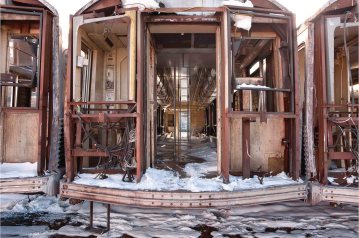
The photographer Stephen Mallon specializes in documenting man’s industrial-scale creations. During his career, he’s focused his lens on the recycling industry, the largest floating structure ever built, and the transportation and installation of a new bridge in New York City. So it wasn’t surprising when, in 2008, he was drawn to an unusual program spearheaded by the MTA New York City Transit system: a multi-phased artificial reefing project that saw the shells of 2,580 decommissioned subway train cars repurposed and dropped into coastal waters off New Jersey, Delaware, Maryland, Virginia, South Carolina, and Georgia, between 2001 and 2010.

image (1).jpg

The abstract beauty of stripped-down vehicles in “Transfer, 2009.” STEPHEN MALLON

Mallon arranged to follow the outdated subway cars as they were prepared and cleaned, loaded onto barges, and finally plopped into the sea. As he traveled with a crew in a tugboat to get his shots, the photographer developed his sea legs.

image (2)

Subway cars hoisted in the air in “Mind The Gap, 2008.” STEPHEN MALLON

“I was never underwater, so just needed to keep myself steady on the back of the boat. It’s kind of like surfing or skiing—just keep your balance, keep the horizon line straight, bend your knees, and don’t fall overboard,” Mallon says. Continue reading

Stories Without End – The Grandmother Project

The Ogelthorpe University Museum of Art is one of the gems of the Atlanta area, for good reason. Not only does the museum have its own well curated collections, it receives visiting collections that are timely and powerful.

Tara Rice‘s Grandmother Project photographic series highlights the historically matriarchal influence within African cultures, coinciding with the project based in Senegal “promoting health, well-being and rights of women and children in developing countries through grandmother-inclusive and intergenerational programs that build on communities’ cultural values and resources.”

The photo series dovetails perfectly with the female centric collection of sculptures and masks in the sister exhibit, Stories Without an End.

Stories Without an End: Power, Beauty and Wisdom of Women in African Art of the Mehta Collection

January 18 – April 21, 2018

The exhibition Stories Without an End: Power, Beauty and Wisdom of Women in African Art of the Mehta Collection includes a selection of 50 classically carved wooden sculptures and masks drawn from the collection of Dileep and Martha Mehta.

The exhibition represents art from more than 25 ethnic groups spanning 12 countries. These objects are gathered into thematic groups including women in governance, maternity, idealized beauty, and female ancestors.

OUMA members Dileep and Martha Mehta are collectors of African and Asian arts. Their African art collection, including objects in this exhibit, has greatly benefited from diligent sourcing by and wise counsel of African Art dealers Tamba Kaba and Sanoussi Kalle.

This exhibition was developed by Elizabeth H. Peterson, OUMA director, and organized by Amanda Hellman, PhD, curator of African art, Michael C. Carlos Museum, Emory University.

Stories Without an End was inspired in part by the work of the Grandmother Project (GMP) an American 501(c)(3) nonprofit organization and a Senegalese NGO with representatives throughout the USA and abroad. GMP, with headquarters in Senegal, works with elders in West African villages to fight the maltreatment of young girls. This includes bettering maternal and child nutrition, reproductive health, and marriage standards. The exhibition title is inspired by the GMP initiative “stories without an ending,” which is a tool used to facilitate communication via the elders. For more about the Grandmother Project please visit www.grandmotherproject.org.

The Grandmother Project: Photographs by Tara Rice

January 18 – April 21, 2019

The Grandmother Project (GMP) develops community approaches that promote positive and sustained improvements in the lives of girls, children, women, and families by building on existing cultural and community values, roles and assets in southern Senegal. Continue reading

Elephants By The Sea

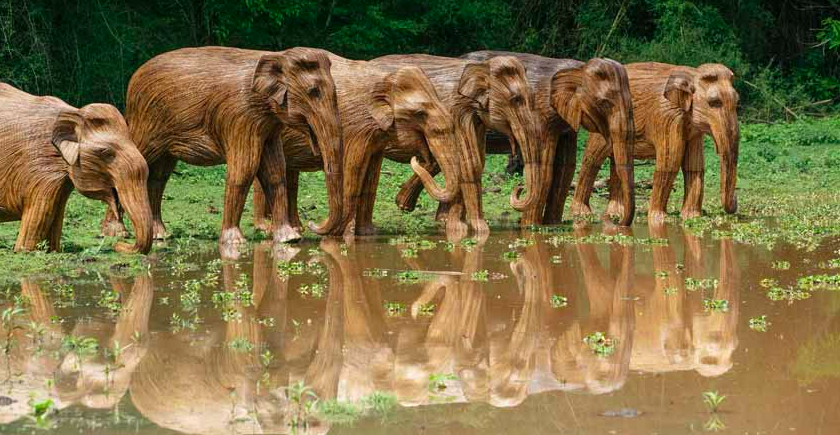
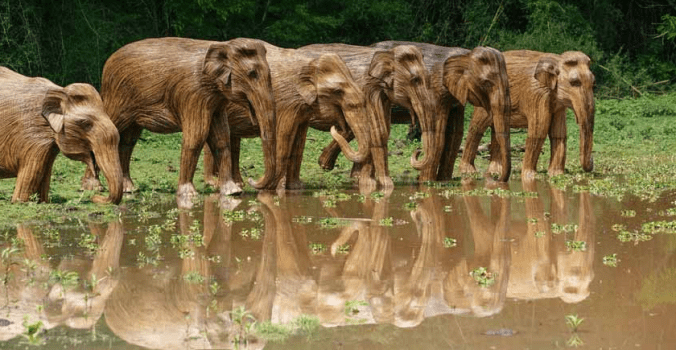
100 life-size lantana replicas of wild elephants will travel across three continents spreading the message of peaceful coexistence with nature.

The beautiful herd of Asian Elephants calmly drinking from this watering hole poses no threat to any onlooker. They’re actually sculptures made from the invasive lantana, introduced to the Indian subcontinent as an ornamental shrub by the British. The harmless looking plant is a scourge to native flora, animals and people of the regions where it’s taken over, as it literally poisons its surroundings so nothing else can survive there, destroying the natural biodiversity of the area.

30 of these extraordinary, life-sized works of art have been on display in Kerala, at Kochi’s South Beach, coinciding with the Kochi-Muziris Biennale. The outdoor exhibit, entitled Co-Exist: Matriarchs for a Whole Earth, is on display for only until the end of February, after which it will travel to Bangalore and New Delhi. In 2020, the elephant models will be taken to England where they will be displayed at the Victoria and Albert Museum and the Royal Parks, both in London. In 2021, they will travel by truck across the USA, where they will finally be auctioned, the proceeds of which will go to preservation of wild animals.

The project is a collaboration between multiple organizations, designers and indigenous community artisans. Members of the Ashoka Trust Trust for Research in Ecology & the Environment (ATREE) devised a way to safely craft with lantana as a raw material and support for the making and display of lantana elephants is through the NGOs Elephant Family, The Real Elephant Collective (TREC), and The Shola Trust.

Fort Kochi To Have 100 ‘Lantana’ Elephants. And Here’s Why You Need To See Them

Highlighting the cause of nature and wildlife conservation at a global scale, the Lantana elephants are part of a greater initiative to raise funds for conservation and help people and elephants live together more harmoniously.

On February 7, if you are wandering around the popular South Beach in Fort Kochi, you are sure to come across a magnificent herd of 100 Asian elephants.

If you are wondering about the possibility of such a huge congregation of these beings at one place, let us break the news.

These are beautifully sculpted life-size elephants that have been made by tribal artisans from Thorapalli in Gudalur using Lantana camara or Lantana, a toxic invasive weed.

Lantana elephants are part of a greater initiative to raise funds for conservation and help people and elephants live together more harmoniously.

“Our vision is to bring Asia’s elephants and the issues they face out of India and the shadow cast by the African ivory crisis. With Asian elephants numbering only a tenth of their African counterparts, the importance of this unique migration cannot be underplayed. The survival of a species is at stake,” says Ruth Ganesh, principal trustee and the creative force of Elephant Family.

She had conceptualised the Lantana herd along with Shubhra Nayar of TREC. Modelled on real elephants from the Gudalur-Pandalur region, in its bid to raise awareness and funds for the conservation of Asian elephants, this unique project is also clearing the harmful Lantana from the Nilgiri forests while providing livelihoods to about 70 artisans from the Paniya, Bettakurumba and Soliga communities.

With their inherent knowledge of wild elephants and their exceptional crafting skills with Lantana, these artisans are bringing life to the elephant forms, while earning a dignified income. The elephants are designed by Shubhra Nayar and Tariq T of TREC, with Subhash Gautam overseeing the process. Continue reading