Whale Shark Citizen Science Maldives Redux

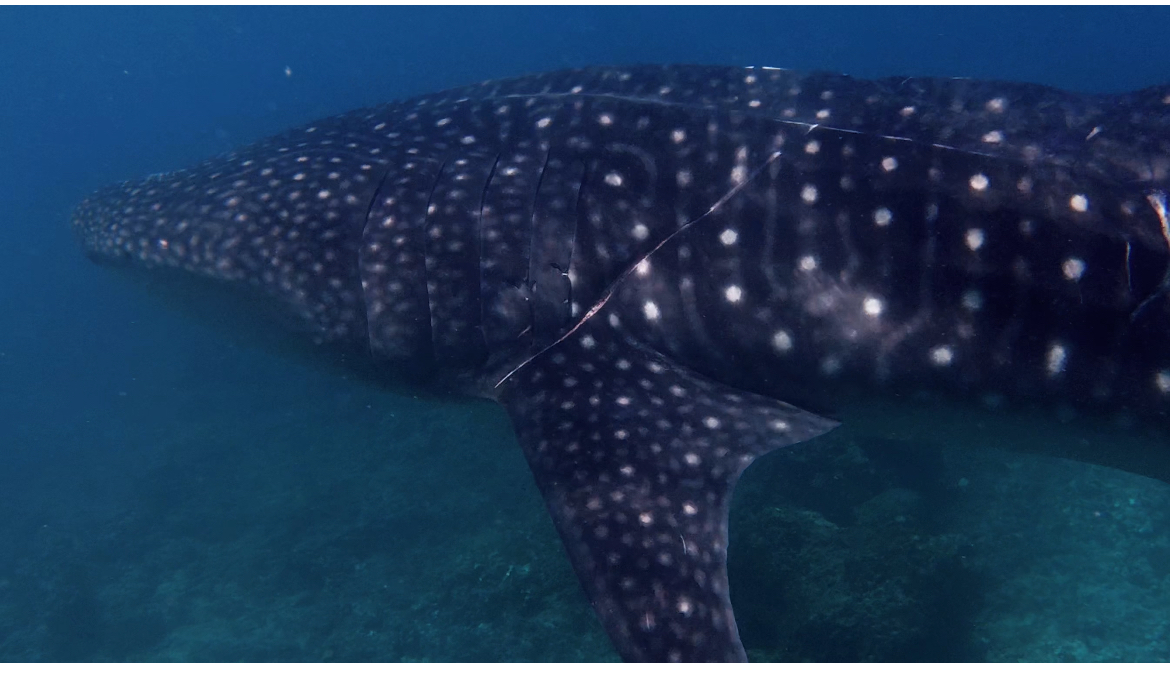
Photo credit: Sommer Laettner

In honor of International Whale Shark Day, which is August 30…

I posted last year about my experience volunteering with the Maldives Whale Shark Research Programme (MWSRP) and the great work they do.  Established in 2006, MWSRP undertakes research and monitoring of whale sharks and other marine megafauna in the Maldives and uses the associated findings and data to advocate for sound conservation policy in the country.

Throughout the year, the MWSRP team, together with volunteers, undertakes patrols along the reef in the South Ari Atoll Marine Protected Area and other locations in the Maldives to record sightings of whale sharks and other marine megafauna and to gather data on vessel traffic and behavior.  Whale shark encounters are documented via photos and video along with data on location, behavior, and ocean conditions.  Encounters are entered into the “BIG FISH network” database, an online citizen science platform developed by MWSRP as a monitoring network for awareness raising and stewardship of whale sharks in Maldives.

I returned to the Maldives this month to get an update on efforts to protect this iconic species and the livelihoods it supports, once again volunteering with MWSRP.  I found that there is both good news and bad news.

First the good news.  Continue reading
International Seabed Authority

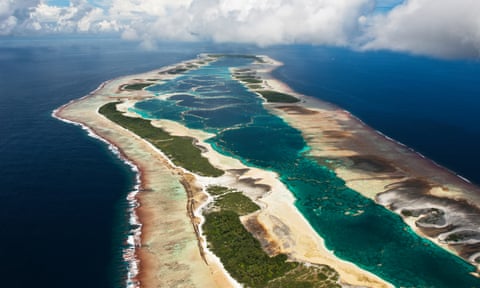
A long thin atoll around a lagoon

The Millennium Atoll in Kiribati, the Pacific state that is sponsoring Michael Lodge for re-election as ISA leader. Photograph: Mauricio Handler/Getty

Before we leave the subject of oceans, back to the question of how their protection is managed, and by whom.

We are learning today that some of the planet’s smaller nation states have a potentially significant, and clearly long overdue influence on how the oceans surrounding them will be protected:

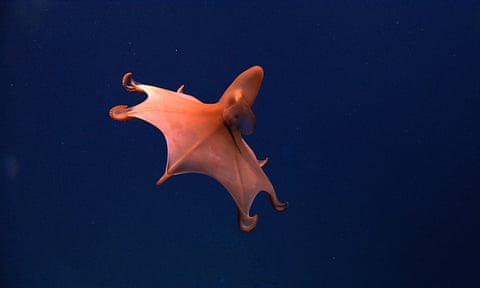
The rare dumbo octopus (Cirrothauma murrayi)

The rare dumbo octopus (Cirrothauma murrayi) is one of many creatures potentially at risk from deep-sea mining. Photograph: NOAA

Inside the battle for top job that will decide the future of deep-sea mining

Marking a pivotal moment for the fate of the barely known ecosystems on the ocean floor, 168 nations will decide this week who will head the International Seabed Authority

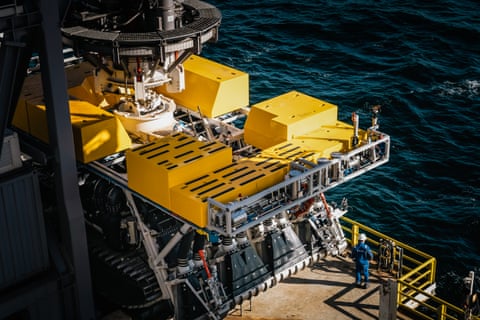
Deep-sea mining exploration machinery in the Pacific Ocean

Deep-sea mining exploration trials under way in the Clarion-Clipperton Zone of the Pacific Ocean between Hawaii and Mexico. Photograph: Richard Baron/The Metals Company

Leticia Carvalho is clear what the problem is with the body she hopes to be elected to run: “Trust is broken and leadership is missing.” Later this week, at the headquarters of the International Seabed Authority (ISA) in Kingston, Jamaica, nations negotiating rules governing deep-sea mining face a critical vote that could impact the nascent industry for years: who should be the next leader of the regulatory body? Continue reading

The Ocean’s Depths & You

An illustration of sea creatures floating in outer space. The planet Earth is in the center.

Isabel Seliger

While Brisa surfs in Tahiti, the fate of our oceans will be on our minds. While not self-evidently important to most of us, most of the time, their scale on our planet gets us to pay attention when someone makes the case. Porter Fox, who reports on climate change, has come to the following conclusions with regard to those waters:

There’s a New Reason to Save Life in the Deep Ocean

Honey Long and Prue Stent

To most of us, the ocean is a no man’s land — a vast, bottomless and uncharted void. Three-quarters of the ocean has never been seen by humans, and only a quarter of its floor has been mapped in detail, which means we have a better understanding of the surface of Mars than we do of the seas on our own planet. It is this lack of exploration and appreciation — particularly of the layer of cold, dark water that begins where light fades, known as the ocean’s twilight zone — that has led us to a very precarious place. Continue reading

Scottish Seaweed Innovations

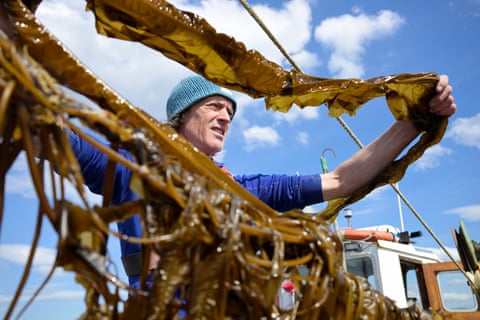
Alex Glasgow of KelpCrofters on a boat harvesting kelp on Skye

Alex Glasgow of KelpCrofters harvesting the seaweed on Skye

Most of us in the Americas and the European  region have not yet had the opportunity to try seaweed, except perhaps in Japanese or other Asian ethnic restaurants. So hearing what the folks who grow seaweed in Scotland are doing with their product to get more of us interested in it–that’s interesting. For these photographs by Christian Sinibaldi and words by Joanna Moorhead we thank the Guardian:

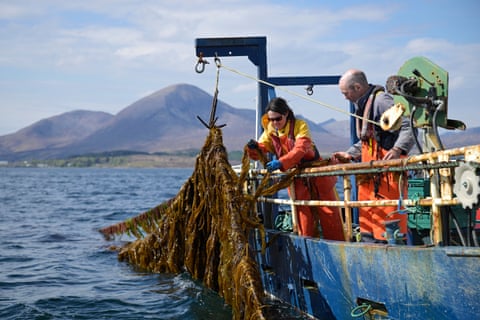
Kyla Orr and Martin Welch of KelpCrofters check the crop from their boat

Kyla Orr and Martin Welch of KelpCrofters check the crop from their boat. Photograph: Christian Sinibaldi/The Guardian

Kelp help? How Scotland’s seaweed growers are aiming to revolutionise what we buy

Farmed kelp could produce plastic substitutes, beauty products and food supplements. Just steer clear of seaweed chocolate

Think sun, sea, Skye – and seaweed. It’s early summer off the west coast of Scotland, and Alex Glasgow is landing a long string of orangey-black seaweed on to the barge of his water farm. Continue reading

Shrimp Transparency

Shrimp and transparent shrimp shells sitting on a white surface.We link to the work of Erik Vance for its clarity and utility:

Americans love their prawns. So how healthy are they — for us and for the planet?

Americans aren’t particularly enthusiastic about seafood. We eat less than half of what a Japanese or Indonesian person does. Less than a third of the average Icelander. But there is one big exception: shrimp. Continue reading

Ever Green & Restoration Of Abundance

We missed Ever Green when it was published last year, but it came to our attention through this essay by one of its co-authors in the current issue of The Atlantic. The essay is about a path to the restoration of hope:

Our Once-Abundant Earth

Protecting species from extinction is not nearly enough.

When Otis Parrish was a kid in the 1940s, abalone were abundant. Each abalone grows in a single, beautiful opalescent shell, which can get as big as a dinner plate. Parrish’s father showed him how to pry the abalone off the rocky shoreline at low tide with an oak stick or the end of a sharpened leaf spring. Continue reading

Paul Watson, Inspiring Parley In 2024

Visit the website of Parley to learn more. We knew Paul Watson‘s reach was far and wide, so no surprise that talent like this has followed his lead:

Everything starts with inspiration. In pirate lore, a parley is a conference or discussion, especially between opposing sides as a negotiation for terms of a truce. The root of the word parley is parler, French for “to speak” or “to talk.” Parley was founded to create a space where seemingly disparate parties can talk, think and act together to negotiate peace between humankind and the life-giving ecosystem that connects us all: the oceans.

Before growing a global network, we launched with a series of Parley Talks. Each session is a curated gathering with a dedicated topic. The talks are meant to give an overview of the state of the oceans, present a specific cause and garner support for a related initiative, and inspire actual change — be it at home, on a campus, in the workplace, across an industry or around the world.

Amphibious Soul, Reviewed

HarperOne

Thanks to National Public Radio’s Barbara King for this review:

The film My Octopus Teacher tells the story of a man who goes diving every day into the underwater South African kelp forest and forms a close relationship there with an octopus. That man — the diver, and also the filmmaker — was Craig Foster, who delighted millions of nature lovers around the world and took home the 2021 Academy Award for Best Documentary Feature. Continue reading

Hammerheads Back In The Caribbean

Scalloped hammerhead sharks are critically endangered. But the discovery of a schooling population in the Caribbean is giving local researchers hope. Blickwinkel/Alamy Stock Photo

Thanks to David Shiffman writing in Hakai Magazine:

In the Caribbean, Hammerhead Sharks Return to School

The detection of schooling behavior is a promising sign of recovery for this iconic and endangered animal.

Hammerhead sharks—fish with pronounced oblong heads and bodies as long as small cars—are unmistakable. Continue reading

Wind Farm Fishing

(Photo credit: Ionna22 / CC BY-SA 4.0 DEED)

Wind power has had reasonable detractors as well as those who resist for aesthetic reasons. Sometimes nimbyism gives way to pimbyism, and in this case it is people who fish that we can thank for the latter. Thanks to Yale Climate Connections for sharing this story:

Some anglers say Rhode Island’s Block Island wind farm has improved fishing

The bases of the turbines attract fish, survey respondents reported.

Off the coast of Rhode Island, anglers fish for striped bass, fluke, and mahi-mahi. Continue reading

South American Fishing Methods, And Choices

An open-net salmon farm on the Chilean side of the Beagle Channel. Photograph: Dani Casado

As we increase our awareness of the many choices we have when consuming fish (among other things), here is more food for thought:

Crabs, kelp and mussels: Argentina’s waters teem with life – could a fish farm ban do the same for Chile?

Puerto Almanza, on the Beagle Channel in Argentinian Tierra del Fuego, is one of the world’s most southerly settlements and best known for the local seafood, especially Patagonian king crabs.
Photograph: Visit Argentina

While the ecosystem is thriving off the coast of Argentina, the proliferation of salmon farms in Chile’s waters is threatening marine life, say critics

A rocky path, strewn with thick tree roots, leads from a dirt road down to a small green hut overlooking the choppy waters of the Beagle Channel, a strait between Chile and Argentina. The shack is home to Diane Mendez and her family but doubles as Alama Yagan, one of nine restaurants in the fishing village of Puerto Almanza. Continue reading

Orcas Reconsidered

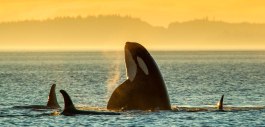
Although all the planet’s killer whales are currently considered a single species (Orcinus orca), some of the world’s leading experts are proposing to split them into three species. Photo by imagebroker.com/Alamy Stock Photo

Hakai is the go-to magazine for marine stories, and we hope to see more work of Craig Welch, the science journalist who wrote the article below, in the future:

Meet the Killer Whales You Thought You Knew

The iconic marine mammals may not belong to one species but several. Surprise!

Transient, or Bigg’s, killer whales, not only look, sound, and act differently than their resident killer whale neighbors, they might be an entirely different species. Danita Delimont Creative/Alamy Stock Photo

John Ford still recalls the first time he heard them. He’d been puttering around the Deserters Group archipelago, a smattering of spruce- and cedar-choked islands in Queen Charlotte Strait, between Vancouver Island and mainland British Columbia. He was piloting a small skiff and trailing a squad of six killer whales. Ford, then a graduate student, had been enamored with cetacean sounds since listening to belugas chirp while he worked part-time at the Vancouver Aquarium as a teenager. Now here he was, on August 12, 1980, tracking the underwater conversations of wild killer whales through a borrowed hydrophone. Continue reading

Whales, Big Brains & Codas

Shawn Heinrichs

Marine biologists are full of surprises, and those who study whales sometimes give the best surprises. Thanks to Ross Andersen and The Atlantic for this story:

HOW FIRST CONTACT WITH WHALE CIVILIZATION COULD UNFOLD

If we can learn to speak their language, what should we say?

One night last winter, over drinks in downtown Los Angeles, the biologist David Gruber told me that human beings might someday talk to sperm whales. In 2020, Gruber founded Project CETI with some of the world’s leading artificial-intelligence researchers, and they have so far raised $33 million for a high-tech effort to learn the whales’ language. Gruber said that they hope to record billions of the animals’ clicking sounds with floating hydrophones, and then to decipher the sounds’ meaning using neural networks. I was immediately intrigued. For years, I had been toiling away on a book about the search for cosmic civilizations with whom we might communicate. This one was right here on Earth. Continue reading

Anchovies Rock

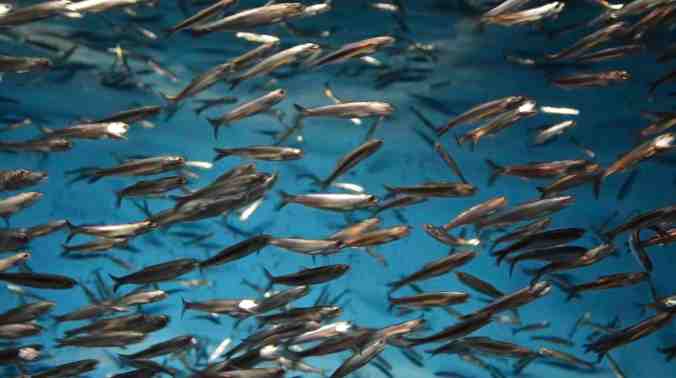
Kalichka / Getty

Anchovies are not exactly a staple in our pages, but they make their presence known. They are important. Thanks to The Atlantic, and their collaboration with Hakai Magazine for this article by Christina Couch that illustrates another remarkable feature of these small creatures:

The little fish’s mating rocks the ocean as much as a major storm.

Bieito Fernández Castro wasn’t expecting to find a turbulent hotbed of anchovy sex.

Commissioned by the Spanish government to investigate the conditions behind algae blooms, which kill mussels, Continue reading

Dominica’s Whale Sanctuary

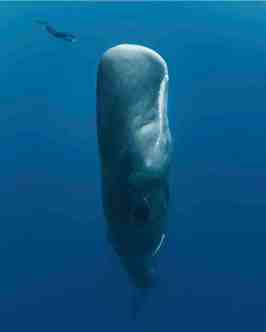
Fewer than 500 sperm whales are estimated to live in the waters surrounding Dominica. Photograph: By Wildestanimal/Getty Images

This island is already known for sperm whales. Protecting their habitat strengthens Dominica’s reputation as the conservation leader in the region:

Dominica creates world’s first marine protected area for sperm whales

Nearly 300 sq miles of water on west of Caribbean island to be designated as a reserve for endangered animals

The tiny Caribbean island of Dominica is creating the world’s first marine protected area for one of Earth’s largest animals: the endangered sperm whale. Continue reading

Big Turbines, Big Location, Big Wind Farm

Image via U.S. Bureau of Ocean Energy Management
A map shows the location of Dominion’s federal lease and where the company proposes to run associated infrastructure.

Thanks to National Public Radio (USA) station WHRO for this news.

It is a big deal:

Dominion can soon start building Virginia Beach offshore wind farm, feds say

Dominion Energy will soon have the green light to start building its long-awaited wind farm off the Virginia Beach coast.

Dominion Energy’s pilot turbines off Virginia Beach this summer. (Photo by Laura Philion)

The Biden administration announced Tuesday its approval of the $9.8 billion Coastal Virginia Offshore Wind project, which when constructed will be the largest in the country’s history.

Dominion can now start constructing infrastructure for the project on-shore, said spokesperson Jeremy Slayton. The company just needs the Bureau of Ocean Energy Management to OK its construction and operations plan for the offshore farm. Continue reading

Climate Change As Understood By Helen Czerski’s Macro Physics

Helen Czerski on a 2018 ocean research expedition to the North Pole. MARIO HOPPMANN

We non-scientists have learned much from the scientists who study climate change, and surprises keep coming, this one from physicist Helen Czerski:

The Pacific Ocean, as seen from space. NASA

The Planet’s Big Blue Machine: Why the Ocean Engine Matters

The ocean is an enormous engine, turning heat energy into motion, says physicist Helen Czerski. But human activity is threatening that machine — depriving the seas of oxygen, increasing stratification, and potentially changing the currents that influence global weather.

Photographs of Earth taken by astronauts in space more than half a century ago revealed a blue planet dominated by oceans and billowing with clouds. Continue reading

More Cameras On The High Seas, Please

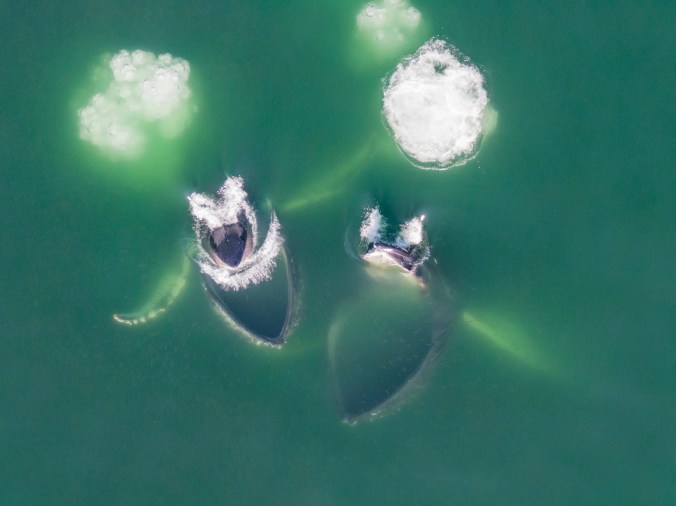
A pair of humpback whales synchronized the release of bubbles to corral and consume sand eels.

This article by Ellie Duke, with photographs and video by Sutton Lynch, is a sort of bookend to another recent article. It makes one wish for more people skilled with cameras in the oceans, and fewer skilled in placing nets:

A school of bluefish forming a circle in shallow water.

The photographer Sutton Lynch is documenting a dramatic turning point off the coast of Long Island — a resurgence of sea life after decades of depletion.

Sutton Lynch rises most days before the sun, arriving at Atlantic Beach in Amagansett, N.Y., for the early-morning calm. It’s the same beach he’s been going to since he was a child, and where he worked as a lifeguard for years as a teenager. Now 23, he spends his mornings surveying the horizon. When he spots activity on the water’s surface, he sends out his drone. Continue reading
Proposed Chumash Sanctuary One Step Closer

Thanks to National Public Radio (USA) for bringing this to our attention:

Members of the Chumash tribe have pushed for a decade to create a new marine sanctuary. If created, it would be the first to be designated with tribal involvement from the outset. Robert Schwemmer/NOAA

Biden proposes vast new marine sanctuary in partnership with California tribe

The Biden administration is one step away from designating the first national marine sanctuary nominated by a tribe. The Chumash Heritage National Marine Sanctuary would protect 5,600 square miles of ocean off the central California coast, an area known for its kelp forests, sea otters and migratory whales. Tribal members of the Chumash, who have lobbied for its creation for more than a decade, would be involved in managing it…

The First Tribally Nominated Sanctuary

Preserving marine and cultural resources along 156 miles of Central California Coastline

Estimated to generate $23 million in economic activity and create 600 new jobs

Will safeguard the Central Coast from offshore oil expansion and other threats


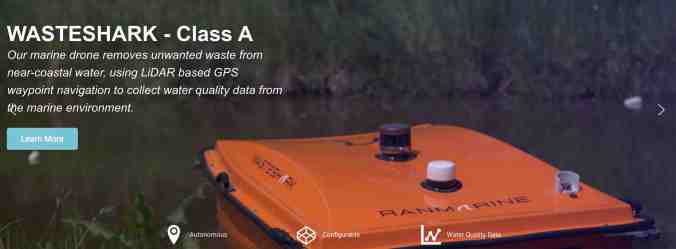
WasteShark

Our thanks to Robert Sullivan for this attention-getting article on a new device:

A Trash-Eating Sea Monster Appears in the Hudson!

A team of scientists and environmentalists tests out the WasteShark, an unmanned watercraft that vacuums up soda cans and potato-chip bags.

WasteShark is not a shark. It is an unmanned watercraft that its creators named for a shark, owing to similarities between how WasteShark collects its prey and the feeding habits of the Rhincodon typus, or whale shark. Continue reading