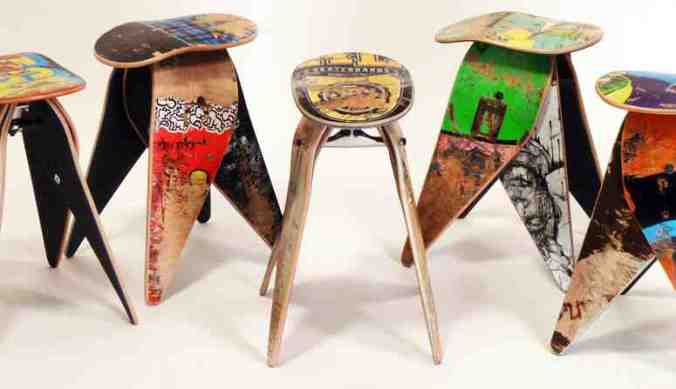
Another in our series of links to fresh ideas and innovative recycling social enterprises:
Broken skateboards are an unfortunate side effect of skateboarding Continue reading
Another in our series of links to fresh ideas and innovative recycling social enterprises:
Broken skateboards are an unfortunate side effect of skateboarding Continue reading
Brazilian artist Vik Muniz has been on our radar for quite some time. Partially because his work redefines the concepts of waste and the proper “mediums” in art, but mostly because his work is just plain fun. While some previous series have used medium as bizarre as dust, granulated sugar or melted chocolate, the prints exhibited at the 2013 New York Armory Show were created with the metal waste of the modern world.
Muniz is not only a master at recycling but at keeping his viewer completely off balance with his sense of scale. His 3 dimensional collages, whether made of scrap metal like the ones in the slideshow above, or with more “generalized garbage” as in the pieces depicted in the documentary The Waste Land, are orchestrated piece by piece from a 20 meter vantage point. For example, at first glance the hummingbird image looks as shimmeringly delicate as a Hupert Duprat/caddisworm collaboration, but wait! Are those paint cans, bed springs and automobile tire hubs I see? Continue reading

Arsenale installation from the 2007 Venice Biennale
During a recent visit to the Nelson-Atkins Museum of Art in Kansas City I was struck by a 3-dimensional piece that combines the opulence of a Gustav Klimt painting and the earthy elegance of Ghanian Kente cloth. The comparison isn’t as bizarre as it might appear when it’s understood that its creator is the Ghanian artist El Anatsui. Over a decade ago the sculptor found a bag of thousands of colorful aluminum screw tops discarded by a local distillery. The artist began by cutting and folding the bottle tops into flat pieces then used copper wire to stitch them together, creating patterns inspired by his country’s iconic cloth. Continue reading
From the collaborative film Waste Land about the catadores (trash pickers) of Jardim Gramacho to the new documentary Trashed, there are film makers and organizations talking about the growing and overpowering problem of waste. Waste Land talks about the transformation of trash into art. The documentary film Landfill Harmonic is about “people transforming trash into music; about love, courage and creativity.”
With the ethos of reuse and recycle there are those who grab the creative spirit along with our attention with programs like the Paraguayan Sonidos de la Tierra (Saving Children Through Music) and Favio Chávez, director of the orchestra of recycled instruments on the Catuera Landfill on the banks of the Paraguay River. Continue reading
“In African mythology the elephant reincarnates carrying the soul of a murdered God. It is thus the embodiment of the transmigration of souls. It is also the metaphor for the world’s preoccupation with Africa as an exotic location. The elephant thus embodies the world’s romanticism with Africa…” Andries Botha
South African artist Andries Botha has been paying homage to the strength, majesty and perseverance of elephants throughout his career. Blending Western and African elements he has created numerous life size pieces, both as individuals and in groups, that portray a sense of mysticism in their unexpected settings. Continue reading

For over a year now we’ve been writing about newspaper bags along with the people and organizations who work with them. We’ve also written about how newspapers are used in other forms of recycling. I have recently come upon an additional “closed loop” use for this ubiquitous material.
Dutch designer Mieke Meijer in collaboration with design label Vij5 has created a product called NewspaperWood. The material has the potential to put a portion of newspaper discarded daily into an up-cycle system bringing paper closer to the wood from which it’s made.
Given these acute demands for water and constraints on current — and likely future — availability, Grant said, “the real alternative, the really only alternative, is to improve what’s called water productivity, which is essentially the amount of value services that are achieved with a given unit of water.”
Click the headline for this accessible explanation of a very complicated challenge.
I’ve written about numerous artists who have just the right “tinker’s eye” to see the aesthetic potential in what many would call trash. But as far as I know, Chicago based artist and educator Nick Cave (not to be confused with the deep voiced musician of the same name) is the only one to take the next step to turn sculpture into a kinetic, interactive celebration. Continue reading

Ingenuity can go a long way in meeting people’s essential needs with the simplest of materials.
The recipe: Start with students from the Massachusetts Institute of Technology (MIT), add basic materials destined for dumps and landfills around the world, mix with filtered water and bleach, install, expose to sunlight. And voilà!–a light that will last for 10 years!
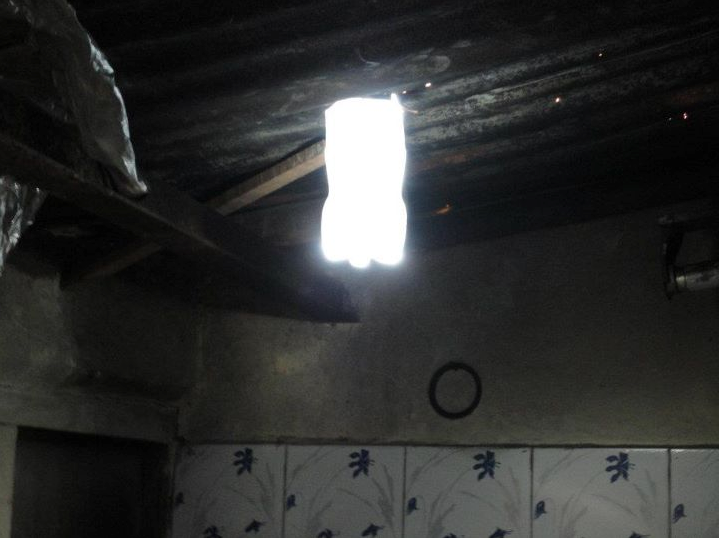
The Solar Bottle Bulb is based on the principles of Appropriate Technologies – a concept that provides simple and easily replicable technologies that address basic needs in developing communities.
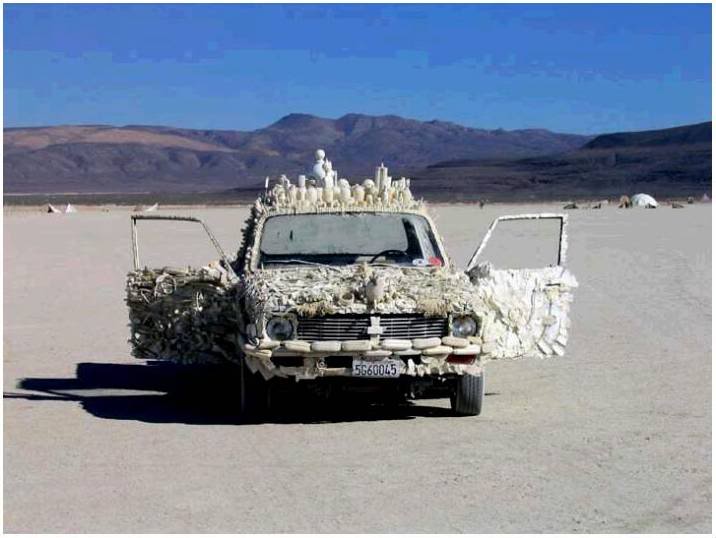 For over a decade Judith Selby Lang and Richard Lang have been scouring their stretch of Kehoe Beach along Northern California’s Point Reyes National Seashore. Far from the classic beach comber either in search of drift wood or with metal detector in hand, the eyes of this artist couple are caught by the most pedestrian of materials: plastic.
Continue reading
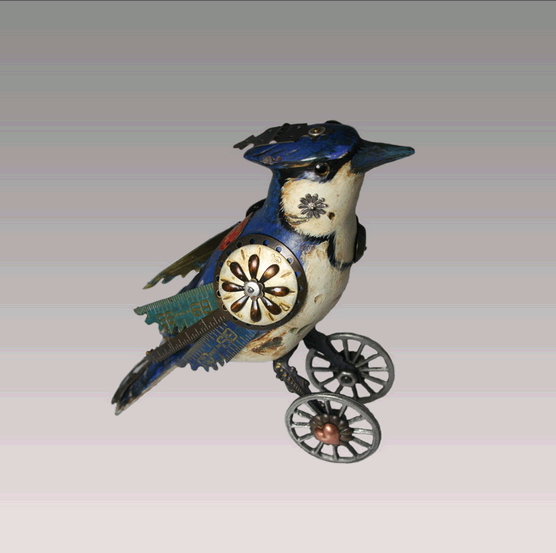
Blue Jay on Wheels by Mullanium
Sometimes I wonder whether the attraction to birds is universal. Based on bird watcher statistics I would lean toward a “yes”. Is it the colorful plumage that so attracts us? The cheery tweets and chatters? The flamboyant beaks, wattles, crests and tails? Or is it just that anthropomorphically curious tilt of the head? Continue reading
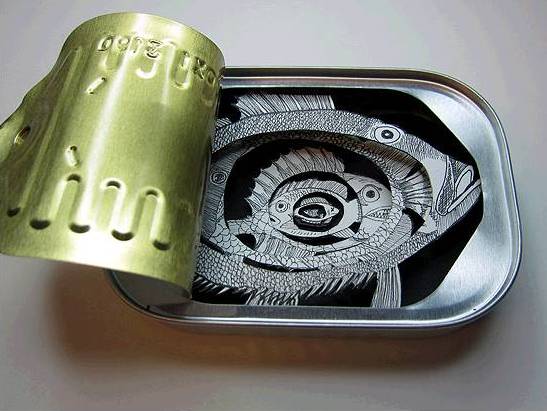 Like a Fish Needs a Bicycle, Jim Doran
When I recently came across the artist/web designer Jim Doran’s work my mind began to swim with connections. In a world where resources, whether our land or our seas, are becoming more and more precious, the more we need to give free rein to our imaginations. In other words, rarely are solutions found within the status quo. Continue reading
Today I saw something very odd: dozens of ladybugs crawling along the top of a recycling bin. Some were the dark red that we normally associate with ladybugs, while others were a pale orange verging on yellow. Strange looking half-formed ladybugs, seemingly crouched in tight balls, adhered themselves along the surface as well. In the midst of it all swarmed long, fat black bugs with orange spotting along their backs. What was going on here? And what was this panoply of ladybug life occurring on a recycling bin in the middle of a college campus?

Two ladybug pupae
When I afterwards looked up ladybugs, I found that I had actually witnessed something pretty cool: the full life cycle of Coccinellidae, known as the ‘ladybug’ in America but the ‘ladybird’ elsewhere in the world. It’s also known as ‘God’s cow,’ the ‘ladyclock,’ or the ‘lady fly.’ There are over five thousand species worldwide, but the name ‘ladybug’ is perhaps most readily synonymous with the image of a small, round red bug with black spots.
The ladybug, as I had seen, has four distinct phases in its life cycle. The life of the ladybug begins in an egg; small clutches hatch after three or four days at which point the larval form of the bug emerges. It may molt three to four times over a period of about twelve days before pupation (i.e., the beetle creates a pupa). Continue reading
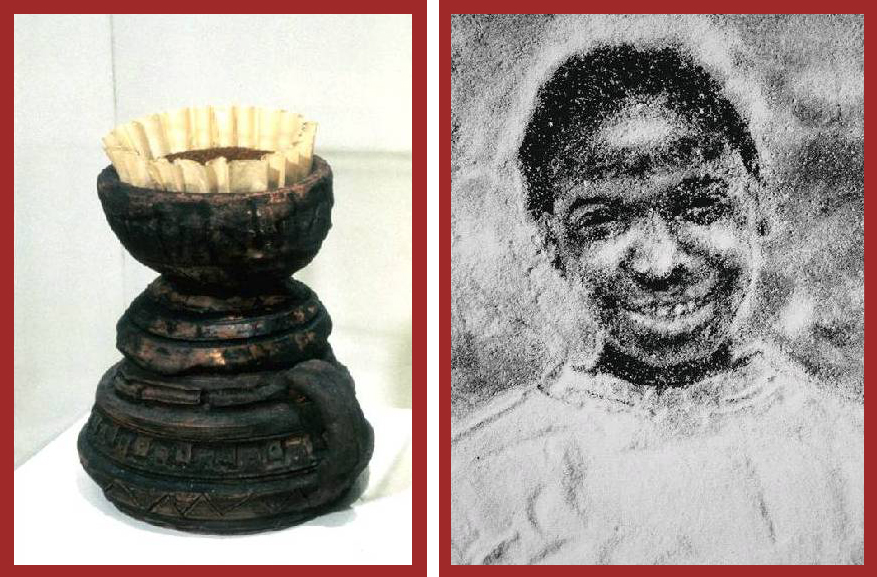
When I posted about the artist Vik Muniz a few days ago I wrote primarily about his collaborative film with director Lucy Walker. I feel I didn’t do justice to the general wit of his work. Like fellow artists Chris Jordan and Mary Ellen Croteau, Muniz is an ultimate recycler, but his “puckish” personality informs his work, both through his choice of medium (sugar to create shimmering portraits of the children of cane workers on St. Kitts) or visual jokes (Pre-Columbian drip coffee maker). Continue reading
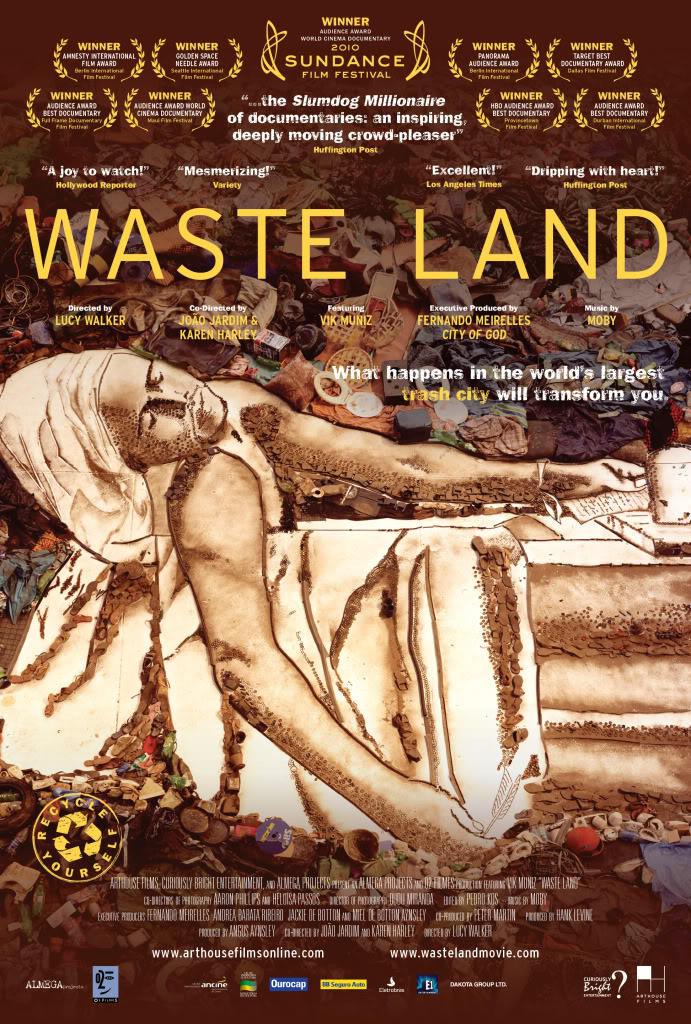
The beautiful thing about garbage is that it’s negative; it’s something that you don’t use anymore; it’s what you don’t want to see. So, if you are a visual artist, it becomes a very interesting material to work with because it’s the most nonvisual of materials. You are working with something that you usually try to hide. –Vik Muniz
Brazilian artist Vik Muniz is known for his visual wit using either the world’s detritus or the generally unexpected as the medium for his portraits and landscapes. Each piece, formed by ink drops, chocolate drips, dust motes, thread swirls or garbage itself, is temporary by nature, achieving permanence via a camera’s lens. Continue reading
Two months ago I wrote about British restaurateur Arthur Potts Dawson and his closed loop restaurant concepts and social enterprise food cooperatives here. When I came across the Greenhouse I found the perfect follow up. One would not be amiss to call the Australia based designer/builder/environmentalist Joost Bakker “green-blooded”. His Dutch flower growing heritage helped forge a lifelong passion with growing things and plant inspired structures, such as greenhouses and conservatories. His greenery walls invoke the power of nature creeping back into urban environments, making them simultaneously comforting and edgy. Continue reading
Milo has commented on the next generation of wind harvesting in an earlier post, but the use of technology is only bound by the limits of inventiveness and imagination. Even in resource poor parts of the world opportunities are available to dreamers who see the possibilities in what has been discarded.
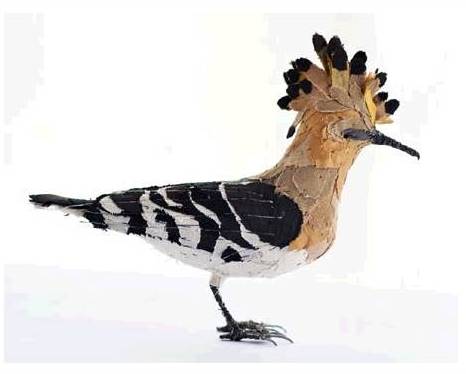 Hoopoo by Textile Artist Abigail Brown
Question: What would a Natural History Museum look like in Wonderland?
Answer: Abigail Brown’s studio.
The Victorians were avid collectors, and there’s something deliciously Victorian about the detail and precision with which textile artist Abigail Brown practices her craft, bringing the winged world to life with bits and pieces of cloth that each carries their own history. Continue reading

Chris Jordan, Caps Seurat, 2011
Seattle based photographer Chris Jordan has been making visual statements about mass consumption for over ten years. Using the “artist’s eye” to be able to step back from the overwhelming truths of societies’ excesses, he simultaneously breaks down that mass consumption into its smallest part and its incomprehensible whole.
Jordan uses commodities that are discarded daily–plastic and paper cups, newspapers, electronics–as the “brushstrokes” to illustrate the wastefulness in cultures of consumerism. His photographs place both conscious and unconscious behaviors under a microscope, which is often unsettling, and always thought provoking. Continue reading
Guest Author: Diwia Thomas
While asking around for newspaper donations, I often meet with reluctance and wondered why? Ten years ago a kilo of old newspaper fetched only a meagre Rs 3/- , today the raddi-wala (the guy down the road who buys scrap) pays an enticing and irresistible Rs 7/- per kg. I promptly made a trip down there to broker a deal with him for a steady supply of newspaper for our paper bags. He tells me that newsprint companies in India have begun to recycle old newspaper into newsprint. In the past newspaper was recycled into boards or brown coloured paper for packaging and boxes because recycled newsprint turns a dull greyish colour unsuitable for printing. Indian newspaper companies have found ways to deink newsprint pulp and retain its brightness for printing purposes. Mammoth deinking machines do this job. Featured here is a small one, just to demonstrate the process. Continue reading

 Organikos