Don’t Blink

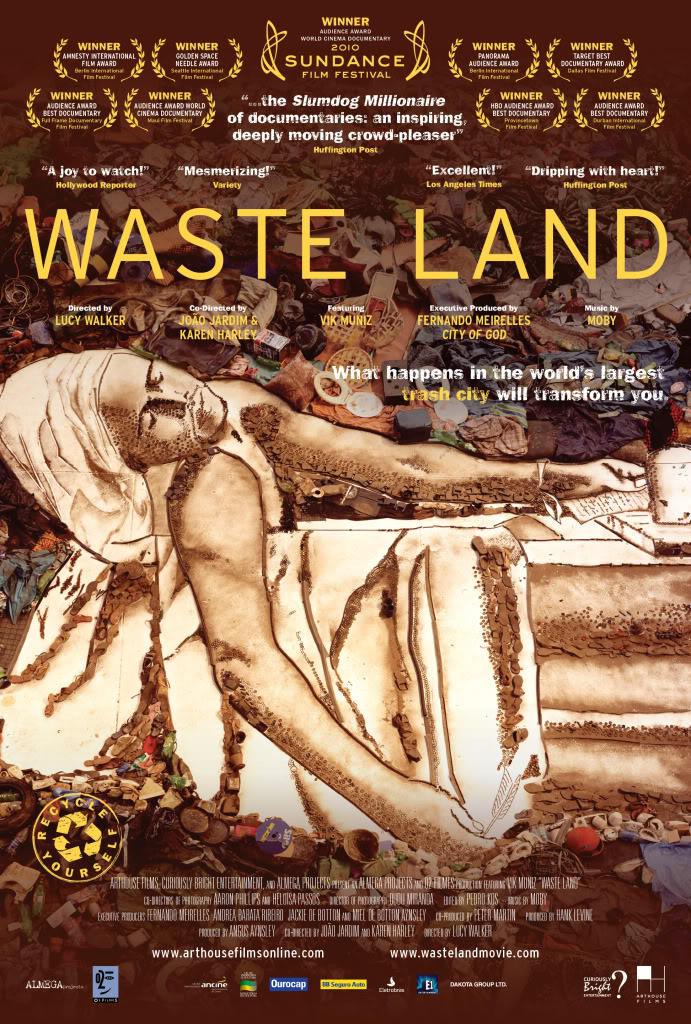
The beautiful thing about garbage is that it’s negative; it’s something that you don’t use anymore; it’s what you don’t want to see. So, if you are a visual artist, it becomes a very interesting material to work with because it’s the most nonvisual of materials.  You are working with something that you usually try to hide. –Vik Muniz

Brazilian artist Vik Muniz is known for his visual wit using either the world’s detritus or the generally unexpected as the medium for his portraits and landscapes.  Each piece, formed by ink drops, chocolate drips, dust motes, thread swirls or garbage itself, is temporary by nature, achieving permanence via a camera’s lens. Continue reading
Glassy Eyed

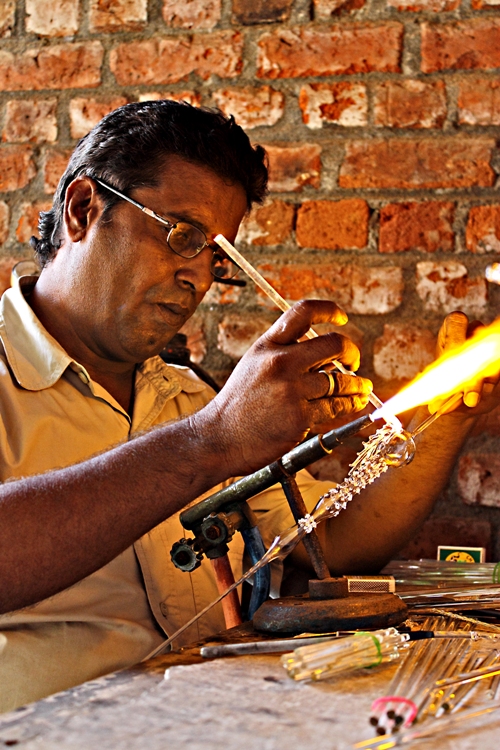
While in Chennai about a week ago, I visited a cultural center, somewhat like a living museum, about an hour outside the city. Dakshinchitra, the name of the display, means “picture of the South” – and it lives up to its name. In addition to being a window to the past, the center, supported by an NPO, supports local artists who set up small stalls on the premises, selling their crafts directly to the buyer, eliminating dealers and price-cranking middlemen. One such artist is Mr. V. Srinivasa Raghavan – a glass blower born and bred in Tamil Nadu.

While I at first felt that the blowtorch-wielding artist was out of place in the century-old surroundings of the compound, I was soon thinking back to my historical education, remembering that glass was being manipulated as far back as the Roman Empire. The means in this case justifies the ends – perhaps the trade’s Continue reading

Littler & Bigger Pictures

That bumper sticker activated my reflective reflex.  36 hours later I was going back, trying to find an article I had read (but when?) that quite artfully illuminated “things” for me.  Things related to that bumper sticker and the recent visit to New York City.  I found the article, re-read it, and recommend it.

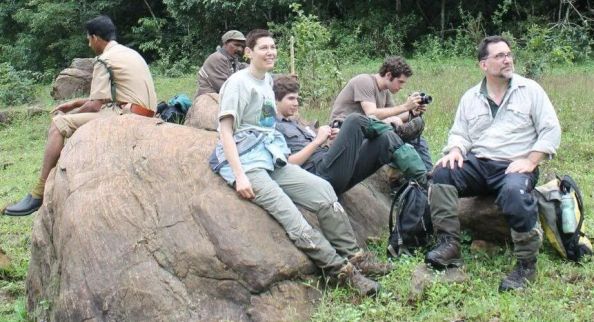
At the same time I had photos and correspondence with Tal (he is the one looking at his camera in the photo below that Milo took) in the mix.  That all seemed related too (but how?).

TalMilo

Continue reading

Howling, Manuel Antonio

Have you ever heard a Howler Monkey make noise? If not, imagine the noise coming from an animal that is (sonically) a mix between a cow and a lion–mostly lethargic, but fierce when it wants–that is about to die and screams out all the pain and agony. To me that’s how it sounds. Continue reading

What The Night Reveals

In my previous post, I talked briefly about the beauty of contrast between stationary backdrops and objects in motion, waterfalls being my focal point. Still without a tripod (an almost essential piece of equipment for this kind of photography), I have been putting myself and many props in uncomfortable positions to steady my camera as I aimed for enlightenment.

Continue reading

“Lord God Birds”

Left: Ivory Billed Woodpecker by John James Audubon;

Right: Imperial Woodpecker by John Livzey Ridgway

In the world of ornithology and bird watching, scale is as important as plentiful plumage, vivid color or song style.  From Cuba’s Mellisuga helenae (bee hummingbird) to the Andean Condor, life lists are often based on superlatives.  The Campephilus (woodpecker) family has its own followers, especially the larger species that have eluded scientists and amateurs alike for decades.

While in Chaihuín, part of the Nature Conservancy’s Valdivian Coastal Reserve in Chilean Patagonia, we saw the Magellanic Woodpecker, a sighting that preceded a “Stop the Jeep!” moment of excitement.  Part of that excitement was based on the memory of a Cornell Lab of Ornithology film we’d recently seen about the Ivory Billed Woodpecker. Continue reading

Revisiting The Tiger Trail

When I send emails to friends, colleagues, and others about this website, and the objectives of Raxa Collective, I normally add links to a few posts that I think are representative.
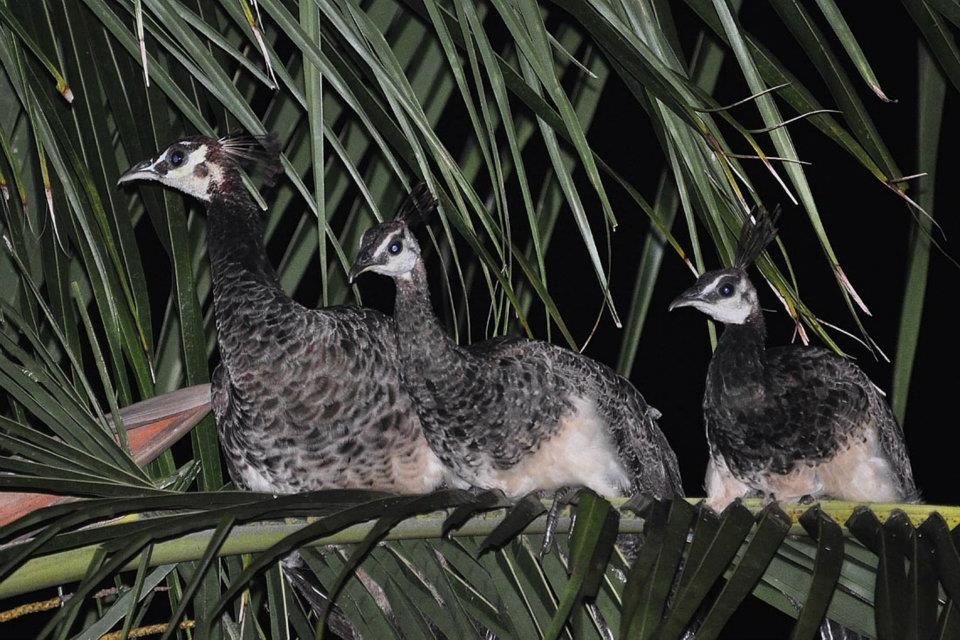
Almost always, this one is included.  Michael captured the moment well.

As we continue adding contributors to this site, and the diversity of topics and locations we pay attention to expands, for some reason I still come back to the Tiger Trail as a favored topic because it is such a good example of what we care about.

That tendency to return, at least in thought, led me to reconnect with a “lost” member of our Tiger Trail entourage. Continue reading

Stretching Venues

This slideshow requires JavaScript.

I have posted images and passing thoughts about my recent work travels to venues that represent my day to day work, but nothing until now about visiting with another contributor to this site, in New York City, on a beautiful autumn long weekend.  That visit had its work component too, but I took away an image of creative energy that was not particularly work-related, nor (I thought until now) related to the core themes of this site, so I neglected to share these images before. Continue reading

Urbanature

Yes, spotting wild elephants on a mountainside is exciting. Agreed, a field full of flowers that blooms once every dozen years is a heart-warming sight. But not everyone who loves and appreciates nature has the time or money to travel to places where such phenomena can be experienced. Many people who live in cities – myself included – complain about not being able to connect with nature the way they would if they weren’t urbanites. However, I recently had an eye-opening (or re-eye-opening, rather) experience in Chennai, a city proportionally larger and less vegetated than Cochin, where I live, which showed me that nature is never far away.  Continue reading

Sometimes Comment Is King

Raxa Collective does not have any in-house physicists but we are determined to keep up with the Joneses on matters of interest like footprints.  We think about footprint in as many ways as possible in addition to our preferred venue, travel. In recent years that includes thinking about the footprint of the tool we take for granted as essential to our work: the internet.  Continue reading

All the World’s a Stage

In a recent post Matthias Jost shared his impressions of San Jose, Costa Rica and its Teatro Nacional.  But what he didn’t share was the fascinating history that surrounds this piece of National Patrimony.

Part apocryphal and part historical, the tale goes that in the late nineteenth century an important European Opera Troupe was touring Central and South America, but they refused to stop in the “back water” of Costa Rica, as it had no proper venue for them to perform in. Continue reading

Mad Dogs

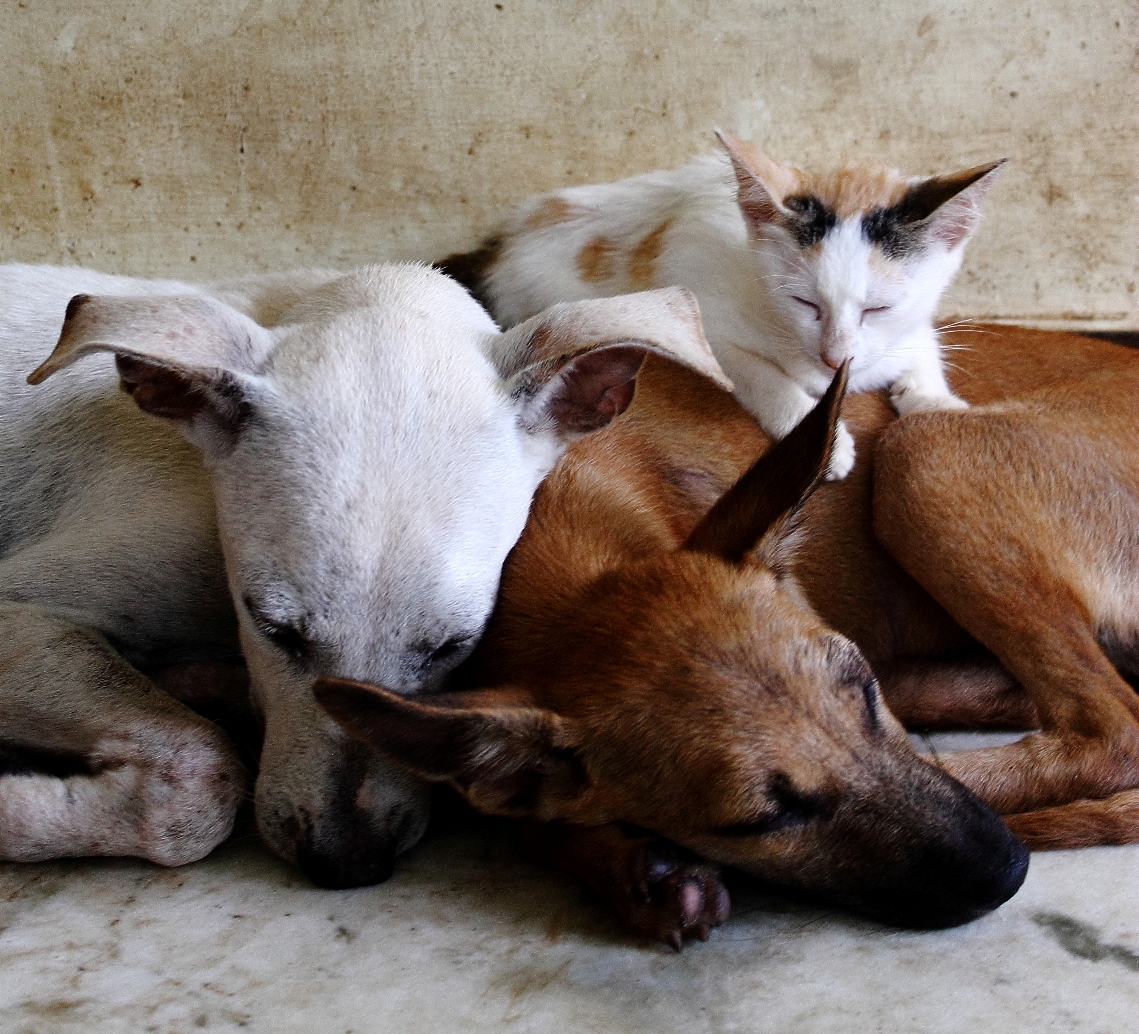
Street life for animals anywhere is hard, but in India it is exceptionally so. The infamous modus operandi of Indian motorists is based in fact, and stray animals on the road frequently bear the consequences of too many cars and people in too little space. Animal cruelty is not unheard of anywhere in the world – even the most modern of American cities have incidences; India is much less well-organized in terms of prevention and consequences. Despite the sprawling bureaucracy of Kerala’s government, there is no sole agency dedicated to the safety and well-being of urban animals. As such, the responsibility falls to warm-hearted citizens, either by adopting stray animals or taking them to a shelter. Continue reading

Opening Doors

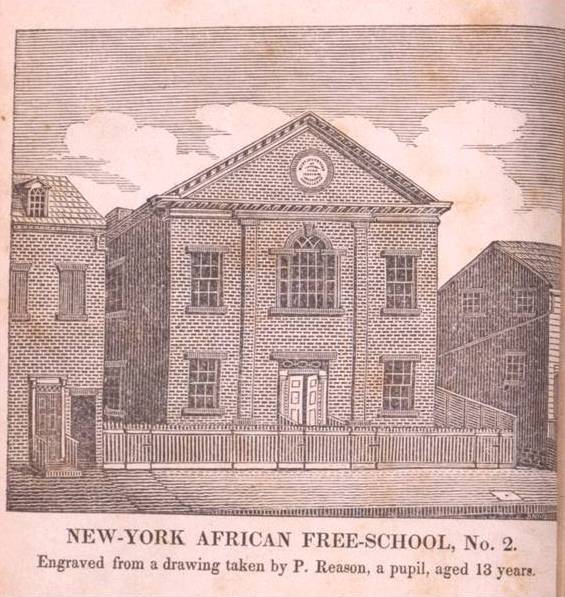
Source: Schomburg Center for Research in Black Culture / Manuscripts, Archives and Rare Books Division/ The New York Public Library, via Columbia University

The New York African Free School was established November 2, 1787, seventy-eight years before slavery was officially abolished by the 13th Amendment of the U.S. Constitution. Despite the fact that slavery was considered “crucial to the prosperity and expansion of New York”, groups such as the New York Manumission Society were established that advocated for African Americans and abolition.

Certainly ahead of its time, the school was co-educational, teaching reading, writing, arithmetic, and geography equally to children of both slaves and free men. Vocational skills were taught as well; the boys were offered astronomy and cartography, skills needed by seamen, and the girls learned sewing and knitting. Continue reading

What the Trees Read

Without question, the section of Cayuga Lake’s Inlet that receives the most traffic is a small area of shoreline at the corner of the second tendril extending east from the Inlet into Ithaca. Community members and college students are attracted to this little spot on the Inlet, known as Steamboat Landing, because the Ithaca Farmer’s Market spends its weekends there, sheltered under a long wooden pavilion topped by a green metal roof. Dozens of stalls are laden with earthly, culinary, and artistic crafts; more than a couple hundred people a day visit each of them to browse and purchase these locally produced goods.

This quaint market is surrounded by a mixture of modern development and natural shoreline that I could not have noticed from the Inlet’s waters—only by walking around Steamboat Landing was I able to understand the spot’s significance to the Ithaca community, and connect elements of Henry David Thoreau’s and Aldo Leopold’s writings with the history of the place. Continue reading

Progress Back And Forth

We have noted before the intriguing coincidences that link the “old world” to the “new world”–not least the desire to establish trade with what is now Kerala and the accidental discovery of somewhere else; and other links in both directions.  “Old” and “new” become fuzzy qualifiers when considering “modern” European travelers of the 15th century sailing to “ancient” India and instead encountering people we now call Pre-Columbians.  Seth has posted on the environmental impacts of people from that so-called old world as they settled in the new world and brought their definitions of progress with them.  Now, thanks to an article in Smithsonian Magazine our attention is brought to a book and a man who broaden our horizons back to the old world from which those people came. Continue reading