Chile Has New Hands On Deck

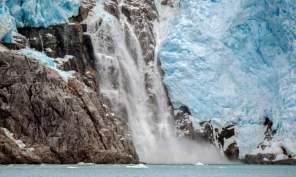
The receding Santa Ines glacier in Seno Ballena fjord in Punta Arenas, southern Chile. Photograph: Martin Bernetti/AFP/Getty

Bringing experts into government does not sound like a news story, until you consider Chile. A country governed for decades by Chicago school economics–a strong invisible hand of market forces combined with a strong visible hand of military rule to keep leftists at bay–Chile’s most recent election led to some new hands in the governance picture.

With the climate crisis, Chile has an opportunity to set a new example for the world. The failure of markets until now to address a human-induced environmental catastrophe will be met with the combined force of expert scientific knowledge and public sector governance:

‘We need politicians and experts’: how Chile is putting the climate crisis first

President Gabriel Boric has brought renowned named climate scientist Maisa Rojas into government to help ensure a greener future

‘We need politicians and experts’: how Chile is putting the climate crisis first
President Gabriel Boric has brought renowned named climate scientist Maisa Rojas into government to help ensure a greener future

Hidden behind the Andes in a quiet corner of South America, a formidable generation of former student leaders are putting together one of the world’s most exciting progressive movements.

On 11 March, Gabriel Boric, 35, a tattooed leftist with a steely resolve to reform Chile from the bottom up, will become the country’s youngest ever president – and his green agenda is echoing across the world as time ticks away on an impending climate catastrophe.

“It is so exciting to see what these young people have done,” says Maisa Rojas, 49, a renowned Chilean climate scientist who has been named environment minister in a cabinet including several of Boric’s student protest generation. Continue reading
Senegal’s Plastic Recycling Entrepreneurship

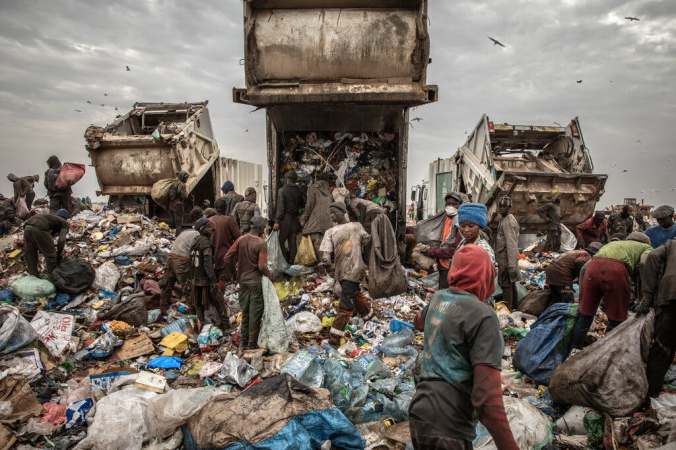
Waste pickers searching for plastics at the main dump in Dakar, Senegal.

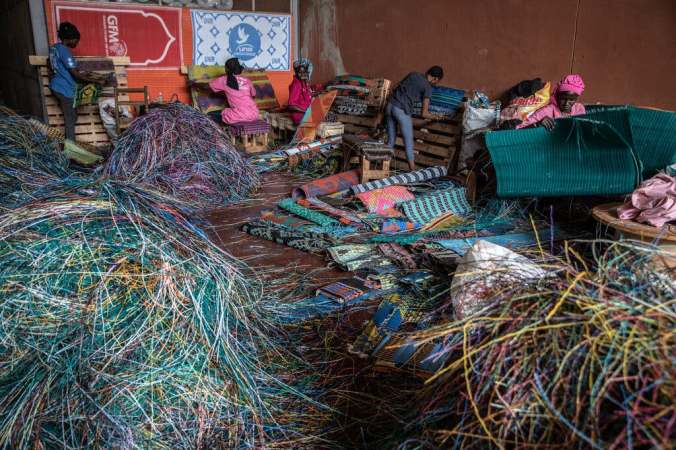
The article below, written by Ruth Maclean and accompanied with photographs by Finbarr O’Reilly, is a portrait in developing world green opportunism. It is not a pretty picture, per se, but it is a sight to behold after the market for recycled plastic seemed to implode in recent years. The photo above shows the gritty reality of the work. The photos below show some of the prettier, and more entrepreneurial downstream opportunities from that work:

Workers stripping reusable plastic from mats at the Sosenap factory, which recycles plastic to make mats and carpets in Diamniadio, on the outskirts of Dakar.

‘Everyone’s Looking for Plastic.’ As Waste Rises, So Does Recycling.

Plagued by plastic pollution, Senegal wants to replace pickers at the garbage dump with a formal recycling system that takes advantage of the new market for plastics.

The main event at the outdoor venue for Dakar Fashion Week in December, which had a theme of sustainability.

DAKAR, Senegal — A crowd of people holding curved metal spikes jumped on trash spilling out of a dump truck in Senegal’s biggest landfill, hacking at the garbage to find valuable plastic. Continue reading

Agave, Night, Nectar

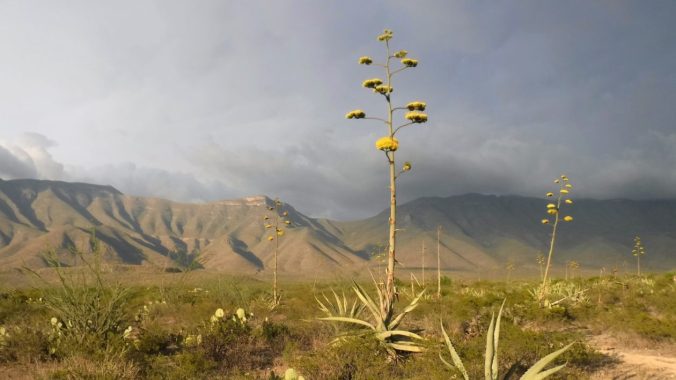
Video (click image above): Mexican long-nosed bats drinking nectar from agave flowers at night. Credit: Bat Conservation International

Bats, agave, and half a minute of night-time feeding are in the video above, which is also embedded in this article by Janet Marinelli, published in Yale e360:

How Preserving Agave Could Help Save an Endangered Bat

Drought linked to climate change, along with overgrazing, is destroying the agave plants on which the Mexican long-nosed bat depends. Now, an initiative is trying to restore the balance between the agaves, the bats that feed on them, and the people who live on these lands.

Agaves blooming in Estanque de Norias, Mexico. KRISTEN LEAR / BAT CONSERVATION INTERNATIONAL

At the southeast tip of a large valley in the northern Sierra Madre Oriental is the small Mexican town of Estanque de Norias, some 200 miles west of the Texas border at Laredo.

Continue reading

Volunteering For Town-Saving

The Ascutney ski resort once boasted 1,800 vertical feet of skiing on over 50 trails. When it closed for the last time in 2010, it was a crushing blow to the town of West Windsor. Caleb Kenna for The New York Times

Volunteers inspire more volunteerism, so here is another story about a community volunteering to save its own future, thanks to David Goodman and the New York Times for A Town That Saved a Mountain, and a Mountain That Saved a Town:

At the heart of the mountain’s revival is Ascutney Outdoors, a nonprofit with over 100 volunteers that now runs recreation on the mountain. Caleb Kenna for The New York Times

After the Ascutney ski resort in Vermont closed because of erratic snowfall and mismanagement, it threatened to take with it the nearby town of West Windsor. The community took the situation into its own hands.

Jim Lyall briskly skied up Mount Ascutney, eagerly pointing out the view. We were skinning up a ski area in southern Vermont, but the chairlifts are long gone. At the top of the mountain we arrived at an abandoned ski patrol cabin and lift station. A cold breeze whipped through the deserted structures. It had a ghostly, post-apocalyptic feel. Continue reading

Big Agriculture, Anti-Regulation & Antisocial Behavior

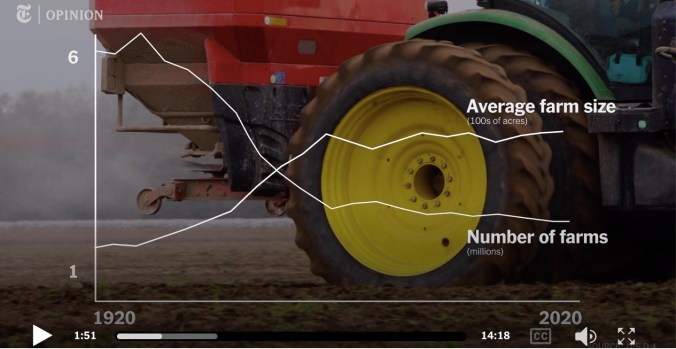
Click any image here to go to an op-ed video that takes just over 14 minutes to watch. You’ll get an inside look into what has happened to food production in the USA, and how, and why.

Summed up, it is all about the power of big-ag lobbying. They want no regulations. They want to decide on their own how to produce food. And it is making a big mess. This anti-regulatory ideology, which has the hallmark of antisocial behavior, is not unique to agricultural lobbyists, but is quite well illustrated by them.

Meet the People Getting Paid to Kill Our Planet

American agriculture is ravaging the air, soil and water. But a powerful lobby has cleverly concealed its damage.

“We’re Cooked” is an Opinion Video series about our broken food system and the three chances you get to help fix it — and save the planet — every day.


The global food system is a wonder of technological and logistical brilliance. It feeds more people than ever, supplying a greater variety of food more cheaply and faster than ever.

It is also causing irreparable harm to the planet. Continue reading

Aesop’s Animals Reviewed In Undark Magazine

An illustration from “Aesop’s Animals” by Hana Ayoob.

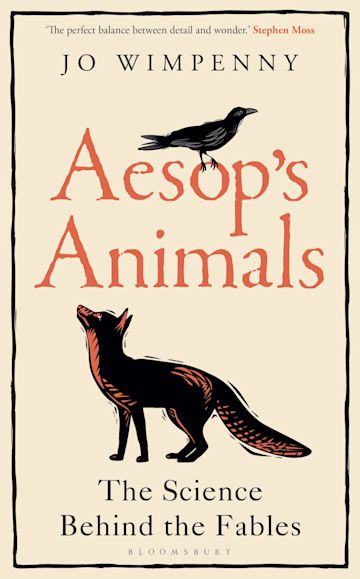
The fables attributed to Aesop were mentioned twice in posts in our pages during our first year. Again the following year. And plenty of times since then. But there is plenty more to say about the menagerie, and a new book takes on that task. Dan Falk offers this Book Review: The Science Behind Aesop’s Menagerie in Undark Magazine (click the image above or the title below to read the entire review at the source):

Aesop’s Animals coverIn “Aesop’s Animals,” zoologist Jo Wimpenny provides a guided tour of animal behavior drawn from the classic fables.

SEVERAL CHAPTERS into “Aesop’s Animals: The Science Behind the Fables,” zoologist and science writer Jo Wimpenny explains that, as a very young girl, she sometimes wanted to be a dog. (In a footnote she credits growing up in Wales for encouraging her “to think outside the box.”) This childhood fantasy, as the reader can readily imagine, involved crawling along the ground on all fours. But that only gets one part-way toward doghood, as the grown-up Wimpenny would come to realize. Continue reading

Palm Oil Potential

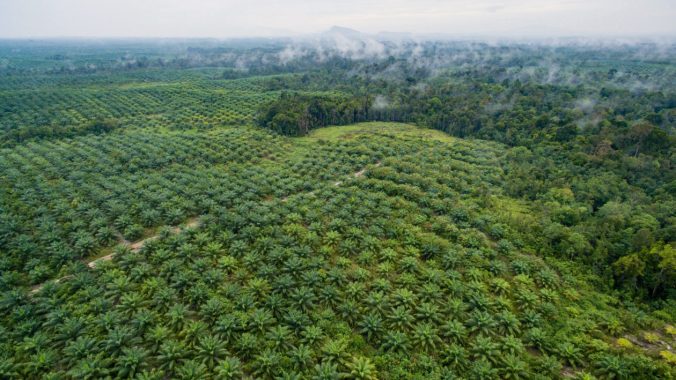
An oil palm plantation encroaches on a rainforest in West Kalimantan, Indonesia. NANANG SUJANA / CIFOR

Palm oil’s problems, and potential solutions have been catalogued in these pages many times. In this recent story by James Dinneen, writing again for Yale Environment 360, a new potential solution is explored:

Can Synthetic Palm Oil Help Save the World’s Tropical Forests?

Christopher Chuck, a chemical engineer at the University of Bath, is working to produce yeast able to generate more oil from cheaper feedstocks. UNIVERSITY OF BATH

Numerous startups are creating synthetic palm oil in the lab, hoping to slow the loss of tropical forests to oil palm cultivation. But palm oil is the most widely used vegetable oil, and producing a synthetic version on a large scale remains a daunting challenge.

Tom Jeffries and Tom Kelleher met at Rutgers University in the 1970s while studying industrially useful microbes. Jeffries went on to run a yeast genomics program at the U.S. Department of Agriculture; Kelleher spent decades in the biomedical industry, working with biologics like insulin, which are produced by genetically modified microbes in giant, fermenting vats. Continue reading

Cairngorms Connect & Scotland’s Rewilding

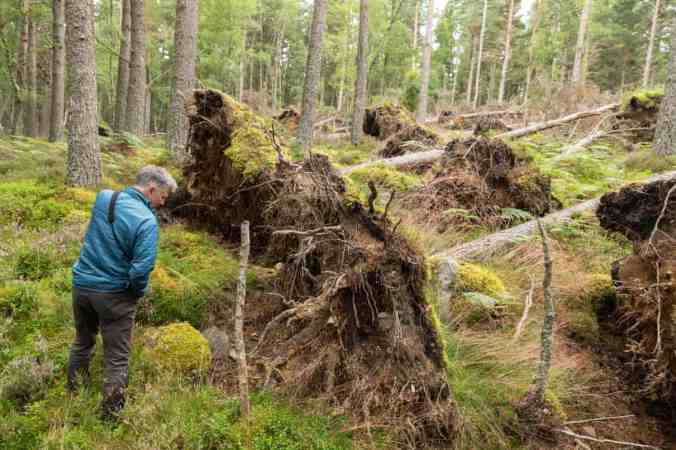
Jeremy Roberts examines the root plate of a felled Scots pine. Photograph: Mark Hamblin/The Guardian

Rewilding looks different in earlier posts about Scotland’s pioneering projects. But here is an additional piece of the puzzle worth understanding:

Chopping, twisting, felling: the unruly way to rewild Scotland’s forests

Orderly pine plantations in the Cairngorms are being messed up as part of a plan to let nature thrive

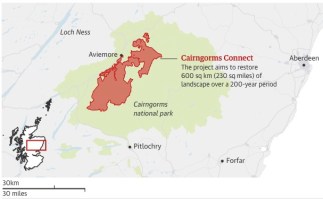
Cairngorms Connect is the UK’s largest land restoration project

The Scots pine plantations in Abernethy forest are the crème de la crème in forestry terms: tall, straight and dense. These plantations were created in the 1930s, and the wood had a variety of uses, from ships’ masts to trench timbers. Now, this woodland is being retrofitted for wildlife as part of the UK’s largest land restoration project because, although it is striking to wander in such a regimented landscape, nature prefers things to be less orderly. Continue reading

Big Win On Climate, Says McKibben

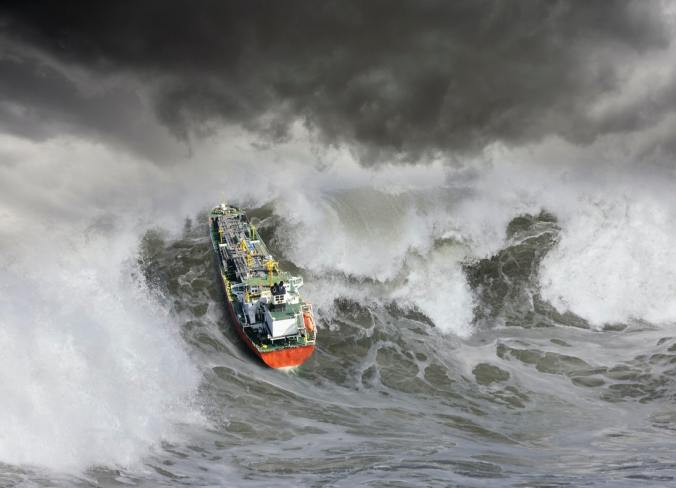
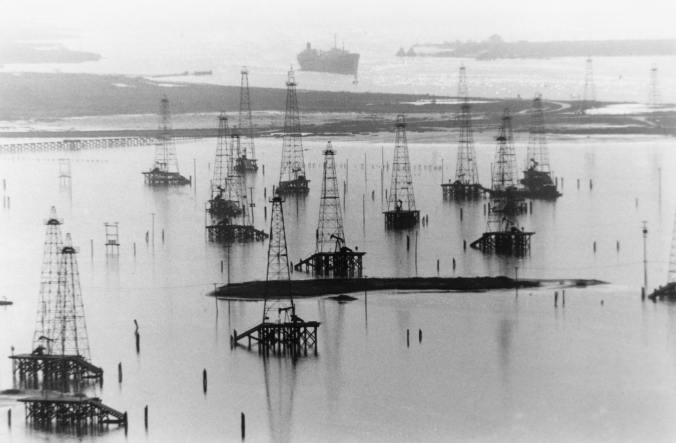
Early offshore action in Texas. the rigs are bigger now—so big that a federal court found yesterday that they’re endangering the climate.

His first book was an early harbinger that we wish had changed the world. Now, decades later, his newsletter is worth subscribing to. When Bill McKibben says something has gone right, we cannot wait to read it:

Something went right!?

Through no fault of its own, Biden’s team gets a big win on climate

Last summer the Biden administration granted the largest set of offshore oil leases in American history. The ironies abounded—Biden had insisted during his campaign that he would not be doing this (“And by the way, no more drilling on federal lands, period. Period, period, period,” he’d explained during the New Hampshire primary); it was the Interior Department that officially sold the leases, headed by a secretary, Deb Haaland, that environmentalists had fought like crazy to get confirmed. Continue reading

How Are You With Snow?

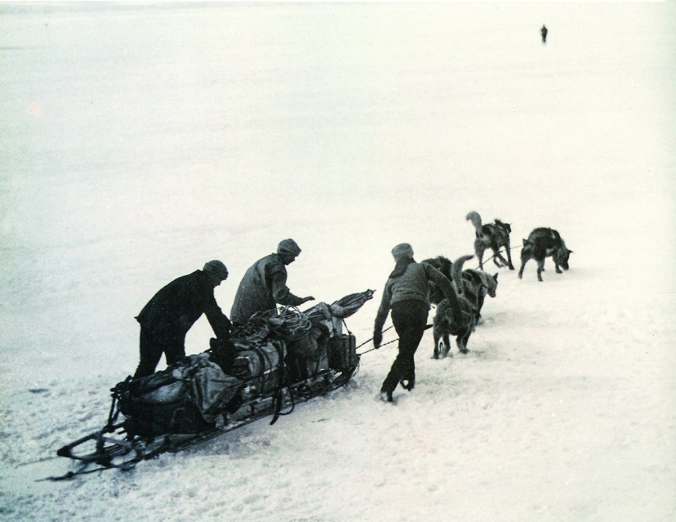
Shackleton leading the Aurora relief party in the winter of 1916, searching for nine lost men.

We are headed to NYC, where  snowy conditions await us. This is the perfect review to read en route, to remind me what others have accomplished in snowy conditions much more extreme:

One Good Antarctic Explorer Deserves Another

Hopefully you have an independent bookshop nearby if you plan to buy this book, but if you want to buy online please support an independent bookshop by clicking on this book image

Here is a test. Scott, Shackleton, Mawson, Amundsen — who comes next? As surely as “10” follows the pattern 2, 4, 6, 8, by almost any measure “Fiennes” is the name that should come after the other four synonymous with Antarctic exploration. To give him his full moniker, Sir Ranulph Twisleton-Wykeham-Fiennes has probably man-hauled sledges farther, endured more blizzards and lost more fingertips to frostbite than the rest of them put together.

So when Fiennes produces a book about Ernest Shackleton, it should get our attention: It suggests an insider’s look into a very select club. In a sense, that creates a problem. It is easy to set expectations too high, though Fiennes himself is complicit in this. Continue reading

Hargila


“Hargila” Film Documents India’s Grassroots Effort to Save the Endangered Greater Adjutant Stork

A new film by the Cornell Lab of Ornithology’s Center for Conservation Media tells the story of a wildlife photographer who travels to India intent on documenting the rarest stork on earth, but soon discovers a conservation hero and her inspiring efforts to rally a community to save it. Hargila documents the Greater Adjutant, a huge scavenging stork that was once widely distributed across India and Southeast Asia but is now mostly confined to a last stronghold in Assam, with small populations persisting in Cambodia’s northern plains region. Greater Adjutants are called “hargila” in the Assamese language, which literally translates as “bone swallower.” Continue reading

Turbines Replacing Rigs In Scotland’s Waters

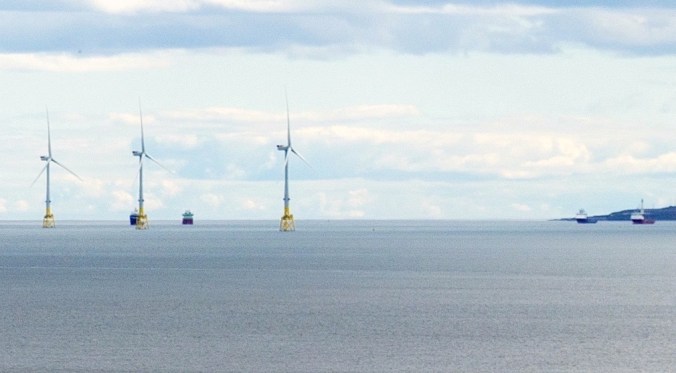
The Aberdeen Bay Wind Farm, an offshore wind demonstration facility off the coast of Aberdeenshire, in the North Sea, Scotland. ZANASZANAS VIA WIKIPEDIA

When big oil companies dismantle rigs and switch to building new turbines, it has the ring of something good. Our thanks to Yale E360 for this news brief:

North Sea Fossil Fuel Companies Plan to Invest More in Wind than Oil Drilling

Having won rights to develop wind farms off the coast of Scotland, Shell, Total, and BP are set to invest more in wind power than in oil and gas drilling in the North Sea in the years ahead, the latest evidence of oil majors changing tack on renewables to better navigate the energy transition. Continue reading
Good Fences Make Good Neighbors

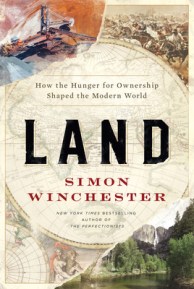
Land acquisition, for the purpose of conservation, is a subject that we touch upon from time to time. The bigger arc of land acquisition’s history, as well as its future, helps with perspective. The book to the right (linked to an independent bookseller’s website), potentially important for such perspective, is reviewed by Francisco Cantú in Human History and the Hunger for Land, as excerpted below (you can listen to the review by clicking the start button here):

From Bronze Age farmers to New World colonialists, the stories of struggle to claim more ground have shaped where and how we live.

Territorial expansion once meant conquest, but other modes are being explored. Illustration by Vincent Mahé

The final piece of terrain to be incorporated into the contiguous United States was an oddly shaped strip stretching from Las Cruces, New Mexico, to Yuma, Arizona. Known as the Gadsden Purchase, the area was obtained from Mexico in 1854 for ten million dollars, adding nearly thirty thousand square miles to a nation still drunk with Manifest Destiny expansionism. The motivations for acquiring the land were many—it contained huge deposits of ore and precious metals, held vast agricultural potential in the soils of its fertile river valleys, and, most important, had an arid climate that could allow a rail route to connect the coasts while remaining free from snowpack year-round. Continue reading
Carless Berlin

A cyclist in Berlin, Germany.

A cyclist in Berlin, Germany. HENDRIK WIEDUWILT VIA FLICKR

Thanks to Yale E360 for Berlin Looks to Create Car-Free Zone Larger Than Manhattan, a snapshot of the city’s fewer cars campaign, with links to further details in related stories by the Guardian and Fast Company:

Berlin’s regional parliament is considering creating a car-free zone in the German capital in response to a concerted push from a local advocacy group. Continue reading

Plastic Transformed With Purpose

Interior detail of “Earth Poetica,” which is a huge globe created out of plastic waste. Amit Elkayam for The New York Times

The challenge of plastic is a topic that goes back a decade in our pages.  We have featured artisanal plastic upcycling initiatives that we have supported entrepreneurially, as well as articles about other artisanal initiatives.

Today, in the same vein: Israeli Artist Turns Plastic Pollution Into ‘Earth Poetica’.

Beverly Barkat in her Jerusalem studio assembling “Earth Poetica,” a huge globe, from plastic waste. Its permanent home will be a building at ground zero in Manhattan. Amit Elkayam for The New York Times

In Beverly Barkat’s quest to connect people with nature, she found that environmental waste could be a powerful medium.

JERUSALEM — When the Jerusalem artist Beverly Barkat began to create an artwork for the lobby of a building in the new World Trade Center complex overlooking ground zero in Lower Manhattan, she aimed to come up with something architecturally site specific and impactful, large enough to connect with the space but not so enormous as to disconnect from the observer.

Barkat had a stark message to convey. Years earlier, she said, she had been struck by an image of children scavenging on a once-beautiful beach awash in plastic waste. Continue reading

A Question Worth Asking, Again And Again

Photograph by Matthew Porter for The Atlantic

Surprising the question needs asking, but after reading HOW BAD ARE PLASTICS, REALLY? you will understand the rhetorical purpose. The author, Rebecca Altman, has written plenty on the topic, and here in the Atlantic her perspective is clear:

They’re harmful to health, environment, and human rights—and now poised to dominate this century as an unchecked cause of climate change.

This is hardly the time to talk about plastics is what I think when Dad, hovering over the waste bin at a post-funeral potluck, waves me over, his gesture discreet but emphatic. He has retrieved from the trash a crystalline plastic cup, with fluted, rigid sides. “Polystyrene,” he grins, inverting the cup to reveal its resin code (a 6 stamped inside the recycling symbol). “But not my kind.” Continue reading

The Great Bamboozle

Bill McKibben’s newsletter on Substack asks the question:

What happens if you greenwash greenwash?

It’s hard to go lower than net zero….

Greenwashing began, as it name implies, as a gentle, barely perceptible rain of fibs. Back at the start, it was mostly pictures; it was pretty easy to gauge how much environmental damage a company did by the number of penguin photographs it felt it needed to include in its annual report. Continue reading

Schoonschip’s Floating Homes

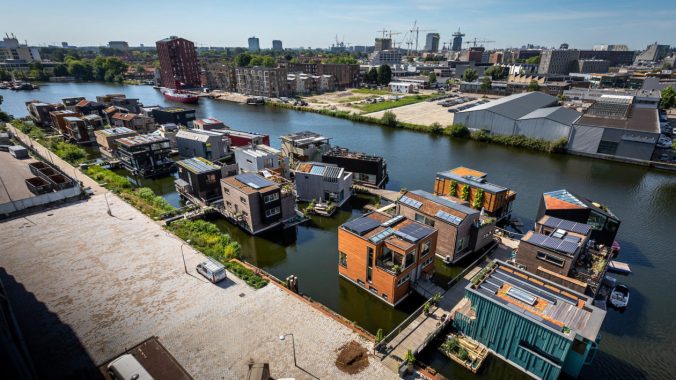
Schoonschip, a floating home development in Amsterdam. ISABEL NABUURS

Shira Rubin, writing in Yale e360, offers a view of Holland’s innovative housing approach to a future where the increase in waterscape can become an advantage. And she illustrates how this might be of use in other parts of the world facing the same challenges from rising seas:

Embracing a Wetter Future, the Dutch Turn to Floating Homes

Faced with worsening floods and a shortage of housing, the Netherlands is seeing growing interest in floating homes. These floating communities are inspiring more ambitious Dutch-led projects in flood-prone nations as far-flung as French Polynesia and the Maldives.

When a heavy storm hit in October, residents of the floating community of Schoonschip in Amsterdam had little doubt they could ride it out. They tied up their bikes and outdoor benches, checked in with neighbors to ensure everyone had enough food and water, and hunkered down as their neighborhood slid up and down its steel foundational pillars, rising along with the water and descending to its original position after the rain subsided. Continue reading

The New Forestry In Germany

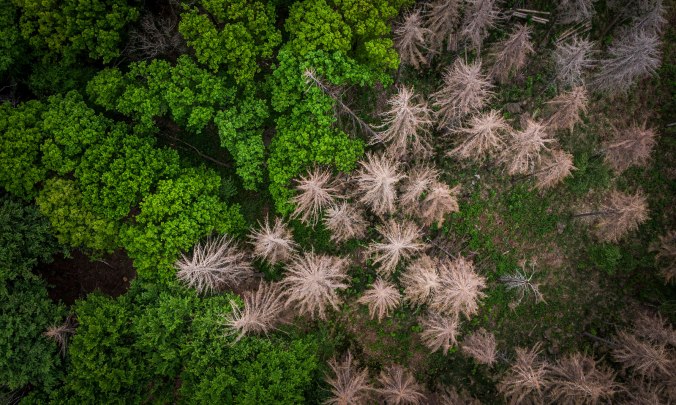
KOENIGSHAIN, GERMANY – MAY 19: Aerial photograph of dead conifers in a mixed forest on May 19, 2020 in Koenigshain, Germany. Because of the last years of drought needleleaf forests are infested by bark beetles. Many trees are felled to stop spreading these beetles. (Photo by Florian Gaertner/Photothek via Getty Images)

Gabriel Popkin offers this overview of the history of, and the new German approach to forest management in his article titled FOREST FIGHT, in Science:

Forest researchers Pierre Ibisch (left) and Jeanette Blumröder check a data logger in a pine forest that burned in 2018 and is now being allowed to naturally regenerate. LENA MUCHA

Germany invented “scientific” forestry. But a huge dieback triggered by climate change has ignited a fierce debate over how the nation should manage its trees

SCHWENDA, GERMANY—Last summer, Friederike and Jörg von Beyme stood on a bramble-covered, Sun-blasted slope outside this small town in eastern Germany. Just 4 years ago, the hillside, part of a nearly 500-hectare forest the couple bought in 2002, was green and shady, covered in tall, neatly arranged Norway spruce trees the couple planned to cut and sell. Continue reading

Tiles, Heritage & Conservation

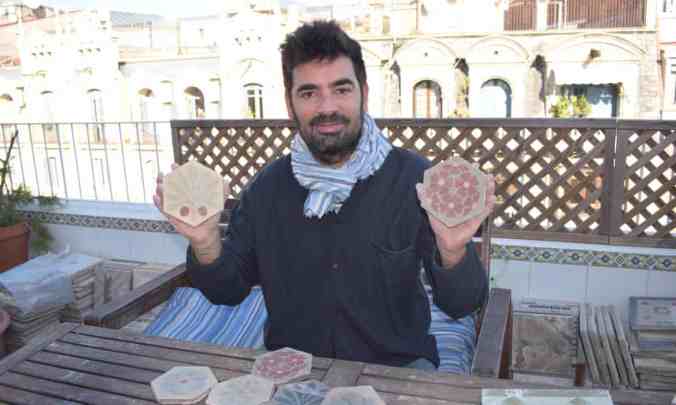
Joan Moliner with some of the 1,600 tiles he has found in builders’ skips. Photograph: Stephen Burgen/The Guardian

When we were working on the project that became Xandari Harbour, articles like the one below, or any about architectural preservation, were the type we most enjoyed sharing. It has been too long, so here goes:

A man on a mission to preserve Barcelona’s decorative floor tiles

As 19th-century apartment blocks become luxury flats, Joan Moliner is saving part of the city’s heritage

A tile display with Moliner’s Brompton bicycle. Photograph: Joan Moliner

Each morning, from the moment when Joan Moliner unfolds his bicycle for the ride to work to Barcelona city centre, he is on a mission, one eye on the road, the other on builders’ skips. His quarry, if that’s the word, is cement floor tiles.

All over the city, 19th-century apartment blocks are being made over into luxury flats. In the process, a vital part of Barcelona’s heritage – its decorative tiled floors – is ending up in a dump.

Conservation of the architectural heritage rarely extends beyond listing the facade, despite the wealth of interior detail in buildings erected at a time when Barcelona was a mecca for artists and artisans. Continue reading