Making Barrels High-tech

Kyle Guyer prepared to flip a barrel during toasting at the Missouri Cooperage operation of Independent Stave in Lebanon, Missouri. Lasers and infrared cameras have refined the toasting process to give the customer a desired flavor profile.
Credit August Kryger for The New York Times

Every now and then we find interesting stories from the world of distilleries. Maybe it’s a small mescal brewer, or a giant liquor corporation giving back in some way, or the history of traditional London gin, or people making beer out of wasted bread. In the world of wine and certain spirits, oak barrels are imperative to the process of aging the drink, and the technology involved in cooperage has changed a lot in the last couple years, even as barrels look exactly as they did hundreds of years ago. Clay Risen reports for the New York Times:

SALEM, Mo. — Standing on a wooded hillside in the Ozarks, about 100 miles southwest of St. Louis, Brad Boswell watches a chain-saw-wielding logger make several deft cuts at the base of a 100-foot white oak. The logger points to a clearing down the slope and, with one final, quick slash, sends the tree falling, exactly where he pointed.

Mr. Boswell scrambles over to look at the swirls and loops that make up the tree’s cross section. If they’re consistent, and the wood doesn’t show scars from fire damage or disease, it will most likely end up in some of the hundreds of thousands of barrels that his 1,500-person company, Independent Stave, turns out every year.

Continue reading

Growing Hops & Crafting Beer

hops_custom-06d73795999a6d93f111680ade5849c244609f3f-s1400-c85.jpg

Ripe summer hops good for making beer. Tim Newman/Getty Images

We are anticipating another post by one of our authors, on a topic related to this news story below (thanks to NPR’s great special section, the salt), so let this serve as a reminder and a harbinger:

Hop Growers are raising a glass to craft brewers. The demand for small-batch brews has helped growers boost their revenues, expand their operations, and, in some cases, save their farms.

“Without the advent of craft brewing, a few large, corporate growers would be supplying all of the hops and local, family owned farms like ours would have gone bankrupt,” says Diane Gooding, vice president of operations at Gooding Farms, a hop grower in Wilder, Idaho. “It’s saved the industry.” Continue reading

Old School Fromage

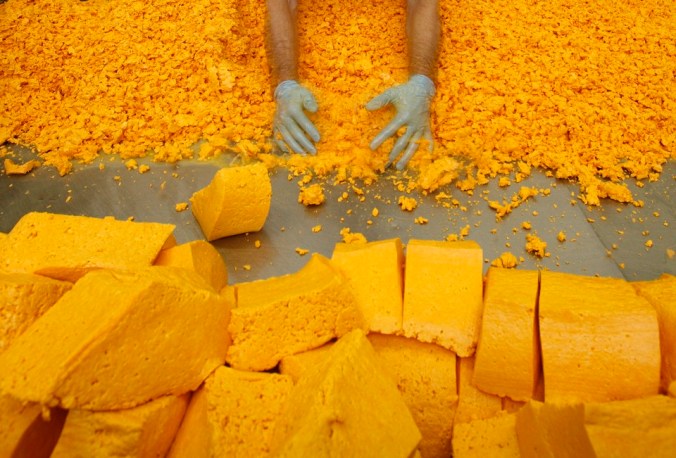
Cheesemaker David Clarke separates the curds and whey to make Red Leicester cheese at Sparkenhoe Farm in Upton

Cheesemaker David Clarke separates the curds and whey to make Red Leicester cheese at Sparkenhoe Farm in Upton, central England October 8, 2007. Red Leicester cheese had not been made in Leicestershire since 1956 until Clarke started producing his traditional, unpasteurised cloth-bound cheese using milk from his 150 pedigree Holstein Fresian cows. REUTERS/Darren Staples (BRITAIN)

Thanks to the Atlantic’s concern for our culinary well-being:

How Real Cheese Made Its Comeback

After decades of Kraft Singles, more Americans than ever are hungry for artisanal varieties of the past. An Object Lesson.

by LAURA KIESEL

As a child, I was a picky eater. Except when it came to cheese. Continue reading

I Love IPA, And I Know Why

HopsOne of the ironies of living in India for six years, as a devotee of IPA, is that IPA is not to be found in India. So, I have it only when I travel, and mostly in the USA where the craft of brewing in small batches has grown radically in recent years.

The book to the right is a tiny drop in a big bucket of evidence of how the craft of brewing has reached far and wide, and it came to my attention when I visited a website associated with its authors:

IPAWhich came to my attention in this post by Russell Shorto, which must be read in its entirety (it takes only a few minutes) if you care about IPA, hops, ethnobotany or just excellent non-fiction writing, and includes these two paragraphs:

…while an emphasis on hops has likewise boosted the business of small-scale brewers, I.P.A. aficionados are known to be among the most fickle of beer consumers, flitting from one label to another in their endless search for new flavor elements. That puts pressure on brewers to come up with new beers, which, in turn, leads to a hunt for new hops varieties.

Enter Paul Matthews, who is to hops what John James Audubon was to birds. He has been involved in the search for wild hops strains from Colorado to the Caspian Sea; from these he teases out flavor components. Spicy, floral, grassy, citrus, herbal, evergreen: the horizon keeps expanding, and still the crowd wants more…

Ha! Top that. Actually, he does. Keep reading it. Continue reading

Drink Maple? Sure

squam-swamp-run-maple--3781_wide-e793fcc0e7e7afb2f5f94466ffbbc47899d9fbae-s1400-c85

Courtesy of Drinkmaple

 Those of us who grew up in maple territory can easily relate to this, and even place palm on forehead and ask–why didn’t I think of that?–so thanks to the Salt over at National Public Radio (USA) for this:

From Tree To Tap: Maple Water Makes A Splash

Unlike syrup, which is boiled down into a thick, sticky liquid, maple water is made from unprocessed sap that is 98 percent water. Its growing popularity is a boon for local farmers. Continue reading

#8 Of One Dozen Love Letters About Xandari

12974425_1230966180264955_2655848184739776256_n

Photo and pendant by Milo Inman

While we were in the early stages of shaping the look of Xandari Pearl, we had a team of design interns, and these highly creative collaborators sent us a constant stream of design feedback on the evolving Marari pearl concept. Little did I know that at that same time Milo, who at that time I thought of as a photographer-to-be, was developing another artistic talent. The photo above shows one example of that talent.

I consider that pendant as good an artifact of Xandari’s aesthetic legacy as any.  Continue reading

Boxing, Bartending, And One Final Fight

Screen Shot 2016-06-20 at 12.09.18 PMClick above to listen to this remarkable tale, and if you do not feel your socks being knocked off, complain in our comments section below. We first learned about Bob Bozic in early 2012, but now that we hear this update to his story we think we may need to visit him in Belgrade. This is the stuff we live for:

At Fanelli’s, a venerable bar in SoHo, Bob Bozic was the kind of bartender who also served as entertainment, telling endless stories about his life: he was the scion of a rich inventor in Serbia, a prizefighter, even a onetime bank robber. Nick Paumgarten, who wrote about Bozic in 2012, discovered that these barroom tales are true. Recently, Bozic was in touch again, with big news: he was quitting the bar and going to Serbia to pursue a restitution claim on his father’s mansion, one of the nicest houses in Belgrade, which was seized by the Communists in 1946.

Architecture’s Role In Renewal

aravena-slide-ZVL1-articleLarge

The fortress-like facade of the 17,000-ton Angelini Innovation Center in Santiago, Chile, which Alejandro Aravena designed for the Pontificia Universidad Católica de Chile in 2011. CreditPhotograph by Anthony Cotsifas

There is an excellent story in today’s New York Times about an architect, likely to become a celebrity due to the prize he won this year. I am not a huge fan of concrete (notwithstanding this), but so what? None of my business, plenty of Chilenos would say, and rightly so. However, as noted in my post yesterday, I can sometimes turn on a dime of an image is moving enough. And this image is enough to draw me in to Mr. Aravena’s world. So is this story that the photo illustrates:

Alejandro Aravena, the Architect Rebuilding a Country

Good-looking, charming and a celebrity in his native Chile, the surprise winner of this year’s Pritzker cares more about solving social problems than exercising his artistic chops.

By

THE EARTHQUAKE, one of the biggest ever recorded, hit in the middle of a late February night in 2010. The real damage came 18 minutes later, with the tsunami, crashing from the Pacific up the estuary of the River Maule, where the small, hardscrabble city of Constitución nestles. Continue reading

Intangible Heritage Worthy Of Conservation

9-690

Who gets to decide what is worthy of conservation, and what is not? I am given reason to think about this on a regular basis, given the work that we have been doing for the last two decades. There is no one answer, of course, but I conclude regularly that it comes down to very deep personal experiences–those which lead individuals to alter the path of their lives and thereby have an impact on the conservation of something they have come to care deeply about. John Muir, Teddy Roosevelt and others come to mind on the larger scale of this line of thinking.

Reading one of our other blog posts today, I was taken back in time to pre-India workdays, 2008-2010. Milo, I had forgotten until just now, had a chance to wrestle firsthand with one of Patagonia’s most important conservation issues, and it is fair to say that what he is doing today is influenced by intense experiences he had in Patagonia, followed by a couple of years living with us in India. That would be an example of a smaller scale of this line of thinking. Same goes for the story I just read, and when I look at the photo above, and the one below, I am reminded that sometimes an image alone, or a series of images like these, can lead to this same path-changing epiphany.

4-690

I have family in the vicinity of this story’s subjects, and am thinking just now that I have not made a visit to that family in too long; time to plan a visit? The thought is now lodged deeply in my thinking.
Continue reading

Purity Is Never Out Of Date

germanbeer_custom-b386ef6cf1c1b0762fcba4c0b18588f8df0b00ef-s1400-c85

A waiter carries beers at the Theresienwiese fair grounds of the Oktoberfest beer festival in Munich, southern Germany, last September. For centuries, a German law has stipulated that beer can only be made from four ingredients. But as Germany embraces craft beer, some believe the law impedes good brewing. Karl-Josef Hildenbrand/AFP/Getty Images

Laws can come and go, as far as we are concerned (and we get the point here), but purity remains forever of value (thanks to National Public Radio, USA):

Germany’s Beer Purity Law Is 500 Years Old. Is It Past Its Sell-By Date?

With more than 1,300 breweries producing some five-and-a-half thousand different types of beer, Germany is serious about the amber nectar. There’s even a word for it –bierernst – which means “deadly serious” and translates literally as “beer serious.”

This sober attitude applies particularly to the German beer purity law known as the Reinheitsgebot. Introduced in 1516 by Duke Wilhelm IV of Bavaria, the decree allows for only hops, barley, water and, later, yeast in every Stein. For 500 years, this recipe has served Bavaria very well, and for the last century, the rest of Germany. Continue reading

Strange Brew

160404_r27913-690

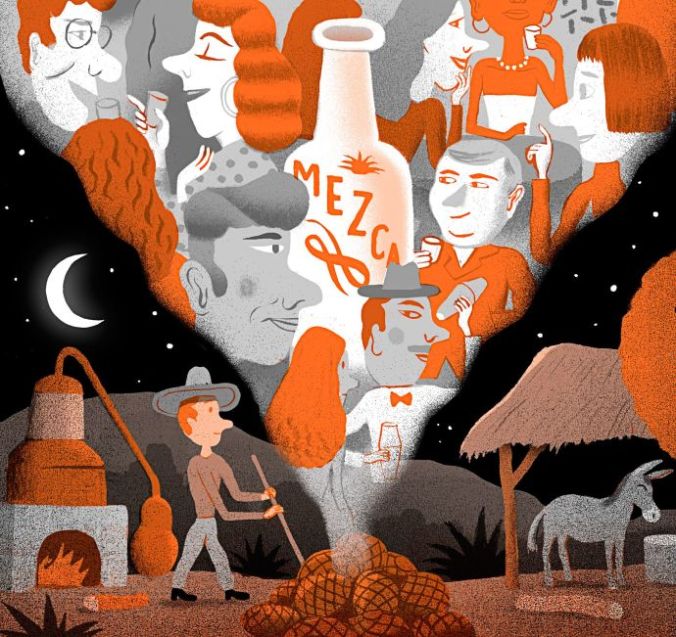
“Mezcal makes you cry, sing, dance, hug the neighbor you just met an hour ago.” ILLUSTRATION BY BJORN LIE

One more gem from the magazine issue that most recently also brought you this, and this:

Mezcal Sunrise

Searching for the ultimate artisanal distillate.

BY DANA GOODYEAR

Bricia Lopez is the mezcal queen of Los Angeles. Five years ago, Lopez, who is thirty-one and imposingly savvy, persuaded her father to let her build a mezcal bar at Guelaguetza, the restaurant that he opened when the family moved north from Oaxaca, a center of mezcal culture, in the mid-nineties. He didn’t know if Americans would like mezcal, or if Mexicans would admit that they did. But he decided to trust Bricia, and she focussed her offerings on premium mezcals—high proof, small lots, no worm. At that point, there were only a handful of brands on the market. Since then, mezcal imports have spiked, and labels have proliferated. Lopez now carries thirty. When I visited her at the bar the other day, she was in the midst of a renovation, doubling its size. Continue reading

Float

The ocean stirs the imagination and inspires the heart. In its frolicking waves and every grain of sand is a story of the earth. And the beautifully timed crash of the waves whisper about nature’s simple treasures. For the sea and its tales along the land are a continual miracle. – Rosanna Abrachan

The tale we hear is thrilling – of knowledge passed down for generations, of artisanal fishing practices that grace us with sustenance from the Arabian Sea without depleting her waters.

Come sea!

Fair’s Fare, More Than Fair

160404_r27910-690

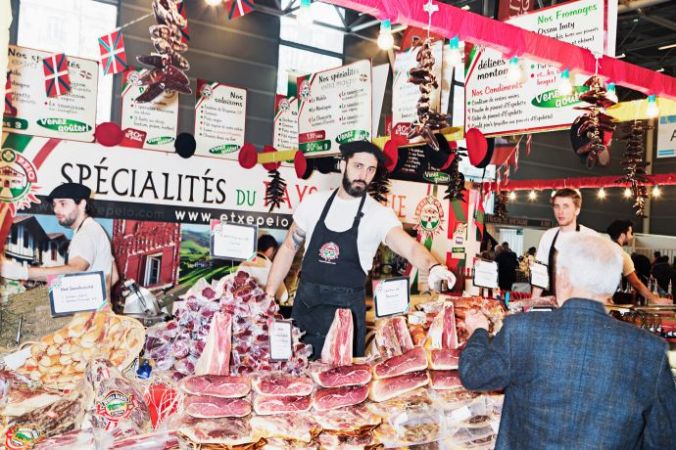
The Salon de l’Agriculture, held every year in Paris, is also a political crucible. PHOTOGRAPH BY IMMO KLINK FOR THE NEW YORKER

It is our favorite annual edition of our favorite source of longform journalism, and this looks like it could be our favorite article from this year’s edition:

Come to the Fair

The food-and-booze fest that is France’s national agricultural exhibition.

BY LAUREN COLLINS

It would be a mistake to think of microtourism, the latest invented word to capture the imagination of the travel sector, as mere staycationing. The practice, as defined by a pair of design students in Denmark who recently completed a project on the theme, is a prerogative of a future in which “gas prices are so high that we must develop a new form of adventure that does not require travelling great distances.” Microtourism is not glamping (no yurt) or bleisure (no work) or minimooning (no wedding). Nor is it Netflix and putter. If a staycation means pajamas and the garden shed, microtourism means sneakers and the subway. Continue reading

An Unusual Library With A Conservation Mission

3058058-slide-3-the-rarest-colors-in-the-harvard-pigment-library.jpg

A short note here to link out to a story of interest because of its intersection of conservation, commerce and education. Thanks to this new (to us) source of interesting (to us) news:

The Harvard Library That Protects The World’s Rarest Colors

The most unusual colors from Harvard’s storied pigment library include beetle extracts, poisonous metals, and human mummies.

Today, every color imaginable is at your fingertips. You can peruse paint swatches at hardware stores, flip through Pantone books, and fuss with the color finder that comes with most computer programs, until achieving the hue of your heart’s desire. But rewind to a few centuries ago and finding that one specific color might have meant trekking to a single mineral deposit in remote Afghanistan—as was the case with lapis lazuli, a rock prized for its brilliant blue hue, which made it more valuable than gold in medieval times. Continue reading

Spotted Owls, Intangible Heritage, Future Fortunes

Screen Shot 2016-02-07 at 8.53.56 AM

About one minute in to Mr. Ziermann’s story, he explains how his intent to pursue a life of timber logging in Oregon was waylaid by the “rules and regulations” (he did not sound happy about these) to protect the spotted owl in the American northwest. I recommend taking five minutes with the video here, and a moment more below if you want my two cents on it.

A Fraught Search for Succession in Craftsmanship

Video by Andrew Plotsky
George Ziermann has been making handmade boots for over 40 years.

Continue reading

Glass Art by Kiva Ford

Glass-blowing is an amazing art and science that has continually impressed us in the past. Thanks to the art/design blog ThisIsColossal, we’ve been exposed to the creations of Kiva Ford, who applies the skills he learned for blowing scientific instruments to his personal art, which you can see examples of in the video below:

Continue reading

Sandstructures, Just Because

16CHARACTER-master675

Calvin Seibert spends up to four days a week during the summer at Rockaway Beach in Queens. Credit Nicole Bengiveno/The New York Times

We do not need to explain it; we just like it (click the image to go to the original):

It looked like some futuristic civilization poking up out of the footprinted sand on Rockaway Beach in Queens. A lifeguard walked over to inspect it, then some surfers. A group of dripping children stopped, transfixed.

“Young people tend to watch for longer,” said Calvin Seibert, 57, who was shaping the structure. “If people sense you’re serious about it, they’ll watch longer.”

Mr. Seibert, a Manhattan artist, is serious enough about it to take a long subway ride to the beach up to four days a week from June through September. Continue reading

Collective Roots

Attention to detail is a highly prized attribute in all aspects of the work we have been doing in India since 2010, and we hope it doesn’t seem pedestrian to extend that concept to something as commercial as shopping. Some people may beg to differ, but there are many cases where the “consumer transaction” is so much more.

We’ve spent many happy hours in exploration to find sustainably produced, cottage industry items. A trip to Gujarat led us to the Kala Raksha Trust. Walks in Cochin led us to the Vimalalayam Convent School, and the NGO A Hundred Hands has introduced us to many of the wonderful craftswomen whose products we highlight, including designer Usha Prajapati from Samoolam.

We’ve been great fans of the results of her work with the women of Bihar from the moment we saw it, and hearing her personal story adds a beautiful dimension to the concept of “self-help”. Thanks to FvF (Freunde von Freunden) for their inspiring online interview.

Samoolam, Usha’s design collective, which is making a name for its beautiful hand-crocheted lifestyle products, is incredible not just because its founder is young, talented and inspiring, but because its process of creation is held together by a network of strong and talented women much like her – women who make things happen, who are changing their worlds, one crochet bead at a time.

Continue reading

Biophilia Revisited

This slideshow requires JavaScript.

 Biophilia, the word, came to our attention several years ago, but the concept has been part of our personal ethos for decades. We’re particularly invigorated by the multi-faceted (pun not actually intended) way the word can be applied to so many concentrations, from the scientific, to the literary, to the artistic, to the spiritual.

The work of American artist Christopher Marley attracts on numerous levels. His new book inspires on the design front. For more images and information to pique the interest read McKenna Stayner’s piece in the New Yorker here.

About the book

Christopher Marley’s art expresses his passionate engagement with the beautiful forms of nature. Beginning with insects and moving on to aquatic life, reptiles, birds, plants, and minerals, Marley has used his skills as a designer, conservator, taxidermist, and environmentally responsible collector to make images and mosaics that produce strong, positive emotional responses in viewers. Marley has a brilliant eye for color and pattern in different natural objects, and he expertly captures the deep relationships among them. Biophilia (literally, “love of living things”) is a must-have for nature lovers, designers, artists, craftspeople, and anyone looking for visual inspiration in the arts.

Continue reading

Art & Food, Food & Art

9781614284321_custom-458a1838430962f2508b82415502232ea5d3b9a8-s400-c85

This book review, on the salt (thanks NPR, USA) covers two books for the foodie/arts-oriented audience we sometimes find lurking here:

…We all need to eat, and our preferences are intensely personal. Yet food is often overlooked in the biographies of anyone who wasn’t a chef or gastronomic icon.

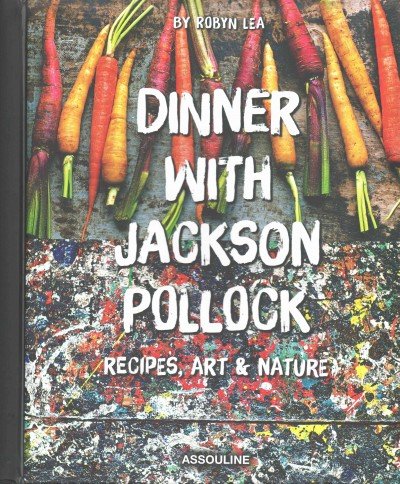
Two new books focusing on the culinary lives of artists — Monet’s Palate Cookbook, by Aileen Bordman and Derek Fell, and Dinner with Jackson Pollock, by Robyn Lea — show this to be an oversight. The artists’ approaches to food provide a new way of thinking about their very different approaches to art, and of understanding the artists themselves.

As Francesca Pollock, the artist’s niece, writes in Dinner‘s introduction, “He painted the same way he cooked: Endlessly using leftovers; keeping and re-using; trying one color or shape and then another. There was never ever any waste. Painting, like cooking, was a way of living.”…

monets-palate_custom-6c7383097b98ea23fd7902df2b0f5ec14718a798-s400-c85

…Food only occasionally appears in Monet’s work, mostly in still-lifes. But though he never painted his private kitchen garden, at 2.5 acres, it was sizable in its own right, and surely at least as much a fixture in his life as its more famous blooming cousin. And Monet himself put a premium on food, according to the authors.

“Almost every franc that he earned, after taking care of his family’s welfare, he would spend on the freshest ingredients for meals and improving the interior and exterior of his house” — originally, a farmhouse and cider press, Bordman and Fell write. Monet, we learn, employed a cook, and his diet included eggs from his own chickens. He was actively involved in directing which vegetables were planted (he liked experimenting with new varieties), and which ones ended up on the dinner table… Continue reading