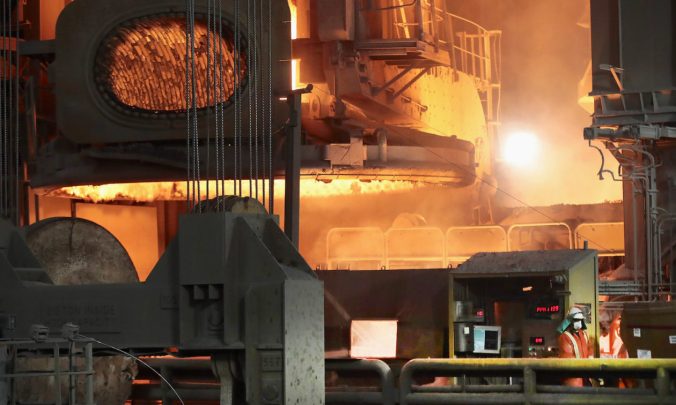
The NLMK mill in Portage, Indiana, which uses a furnace powered by electricity and produces steel from recycled scrap. SCOTT OLSON / GETTY IMAGES
Thanks to Yale e360:
Beyond Biden’s Climate Plan, a New Industrial Revolution Is Needed
The new U.S. climate plan is historic and will pump billions of dollars into advancing the transition away from fossil fuels. But a more far-reaching, innovative approach is needed to push forward the radically new technologies that will be required to decarbonize the economy.
Workers guide a hydrogen-powered truck, part of Anglo American Plc’s NuGen carbon-neutral project, during a moving demonstration at the Anglo American Platinum Ltd. Mogalakwena platinum mine in Mogalakwena, South Africa, on Friday, May 6, 2022. Anglo American unveiled the worlds biggest green-hydrogen powered truck at a platinum mine in northeast South Africa where it aims to replace a fleet of 40 diesel-fueled vehicles that each use about a million liters of the fossil fuel every year. Photographer: Waldo Swiegers/Bloomberg
For all the great news in the Biden administration’s massive new climate spending plan, the hardest work of transforming the economy to stop global warming lies ahead. That’s because nearly all the money in the $369 billion plan will be spent on technologies that American companies already know how to deploy, such as solar farms, making buildings more efficient, and developing networks of electric vehicle charging systems.
Doing a lot more of the same will undoubtedly bring down emissions faster. But deep decarbonization requires a transformation of the American economy that will demand a much more active effort to push the technological frontier and build new industries so emissions can be driven to zero. Continue reading






























 Organikos