Channeling Water Nature’s Way

Just as much as we want packaging of our drinking water to be carefully thought out, we also want the channeling of water to make sense:

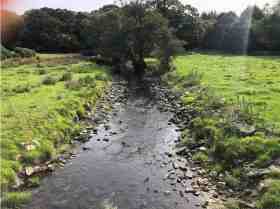
How the beck at James Robinson’s farm looked before the introduction of natural flood management techniques. Photograph: James Robinson

‘The wildlife that has come is phenomenal’: the UK farmers holding off floods the natural way

Planting trees, creating floodplains and rewilding rivers are among the new techniques being used to adapt to a heating climate

The streams, or becks, that run through James Robinson’s Lake District farm used to be cleaned out regularly – with vegetation yanked out and riverbeds dredged, or even completely filled in. Continue reading

The Alternative, Reviewed

Nick Romeo has a new book coming out, and the Guardian recommends it, tentatively. It is up to all of us to answer the reviewer’s doubts through our choices and actions:

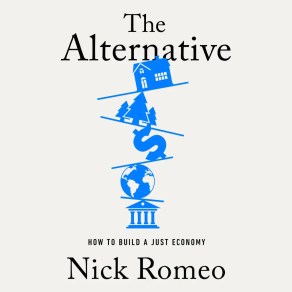
The Alternative by Nick Romeo review – moral substitutes for the free market model

A survey of the global alternatives to the current economic system makes for an enlightening, inspiring read, but you’re left wondering why such initiatives have failed to take hold

Anti-capitalist street art in the 11th arrondissement of Paris. Photograph: Soma/Alamy

I wrestled with how to approach this review. On the one hand, The Alternative brings together an appealing range of ways people across the west are imaginatively and determinedly contesting the givens in today’s capitalism. There is an ache for better – for more just ways of organising the way we work and adding more meaning to our lives. Continue reading

Give Earth A Chance, & Other EcoPosters

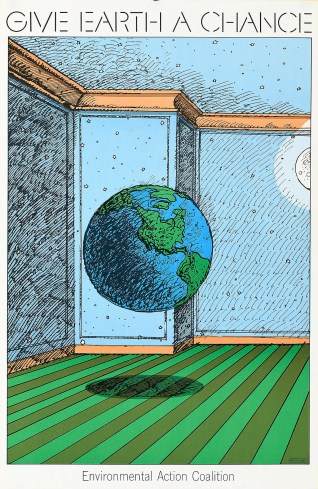
A poster from 1970 by Milton Glaser. via Poster House

If you happen to be in New York City and enjoy graphic design related to conservation you might enjoy this:

Told Ya So: The Prescient Posters of the Environmental Movement

Graphic artists have been helping call attention to climate change for decades, and a new exhibition charts the evolution of their pleas.

Last year was the warmest in recorded history. The graphic artists of the environmental movement tried to warn us. Their posters aimed to scare people straight with pictures of ecological ruin, or glorified nature, clean air and water, sunshine and verdure. Some offered earworm-y slogans and haunting visuals. Whatever their approach — bright, witty, somber, blunt, even sexy — they sought an image, a phrase, that could change enough minds to literally save the world. Continue reading

Franzen, In The Interest Of Birds, Debunks A Myth

A long-serving animal-control officer described a system intensely pressured to keep animals moving through it. “No Kill sounds great,” the officer said. “But it’s a myth.”Illustration by Antoine Maillard

We have Jonathan Franzen to thank for some of the best writing on caring more about birds, and he helps close out 2023 with a detailed look at the implications and complications of a cat population explosion:

How the “No Kill” Movement Betrays Its Name

By keeping cats outdoors, trap-neuter-release policies have troubling consequences for city residents, local wildlife—and even the cats themselves.

This past June, at the height of kitten season in Los Angeles, Gail Raff got a call for help from the neighborhood of Valley Glen, where a young woman had trapped a cat that needed fixing. Although the City of Los Angeles subsidizes the sterilization of unowned cats, appointments at clinics are hard to come by, and Raff was known in the animal-rescue world as a trapper who secures as many appointments as she can. Continue reading

Avocados & Michoacán

An avocado farm in Yoricostio, Michoacán. All photographs from Mexico, August 2023, by Balazs Gardi for Harper’s Magazine © The artist

A decade ago we thought we should source from Harper’s more, but its blog no longer exists to read the whole story that prompted that idea. Still going strong after 173 years of publication, this recent article in the magazine helps us understand what is wrong with one of our favorite farm products:

Forbidden Fruit
by Alexander Sammon

The anti-avocado militias of Michoacán

Phone service was down—a fuse had blown in the cell tower during a recent storm—and even though my arrival had been cleared with the government of Cherán in advance, the armed guard manning the highway checkpoint, decked out in full fatigues, the wrong shade to pass for Mexican military, refused to wave me through. My guide, Uli Escamilla, assured him that we had an appointment, and that we could prove it if only we could call or text our envoy. The officer gripped his rifle with both hands and peered into the windows of our rental car. We tried to explain ourselves: we were journalists writing about the town’s war with the avocado, and had plans to meet with the local council. We finally managed to recall the first name of our point person on the council—Marcos—and after repeating it a number of times, we were let through. Continue reading

Bird-Friendly Architecture

The New York Times building uses fritted glass clad with rods, which make its facade more visible to birds. Photograph: Daniel Slim/AFP/Getty Images

Birds fall victim to carelessly designed buildings. Bravo to the New York Times for building a bird-friendly HQ. Also to the Guardian for reporting on their competitor’s leadership, and on the architects leading the way with careful design:

Buildings kill a billion US birds a year. These architects want to save them

Highly transparent glass can lead to devastating collisions. But innovations in design are creating safer skylines – without sacrificing beauty

Chicago’s Aqua Tower was designed with birds in mind. Photograph: Radomir Rezny/Alamy

Chicago’s 82-story Aqua Tower appears to flutter with the wind. Its unusual, undulating facade has made it one of the most unique features of Chicago’s skyline, distinct from the many right-angled glass towers that surround it.

In designing it, the architect Jeanne Gang thought not only about how humans would see it, dancing against the sky, but also how it would look to the birds who fly past. The irregularity of the building’s face allows birds to see it more clearly and avoid fatal collisions. “It’s kind of designed to work for both humans and birds,” she said.
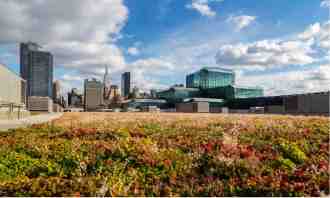
A green roof on the Javits Convention Center serves as a sanctuary for birds. Photograph: David Sundberg/Courtesy of Dan Piselli

As many as 1 billion birds in the US die in building collisions each year. And Chicago, which sits along the Mississippi Flyway, one of the four major north-south migration routes, is among the riskiest places for birds. This year, at least 1,000 birds died in one day from colliding with a single glass-covered building. Continue reading

Authentica, Nicoya Peninsula

Traveling by car from Monteverde to Palo Verde National Park should take about 90 minutes

The Nicoya Peninsula is one of the Blue Zones we have mentioned previously. For our family there is a memorable connection to the wetlands area where we are opening a shop this month, just as there was in Tamarindo. In 1998 we had a dozen family members visiting and organized a small bus to transport us to Arenal, Monteverde, and onward to the Palo Verde National Park. Continue reading

Cop28 Resolution Translated Into Common Language

Peter Dejong/Associated Press

David Wallace-Wells keeps our attention focused on the real message out of Dubai:

It only took 28 years. When Sultan Ahmed Al Jaber banged his gavel on the resolution text of COP28 in Dubai on Wednesday, it marked what has been widely called a historic achievement: the first time nearly every country on Earth agreed that oil and gas play a role in driving global warming, and the first time they nodded toward the need for a fossil fuel drawdown. Continue reading

Copping To The Resolution

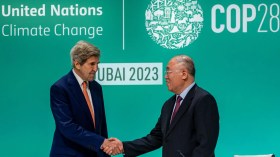
United States’ Special Presidential Envoy for Climate John Kerry(L) and China’s special envoy for climate change Xie Zhenhua (R) attend a press conference during the 2023 United Nations Climate Change Conference (COP28), in Dubai, United Arab Emirates, on December 13th, 2023. Martin Divisek/ZUMA

It started on a flawed premise, that a petrostate bigwig could honestly lead the forum to a legitimate outcome. We knew it was not going to end dirtier than it should have, but still we must parse what just happened. Thanks to Mother Jones for republishing Damien Carrington’s explanation from the Guardian:

Good Cop, Bad Cop: Breaking Down the UN’s New Climate Resolution

Some call the COP28 agreement “historic,” others call it weak. Here’s why.

Language on coal power was no stronger than that of Cop26 in 2021. Photograph: Maxim Shipenkov/EPA

The decision text from Cop28 has been greeted as “historic,”  for being the first ever call by nations for a “transition away” from fossil fuels, and as “weak and ineffectual” and containing a “litany of loopholes” for the fossil fuel industry. An examination of the text helps to explain this contradiction.

Reducing Fossil Fuel Use

The text states the huge challenge with crystal clarity: Continue reading

Good Money After Bad

The energy transition will lead to wide-ranging transformations across economies. | MONTAGE ILLUSTRATION BY NIKO YAITANES/HARVARD MAGAZINE; PHOTOGRAPHS BY UNSPLASH

We applaud the Fund, especially for this work, even if the source of their money is problematic:

Easing the Energy Transition

How the Bezos Earth Fund hopes to seed economic transformation

WHAT ARE THE BIGGEST economic obstacles to the needed rapid transition in energy supplies and the challenges of deforestation driven by climate change? Continue reading

Power Rangers With A Different Approach

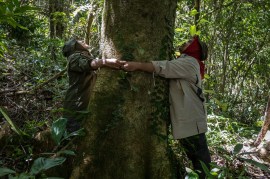
Women rangers hugged a tree while collecting data during a forest patrol near the village of Damaran Baru, in Aceh Province, Indonesia. Ulet Ifansasti for The New York Times

We thank Muktita Suhartono for the story and  Ulet Ifansasti for the photographs:

Female Rangers ‘Don’t Go All Alpha Like the Men’ to Protect a Forest

Rather than take a confrontational approach with trespassers looking to farm or log in a tropical rainforest in Indonesia, teams of women rangers try dialogue first.

Asmia, one of 15 rangers whose job is to protect nearby forests from squatters who want to clear trees for timber or to farm the fertile soil.

Riding her motorbike while balancing a backpack, a wok and a sharp cleaver, Asmia expertly maneuvered her way up a dangerous cliffside: a three-mile trip along a precipitous dirt path, barely 40 inches wide, to reach the mouth of the forest.

Asmia is one of the 15 members of a team of rangers — 10 of whom are women — whose job is to protect their village forest in Aceh Province in Indonesia from the squatters who want to clear the trees for timber or to farm the fertile soil.

Two teams of rangers, each consisting of five women and two men, take turns each month on five-day forest patrols.

“Here, we once fought with a squatter, asking him to stop the encroachment,” Asmia said, pointing as she walked beneath the thick canopy of trees that shadow her rounds. “He insisted on clearing the land, as he wanted to grow coffee. He was persistent. But we talked him out of it.” Continue reading

New York Wind Power

The giant parts for wind turbines await pickup at a pier in New London, Conn. Joe Buglewicz for The New York Times

Wind has always been there for the taking in so many places, the challenges of nimbyism notwithstanding. Now the turbines are arriving to harness it for the New York metropolitan area. Our thanks to Patrick McGeehan and the New York Times for sharing the story:

Huge Turbines Will Soon Bring First Offshore Wind Power to New Yorkers

Parts of what will eventually be the towers of wind turbines out in the ocean. Joe Buglewicz for The New York Times

New York’s best bet for entering the era of offshore wind power is stacked up at the water’s edge in Connecticut.

The pier on the Connecticut coast is filled with so many massive oddities that it could be mistaken for the set of a sci-fi movie. Sword-shaped blades as long as a football field lie stacked along one edge, while towering yellow and green cranes hoist giant steel cylinders to stand like rockets on a launchpad.

It is a launching point, not for spacecraft, but for the first wind turbines being built to turn ocean wind into electricity for New Yorkers. Crews of union workers in New London, Conn., are preparing parts of 12 of the gargantuan fans before shipping them out for final assembly 15 miles offshore. Continue reading

Carlos Manuel Rodriguez, Leading The Conversation, Again

We are grateful to the GEF for sharing this, and to Carlos Manuel Rodriguez for leading the conversation, as he has always done:

Creating space for young people to affect climate policy

In a recent conversation at his home, GEF CEO and Chairperson Carlos Manuel Rodríguez heard from members of the Youth and Climate Change Network of Costa Rica about how the climate emergency is impacting young people. Continue reading

Green Mountain Power, Sunrun, FranklinWH & Innovative Electricity Options

Photograph by Ian Thomas Jansen-Lonnquist / Bloomberg / Getty

We need more energy, and here are some possibilities:

The Next Power Plant Is on the Roof and in the Basement

A Department of Energy report promotes a new system that could remake the energy grid.

On any given Monday in Vermont, Josh Castonguay, the vice-president of innovation at that state’s Green Mountain Power utility, told me, he studies the forecast for the days ahead, asking questions like “What’s it looking like from a temperature standpoint, a potential-of-load standpoint? Is there an extremely hot, humid stretch of a few days coming? A really cold February night?” If there is trouble ahead, Castonguay prepares, among other things, Vermont’s single largest power plant, which isn’t exactly a power plant at all—or, at least, not as we normally think of one. Continue reading

Prioritizing Carbon Capture Versus Emissions Reduction

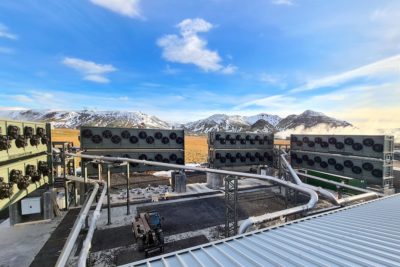
A carbon capture plant near Reykjavik, Iceland.

A carbon capture plant near Reykjavik, Iceland. CLIMEWORKS

Since we first heard of it we have been enthusiastic about the upside potential of this technology, but until now had not considered the tradeoffs:

Climate Plans That Rely Too Much on Carbon Removal Could Breach International Law

Countries that rely too heavily on carbon removal in their climate plans could violate international law, warns a new paper. Continue reading

Letters To The Secretary

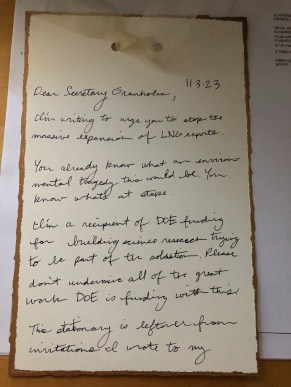
We have appreciated this newsletter since it started, and every issue since. This week it brings these handwritten letters to our attention:

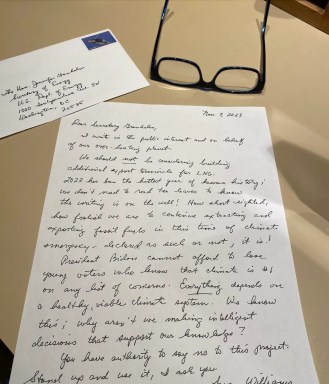
…Oh, and who’s the other group of climate voters the president needs to worry about? That would be older people, like those of us at Third Act—we codgers have been organizing mass protests all year. And while we may not be TikTok savvy, we have another weapon: pen and stationery. In the last week Third Actors have unleashed thousands of letters on DOE headquarters—which may not sound quite as sexy as petitions from the Internet, but they have their own impact, since officials know that if you’re willing to do more than click you’re probably an effective and motivated adversary.

So consider [image above left]

Or [image to the right]

What I’m trying to say is, the Department of Energy has a real problem—an increasingly aware and activated posse of youngsters and oldsters. And a solution: announce CP2 is going nowhere, and that no other project will be approved, or even considered, until there’s been an exhaustive rewrite of the criteria taking into account the latest science and economics. It’s not hard. Continue reading

Photosynthesis Mimicry Out Of Cambridge

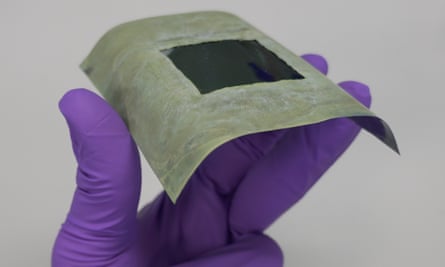
Researchers from the University of Cambridge designed ultra-thin, flexible devices, which take their inspiration from photosynthesis – the process by which plants convert sunlight into food.

Researchers from the University of Cambridge designed ultra-thin, flexible devices, which take their inspiration from photosynthesis – the process by which plants convert sunlight and CO2 into food. Photograph: Virgil Andrei

Photsynthesis comes in handy on this planet. This invention leverages the natural process into a technology to tackle a large scale challenge. We can only hope that it is not too little, too late:

Floating factories of artificial leaves could make green fuel for jets and ships

Cambridge University scientists develop a device to ‘defossilise’ the economy using sunlight, water and carbon dioxide

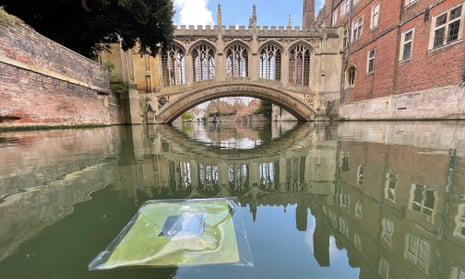
The artificial leaves were tested on the River Cam in and around Cambridge including sites such as the Bridge of Sighs.

The artificial leaves were tested on the River Cam in and around Cambridge including sites such as the Bridge of Sighs. Photograph: Virgil Andrei

Automated floating factories that manufacture green versions of petrol or diesel could soon be in operation thanks to pioneering work at the University of Cambridge. The revolutionary system would produce a net-zero fuel that would burn without creating fossil-derived emissions of carbon dioxide, say researchers. Continue reading

Invasive Pythons Are Winning, Get Your Game On

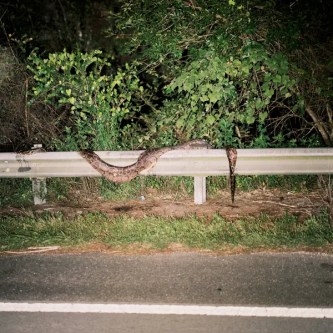
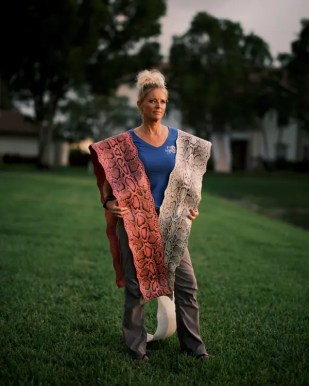
A Burmese python that was hit by a car. Zack Wittman for The New York Times

Nearly 12 years to the day since the first spectacular article we read on invasive species, we still watch for these stories. When it is invasive-hunting season, we take notice when new initiatives are announced:

Her Livelihood? Hunting Pythons in the Dead of Night.

Amy Siewe teaches people how to find and euthanize invasive Burmese pythons, which have been so successful at adapting to Florida that they appear here to stay.

On a clothing rack in Ms. Siewe’s living room are a dozen of skins, dyed deep hues by a tannery that helps her make python-leather products, including Apple Watch bands. Zack Wittman for The New York Times

An unexpected chill can fall over the Florida Everglades late at night. Stars speckle the sky. Frogs croak and croak, their mating calls echoing in the air.

It is all peace and wonder until you remember why you are out at this hour, on the flatbed of a pickup truck outfitted with spotlights, trying to find invasive creatures lurking in the shadows.

A python hunt might evoke images of hunters trudging through swamps and wresting reptiles out of the mud. In reality, it involves cruising the lonely roads that traverse the Everglades in S.U.V.s, hoping for a glimpse of a giant snake. It is strange work, straining on the eyes, brutal on the sleep schedule. Continue reading

The Slow Ways App, For Right Of Way Walkers

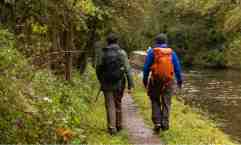
The Slow Ways founder, Daniel Raven-Ellison (right) walks with the Guardian’s Patrick Barkham as they verify a route between Congleton and Macclesfield. Photograph: Fabio De Paola/The Guardian

The right of way is a theme we love, and now there is a technology to assist our pursuit of those rights, at least in one country.

Our thanks to and the Guardian for their coverage of this development:

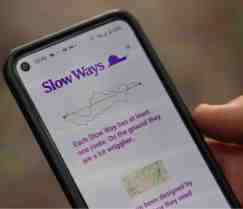
Walk the walk: the app mapping 140,000 miles of public right of way

Slow Ways was set up during the pandemic when frustrated locked-down walkers drew up more than 9,000 walking routes across Great Britain. Photograph: Fabio De Paola/The Guardian

Community-based, Slow Ways has verified 60% of a network of pedestrian-friendly routes across Great Britain

I meet up with Daniel Raven-Ellison, the brains behind the Slow Ways walking network, in the darkness of a drizzly dawn at Kidsgrove railway station in Staffordshire. Our mission? To walk and verify the final 17-mile (27km) link in the route between Birmingham and Manchester. Continue reading