Community Income From Rewilding

Rewilding Spain’s sustainable forest management support service helps municipalities generate income through activities such as resin extraction. NEIL ALDRIDGE

In the decade since we have been watching the work of Rewilding Europe we have seen income generation growing in importance:

Allowing trees to grow old in healthy ecosystems can help to lock up and store huge amounts of carbon.
JUAN CARLOS MUÑOZ ROBREDO /

Rewilding forest generates revenue for communities in the Iberian Highlands

Rewilding Spain has signed its first agreement to protect an old-growth forest in the Iberian Highlands. A change in forest management will support natural regeneration, delivering benefits to both nature and people. With other owners of old-growth forests interested in signing similar agreements, there is significant scaling-up potential.

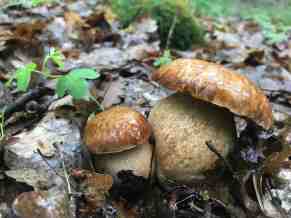
The old-growth forest protected by the new agreement is popular with mushroom pickers.
SEBASTIAN URSUTA

The importance of old-growth forests

Letting forests naturally regenerate is one of the most practical, immediate, and cost-effective ways of addressing our ecological and climate emergencies. As vital ecosystems that support millions of animals and plants, mature natural forests – or old-growth forests – lock up and store huge amounts of carbon. They are more resilient to climate change and disease than young tree plantations, with their diverse mix of native species allowing them to better adapt to a far wider range of conditions. Continue reading
English Apple Heritage

Today completes a trifecta of shared articles about trees, and Sam Knight gets extra thanks for the link with a part of food heritage our family is especially fond of (which led to finding the video above):

Illustration by Nicholas Konrad / The New Yorker

The English Apple Is Disappearing

As the country loses its local cultivars, an orchard owner and a group of biologists are working to record and map every variety of apple tree they can find in the West of England.

In June, 1899, Sabine Baring-Gould, an English rector, collector of folk songs, and author of a truly prodigious quantity of prose, was putting the finishing touches on “A Book of the West,” a two-volume study of Devon and Cornwall. Baring-Gould, who had fifteen children and kept a tame bat, wrote more than a thousand literary works, including some thirty novels, a biography of Napoleon, and an influential study of werewolves. Continue reading

How Much Communication Between Trees?

Baobab trees in Madagascar.
Photograph: Dave Carr/Getty Images

Ancient oak trees in Glastonbury, Somerset. Photograph: Eddie Linssen/Alamy

I acknowledge my enthusiasm for the idea that there is something going on between trees. I always want to hear more about it. Those who know me well joke that I am anti-woo-woo; but this one topic betrays a soft spot for the as-yet not fully explained. So I am thankful to Daniel Immerwahr for reminding me of the boundaries of what we know (so far):

A bristlecone pine tree, one of the oldest living organisms on Earth. Photograph: Piriya Photography/Getty Images

Mother trees and socialist forests: is the ‘wood-wide web’ a fantasy?

In the past 10 years the idea that trees communicate with and look after each other has gained widespread currency. But have these claims outstripped the evidence?

There are a lot of humans. Teeming is perhaps an unkind word, but when 8 billion people cram themselves on to a planet that, three centuries before, held less than a tenth of that number, it seems apt. Eight billion hot-breathed individuals, downloading apps and piling into buses and shoving their plasticky waste into bins – it is a stupefying and occasionally sickening thought. Continue reading

Andrea Vidaurre, Making Good Trouble in California

Take five minutes to celebrate Andrea’s activism and its accomplishments:

2024 GOLDMAN PRIZE WINNER

Andrea Vidaurre

Andrea Vidaurre’s grassroots leadership persuaded the California Air Resources Board to adopt, in the spring of 2023, two historic transportation regulations that significantly limit trucking and rail emissions. The new regulations—the In-Use Locomotive Rule and the California Advanced Clean Fleets Rule—include the nation’s first emission rule for trains and a path to 100% zero emissions for freight truck sales by 2036. The groundbreaking regulations—a product of Andrea’s policy work and community organizing—will substantially improve air quality for millions of Californians while accelerating the country’s transition to zero-emission vehicles.

Marshes Matter, And This One More Than Many

The outer edge of the Nartë lagoon in Vlorë, Albania. YURIY BRYKAYLO / ALAMY STOCK PHOTO

I have worked in some of Albania’s most important coastal and inland bird habitats, though not this one. My time working there is not my only reason for caring about this particular location. Read on–thanks as always to Fred Pearce–to understand why it matters so much. No offense intended to Jared Kushner, but this is not one of his better ideas. The destruction is not worth whatever it is he is hoping to accomplish:

Jared Kushner Has Big Plans for Delta of Europe’s Last Wild River

Albania’s Vjosë River is known as Europe’s last wild river, and its pristine delta is a haven for migratory birds. As plans for luxury developments there — spearheaded by Donald Trump’s son-in-law Jared Kushner — move ahead, conservationists are sounding the alarm.

It is the jewel of the Adriatic. Its shimmering waters feed a rare colony of Dalmatian pelicans, the world’s largest freshwater birds, sustain the endangered Albanian water frog, and host loggerhead turtles on its encircling dunes. Continue reading

Marsh Matters

Coastal marshlands exist in a precarious state: they need enough sediment to stay above water but not so much they get buried. In San Francisco Bay, the US Army Corps of Engineers and others are working to develop a less destructive way of giving marshes the mud they need. Photo by Aerial Archives/Alamy Stock Photo

For the record, marshes matter, so our thanks to Erica Gies, writing for Hakai:

Making a Marsh out of a Mud Pile

In San Francisco Bay, scientists are looking for a better way to rebuild flagging marshland.

The water in California’s San Francisco Bay could rise more than two meters by the year 2100. For the region’s tidal marshes and their inhabitants, such as the endangered Ridgway’s rail and the salt marsh harvest mouse, it’s a potential death sentence. Continue reading
Babatana Rainforest Conservation Project & High Integrity Carbon Credits

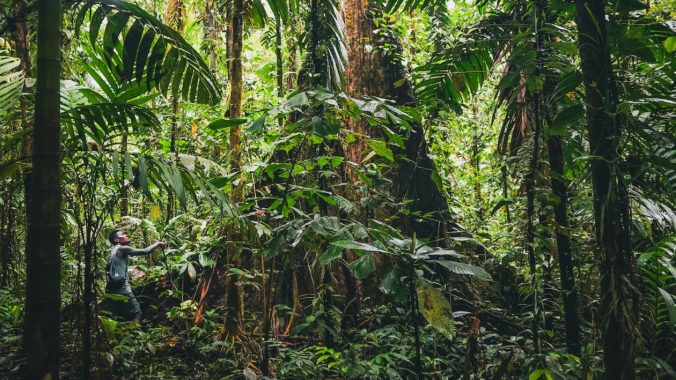
Sirebe tribal ranger Elijah Qalolilio Junior in the rainforest. DOUGLAS JUNIOR PIKACHA / NAKAU

A sign marks the boundary of protected Sirebe land. DOUGLAS JUNIOR PIKACHA / NAKAU

Of all the methods for addressing climate change, new incentives for protecting forests are among those we have most confidence in. Thanks to this article by Jo Chandler in Yale e360, if your introspection after reading this previous article had you down on carbon credits, there may be a way to restore your confidence:

The Sirebe forest at dusk. DOUGLAS JUNIOR PIKACHA / NAKAU

Solomon Islands Tribes Sell Carbon Credits, Not Their Trees

In a South Pacific nation ravaged by logging, several tribes joined together to sell “high integrity” carbon credits on international markets. The project not only preserves their highly biodiverse rainforest, but it funnels life-changing income to Indigenous landowners.

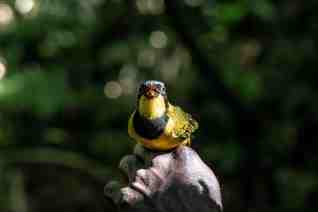
A male oriole whistler on a forest ranger’s hand. DOUGLAS JUNIOR PIKACHA / NAKAU

When head ranger Ikavy Pitatamae walks into the rainforest on Choiseul Island, the westernmost of the nearly 1,000 islands that make up the South Pacific archipelago of Solomon Islands, he surveys it with the heart of a tribal landowner and the eye of a forester. Continue reading

Assisted Evolution

Photo illustration by Lauren Peters-Collaer

If conservation failure is an option, then assisted evolution is a necessary consideration. Emily Anthes walks us through the idea:

When traditional conservation fails, science is using “assisted evolution” to give vulnerable wildlife a chance.

Scientists are trying to save lowland Leadbeater’s possums, tree-dwelling marsupials known as forest fairies, by crossbreeding them with possums from a separate highland population, a strategy known as genetic rescue.

For tens of millions of years, Australia has been a playground for evolution, and the land Down Under lays claim to some of the most remarkable creatures on Earth.

It is the birthplace of songbirds, the land of egg-laying mammals and the world capital of pouch-bearing marsupials, a group that encompasses far more than just koalas and kangaroos. (Behold the bilby and the bettong!) Nearly half of the continent’s birds and roughly 90 percent of its mammals, reptiles and frogs are found nowhere else on the planet.

Australia has also become a case study in what happens when people push biodiversity to the brink. Continue reading
Cambodian Mangrove Wonders

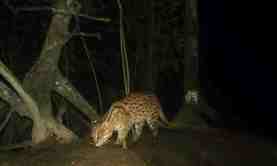
A fishing cat in Peam Krasop wildlife sanctuary. Photograph: Fauna & Flora/FCEE

Thanks to Robin McKie, now Science Editor at the Guardian, for this news from Cambodia:

‘We found 700 different species’: astonishing array of wildlife discovered in Cambodia mangroves

Smooth-coated otters in the mangroves. Photograph: Fauna & Flora/FCEE

Hairy-nosed otters and cats that catch fish are among the startling diversity of creatures making their home in threatened habitats

One of the most comprehensive biodiversity surveys ever carried out in a mangrove forest has revealed that an astonishing array of wildlife makes its home in these key, threatened habitats. Continue reading

Exquisite Textiles

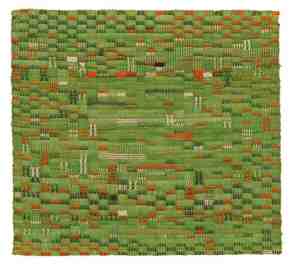
“Development in Rose I” (1952).Art work by Anni Albers / Courtesy © The Josef and Anni Albers Foundation / ARS, 2024

Weavers got more attention during our seven years in India, but we are no less interested in the tradition today. Thanks to Jackson Arn, writing in the New Yorker, for this review:

Anni Albers Transformed Weaving, Then Left It Behind

Her textiles are quiet revelations, but even her later prints show how restraint can generate ravishing beauty.

Imagine you’d been born in 1899. Imagine living through the invention of the Model T, the jet aircraft, the liquid-fuelled rocket, and the computer chip. Now imagine looking back on all this in 1965 and writing, as though with a shrug, “How slow will we appear some day?”

In works like “Pasture” (1958), texture and almost-patterns create an overwhelming experience.Art work by Anni Albers / Courtesy © The Josef and Anni Albers Foundation / ARS, 2024 / © Metropolitan Museum of Art; Photograph by Peter Zeray

It takes an uncommon turn of mind to survive decades this dizzying and then sum them up with perfect nonchalance—but a lot of the greatness of Anni Albers lay in her ability to stay undizzied and keep doing her thing, year after year. Not that she was afraid of innovation; her thing just happened to be weaving, an art form that, by her own calculation, had not changed in any fundamental way since the Stone Age.

Critics reach for a few key words with Albers: “crisp,” “precise,” “mathematical.” Continue reading

Make Space For Weeds

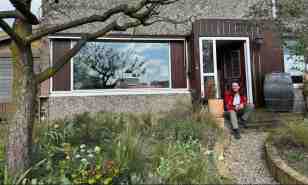
Tineke Menalda on her front doorstep in Amersfoort Photograph: Senay Boztas/Guardian

Weeds are part of nature, whether we like them or not. Thanks to Senay Boztas and the Guardian for this new take on weeds from Holland:

‘We need to accept the weeds’: the Dutch ‘tile whipping’ contest seeking to restore greenery

View image in fullscreen
A pile of ‘whipped’ paving stones in the village of Raalte.

National competition has goal of helping Netherlands reach environmental targets by removing garden paving

Tineke Menalda sits in the sun on her front step, nursing a cup of coffee and idly plucking out the odd weed. Three years ago, the front of her terrace house in Amersfoort was completely paved. But now, sitting in a lush garden of trees and green, she is an official ambassador for the strangest new sport in the Netherlands: tegelwippen, “tile whipping”, or “whipping away” the paving stones. Continue reading
South American Fishing Methods, And Choices

An open-net salmon farm on the Chilean side of the Beagle Channel. Photograph: Dani Casado

As we increase our awareness of the many choices we have when consuming fish (among other things), here is more food for thought:

Crabs, kelp and mussels: Argentina’s waters teem with life – could a fish farm ban do the same for Chile?

Puerto Almanza, on the Beagle Channel in Argentinian Tierra del Fuego, is one of the world’s most southerly settlements and best known for the local seafood, especially Patagonian king crabs.
Photograph: Visit Argentina

While the ecosystem is thriving off the coast of Argentina, the proliferation of salmon farms in Chile’s waters is threatening marine life, say critics

A rocky path, strewn with thick tree roots, leads from a dirt road down to a small green hut overlooking the choppy waters of the Beagle Channel, a strait between Chile and Argentina. The shack is home to Diane Mendez and her family but doubles as Alama Yagan, one of nine restaurants in the fishing village of Puerto Almanza. Continue reading
Illegal Miners Face The Fire

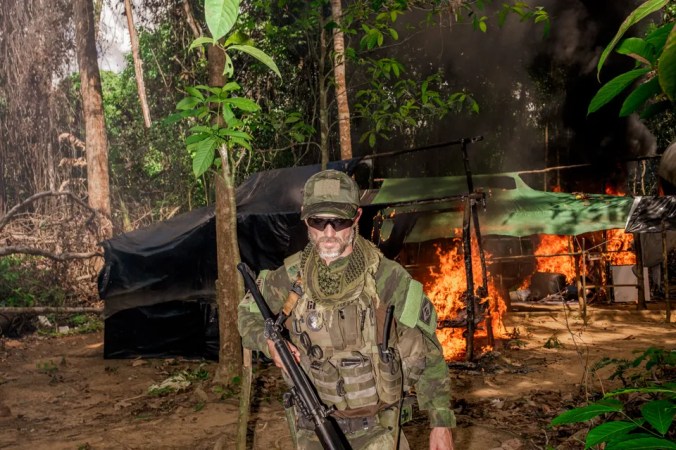
The G.E.F. burns mining camps as part of a long-running counteroffensive against environmental depredation. “Wherever they go, the miners destroy everything,” Felipe Finger, the unit’s leader, says. Photographs by Tommaso Protti for The New Yorker

Thanks to Jon Lee Anderson, as always, for his reporting from the danger zone that Brazil’s Amazon forest too often is:

The Brazilian Special-Forces Unit Fighting to Save the Amazon

As miners ravage Yanomami lands, combat-trained environmentalists work to root them out.

Roberto Cabral, a founder of the G.E.F., attends to a puppy discovered in a camp after miners fled.

In a clearing in the Brazilian Amazon, I stood with a group of armed men, discussing a viral TikTok video. The video, shot from a helicopter full of illegal miners, showed a vast stretch of rain forest, with dense foliage extending in all directions. The only sign of human habitation was below: a dirt circle surrounded by fanlike lean-tos made of wooden poles and palm fronds. It was a maloca, a traditional compound of the Yanomami, an Indigenous group that inhabits a remote territory in the rain forest of northern Brazil. Continue reading

Drone Cowboys

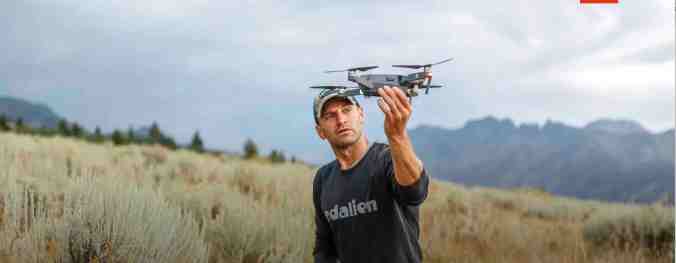
Daniel Anderson holds a drone on his family’s ranch in Montana’s Paradise Valley. Louise Johns/High Country News

High Country News is where a story like this gets assigned, and since they are a hyper-niche publication we thank The Atlantic for broadcasting it. If drones can unite these two constituencies, they are worth a moment of your time:

Illustration by Matteo Giuseppe Pani. Source: Getty.

Drones Could Unite Ranchers and Conservationists

Flying robots could offer a nonlethal way to keep wolves away from cattle.

In the summer of 2022, several researchers with USDA Wildlife Services held their breath as a drone pilot flew a large drone, equipped with a camera, toward a wolf standing in a pasture in southwestern Oregon. Continue reading

PureCycle Technologies, Promising But Still Needing Verification

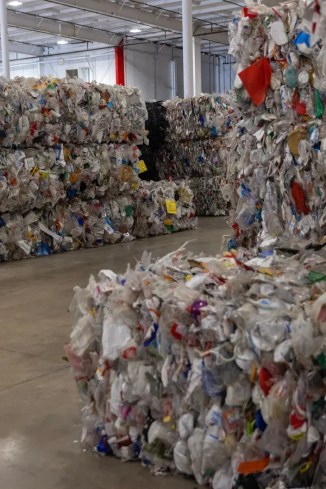
Recycled polypropylene pellets at a PureCycle Technologies plant in Ironton, Ohio. Maddie McGarvey for The New York Times

Big companies have not earned our trust, especially when it comes to plastics. So, our thanks to Hiroko Tabuchi for the tough questions in this New York Times article:

There’s an Explosion of Plastic Waste. Big Companies Say ‘We’ve Got This.’

By 2025, Nestle promises not to use any plastic in its products that isn’t recyclable. By that same year, L’Oreal says all of its packaging will be “refillable, reusable, recyclable or compostable.”

And by 2030, Procter & Gamble pledges that it will halve its use of virgin plastic resin made from petroleum.

To get there, these companies and others are promoting a new generation of recycling plants, called “advanced” or “chemical” recycling, that promise to recycle many more products than can be recycled today.

Crushed plastic waste at the PureCyle plant. Nestlé, Procter & Gamble and L’Oréal have expressed confidence in the company despite its early setbacks. Maddie McGarvey for The New York Times

So far, advanced recycling is struggling to deliver on its promise. Nevertheless, the new technology is being hailed by the plastics industry as a solution to an exploding global waste problem.

The traditional approach to recycling is to simply grind up and melt plastic waste. The new, advanced-recycling operators say they can break down the plastic much further, into more basic molecular building blocks, and transform it into new plastic.

PureCycle Technologies, a company that features prominently in Nestlé, L’Oréal, and Procter & Gamble’s plastics commitments, runs one such facility, a $500 million plant in Ironton, Ohio. Continue reading

Map For Planting & For Not Planting Trees

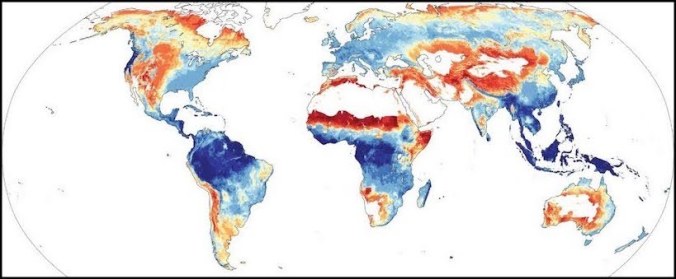
Regions where tree planting would curb warming on balance are shaded in blue, while regions where tree planting would intensify warming are shaded in red. HASLER, ET AL.

As we prepare to plant trees when the rainy season starts in a few weeks, a story like this one gives pause. If you are capable of reading and understanding the article summarized below, congratulations; meanwhile, thanks to Yale e360 for interpretation that allows the lay reader to follow along:
This Map Shows Where Planting Trees Would Make Climate Change Worse

Though oft touted as a fix for climate change, planting trees could, in some regions, make warming more severe, a new study finds. Continue reading
Breadfruit More Fully Appreciated

Wolfgang Kaehler / LightRocket / Getty

Our thanks to Zoë Schlanger for this corrective. Breadfruit has appeared more than once in our pages, but never with appreciation like this:

Too Few Americans Are Eating a Remarkable Fruit

Breadfruit is a staple in tropical places—and climate change is pushing its range north.

Someplace in the lush backroads of San Sebastián, in western Puerto Rico, my friend Carina pulled the car over. At a crest in the road stood a breadfruit tree, full of basketball-size, lime-green fruits, knobbled and prehistoric, like a dinosaur egg covered in ostrich leather. Continue reading

Forest Adaptation Via Scientific Methodology

Scientists in northern Minnesota are exploring how to adapt forests for climate change, transitioning them to a warmer future by planting new mixes of southern seedlings. In this “transition test” in the Cutfoot Experimental Forest, forest ecologists thinned trees and planted seedlings of eight species, grown from seeds collected up to hundreds of miles to the south. CREDIT: BRIAN PALIK / USDA FOREST SERVICE

Thanks to John Tibbets and Knowable Magazine

This 8-year-old bitternut hickory, native to a milder climate to the south, is flourishing in northern Minnesota, notorious for long, intensely cold winters. CREDIT: BRIAN PALIK / USDA FOREST SERVICE

On a brisk September morning, Brian Palik’s footfalls land quietly on a path in flickering light, beneath a red pine canopy in Minnesota’s iconic Northwoods. A mature red pine, also called Norway pine, is a tall, straight overstory tree that thrives in cold winters and cool summers. It’s the official Minnesota state tree and a valued target of its timber industry.

But red pine’s days of dominance here could fade. In coming decades, climate change will make red pine and other Northwoods trees increasingly vulnerable to destructive combinations of longer, warmer summers and less extremely cold winters, as well as droughts, windstorms, wildfires and insect infestations. Climate change is altering ecological conditions in cold regions faster than trees can adapt or migrate. Continue reading

Grazing More Lightly To Lock Away 63 Billion Tons Of Carbon

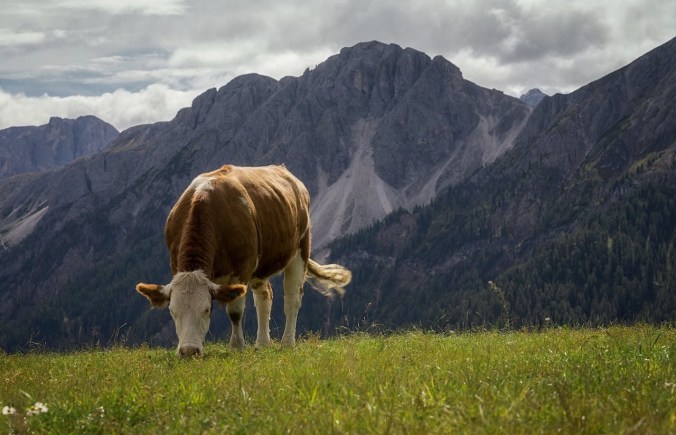
PEXELS

Thanks to Yale e360 Digest:

How Lightly Grazed Lands Can Lock Away Carbon

A new study finds that scaling back grazing on most pastureland worldwide would dramatically increase the amount of carbon stored in soils. Continue reading

Tree Species Moving, To Adapt & Survive

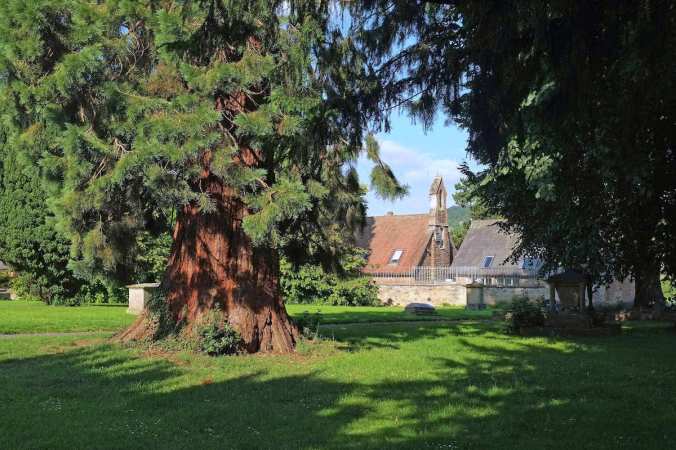
A giant sequoia in Bromyard, England. DEREK HARPER VIA GEOGRAPH

Thanks to Yale e360:

Under Threat in Their Native California, Giant Sequoias Are Thriving in Britain

Worsening drought and wildfires in California are pushing giant sequoias, the biggest trees on Earth, into decline. But sequoias that have been planted in Britain are flourishing, new research finds. Continue reading