Dickson D. Despommier Discussing The New City Concept

The vertical farming part of this concept is one we have linked to many times. The appeal is not difficult to grasp even if sometimes the concept is stretched. This is different and worth hearing him out:

Dickson Despommier Wants Our Cities to Be Like Forests

A leading proponent of vertical farming discusses how urban areas should adapt to a perilous environmental future.

Illustration by Daniele Castellano

In 2000, Dickson D. Despommier, then a professor of public health and microbiology at Columbia University, was teaching a class on medical ecology in which he asked his students, “What will the world be like in 2050?,” and a follow-up, “What would you like the world to be like in 2050?” As Despommier told The New Yorker’s Ian Frazier in 2017, his students “decided that by 2050 the planet will be really crowded, with eight or nine billion people, and they wanted New York City to be able to feed its population entirely on crops grown within its own geographic limit.” Continue reading


Kew Gardens & New Species

Cochlospermum adjanyae, a flowering plant that grows mostly underground and was first recorded by scientists in Angola in 2023. STEVE BOYES

Thanks to Yale e360:

Ten Curious New Plants and Fungi Recorded in 2023

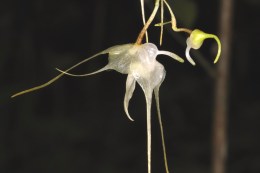
Aeranthes bigibbum. JOHAN HERMANS / RBG KEW

As the planet warms and extinctions mount, scientists are racing to catalog the vast array of life on Earth before species disappear. This year, researchers at the Royal Botanic Gardens, Kew, recorded 89 new species of plant and fungi across the globe, from the rocky edges of Antarctica to a dormant volcano in Indonesia.

Baphia arenicola.

Baphia arenicola. DAVID GOYDER / RBG KEW

“It is an incredibly exciting time to be a scientist, but even as we make these wonderful new discoveries, we must remember that nature is under threat, and we have the power to do something about it,” Martin Cheek, a senior researcher with Kew, said in a statement. Continue reading

Channeling Water Nature’s Way

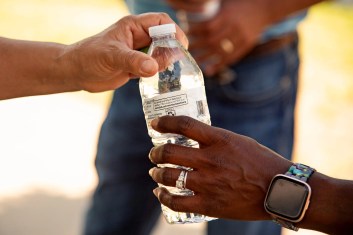
Just as much as we want packaging of our drinking water to be carefully thought out, we also want the channeling of water to make sense:

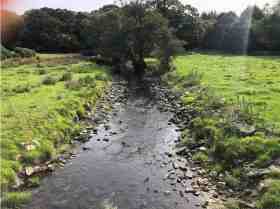
How the beck at James Robinson’s farm looked before the introduction of natural flood management techniques. Photograph: James Robinson

‘The wildlife that has come is phenomenal’: the UK farmers holding off floods the natural way

Planting trees, creating floodplains and rewilding rivers are among the new techniques being used to adapt to a heating climate

The streams, or becks, that run through James Robinson’s Lake District farm used to be cleaned out regularly – with vegetation yanked out and riverbeds dredged, or even completely filled in. Continue reading

Plastic’s Plentiful Problems

Emil Lippe for The New York Times

The waste has been our main objection to plastic water bottles. But there are other major questions.

We have reason to wonder (more on that another day) whether water in reusable glass bottles is an answer to this one:

Bottled Water Is Full of Plastic Particles. Can They Harm Your Health?

Here’s what scientists know so far about the health effects of nanoplastics, and what you can do to reduce your exposure.

A liter of bottled water contains nearly a quarter of a million pieces of nanoplastic on average, according to new research published this week in the Proceedings of the National Academy of Sciences. Continue reading

Nature, Peer-Reviewed Science Since 1869

The scientific journal Nature shows up in exactly one search result among thousands of posts here. And that one, because photos have such a wide audience. We have not linked to their articles because, since 1869, they are written by and oriented to highly credentialed scientists. A look at ten influential articles makes the point. And we can only respect what they do, even if we wish more of us could digest more of the science. Now that they offer some articles in audio version, this may make the science more accessible to those who hear better than they read. Judge for yourself, if you want to pay to play. The audio version of the article below (available on YouTube above) is free, but unless you have a subscription the written version is available for a small charge:

Rooftop solar panels in China. Tandem cells could boost power density in crowded urban areas. Credit: VCG/Getty

A new kind of solar cell is coming: is it the future of green energy?

Firms commercializing perovskite–silicon ‘tandem’ photovoltaics say that the panels will be more efficient and could lead to cheaper electricity.

On the outskirts of Brandenburg an der Havel, Germany, nestled among car dealerships and hardware shops, sits a two-storey factory stuffed with solar-power secrets. It’s here where UK firm Oxford PV is producing commercial solar cells using perovskites: cheap, abundant photovoltaic (PV) materials that some have hailed as the future of green energy. Surrounded by unkempt grass and a weed-strewn car park, the factory is a modest cradle for such a potentially transformative technology, but the firm’s chief technology officer Chris Case is clearly in love with the place. “This is the culmination of my dreams,” he says.

Give Earth A Chance, & Other EcoPosters

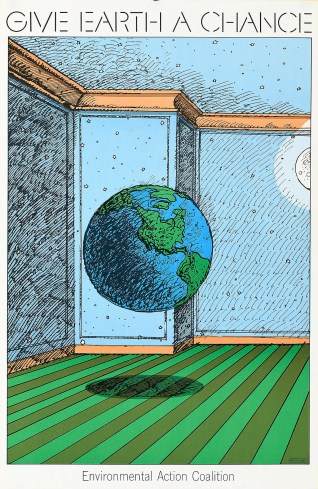
A poster from 1970 by Milton Glaser. via Poster House

If you happen to be in New York City and enjoy graphic design related to conservation you might enjoy this:

Told Ya So: The Prescient Posters of the Environmental Movement

Graphic artists have been helping call attention to climate change for decades, and a new exhibition charts the evolution of their pleas.

Last year was the warmest in recorded history. The graphic artists of the environmental movement tried to warn us. Their posters aimed to scare people straight with pictures of ecological ruin, or glorified nature, clean air and water, sunshine and verdure. Some offered earworm-y slogans and haunting visuals. Whatever their approach — bright, witty, somber, blunt, even sexy — they sought an image, a phrase, that could change enough minds to literally save the world. Continue reading

Ted Greene’s Treetime

Thanks to the Guardian for bringing the above book to our attention:

Ted Green, a conservation adviser to the crown estate at Windsor, has a provocative take on our ‘living heritage’

Ted Green is a rebel. He calls sheep “land maggots”. A horse-riding centre is “a dog-food complex”. And the ancient tree expert’s new book includes a photo of him sticking up two fingers at a portrait of Margaret Thatcher. Continue reading

More Honey & Bees, Also

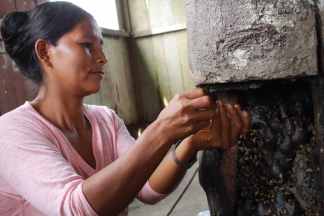
Tarkis Ríos Ushiñahua harvesting honey from stingless bees in a tree-trunk hive, at her home in Puerto Huamán in the Peruvian Amazon, 2019. [Hannah Hutchinson]

Along with anything else to get 2024 off to a good start, an article by Andrew Wingfield and Michael P. Gilmore that we missed from last year. The topic is one that we have only briefly touched on a couple times. The wider world of honey and the bees responsible for it are topics we hope to share more of this year.

To begin, let this bring some joy:

A Sweet and Potent Harvest

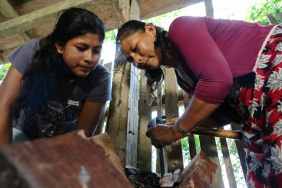
Tarkis Ríos Ushiñahua teaches her daughter to divide a hive, 2022. [Dylan Francis]

For the Maijuna of the Peruvian Amazon, harvesting honey from stingless bees is bringing prosperity and empowerment. Local beekeeping might also help preserve a vast ancestral forest.When Tarkis Ríos Ushiñahua collects honey from one of her beehives, she wears no protective clothing and uses just one tool, a large plastic syringe. 1 As she lifts the lid from the wooden box housing the hive, the bees swarm. They buzz around her face, land on her back, and settle in strands of her straight black hair, but they do no harm — these bees are stingless.

The bee yard of Loida Ríos Tamayo and Saúl Peterman Mosoline, 2021. [Enrique Redondo Navarro]

The slender tip of Ríos Ushiñahua’s syringe fits neatly inside the hive’s honeypots, brownish, papery-looking pouches that the bees have fashioned from wax and plant resins. Continue reading

Avocados & Michoacán

An avocado farm in Yoricostio, Michoacán. All photographs from Mexico, August 2023, by Balazs Gardi for Harper’s Magazine © The artist

A decade ago we thought we should source from Harper’s more, but its blog no longer exists to read the whole story that prompted that idea. Still going strong after 173 years of publication, this recent article in the magazine helps us understand what is wrong with one of our favorite farm products:

Forbidden Fruit
by Alexander Sammon

The anti-avocado militias of Michoacán

Phone service was down—a fuse had blown in the cell tower during a recent storm—and even though my arrival had been cleared with the government of Cherán in advance, the armed guard manning the highway checkpoint, decked out in full fatigues, the wrong shade to pass for Mexican military, refused to wave me through. My guide, Uli Escamilla, assured him that we had an appointment, and that we could prove it if only we could call or text our envoy. The officer gripped his rifle with both hands and peered into the windows of our rental car. We tried to explain ourselves: we were journalists writing about the town’s war with the avocado, and had plans to meet with the local council. We finally managed to recall the first name of our point person on the council—Marcos—and after repeating it a number of times, we were let through. Continue reading

Bird-Friendly Architecture

The New York Times building uses fritted glass clad with rods, which make its facade more visible to birds. Photograph: Daniel Slim/AFP/Getty Images

Birds fall victim to carelessly designed buildings. Bravo to the New York Times for building a bird-friendly HQ. Also to the Guardian for reporting on their competitor’s leadership, and on the architects leading the way with careful design:

Buildings kill a billion US birds a year. These architects want to save them

Highly transparent glass can lead to devastating collisions. But innovations in design are creating safer skylines – without sacrificing beauty

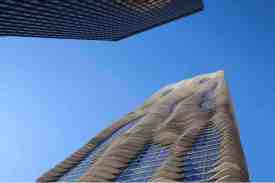
Chicago’s Aqua Tower was designed with birds in mind. Photograph: Radomir Rezny/Alamy

Chicago’s 82-story Aqua Tower appears to flutter with the wind. Its unusual, undulating facade has made it one of the most unique features of Chicago’s skyline, distinct from the many right-angled glass towers that surround it.

In designing it, the architect Jeanne Gang thought not only about how humans would see it, dancing against the sky, but also how it would look to the birds who fly past. The irregularity of the building’s face allows birds to see it more clearly and avoid fatal collisions. “It’s kind of designed to work for both humans and birds,” she said.

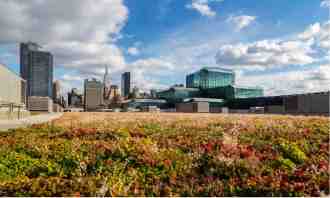
A green roof on the Javits Convention Center serves as a sanctuary for birds. Photograph: David Sundberg/Courtesy of Dan Piselli

As many as 1 billion birds in the US die in building collisions each year. And Chicago, which sits along the Mississippi Flyway, one of the four major north-south migration routes, is among the riskiest places for birds. This year, at least 1,000 birds died in one day from colliding with a single glass-covered building. Continue reading

The American Chestnut, Reconsidered

Illustration by The Atlantic. Source: Millennium Images / Gallery Stock; Bettmann/Getty

Katherine J. Wu reminds us of what it means to love something too much, and not enough:

America Lost Its One Perfect Tree

Lumber, shelter, delicious nuts—there was nothing the American chestnut couldn’t provide.

Across the Northeast, forests are haunted by the ghosts of American giants. A little more than a century ago, these woods brimmed with American chestnuts—stately Goliaths that could grow as high as 130 feet tall and more than 10 feet wide. Nicknamed “the redwoods of the East,” some 4 billion American chestnuts dotted the United States’ eastern flank, stretching from the misty coasts of Maine down into the thick humidity of Appalachia. Continue reading

Standing, Healthy Forests Are Essential

A managed forest near Jokkmokk, Sweden. Humanity will not limit global heating to safe levels without forests and woodland. Photograph: Peter Essick/Aurora/Getty Images

We thank Patrick Greenfield for this opinion in the Guardian:

Root and branch reform: if carbon markets aren’t working, how do we save our forests?

The world has looked to offsetting schemes to protect forests, fund conservation and fight the climate crisis – but many fail to fulfil their promises. Here are five ways to keep our forests standing

Keeping the world’s remaining forests standing is one of the most important environmental challenges of the 21st century. Continue reading

Cashmere, Goats & Accounting Flaws

An aerial photo of goats grazing on the Mongolian Plateau.

Goats grazing on the Mongolian Plateau in Central Asia. Gilles Sabrié for The New York Times

Goats have appeared in our pages from time to time over the years–usually related to their ecological contributions. Thanks to National Public Radio (USA) for the article below, which references the New York Times op-ed where the photo to the left was on display. Now it is time to talk about flaws in the accounting for the true costs of cashmere:

A goat that provides cashmere fibers grazes on foliage. Finnbarr Webster/Getty Images

The uncomfortable hidden costs behind the rise in cheap cashmere

The coveted material known for its luxurious softness has become much more accessible and affordable in recent years. But at what cost?

Who are they? Well, the fellers providing the goods are cashmere goats, many of whom live in parts of Central Asia, like northern China and Mongolia. Continue reading

Authentica, Nicoya Peninsula

Traveling by car from Monteverde to Palo Verde National Park should take about 90 minutes

The Nicoya Peninsula is one of the Blue Zones we have mentioned previously. For our family there is a memorable connection to the wetlands area where we are opening a shop this month, just as there was in Tamarindo. In 1998 we had a dozen family members visiting and organized a small bus to transport us to Arenal, Monteverde, and onward to the Palo Verde National Park. Continue reading

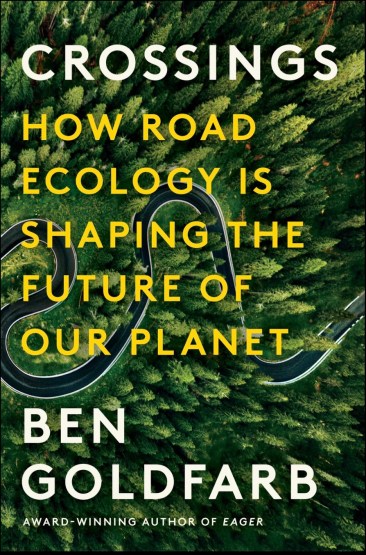
Crossings, By Ben Goldfarb

This journalist and author of the book to the left, surprisingly, has not appeared in our pages before. Here is what he says about himself:

Hi, I’m Ben, an independent conservation journalist. I’m the author of Crossings: How Road Ecology Is Shaping The Future of Our Planet, named one of the best books of 2023 by the New York Times, and Eager: The Surprising, Secret Life of Beavers and Why They Matter, winner of the 2019 PEN/E.O. Wilson Literary Science Writing Award.

And about the book he shares what others have said:

An eye-opening and witty account of the global ecological transformations wrought by roads, from the award-winning author of Eager.

Some 40 million miles of roadways encircle the earth, yet we tend to regard them only as infrastructure for human convenience. While roads are so ubiquitous they’re practically invisible to us, wild animals experience them as entirely alien forces of death and disruption. Continue reading

Beavers’ Resilience On Display In Canada

Beavers are not always welcome, but where they belong, they are a wonder to behold. Ian Frazier offers this dispatch from the great North:

Deep in the Wilderness, the World’s Largest Beaver Dam Endures

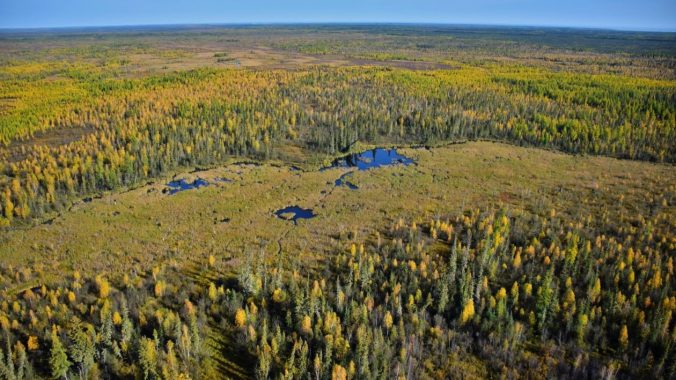
The largest beaver dam on Earth was discovered via satellite imagery in 2007, and since then only one person has trekked into the Canadian wild to see it. It’s a half-mile long and has created a 17-acre lake in the northern forest — a testament to the beaver’s resilience.

Wood Buffalo National Park, the largest national park in Canada, covers an area the size of Switzerland and stretches from Northern Alberta into the Northwest Territories. Continue reading

Rubber-Induced Destruction

Satellite images of Cambodian forest in 2000 (left) and, after being cleared, in 2015 (right). Forests were replaced by a grid of rubber plantations, as well as croplands. Source: NASA

If you have never seen ecosystem destruction firsthand, count yourself lucky. I witnessed, during visits over several years, as 1,000 acres of primary forest ecosystem was destroyed to make way for a rubber plantation. It was horrifying. And I am further horrified to read how what I witnessed was only a small part of a much bigger rubber-induced destruction (thanks as always to Fred Pearce):

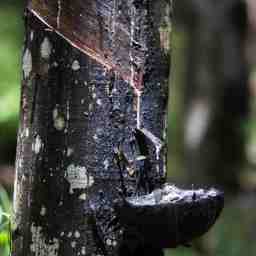
Rubber resin collected from a tree near Lubuk Beringin, Indonesia. TRI SAPUTRO / CIFOR

How Mounting Demand for Rubber Is Driving Tropical Forest Loss

The growing market for rubber is a major, but largely overlooked, cause of tropical deforestation, new analysis shows. Most of the rubber goes to produce tires, more than 2 billion a year, and experts warn the transition to electric vehicles could accelerate rubber use.

The elephants are gone. The trees are logged out. The Beng Per Wildlife Sanctuary in central Cambodia is largely destroyed, after being handed over by the government to a politically well-connected local plantation company to grow rubber. Continue reading

Good Money After Bad

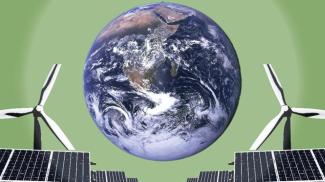
The energy transition will lead to wide-ranging transformations across economies. | MONTAGE ILLUSTRATION BY NIKO YAITANES/HARVARD MAGAZINE; PHOTOGRAPHS BY UNSPLASH

We applaud the Fund, especially for this work, even if the source of their money is problematic:

Easing the Energy Transition

How the Bezos Earth Fund hopes to seed economic transformation

WHAT ARE THE BIGGEST economic obstacles to the needed rapid transition in energy supplies and the challenges of deforestation driven by climate change? Continue reading

Power Rangers With A Different Approach

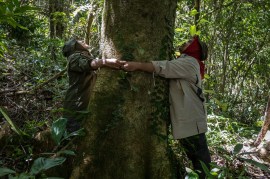
Women rangers hugged a tree while collecting data during a forest patrol near the village of Damaran Baru, in Aceh Province, Indonesia. Ulet Ifansasti for The New York Times

We thank Muktita Suhartono for the story and  Ulet Ifansasti for the photographs:

Female Rangers ‘Don’t Go All Alpha Like the Men’ to Protect a Forest

Rather than take a confrontational approach with trespassers looking to farm or log in a tropical rainforest in Indonesia, teams of women rangers try dialogue first.

Asmia, one of 15 rangers whose job is to protect nearby forests from squatters who want to clear trees for timber or to farm the fertile soil.

Riding her motorbike while balancing a backpack, a wok and a sharp cleaver, Asmia expertly maneuvered her way up a dangerous cliffside: a three-mile trip along a precipitous dirt path, barely 40 inches wide, to reach the mouth of the forest.

Asmia is one of the 15 members of a team of rangers — 10 of whom are women — whose job is to protect their village forest in Aceh Province in Indonesia from the squatters who want to clear the trees for timber or to farm the fertile soil.

Two teams of rangers, each consisting of five women and two men, take turns each month on five-day forest patrols.

“Here, we once fought with a squatter, asking him to stop the encroachment,” Asmia said, pointing as she walked beneath the thick canopy of trees that shadow her rounds. “He insisted on clearing the land, as he wanted to grow coffee. He was persistent. But we talked him out of it.” Continue reading

New York Wind Power

The giant parts for wind turbines await pickup at a pier in New London, Conn. Joe Buglewicz for The New York Times

Wind has always been there for the taking in so many places, the challenges of nimbyism notwithstanding. Now the turbines are arriving to harness it for the New York metropolitan area. Our thanks to Patrick McGeehan and the New York Times for sharing the story:

Huge Turbines Will Soon Bring First Offshore Wind Power to New Yorkers

Parts of what will eventually be the towers of wind turbines out in the ocean. Joe Buglewicz for The New York Times

New York’s best bet for entering the era of offshore wind power is stacked up at the water’s edge in Connecticut.

The pier on the Connecticut coast is filled with so many massive oddities that it could be mistaken for the set of a sci-fi movie. Sword-shaped blades as long as a football field lie stacked along one edge, while towering yellow and green cranes hoist giant steel cylinders to stand like rockets on a launchpad.

It is a launching point, not for spacecraft, but for the first wind turbines being built to turn ocean wind into electricity for New Yorkers. Crews of union workers in New London, Conn., are preparing parts of 12 of the gargantuan fans before shipping them out for final assembly 15 miles offshore. Continue reading