Dos Rios, California’s New State Park

Dos Rios mural signage, photographed June 28, 2024 in Dos Rios located in Modesto, California

Grayson muralist Jose Muñóz hand-painted this sign welcoming visitors to Dos Rios. Geloy Concepcion for NPR

California has a new protected area, complete with a Native Use Garden. Visit the website for the Dos Rios, described by National Public Radio (USA) as follows:

A view from the Oak Tree Grove June 28, 2024 in Dos Rios State Park in Modesto, California.

The sun rises, shedding light onto an oak grove along the western edge of Dos Rios. Geloy Concepcion for NPR

California’s newest state park is like a time machine

At the crack of dawn in California’s Central Valley, birds sing their morning songs and critters chirp unabashedly. In a shady grove next to a river, an owl swoops down from the spindling branches of an oak tree that has stood its ground for centuries.

A few feet above the tree’s base, its massive trunk is lined with a white ring, indicating how high the San Joaquin River rose during a flood last year. Dos Rios is supposed to flood — it’s a floodplain, recently transformed into California’s newest state park.

Native use garden on June 28, 2024 in Dos Rios State Park in Modesto, California.

The Native Use Garden is a place where, with permission from Dos Rios staff, tribal members can go to gather native plants for ceremonial use and other cultural practices. Geloy Concepcion for NPR

The park opened this summer, emerging among the never-ending rows of agriculture the valley is known for. It’s a lush 2.5 square miles now bursting with hundreds of thousands of native trees, bushes and animals.

Dos Rios, named for the Tuolumne and San Joaquin rivers that meet at the edge of the park, is the first new California state park in more than a decade.

But it isn’t like most state parks. In addition to bringing much-needed green space to an underserved area, its unusual design uses nature-based climate solutions that reinvigorate native wildlife. Continue reading

Dry, Hot Places Greening?

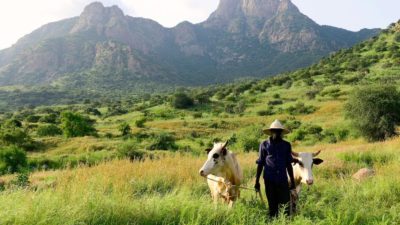
The Guera Mountains in southern Chad, a region that has grown greener in recent decades.

The Guera Mountains in southern Chad, a region that has grown greener in recent decades. NATURE PICTURE LIBRARY / ALAMY STOCK PHOTO

Fred Pearce, writing in Yale e360, offers this surprising news from some of the driest, hottest places:

With CO2 Levels Rising, World’s Drylands Are Turning Green

Despite warnings that climate change would create widespread desertification, many drylands are getting greener because of increased CO2 in the air — a trend that recent studies indicate will continue. But scientists warn this added vegetation may soak up scarce water supplies.

Southeast Australia has been getting hotter and drier. Droughts have lengthened, and temperatures regularly soar above 95 degrees F (35 degrees C). Continue reading

With Rewilding, Markets Are Not Everything, But Are A Key Ingredient

Rewilding can support the development of a wide range of nature-based businesses. NEIL ALDRIDGE

Places can have a particular taste, maybe one that is even iconic, and coffee was the obvious tool in our taste of place toolkit for decades. When it came time to focus on these products as our primary work we drew on some earlier experiments.

One was with honey and the other was with wine. All that was long before coming home to Costa Rica to launch Organikos.

Lunch provided with products from the Wild Côa Network during the ERN-EYR event in the Greater Côa Valley. The Wild Côa Network, which now comprises over 50 members, is driving the development of nature-based enterprise in and around Portugal’s Greater Côa Valley. NELLEKE DE WEERD

We are about to introduce two new products, and one has a story that mixes conservation and rewilding. So, in this story  that follows we sense something akin to the Organikos products in our Authentica shops:

Nature-based business networks take off across Rewilding Europe landscapes

Helping nature heal can lead to prosperous local economies. Nature-based business networks are being developed in a growing number of our rewilding landscapes, enabling businesses and communities to benefit from nature recovery in a sustainable way. This, in turn, is generating more support for rewilding.

The network effect

Today, nature-based business networks are a growing feature of Rewilding Europe’s expanding portfolio of rewilding landscapes. These bring businesses together under a shared rewilding vision for the landscape, facilitating the creation of new tourism packages, helping to close gaps in tourism experiences, and creating new economic opportunities. Continue reading

Really, SpaceX?

A rocket stands with water in the foreground.

Starship, the upper stage of SpaceX’s new rocket, at its launchpad in Boca Chica, Texas. Conservationists are concerned with the environmental impact space operations have on the area.

After assurances about protecting the environment, damage was done. They declined responsibility (the words they used included “…it’s cool”). Not cool:

Wildlife Protections Take a Back Seat to SpaceX’s Ambitions

A New York Times investigation found that Elon Musk exploited federal agencies’ competing missions to achieve his goals for space travel.

As Elon Musk’s Starship — the largest rocket ever manufactured — successfully blasted toward the sky last month, the launch was hailed as a giant leap for SpaceX and the United States’ civilian space program.

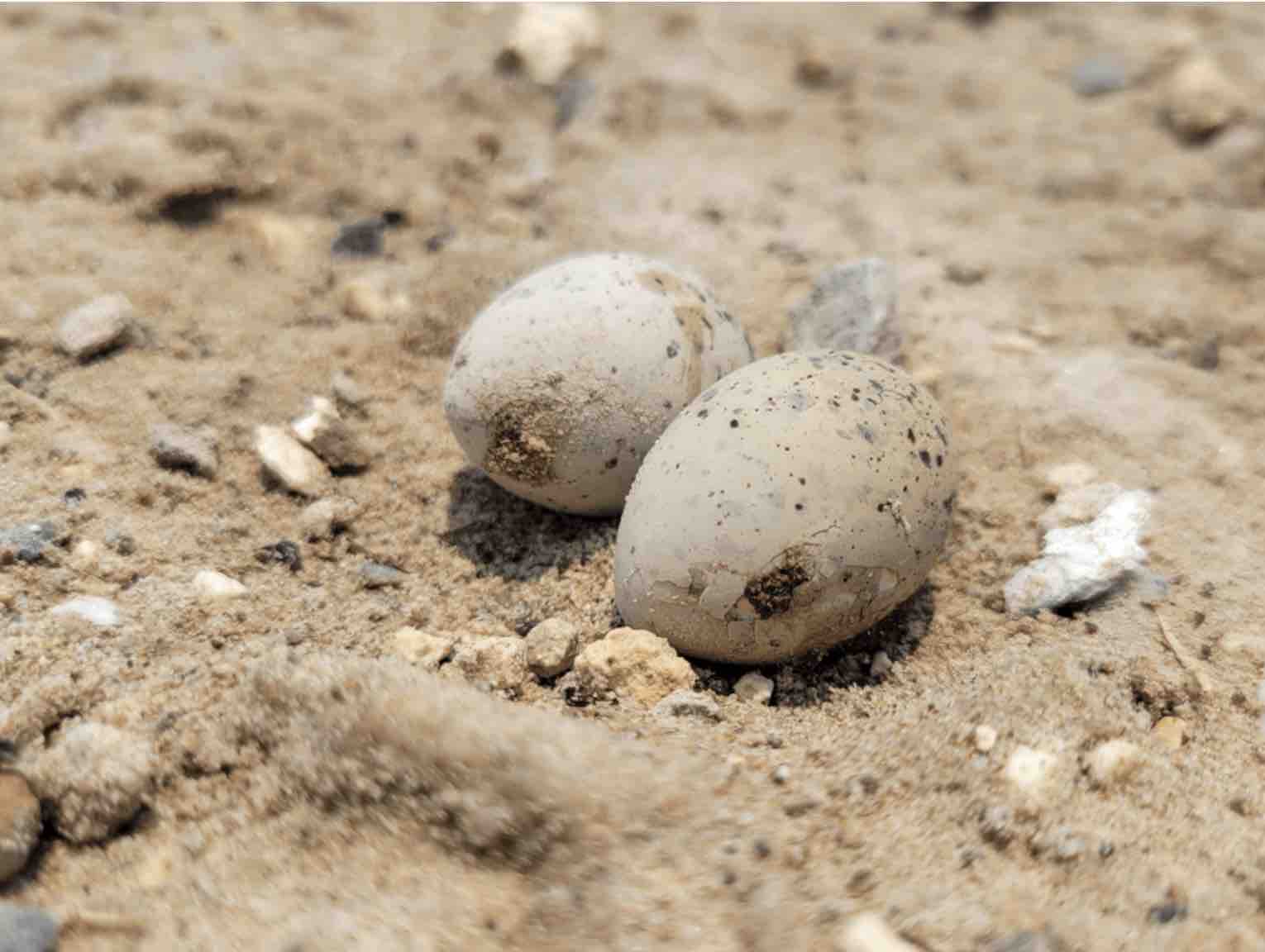
Figure 9. LETE 1 showing both eggs with large holes/cracks and dried egg contents emerging on June 6, 2024.

Two hours later, once conditions were deemed safe, a team from SpaceX, the U.S. Fish and Wildlife Service and a conservation group began canvassing the fragile migratory bird habitat surrounding the launch site.

The impact was obvious.

The launch had unleashed an enormous burst of mud, stones and fiery debris across the public lands encircling Mr. Musk’s $3 billion space compound. Chunks of sheet metal and insulation were strewn across the sand flats on one side of a state park. Elsewhere, a small fire had ignited, leaving a charred patch of park grasslands — remnants from the blastoff that burned 7.5 million pounds of fuel.

Most disturbing to one member of the entourage was the yellow smear on the soil in the same spot that a bird’s nest lay the day before. None of the nine nests recorded by the nonprofit Coastal Bend Bays & Estuaries Program before the launch had survived intact.

Egg yolk now stained the ground. Continue reading

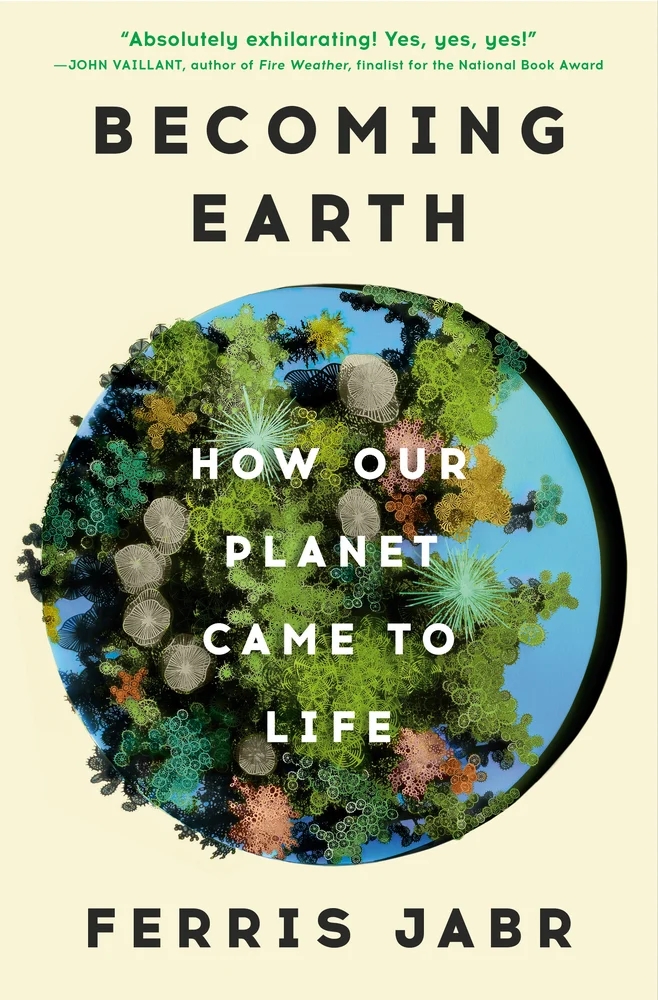
Becoming Earth, Adapted In Essay Form

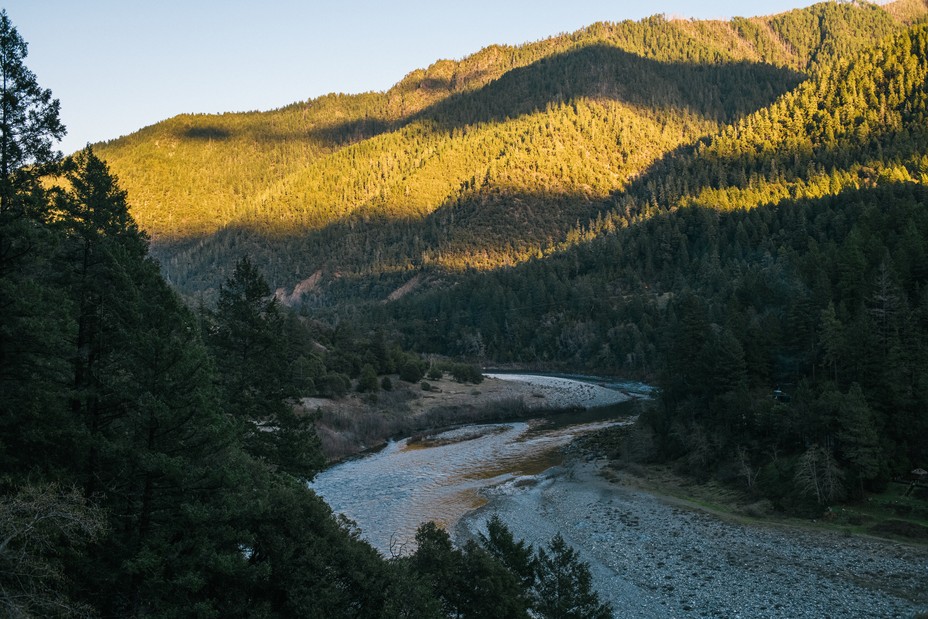
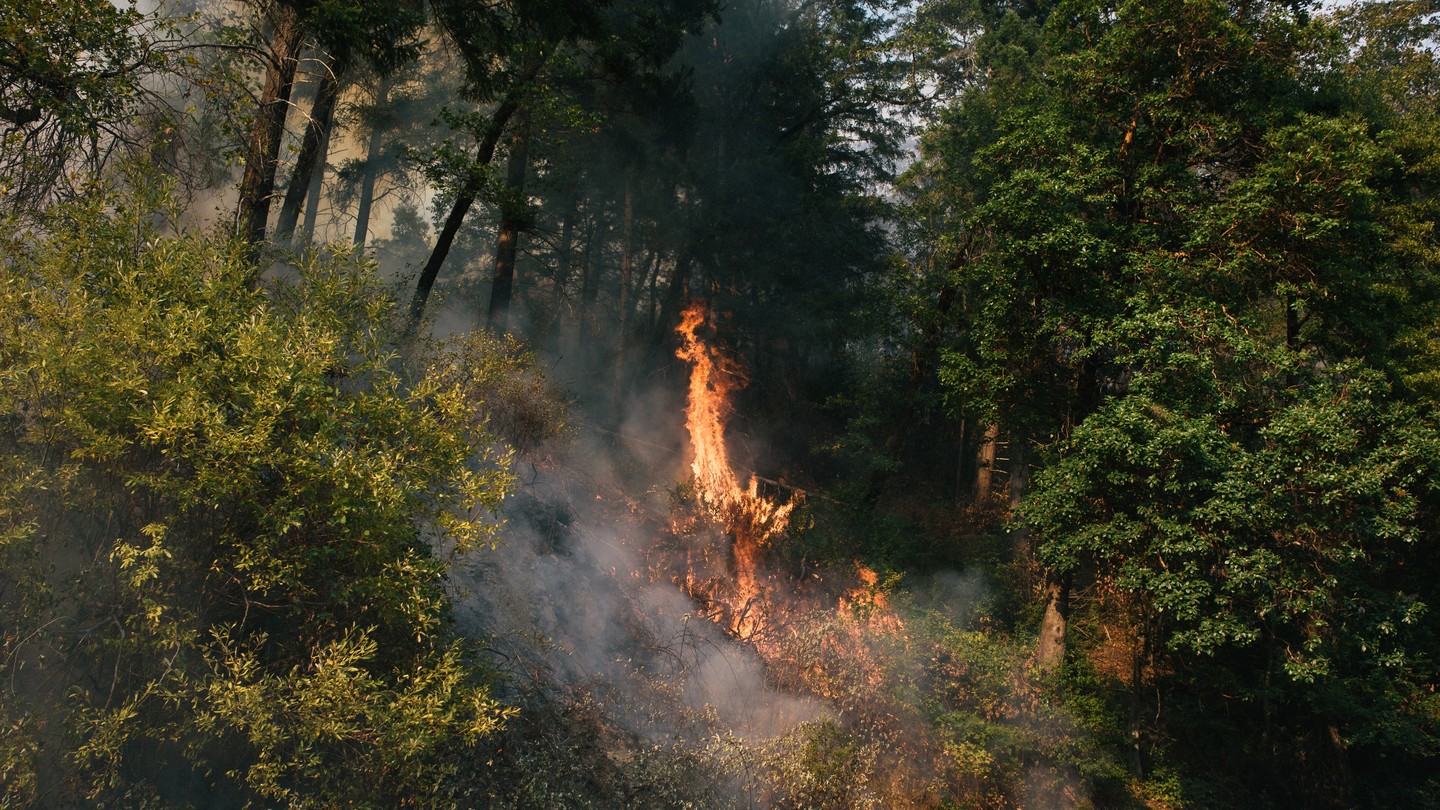
Picture of the view from Klamath from Orleans, California. Ancestral Karuk territory.

View of the Klamath from Orleans, California, ancestral Karuk territory. For millennia, the Yurok, Karuk and Hupa of northern California, and indigenous tribes worldwide, passed the use of fire down through generations as a means of land stewardship and survival. Light, frequent burning created fire-adapted landscapes.

I recall during the pandemic reading the work of Ferris Jabr, which expanded on our understanding of the social networking of trees, an idea I remain compelled by. Now he has a book,  adapted for The Atlantic. In the essay form he focuses on the value of indigenous knowhow handed down generation to generation for centuries. He  highlights how fire is a wild, powerful element of nature, wielded as a tool for stable life of ecosystem and society.

Picture of a fire from a drip torch during a cultural prescribed burn training

Detail of a landscape during a cultural prescribed burn training (TREX) hosted by the Cultural Fire Management Council and the Nature Conservancy in Weitchpec, California. (Alexandra Hootnick)

THE DEEP CONNECTION BETWEEN LIFE AND FIRE

How wildfire defines the world

Perched on a densely forested hill crisscrossed with narrow, winding, often unsigned roads, Frank Lake’s house in Orleans, California, is not easy to find. On my way there one afternoon in late October, I got lost and inadvertently trespassed on two of his neighbors’ properties before I found the right place. When Lake, a research ecologist for the United States Forest Service, and his wife, Luna, bought their home in 2008, it was essentially a small cabin with a few amenities. They expanded it into a long and handsome red house with a gabled entrance and a wooden porch. A maze of Douglas firs, maples, and oaks, undergrown with ferns, blackberries, and manzanitas, covers much of the surrounding area. Continue reading

Hortus Arboretum & Botanical Gardens

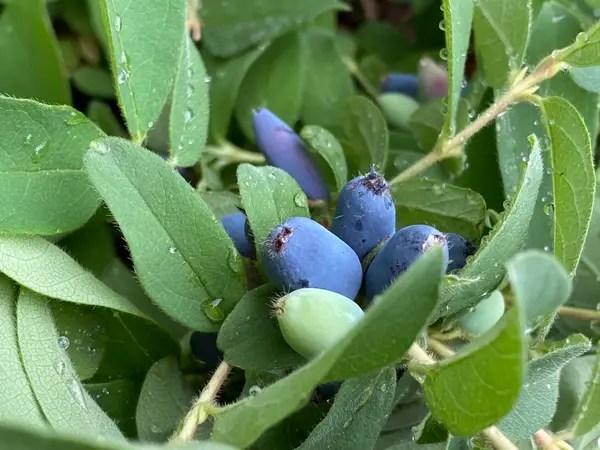
Allyson Levy and Scott Serrano describe their arboretum as “an aesthetically arranged experiment station to test interesting and useful plants” — like honeyberry, a honeysuckle relative with blue fruit that ripens very early. Hortus Arboretum & Botanical Gardens

Hortus is an inspiration. Our thanks, as always, to Margaret Roach for sharing on the broad and diverse topic of gardens and gardening:

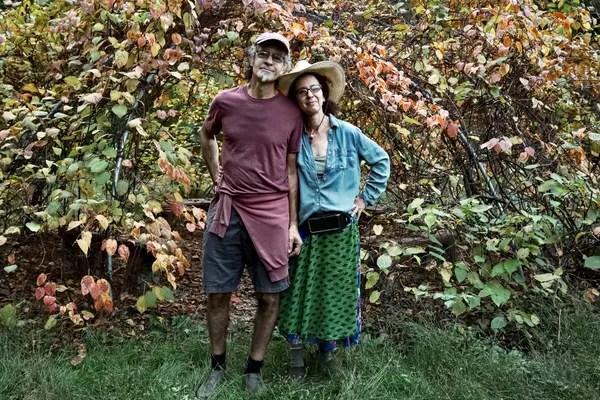
Ms. Levy and Mr. Serrano are visual artists who moved to Stone Ridge, N.Y., 25 years ago. Hortus Arboretum & Botanical Gardens, their 21-acre undertaking, began as a backyard garden. Mia Allen

How One Couple Turned Their Backyard Into an Arboretum

Their passion for fruit you’ve never heard of started small. Now they have a botanical garden that’s open to the public.

This is what happens if you stay put, and keep digging holes: An effort that begins innocently enough — planting a garden at home — may grow on you. And it could morph into an arboretum. Continue reading

Shrimp Transparency

Shrimp and transparent shrimp shells sitting on a white surface.We link to the work of Erik Vance for its clarity and utility:

Americans love their prawns. So how healthy are they — for us and for the planet?

Americans aren’t particularly enthusiastic about seafood. We eat less than half of what a Japanese or Indonesian person does. Less than a third of the average Icelander. But there is one big exception: shrimp. Continue reading

Romanian Bison & Carbon Sequestration

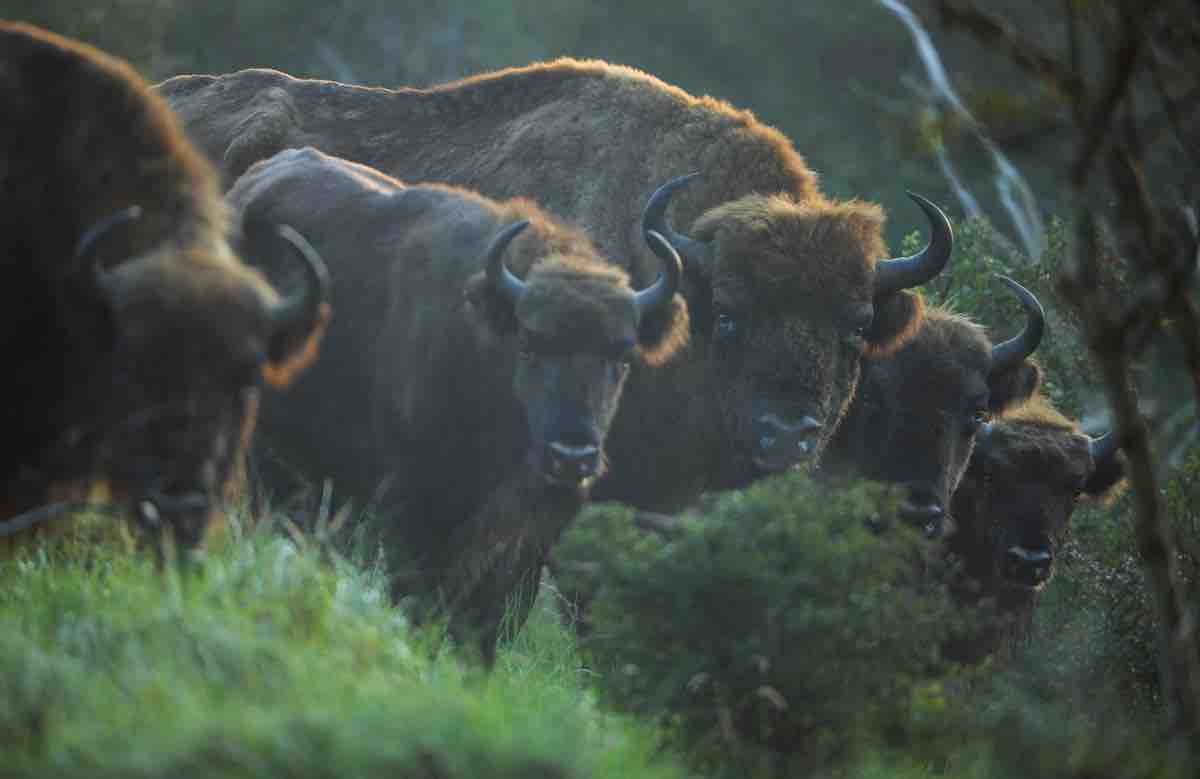
Bison (Bos Bonasus), Kennemerduinen National Park, Kraansvlak, The Netherlands. Enclousure in a fenced reserve, 250 hectar, in Kennemerduinen National Park. STAFFAN WIDSTRAND / REWILDING EUROPE

Bison restoration stories we have linked to are mostly in North America. But the Carpathian mountains have demonstrated Romania’s outsized efforts at rewilding. Now the largest such effort in Europe, according to Rewilding Europe, is this:

The goal of the Tarcu Mountains bison initiative is to help build a herd of at least 500 bison living in freedom by 2025 in the Southern Carpathians. This is an area spanning some 1.4 million hectares of wild mountains and valleys in the southern part of the Carpathian mountain chain.

Thanks to Yale e360 for more on this news from Romania.

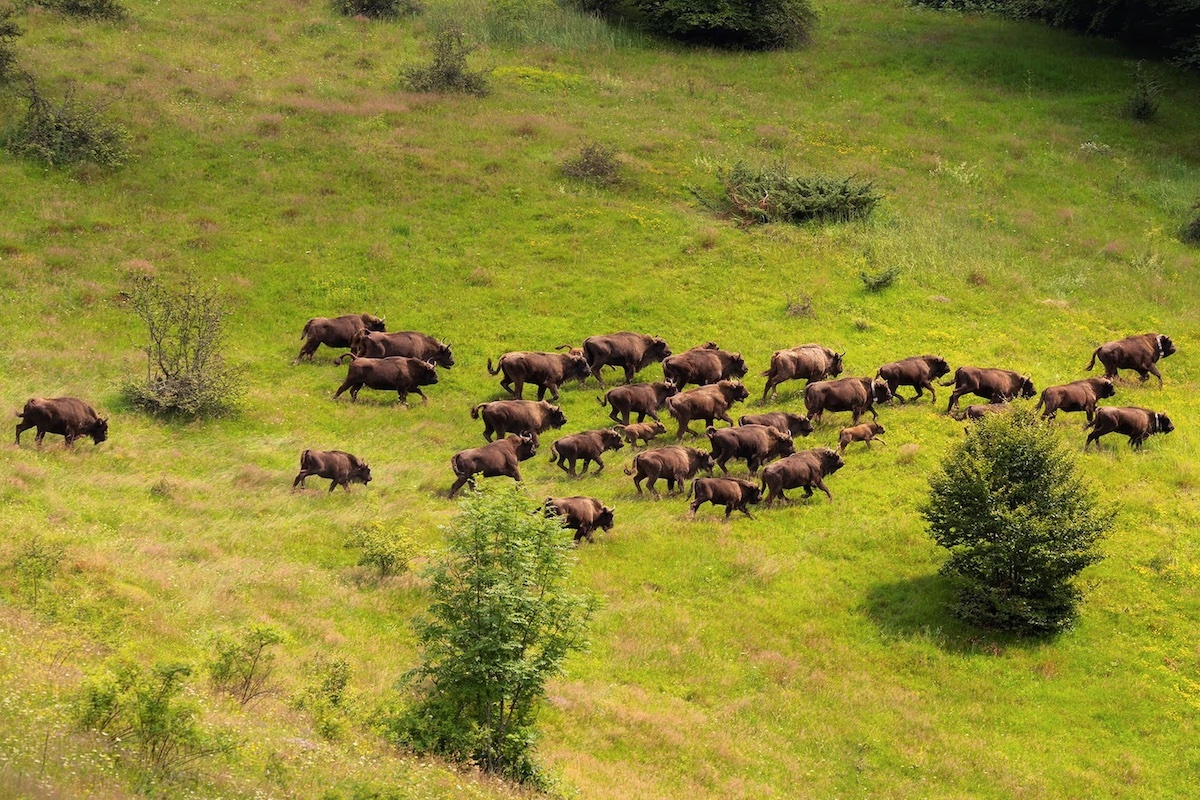
European bison in the Carpathian Mountains in Romania. DANIEL MIRLEA / WWF ROMANIA

How a Small Herd of Romanian Bison Is Locking Away Thousands of Tons of Carbon

Gone from Romania for 200 years, European bison were reintroduced to the Țarcu Mountains, at the southern end of the Carpathian range, in 2014. Now numbering 170, the bison are reshaping the mountain landscape in ways that are helping clean up emissions. Continue reading

Marsh Matters

Coastal marshlands exist in a precarious state: they need enough sediment to stay above water but not so much they get buried. In San Francisco Bay, the US Army Corps of Engineers and others are working to develop a less destructive way of giving marshes the mud they need. Photo by Aerial Archives/Alamy Stock Photo

For the record, marshes matter, so our thanks to Erica Gies, writing for Hakai:

Making a Marsh out of a Mud Pile

In San Francisco Bay, scientists are looking for a better way to rebuild flagging marshland.

The water in California’s San Francisco Bay could rise more than two meters by the year 2100. For the region’s tidal marshes and their inhabitants, such as the endangered Ridgway’s rail and the salt marsh harvest mouse, it’s a potential death sentence. Continue reading

Assisted Evolution

Photo illustration by Lauren Peters-Collaer

If conservation failure is an option, then assisted evolution is a necessary consideration. Emily Anthes walks us through the idea:

When traditional conservation fails, science is using “assisted evolution” to give vulnerable wildlife a chance.

Scientists are trying to save lowland Leadbeater’s possums, tree-dwelling marsupials known as forest fairies, by crossbreeding them with possums from a separate highland population, a strategy known as genetic rescue.

For tens of millions of years, Australia has been a playground for evolution, and the land Down Under lays claim to some of the most remarkable creatures on Earth.

It is the birthplace of songbirds, the land of egg-laying mammals and the world capital of pouch-bearing marsupials, a group that encompasses far more than just koalas and kangaroos. (Behold the bilby and the bettong!) Nearly half of the continent’s birds and roughly 90 percent of its mammals, reptiles and frogs are found nowhere else on the planet.

Australia has also become a case study in what happens when people push biodiversity to the brink. Continue reading

Illegal Miners Face The Fire

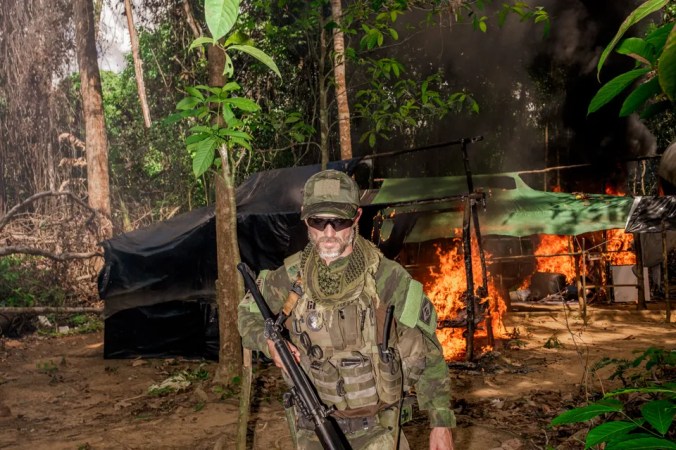
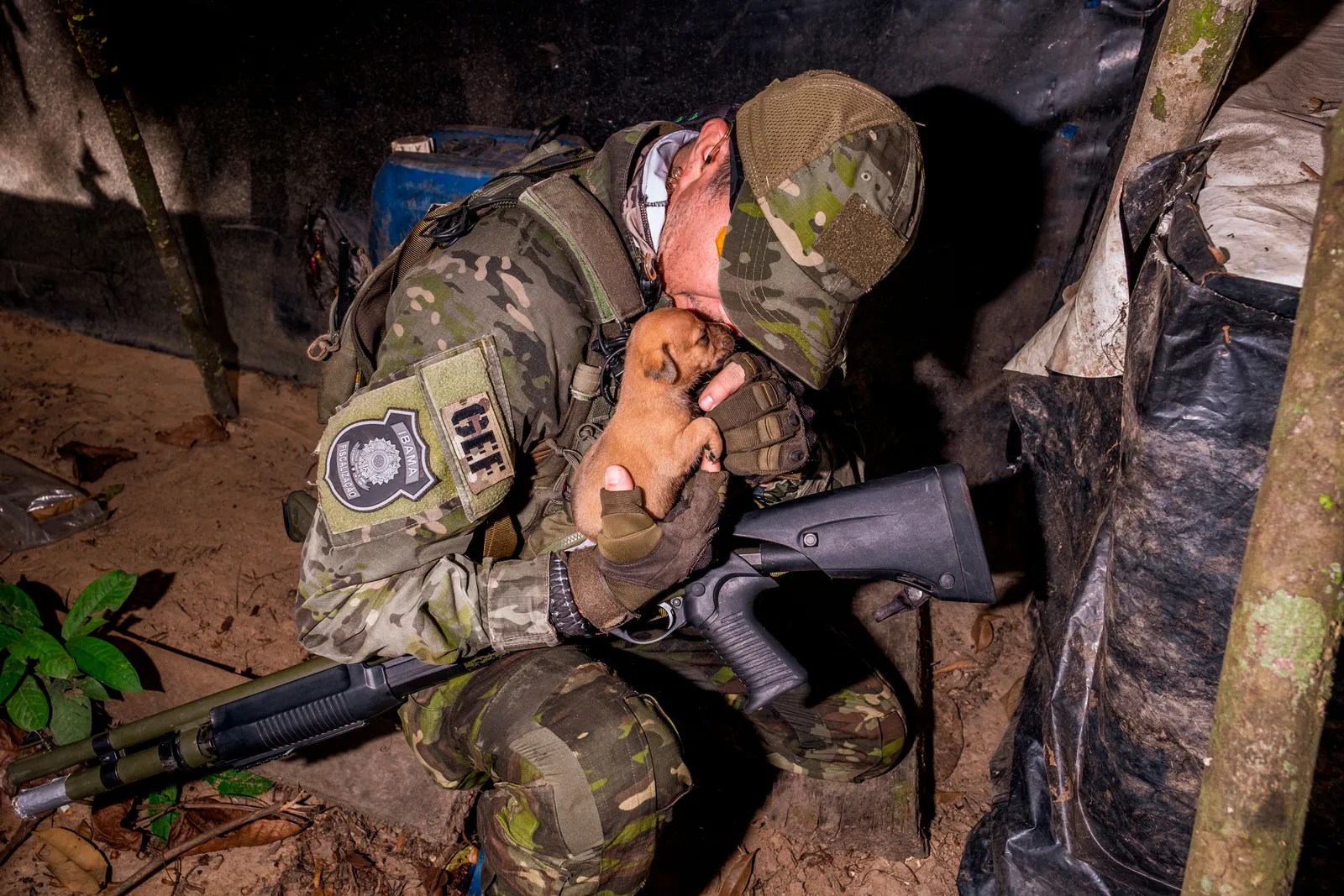
The G.E.F. burns mining camps as part of a long-running counteroffensive against environmental depredation. “Wherever they go, the miners destroy everything,” Felipe Finger, the unit’s leader, says. Photographs by Tommaso Protti for The New Yorker

Thanks to Jon Lee Anderson, as always, for his reporting from the danger zone that Brazil’s Amazon forest too often is:

The Brazilian Special-Forces Unit Fighting to Save the Amazon

As miners ravage Yanomami lands, combat-trained environmentalists work to root them out.

Roberto Cabral, a founder of the G.E.F., attends to a puppy discovered in a camp after miners fled.

In a clearing in the Brazilian Amazon, I stood with a group of armed men, discussing a viral TikTok video. The video, shot from a helicopter full of illegal miners, showed a vast stretch of rain forest, with dense foliage extending in all directions. The only sign of human habitation was below: a dirt circle surrounded by fanlike lean-tos made of wooden poles and palm fronds. It was a maloca, a traditional compound of the Yanomami, an Indigenous group that inhabits a remote territory in the rain forest of northern Brazil. Continue reading

Forest Adaptation Via Scientific Methodology

Scientists in northern Minnesota are exploring how to adapt forests for climate change, transitioning them to a warmer future by planting new mixes of southern seedlings. In this “transition test” in the Cutfoot Experimental Forest, forest ecologists thinned trees and planted seedlings of eight species, grown from seeds collected up to hundreds of miles to the south. CREDIT: BRIAN PALIK / USDA FOREST SERVICE

Thanks to John Tibbets and Knowable Magazine

This 8-year-old bitternut hickory, native to a milder climate to the south, is flourishing in northern Minnesota, notorious for long, intensely cold winters. CREDIT: BRIAN PALIK / USDA FOREST SERVICE

On a brisk September morning, Brian Palik’s footfalls land quietly on a path in flickering light, beneath a red pine canopy in Minnesota’s iconic Northwoods. A mature red pine, also called Norway pine, is a tall, straight overstory tree that thrives in cold winters and cool summers. It’s the official Minnesota state tree and a valued target of its timber industry.

But red pine’s days of dominance here could fade. In coming decades, climate change will make red pine and other Northwoods trees increasingly vulnerable to destructive combinations of longer, warmer summers and less extremely cold winters, as well as droughts, windstorms, wildfires and insect infestations. Climate change is altering ecological conditions in cold regions faster than trees can adapt or migrate. Continue reading

A Tiny Forest For Roosevelt Island

An artist’s rendering of the Manhattan Healing Forest. Courtesy of SUGi

Thanks to Cara Buckley for another in her long line of tree stories:

Coming Soon to Manhattan, a Brand-New Tiny Forest

Pocket-size forests filled with native plants have been embraced worldwide for their environmental benefits. Now one is planned for New York City.

A trend that’s gaining momentum around the world is set to finally arrive in Manhattan. It’s a tiny forest, to be planted on the southern end of Roosevelt Island, in the East River, this spring. According to its creators, it would be the first of its kind in the city and would consist of 1,000 native plants, trees and shrubs, covering just 2,700 square feet. Continue reading

A Century’s Evidence On The Benefits Of Planting Trees

People work to reforest Allegheny National Forest in Pennsylvania circa 1934.
Photograph: Universal History Archive/Universal Images Group via Getty Images

Planting trees, we have noted, is smart policy.  Some campaigns may have stretched beyond scientific evidence, but science has given us plenty to go on:

Very cool: trees stalling effects of global heating in eastern US, study finds

Vast reforestation a major reason for ‘warming hole’ across parts of US where temperatures have flatlined or cooled

Civilian Conservation Corps workers plant 15,000,000 trees across the wastelands of southern Mississippi on 11 April 1940. They are part of the United Forest Service which will re-establish forests destroyed by logging and lumbering operations decades ago. Photograph: AP

Trees provide innumerable benefits to the world, from food to shelter to oxygen, but researchers have now found their dramatic rebound in the eastern US has delivered a further, stunning feat – the curtailing of the soaring temperatures caused by the climate crisis.

While the US, like the rest of the world, has heated up since industrial times due to the burning of fossil fuels, scientists have long been puzzled by a so-called “warming hole” over parts of the US south-east where temperatures have flatlined, or even cooled, despite the unmistakable broader warming trend. Continue reading
Returning Golf Land To Nature

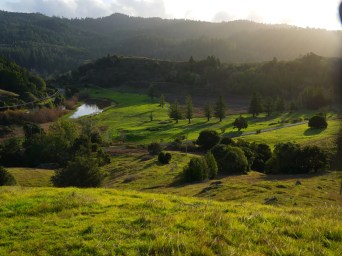
The San Geronimo Golf Course is being reclaimed and rewilded and is now known as San Geronimo Commons. Jim Wilson/The New York Times

Golf is known to be problematic. But then again, what is not problematic? And we appreciate seeing cases where golf gives way to nature. Our thanks to Cara Buckley for bringing this story to our attention in the New York Times. We applaud the imagination of those responsible:

After Shutting Down, These Golf Courses Went Wild

The restoration of the San Geronimo land is still underway. Trails are planned that would skirt sensitive habitat and help to make it starkly different from its time as a golf course. Jim Wilson / The New York Times Image

Most defunct golf courses get paved over, but a number are getting transformed into ecological life rafts for wildlife, plants — and people.

There was scraggly grass in one sand trap and wooden blocks and a toy castle in another, evidence of children at play. People were walking their dogs on the fairway, which was looking rather ragged and unkempt. This was only to be expected. Continue reading

Melipona Bees, A Peruvian Wonder

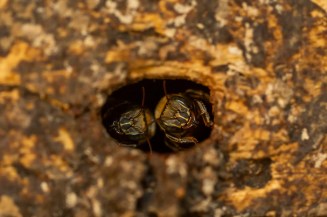
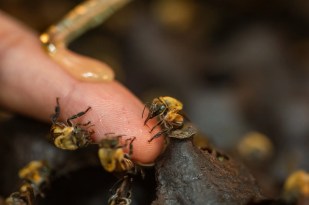
Melipona eburnea, a species of bee, is native to the Amazon. Unlike the more familiar but invasive honey bees from Africa and Europe that have spread through the Americas, these bees don’t sting. Ana Elisa Sotelo for National Geographic

The countless wonders of bees, as well as the many problems they now face, have made Melipona bees, also known as stingless bees, of particular interest to our daily scan for news stories:

Native to the tropics, these pollinators are taking a lead role in one of the latest efforts to conserve the Amazon rainforest.

Manatees, To Brighten Your Horizon

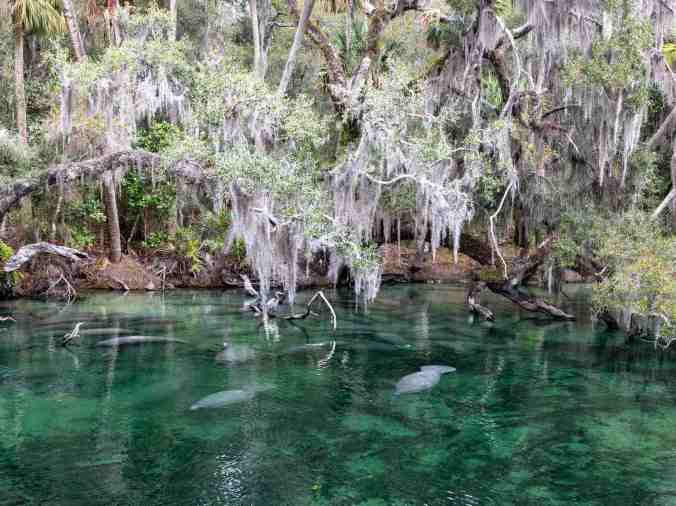
Manatees are generally solitary creatures, but tend to gather at warm water sites in the winter.
Florida State Parks

After a Kolbert doomcloud, a bit of sunshine is needed. Here it is in the form of creatures so charismatic they make you see something other than darkness. Thanks to National Public Radio (USA):

Legend has it that centuries ago, manatees used to be mistaken for mermaids, so a sight last week at one Florida state park would have put ancient sailors in shock.

Blue Spring State Park is home to one of the largest winter gathering sites for manatees in Florida, and recently, the park reached a new record when the number of manatees spotted in one group was nearly 1,000. Continue reading
A 20-Minute Read On Problematic Forest Management Policies

Elizabeth Kolbert always carries out her duty, which often makes it difficult to savor life’s small pleasures or even big victories without considering the law of unintended consequences. Give 20 minutes of your time to this one:

The Perverse Policies That Fuel Wildfires

Strategies intended to safeguard forests and homes have instead increased the likelihood that they’ll burn.

The provincial government of Alberta defines a “wildfire of note” as a blaze that could “pose a threat to public safety, communities or critical infrastructure.” Continue reading
Insects Love Solar Farms

A monarch caterpillar on a common milkweed leaf at a solar farm in Minnesota. LEE WALSTON / ARGONNE NATIONAL LABORATORY

We have already linked a couple of times to the multidimensional benefits of solar, and here is another dimension:

At Solar Farms Planted with Native Vegetation, Insects Flourish

To reach its climate goals, the U.S. will need to build solar arrays on some 15,000 square miles of land, an area larger than Maryland. Continue reading
Channeling Water Nature’s Way

Just as much as we want packaging of our drinking water to be carefully thought out, we also want the channeling of water to make sense:

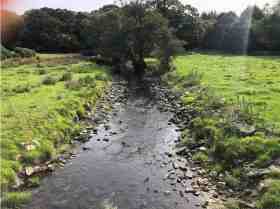
How the beck at James Robinson’s farm looked before the introduction of natural flood management techniques. Photograph: James Robinson

‘The wildlife that has come is phenomenal’: the UK farmers holding off floods the natural way

Planting trees, creating floodplains and rewilding rivers are among the new techniques being used to adapt to a heating climate

The streams, or becks, that run through James Robinson’s Lake District farm used to be cleaned out regularly – with vegetation yanked out and riverbeds dredged, or even completely filled in. Continue reading