Understanding That Recent Bird Crash

When news reports about this unusual event reached us, time was short. We did not have time to read any details, and now it is clear that waiting for science to comment was a useful delay.

Thanks to Juan Siliezar for the explanation:

iStock

Those birds that crashed and died? It wasn’t fumes

After internet theorists react to viral video, Harvard researchers answer with science

You’ve probably seen the video — or at least heard some chirpings about it.

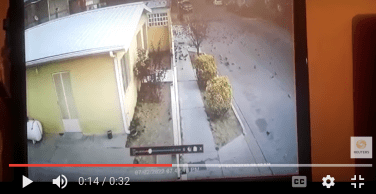
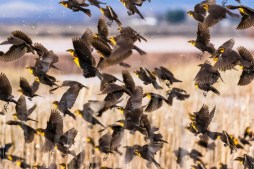
Footage from a security camera in Cuauhtémoc, a city in Chihuahua, Mexico, shows a massive flock of migratory birds swooping down like a cloud of black smoke and crashing onto pavement and the roof of a house. Continue reading

Frederick Law Olmsted At 200

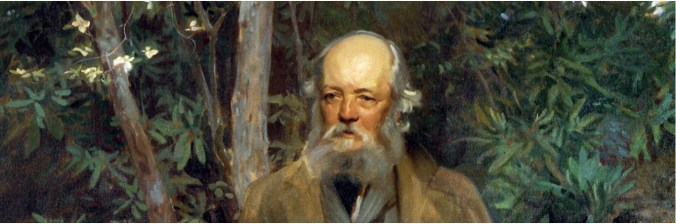
Portrait of Frederick Law Olmsted (detail), 1895, by John Singer Sargent (1856–1925); The Artchives/Alamy Stock Photo.

From Hedgehog Review, a bit of scholarly reflection on a man whose impact on the landscape of cityscapes is still worthy of consideration:

The Man Who Built Forward Better

On Frederick Law Olmsted’s Bicentennial

Witold Rybczynski

What would Frederick Law Olmsted (1822–1903) make of his works today, in the bicentennial year of his birth? No doubt he would be delighted by the survival and continued popularity of so many of his big-city parks, particularly Central Park and Prospect Park, but also parks in Boston, Chicago, and Montreal, as well as Buffalo, Detroit, Rochester, and Louisville. He might be surprised by the bewildering range of activities these parks now accommodate—not only boating and ice-skating, as in his day, but exercising, jogging, picnicking, and games, as well as popular theatrical and musical events. I don’t think this variety would displease him. After all, it was he who introduced free band concerts in Central Park, over the objections of many of his strait-laced colleagues. He would be pleased by the banning of automobiles; his winding carriage drives were never intended for fast—and noisy—traffic. Continue reading

Maori Tree-Saving

Tourists visiting Tāne Mahuta, the largest known kauri tree, in Waipoua Forest in New Zealand. The tree is named for a god in Māori mythology. Ruth Mcdowall for The New York Times

A former kauri ambassador blowing a conch shell near Tāne Mahuta. There’s hope among advocates that Māori-led interventions have created enough time for scientists to save the kauri. Ruth Mcdowall for The New York Times

Thanks to Pete McKenzie for this story, How Maori Stepped In to Save a Towering Tree Crucial to Their Identity, in the New York Times:

Tāne Mahuta, an ancient tree named after the god of forests in Māori mythology, is threatened by the slow creep of an incurable disease.

WELLINGTON, New Zealand — In an ancient grove in northern New Zealand, the mighty conifer known as Tāne Mahuta, lord of the forest, is threatened by the encroachment of a deadly enemy. Continue reading

Jumpstarting System Change

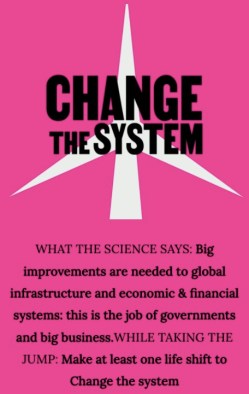
So many things to change, so little time. If you are looking for a way to jumpstart a change to the system, consider these six lifestyle adjustments (thanks to the Guardian for the feature story on Jump):

From using smartphones for longer to ending car ownership, research shows ‘less stuff and more joy’ is the way forward

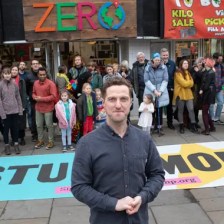
Founder of the Jump campaign Tom Bailey. Photograph: Andy Hall/The Observer

Research shows that people in wealthier, high-consuming countries can help avert climate breakdown by making six relatively straightforward lifestyle changes, creating a society of “less stuff and more joy”.

Experts say if enacted these “shifts” would account for a quarter of the required emissions reductions needed to keep the global heating down to 1.5C and increase pressure on government and the private sector to make the necessary far-reaching systemic change. Continue reading

Seeding Clouds To Relieve Megadrought

Cloud seeding equipment on the wing of plane flying over North Dakota. JIM BRANDENBURG VIA MINDEN PICTURES

Times are tough with regard to water, among other things. Tough times call for creative measures. Be creative, but also beware of unintended consequences:

Can Cloud Seeding Help Quench the Thirst of the U.S. West?

In the midst of an historic megadrought, states in the American West are embracing cloud seeding to increase snow and rainfall. Recent research suggests that the decades-old approach can be effective, though questions remain about how much water it can wring from the sky.

Not since Charlemagne was crowned Holy Roman Emperor in 800 A.D. has the American West been so dry. Continue reading

Circularity & The Future Of Recycling Plastic

Getty

Since our earliest days we have had team members searching for news on the subject of plastic, and what to do about it. The Atlantic, publishing an article by Ula Chrobak that was originally featured in Undark, points out The False Promise of Plastic Recycling:

A French company has a new solution to the plastic problem. Not everyone is buying it.

Since the first factories began manufacturing polyester from petroleum in the 1950s, humans have produced an estimated 9.1 billion tons of plastic. Of the waste generated from that plastic, less than a tenth of that has been recycled, researchers estimate. Continue reading

Less Beef Is Better, No Beef Is Best

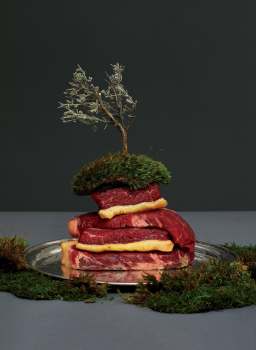
A beef rib lifter stacked with strip steak and a sagebrush tree. Photograph by Kyoko Hamada. Styled by Martin Bourne

The photo to the left might have appealed to me last year or earlier. But having tried giving up beef for so long, and finally prevailing, now it has no appeal. It does not disgust me, but I expect to get there.

Ligaya Mishan’s article What Does the End of Beef Mean for Our Sense of Self? has excellent photography by Kyoko Hamada.

My highest compliment is reserved for the stylist Martin Bourne, for making the photos just slightly creepy, matching my current emotional response to looking at beef.
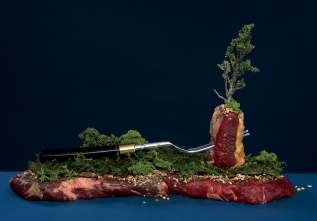
Strip steaks alongside a piece of sirloin tip. Photograph by Kyoko Hamada. Styled by Martin Bourne

When it comes to America’s legacy of Manifest Destiny, there’s perhaps no meal more symbolic than a bleeding steak. So who are we now that we’re consuming less red meat?

MEAT IS PRIMAL, or so some of us think: that humans have always eaten it; that it is the anchor of a meal, the central dish around which other foods revolve, like courtiers around a king; that only outliers have ever refused it. But today, those imagined outliers are multiplying. The United Nations Food and Agriculture Organization reports that the consumption of beef per capita worldwide has declined for 15 years. Nearly a fourth of Americans claimed to have eaten less meat in 2019, according to a Gallup poll. The recipe site Epicurious, which reaches an audience of 10 million, phased out beef as an ingredient in new recipes in 2020. Continue reading

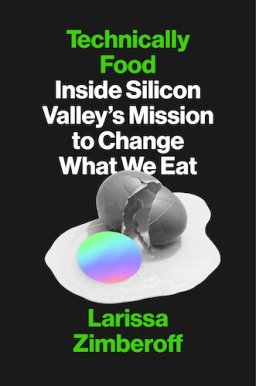
Technically Food

We instinctively favor real food, but this author’s book has our attention:

The inside story of the paradigm shift transforming the food we eat, and the companies behind it.

Eating a veggie burger used to mean consuming a mushy, flavorless patty that you would never confuse with a beef burger. But now products from companies like Beyond Meat, Impossible Foods, and Eat Just that were once fringe players in the food space are dominating the media, the refrigerated sections of our grocery stores, and, increasingly, the world. With the help of scientists working in futuristic labs––making milk without cows, and eggs without chickens––startups are creating wholly new food categories. Real food is being replaced by high-tech. Continue reading

Stenophylla, A Coffee With Real Potential & Poster Child For Food Diversity

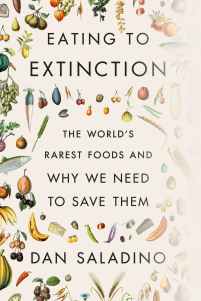
Our thanks to Dan Saladino, a food journalist and author of Eating to Extinction: The World’s Rarest Foods and Why We Need to Save Them as well as recipient of a James Beard Award for food journalism.

He offers an inside look at a relatively unknown coffee varietal with potential, and at the same time, an argument in favor of diversity, in his article Edible Extinction: Why We Need to Revive Global Food Diversity:

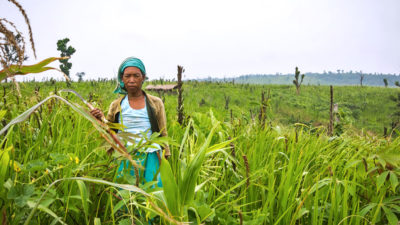
A Khasi farmer growing millet in Meghalaya, India.

A Khasi farmer growing millet in Meghalaya, India. NORTH EAST SLOW FOOD & AGROBIODIVERSITY SOCIETY

The Green Revolution helped feed a surging global population, but at the cost of impoverishing crop diversity. Now, with climate change increasingly threatening food supplies, the need for greater agricultural resilience means restoring endangered crop and food varieties.

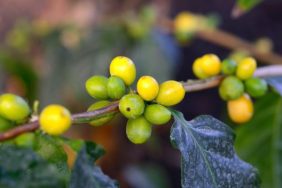
Stenophylla beans up close. RBG KEW; KLAUS STEINKAMP / ALAMY

In August 2020, inside the cupping room of a London roastery, a team of botanists and baristas gathered to taste a coffee species that most believed had been lost forever. It was an important moment. Coffee experts had spent years searching in West Africa for the few remaining trees of this species, even issuing “wanted posters” to farmers asking if they had seen it. Continue reading

Plastic, The Gift That Keeps Giving

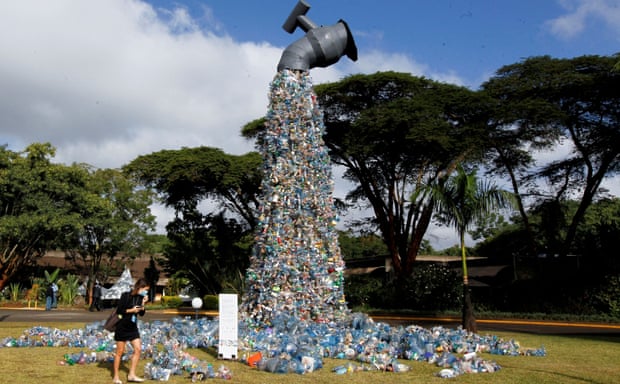
An artwork at the Nairobi summit venue by the artist Benjamin von Wong, made with rubbish from Kibera slum, urging people to ‘turn off the plastic tap’. Photograph: Monicah Mwangi/Reuters

We have endless opportunities to demonstrate leadership, thanks to plastic:

World leaders agree to draw up ‘historic’ treaty on plastic waste

UN environment assembly resolution is being hailed as biggest climate deal since 2015 Paris accord

World leaders, environment ministers and other representatives from 173 countries have agreed to develop a legally binding treaty on plastics, in what many described a truly historic moment. Continue reading