Having arrived in the country via the Spanish Conquest, the grain’s presence poses the question: What’s native, and what isn’t, when it comes to a nation’s culinary history?
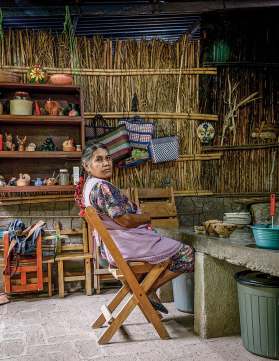
Margarita Navarro Gómez sits in one of her three kitchens at home in the village of Santo Tomás Jalieza, just outside of Oaxaca, where she lives with her two sisters, Crispina and Inés. The three siblings are known for their hand-woven textiles and for their homemade version of the rice-based beverage horchata. Stefan Ruiz
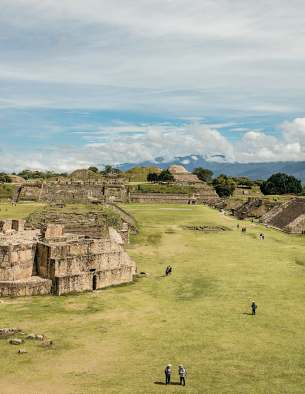
I ARRIVED IN Oaxaca on a rainy afternoon in May. We flew over pleated hills that formed a girdle around the Oaxaca valley, one of the most fertile variegated soils in the world. The earth was stamped with cloud shadows that gave an impression both of movement and fixity — a rich, dark earth with an inner seam that showed red and metallic in places. The shadow of the plane, like a fighter escort, followed us as we descended, then was subsumed by the rain-drenched tarmac. The sky was full of light. Leaving the small white airport, we passed a palisade of organ pipe cactuses. There was blue-leaved agave in the traffic islands and, lining the streets, the trees of my childhood in Delhi — flamboyant, laburnum, jacaranda — were in flower. A nondescript modern town of brightly shuttered shops, auto repair and signs that read “aluminio y vidrio” gave way to a fully intact Spanish colonial town from the 16th century. “Downtown: local people,” my driver said, observing the change, “centro histórico for foreign people.”
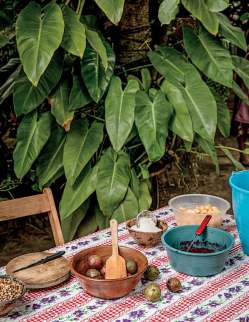
Some of the raw ingredients for horchata, including (from left) walnuts, prickly pear, prickly pear pulp, sugar and melon, which are later added to a mixture of ground rice and cinnamon. Stefan Ruiz
We came along large-stoned cobbled streets and single-story buildings painted in warm shades of ocher and that famous Oaxacan color — a carmine, drawn from the cochineal, a cactus-dwelling insect, which, with the addition of a single drop of lemon juice, turns into one of the most seductive reds known to man. There is no place, not even India, where the use of color produces as beguiling a mixture of gaiety and melancholy as Mexico. The British writer Rebecca West, who was here in the 1960s, has a description in “Survivors in Mexico” (2003) that cannot be bettered: “Here these walls are painted colors that are special to Mexico, touching variants of periwinkle blue, a faded acid pink, the terra-cotta one has seen on Greek vases, a tear-stained elegiac green.” Continue reading →
 Moosewood has been mentioned, along with its cookbooks, and we have featured plenty of other stories about veg-forward diets and related cookbooks; so it is odd that neither this book nor its author have featured in our pages before. Just in time to celebrate five decades, a fitting tribute to its author:












 Organikos