Glass Origins

This glass fish was found in a fairly modest private house in Amarna, buried under a plaster floor along with a few other objects. It may once have contained ointment. The Trustees of the British Museum

We have featured stories about artisanal glass in the previous posts but this time the story is about the origins of the substance:

A Brief Scientific History of Glass

Featuring ingots, shipwrecks and an international trade in colors, the material’s rich past is being traced using modern archaeology and materials science

Blue glass ingots from the Uluburun shipwreck. Panegyrics of Granovetter / Flickr

Today, glass is ordinary, on-the-kitchen-shelf stuff. But early in its history, glass was bling for kings.

Thousands of years ago, the pharaohs of ancient Egypt surrounded themselves with the stuff, even in death, leaving stunning specimens for archaeologists to uncover. King Tutankhamen’s tomb housed a decorative writing palette and two blue-hued headrests made of solid glass that may once have supported the head of sleeping royals. His funerary mask sports blue glass inlays that alternate with gold to frame the king’s face. Continue reading

More Trees Now

A hazel sapling (Corylus avellana) in the ditches of the tree hub at Amsterdamse Bos. Photograph: Judith Jockel/The Guardian

The trillion trees concept, which inspires but has had its share of legitimate questions, has a scrappy cousin with a novel approach:

‘Every tree counts’: Dutch come up with cunning way to create forests for free

More Trees Now aims to give away 1m unwanted saplings to farmers and councils with hope idea will spread across Europ

Hanneke van Ormondt saves a sapling at the tree hub in Amsterdamse Bos, Amsterdam, the Netherlands. Photograph: Judith Jockel/The Guardian

In a clearing in the Amsterdamse Bos, a forest on the outskirts of the Dutch capital, is a “tree hub” where hundreds of saplings, among them hazelnut, sweet cherry, field maple, beech, chestnut and ash, are organised by type.

The idea behind it is simple: every day unwanted tree saplings were being cleared and thrown away when those young trees could be carefully collected and transplanted to where they are wanted. Continue reading
Fixing Carbon Offset Markets

A steel re-rolling mill in Narayanganj, Bangladesh. Well-designed carbon markets could spur companies in developing countries to reduce emissions. AHMED SALAHUDDIN / NURPHOTO VIA AP

Thanks to Yale e360 for this opinion on a hot topic that we have sometimes mused less seriously about:

How to Repair the World’s Broken Carbon Offset Markets

Markets that connect businesses hoping to offset their carbon emissions with climate change mitigation projects have been plagued by problems. But an economist and his co-authors argue that carbon markets can be reformed and play a significant role in slowing global warming

In the wake of the Glasgow climate summit, governments must now return to the daunting challenge of making good on their emissions-reductions pledges, which at this point remain insufficient to hold warming below 2 or even 1.5 degrees C above pre-industrial levels. Continue reading
Thanksgiving, Organikos & Authentica At Year 3

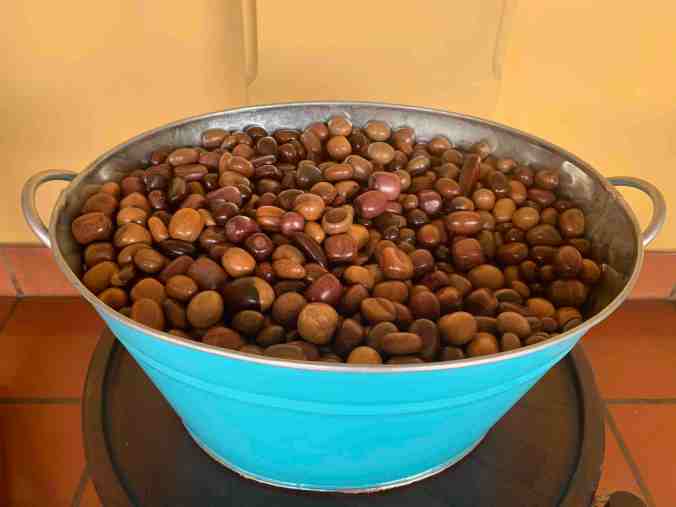
Introduced at the Authentica shops in Costa Rica on Thanksgiving Day, 2021

The base of the lamp at my desk is a ceramic bird that serves as a year-round reminder of Thanksgiving. And the ceramic coffee artifacts on my desk serve the same purpose, reminding me each time I sit to work that there are constantly plenty of reasons to give thanks.

We opened two Authentica shops in Costa Rica on Thanksgiving weekend 2019. Sophomore year for both Organikos and Authentica was mettle-testing. We passed. If flying colors were not evident enough in how we passed, here they are in the label for our newest coffee. First introduced last month to a group of students at Cornell University, whose tasting notes we have appreciated receiving, as of today it is available in our shops in Costa Rica.

So, thanks for all that.

In The UK, Trees Say I Love You

One of the National Trust’s tree-planting projects, at Kingston Lacy in Dorset. Its Plant a Tree appeal has topped £1m. Photograph: James Dobson/National Trust/PA

Planting trees is part of our business model. So, we love this news:

Forget flowers – poll shows third of people prefer to say I love you with a tree

National Trust says tree giving growing in popularity but only 7% know best season to plant

A National Trust ranger, David Smith, preparing saplings for planting at Hafod Garegog in north Wales. Photograph: Paul Harris/National Trust/PA

For centuries people have said it with flowers but research suggests a new tradition is gaining popularity in the UK – expressing love, thanks, perhaps even regret with the gift of a tree.

A third of people said they would consider saying it with a tree rather than a bouquet and more than one in 10 had already done so, according to the research commissioned by the National Trust.

However, the conservation charity also said only 7% of people in the UK knew the best time of year to plant, and it was launching a drive to improve “tree literacy”. Continue reading

More Solar Canopy Initiatives

A solar-covered parking lot at the plant of Anhui Quanchai Engine Co., Ltd. in Chuzhou, China. IMAGINECHINA VIA AP IMAGES

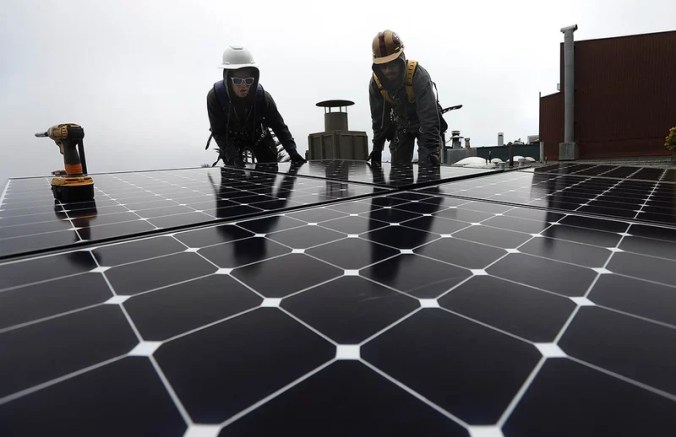
Using solar panels to create shade for coffee trees requires thought about the tradeoffs between the non-shade benefits trees otherwise provide: (nitrogen-fixing in the case of poro trees, plus bird habitat and other biodiversity benefits) and the non-shade benefits that solar panels provide (renewable energy). Solar panels on parking lots and other roofs, on the other hand, seems the definition of a no-brainer. Our thanks to Richard Conniff and Yale e360, as always:

Why Putting Solar Canopies on Parking Lots Is a Smart Green Move

Solar farms are proliferating on undeveloped land, often harming ecosystems. But placing solar canopies on large parking lots offers a host of advantages — making use of land that is already cleared, producing electricity close to those who need it, and even shading cars.

A solar parking facility at Rutgers University in Piscataway, New Jersey, with an output of 8 megawatts of electricity.

Fly into Orlando, Florida, and you may notice a 22-acre solar power array in the shape of Mickey Mouse’s head in a field just west of Disney World. Nearby, Disney also has a 270-acre solar farm of conventional design on former orchard and forest land. Park your car in any of Disney’s 32,000 parking spaces, on the other hand, and you won’t see a canopy overhead generating solar power (or providing shade) — not even if you snag one of the preferred spaces for which visitors pay up to $50 a day. Continue reading
Solar Canopy + Bellwether Roaster = Interesting Option

As we consider new canopy options, a switch to electric roasting of Organikos coffee also seems clearly worthy of consideration. I just found out about this company, and its sustainability report from last year puts it high on my list of roasters to consider:

Letter from Bellwether

We would be remiss to start our Sustainability Report without acknowledging what a crazy year 2020 was. A global pandemic forced many of our customers, like other businesses across the world, to close their doors. Continue reading

Diet For A Small Planet, Five Decades And Counting

Moosewood has been mentioned, along with its cookbooks, and we have featured plenty of other stories about veg-forward diets and related cookbooks; so it is odd that neither this book nor its author have featured in our pages before. Just in time to celebrate five decades, a fitting tribute to its author:

Frances Moore Lappé’s last hamburger was in 1971, the same year she published “Diet for a Small Planet,” her hugely influential book about food and sustainability, which virtually created the publishing category of food politics and turned Ms. Lappé into what she once self-deprecatingly called “the Julia Child of the soybean circuit.” Continue reading

BioInvention Is The Thing

Recycling Is Not Sufficient

We just attended an event that has been held each recent (non-pandemic) year in November, in Spanish called ExpoPYME. Small and medium sized companies are invited to show their products, and we like the messaging that this artisan had on a couple t-shirts.

Take Care Of The Environment

BioInventate is not an actual word in Spanish, yet. But if this campaign catches on it will be because more and more people are aware of the need to invent solutions to ecological problems.

Thanks Big Oil, We Got Your Messages

Illustration: Guardian Design

Geoffrey Supran and Naomi Oreskes have compiled reminders of the messaging from some of big oil’s leaders of climate change messaging, and shared it with us in the Guardian:

The forgotten oil ads that told us climate change was nothing

Since the 1980s, fossil fuel firms have run ads touting climate denial messages – many of which they’d now like us to forget. Here’s our visual guide

Both ads from the Informed Citizens for the Environment, 1991

Why is meaningful action to avert the climate crisis proving so difficult? It is, at least in part, because of ads.

The fossil fuel industry has perpetrated a multi-decade, multibillion dollar disinformation, propaganda and lobbying campaign to delay climate action by confusing the public and policymakers about the climate crisis and its solutions. This has involved a remarkable array of advertisements – with headlines ranging from “Lies they tell our children” to “Oil pumps life” – seeking to convince the public that the climate crisis is not real, not human-made, not serious and not solvable. The campaign continues to this day. Continue reading