Becoming Earth, Adapted In Essay Form

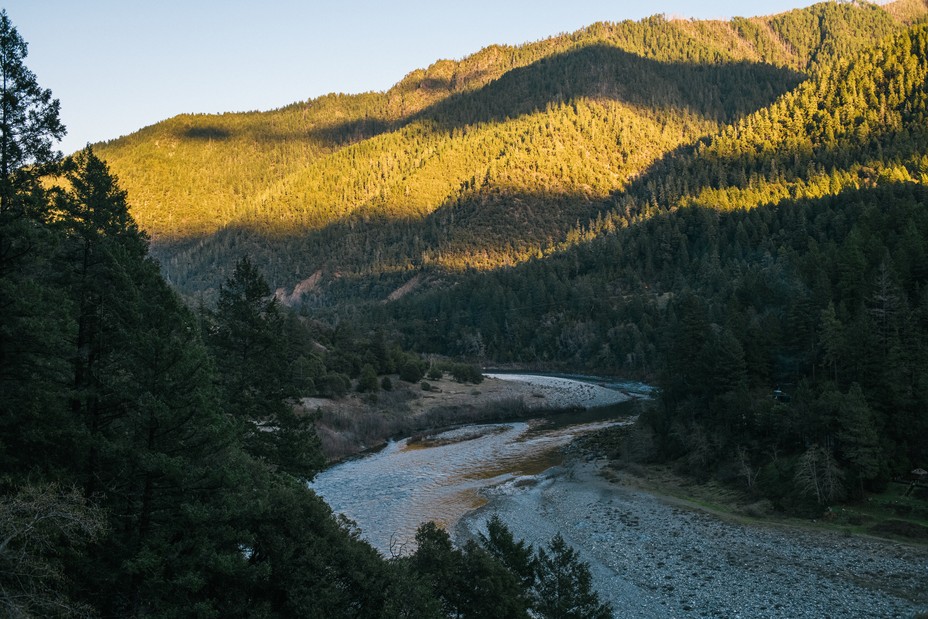
Picture of the view from Klamath from Orleans, California. Ancestral Karuk territory.

View of the Klamath from Orleans, California, ancestral Karuk territory. For millennia, the Yurok, Karuk and Hupa of northern California, and indigenous tribes worldwide, passed the use of fire down through generations as a means of land stewardship and survival. Light, frequent burning created fire-adapted landscapes.
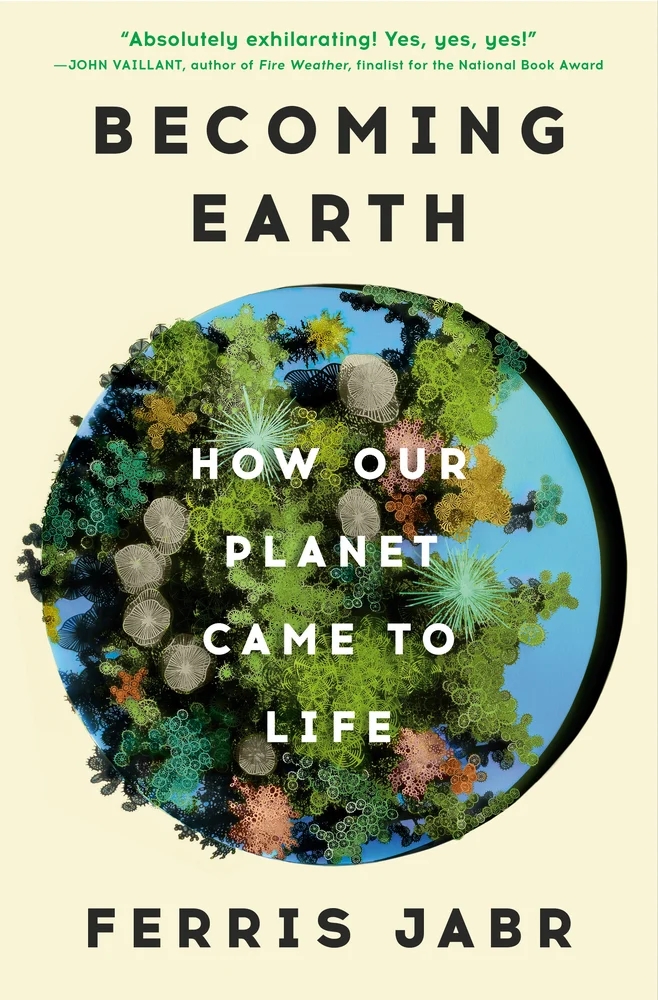
I recall during the pandemic reading the work of Ferris Jabr, which expanded on our understanding of the social networking of trees, an idea I remain compelled by. Now he has a book,  adapted for The Atlantic. In the essay form he focuses on the value of indigenous knowhow handed down generation to generation for centuries. He  highlights how fire is a wild, powerful element of nature, wielded as a tool for stable life of ecosystem and society.

Picture of a fire from a drip torch during a cultural prescribed burn training

Detail of a landscape during a cultural prescribed burn training (TREX) hosted by the Cultural Fire Management Council and the Nature Conservancy in Weitchpec, California. (Alexandra Hootnick)

THE DEEP CONNECTION BETWEEN LIFE AND FIRE

How wildfire defines the world

Perched on a densely forested hill crisscrossed with narrow, winding, often unsigned roads, Frank Lake’s house in Orleans, California, is not easy to find. On my way there one afternoon in late October, I got lost and inadvertently trespassed on two of his neighbors’ properties before I found the right place. When Lake, a research ecologist for the United States Forest Service, and his wife, Luna, bought their home in 2008, it was essentially a small cabin with a few amenities. They expanded it into a long and handsome red house with a gabled entrance and a wooden porch. A maze of Douglas firs, maples, and oaks, undergrown with ferns, blackberries, and manzanitas, covers much of the surrounding area. Continue reading
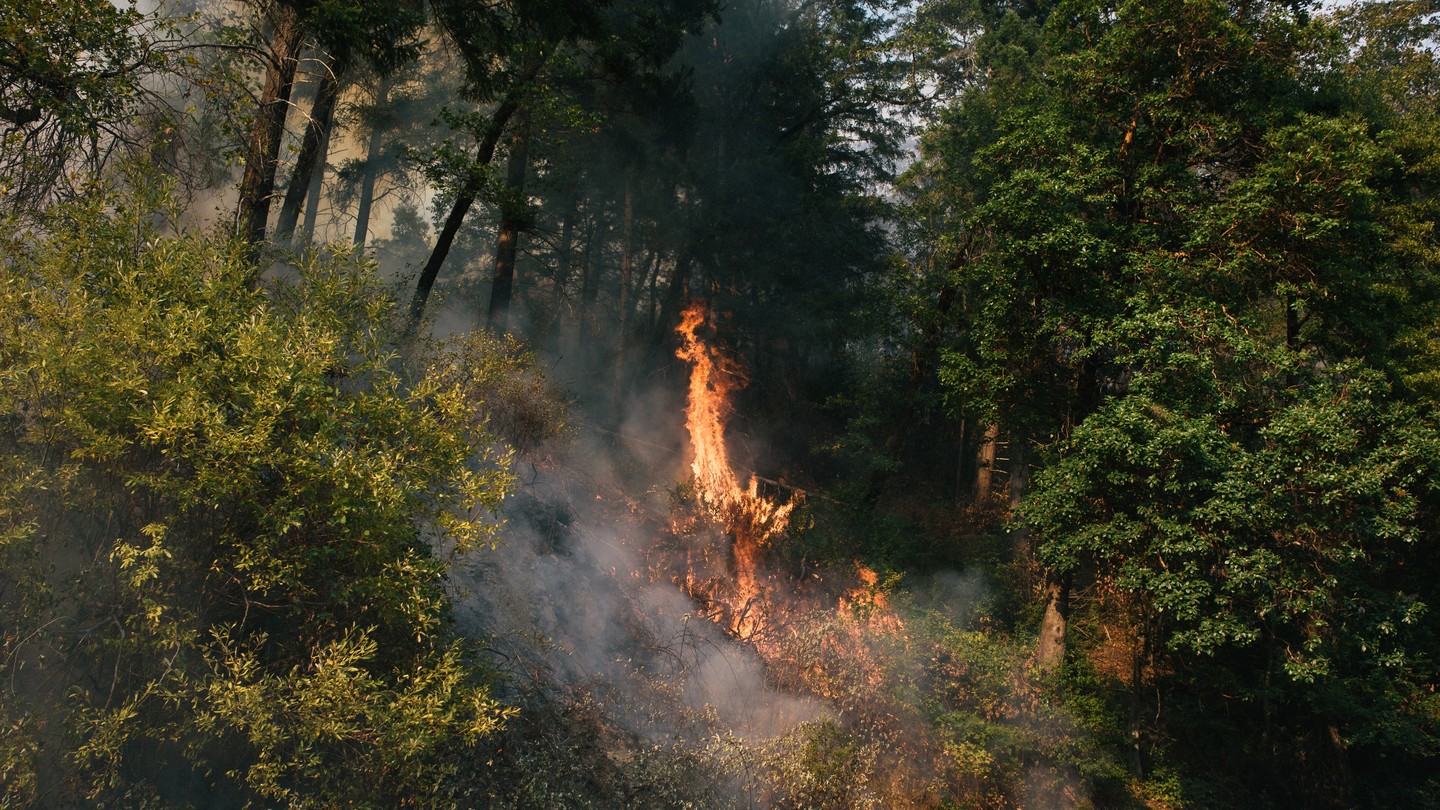
Dickson D. Despommier Discussing The New City Concept

The vertical farming part of this concept is one we have linked to many times. The appeal is not difficult to grasp even if sometimes the concept is stretched. This is different and worth hearing him out:

Dickson Despommier Wants Our Cities to Be Like Forests

A leading proponent of vertical farming discusses how urban areas should adapt to a perilous environmental future.

Illustration by Daniele Castellano

In 2000, Dickson D. Despommier, then a professor of public health and microbiology at Columbia University, was teaching a class on medical ecology in which he asked his students, “What will the world be like in 2050?,” and a follow-up, “What would you like the world to be like in 2050?” As Despommier told The New Yorker’s Ian Frazier in 2017, his students “decided that by 2050 the planet will be really crowded, with eight or nine billion people, and they wanted New York City to be able to feed its population entirely on crops grown within its own geographic limit.” Continue reading

Niemann On Earth

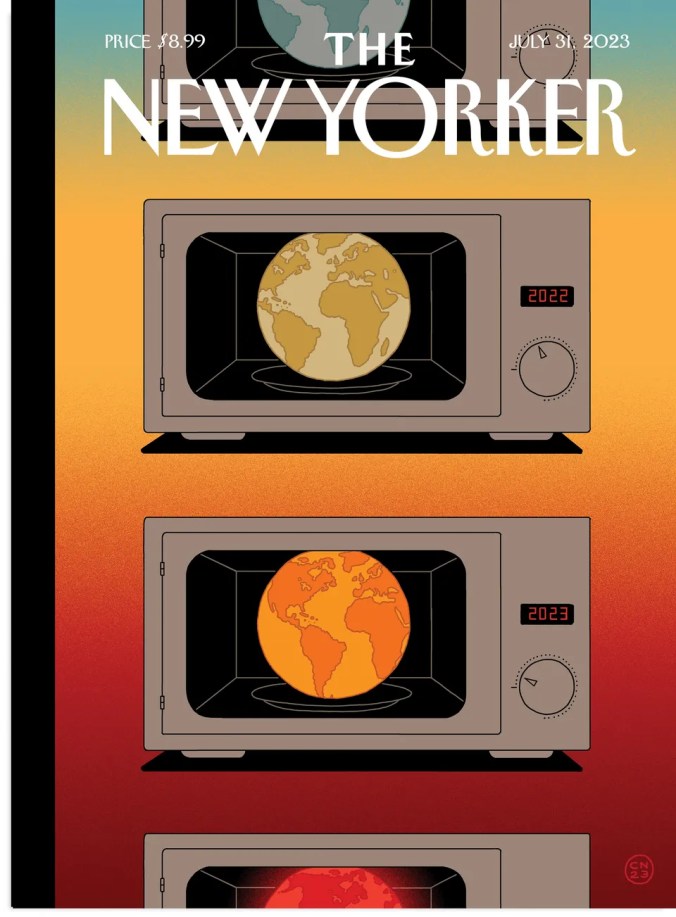
We have referenced Françoise Mouly once before, but the art of Christoph Niemann many more times. This one is not fun, more of a gut punch; but at the source scroll down and see all the other covers on the same theme:

Christoph Niemann’s “Recipe for Disaster”

The artist expresses his sense of urgency about the emergency unfolding all around us.

News cycles, by nature, tend to document crises as discrete events. Suffusive emergencies—like the climate crisis—are captured mostly in the accelerating pace and frequency of such coverage. Continue reading
Climate Optimism, Part 2

Hilary Swift for The New York Times

Bill McKibben’s occasional optimism notwithstanding, he and Al Gore are the two most visible alarmists on climate change. Even in the worst of circumstances both find reason to point out our remaining options for actually doing something.

Our thanks to David Gelles and the New York Times for rounding out the doom and gloom with a bit of hope:

Al Gore on Extreme Heat and the Fight Against Fossil Fuels

The past few weeks have him even more worried than usual.

It’s been 17 years since former Vice President Al Gore raised the alarm about climate change with his documentary, “An Inconvenient Truth.” Since then, he’s been shouting from the rooftops about the risks of global warming more or less nonstop. Continue reading
Climate Optimism Part 1

Illustration by João Fazenda

Bill McKibben acknowledges in his most recent newsletter that in spite of all his efforts over the decades, he and we all are failing on climate change mitigation. But he has not given up hope:

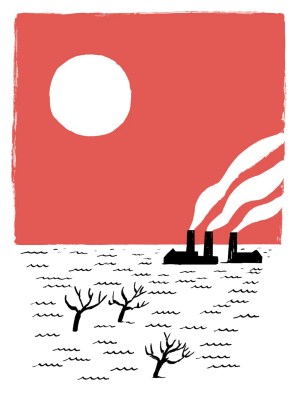
Big Heat and Big Oil

A rapid end to burning fossil fuel would arrest the heating that has caused extreme damage in recent weeks; and that rapid end is possible.

In the list of ill-timed corporate announcements, historians may someday give pride of place to one made by Wael Sawan, the new C.E.O. of Shell, the largest energy company in Europe. In 2021, Shell said that it would reduce oil and gas production by one to two per cent a year up to 2030—a modest gesture in the direction of an energy transition. Continue reading
Why Are We Not More Afraid Of The Heat?

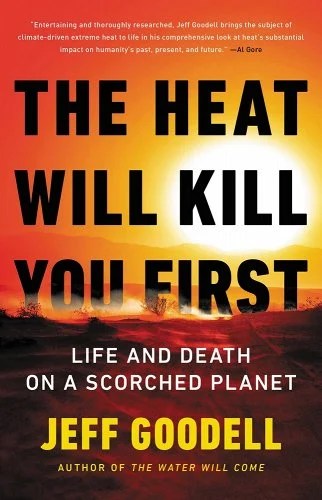
Jeff Goodell shares his opinion in the newspaper of record in the USA. It will serve as a preview of his book to the right, reviewed here. He has also spoken about this topic. There is no pleasure to be had here. Only awareness, and the question why we are not doing more:

In Texas, Dead Fish and Red-Faced Desperation Are Signs of Things to Come

In 2019, I happened to be visiting Phoenix on a 115-degree day. I had a meeting one afternoon about 10 blocks from the hotel where I was staying downtown. I gamely thought I’d brave the heat and walk to it. How bad could the heat really be? I grew up in California, not the Arctic. I thought I knew heat. I was wrong. After walking three blocks, I felt dizzy. After seven blocks, my heart was pounding. After 10 blocks, I thought I was a goner. Continue reading

Anthropocene Representative Location

A wide view of a lake with trees surrounding it and blue sky with clouds in distance. We now have a place to match to the name for our epoch:

The Human Age Has a New Symbol. It’s a Record of Bomb Tests and Fossil Fuels.

A scientific panel has picked Crawford Lake, Ontario, to represent the Anthropocene, a proposed, and hotly contested, new chapter in geologic time.

For almost 15 years, a panel of scholars has been chewing over a big question: Has our species transformed the planet so much that we have plunged it into a new interval of geologic time? Continue reading
Viewed From Above, Our Most Important Leaks

Illustration by Ard Su

David W. Brown offers this updated look at the use of satellite technology for a key metric:

A Security Camera for the Planet

A new satellite, funded by a nonprofit, aims to pinpoint emissions of methane—a gas that plays a major role in global warming.

When his phone rang, Berrien Moore III, the dean of the College of Atmospheric and Geographic Sciences at the University of Oklahoma, was fumbling with his bow tie, preparing for a formal ceremony honoring a colleague. He glanced down at the number and recognized it as nasa headquarters. This was a bad sign, he thought. In Moore’s experience, bureaucrats never called after hours with good news.

It can see large methane concentrations along its orbital path, but can’t pinpoint emissions sources. Illustration by Ard Su

For roughly six years, Moore and his colleagues had been working on a space-based scientific instrument called the Geostationary Carbon Cycle Observatory, or GeoCarb. nasa had approved their proposal in 2016; it was now 2022, and GeoCarb was being built by Lockheed Martin, in Palo Alto, California. Once it was in space and mounted to a communications satellite, GeoCarb would scan land in the Western Hemisphere continuously in strips, taking meticulous measurements of three carbon-based gases: carbon dioxide, carbon monoxide, and methane. It would give scientists a detailed view of the carbon cycle—the process by which carbon circulates through the Earth’s forests, lakes, trees, oceans, ice, and other natural features. Continue reading
Embracing Anthropocene

Image credits: Alamy; David Guttenfelder for The New York Times; Getty Images; Ashley Gilbertson for The New York Times; Michael Probst/Associated Press; Getty Images; NASA

We have been using this terminology already for more than a decade, thinking it was apt enough to be official:

For Planet Earth, This Might Be the Start of a New Age

A panel of experts has spent more than a decade deliberating on how, and whether, to mark a momentous new epoch in geologic time: our own.

The official timeline of Earth’s history — from the oldest rocks to the‌ dinosaurs to the rise of primates, from the Paleozoic to the Jurassic and all points before and since — could soon include the age of nuclear weapons, human-caused climate change and the proliferation of plastics, garbage and concrete across the planet. Continue reading

Sylvia Earle, Her Deepness

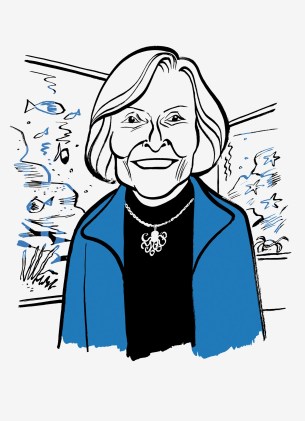
Sylvia Earle. Illustration by João Fazenda

Yesterday’s post got me looking back at our attention to marine science over the years, making me wonder whether we have given that topic its fair share. Yes, probably, but more is needed. I already knew this name because it has appeared in our pages a few times over the years. But just recently I heard her name from two different people who have had the chance to know her personally. One of them, when I mentioned the name, replied with Her Deepness replacing Sylvia Earle’s given name. Thanks to Dana Goodyear, who had me at puma, but who also knows a thing or two about water, now this:

Without Sylvia Earle, We’d Be Living on Google Dirt

The marine biologist and aquanaut evokes a Bond girl with a Ph.D. To save a species, she says, you have to know it.

Do you like to breathe?” This is a question that the marine biologist and deep-sea explorer Sylvia Earle asks frequently. The ocean produces half of the oxygen on Earth. If it dies, humanity can’t survive, so humans better pay attention to it. Continue reading

Innovative Illustration & Atmospheric Pressure

Source: Geophysical Research Letters.

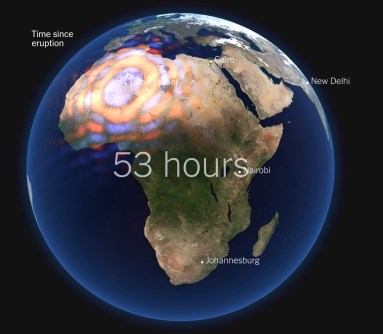
Whenever we see advances in innovative illustration to better our understanding of phenomena, natural or otherwise, we note it here. Atmospheric pressure is something most of us have heard countless times, but not necessarily stopped to think what it is. Among other things, it is important. Also, it is understandable. If you have a couple minutes, watch this accessible animation of a natural phenomenon that does not get enough attention, and read the accompanying text:

‘It’s Super Spectacular.’ See How the Tonga Volcano Unleashed a Once-in-a-Century Shockwave.

By Aatish Bhatia and Henry Fountain

Produced by Aatish Bhatia and Sean Catangui

As shown in this visualization, based on a simulation created by Ángel Amores, a physical oceanographer at the Mediterranean Institute for Advanced Studies in Majorca, Spain, the shockwave took about 36 hours to circumnavigate the globe, spreading out in concentric rings from the volcano known as Hunga Tonga-Hunga Haʻapai and traveling at the speed of sound. The simulation was published in the journal Geophysical Research Letters in March. Continue reading

Improving The Lives Of The Poor And Disadvantaged With Nature

LUISA RIVERA / YALE E360

Thanks to Carl Safina for this opinion:

Protecting Earth: If ‘Nature Needs Half,’ What Do People Need?

The campaign to preserve half the Earth’s surface is being criticized for failing to take account of global inequality and human needs. But such protection is essential not just for nature, but also for creating a world that can improve the lives of the poor and disadvantaged.

Must nature and civilization be opposing interests? Is nature conservation anti-people? What must be preserved to preserve what needs preserving? Is there a single path that can reverse the three crises of apocalypse: the extinction crisis, the toxics crisis, and the climate crisis? Sixteen ecologists, including me, think the answer to that last question is yes. Continue reading

Heat & Humanity

Last week, researchers at nasa and noaa found that “the earth is warming faster than expected.” Photograph by Kyle Grillot / Bloomberg / Getty

This week’s newsletter ponders how adaptable we are and serves as a reminder that we cannot take for granted that we are sufficiently so for the changes upon us:

It’s Not the Heat—It’s the Humanity

Rising air temperatures remind us that our bodies have real limits.

By Bill McKibben

It’s hard to change the outcome of the climate crisis by individual action: we’re past the point where we can alter the carbon math one electric vehicle at a time, and so activists rightly concentrate on building movements large enough to alter our politics and our economics. But ultimately the climate crisis still affects people as individuals—it comes down, eventually, to bodies. Which is worth remembering. In the end, we’re not collections of constructs or ideas or images or demographics but collections of arteries and organs and muscles, and those are designed to operate within a finite range of temperatures. Continue reading

Kate Marvel Has A Way With Words

shifaaz-shamoon-302656-768x1365.jpg

Image by Shifaaz Shamoon/Unsplash, Public Domain Dedication (CC0).

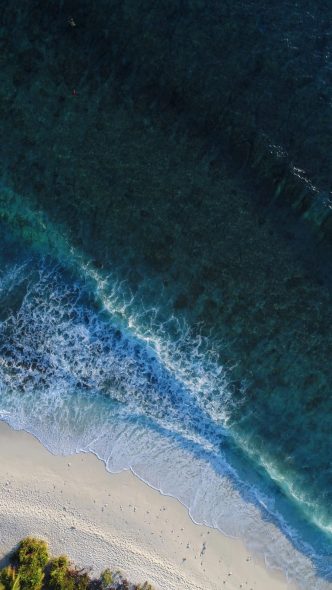
We Should Never Have Called It Earth

We should never have called it Earth. Three quarters of the planet’s surface is saltwater, and most of it does not lap at tranquil beaches for our amusement. The ocean is deep; things are lost at sea. Sometimes we throw them there: messages in bottles, the bodies of mutinous sailors, plastic bags of plastic debris. Our sewage.

She is a scientist who explains in language I understand, without dumbing it down too much, something as complex as climate change and its relationship to global warming. She is also funny. I found the blog post above after listening to her on this podcast, just to double check that she is consistently clear, profound and funny. She will be responsible for my staying tuned to this series:

Underland, Reviewed

16Williams-COVER-jumbo.jpg

Armando Veve

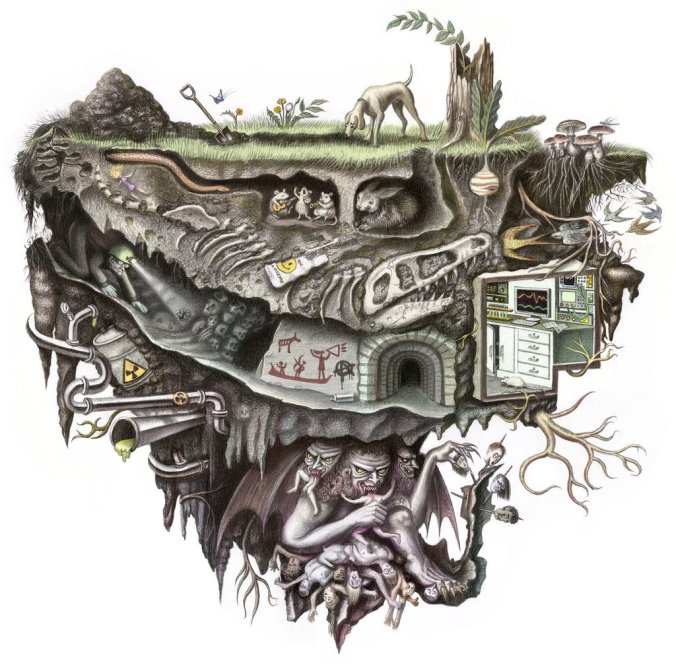
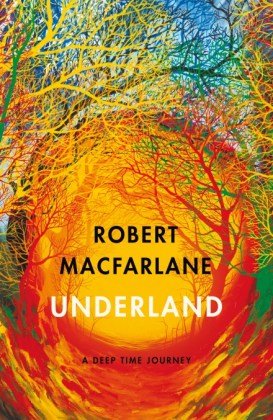
Robert Macfarlane first came to my attention in Ethiopia a few years ago. And then again the following year while in India. And now I see where it was all leading, in the form of a book, to see what is beneath our feet, reviewed here:

McfarlaneYou know a book has entered your bloodstream when the ground beneath your feet, once viewed as bedrock, suddenly becomes a roof to unknown worlds below. The British writer Robert Macfarlane has written such a book. “Underland: A Deep Time Journey” is an epic exploration and examination of darkness and the caverns underground that have captured our imaginations, pulled us downward, housed our dead and allowed us to bury our most violent secrets. It is also a descent into the beauty where dark wisdom is located.

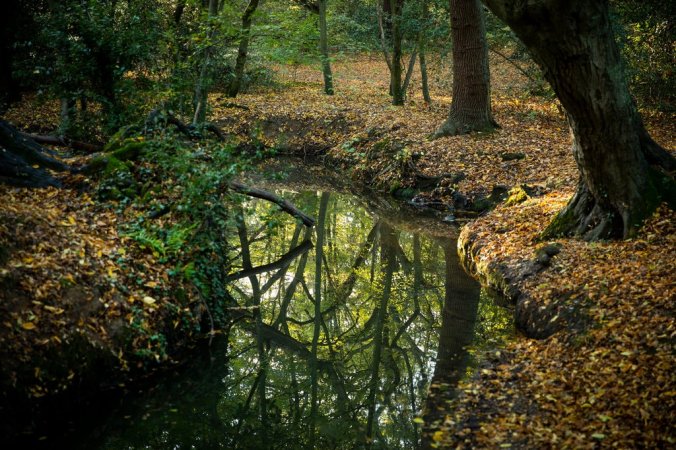
Macfarlane divides his explorations into three sections, or “chambers,” devoted to “Seeing,” “Hiding” and “Haunting.” As he moves through them, he will take us to ancient barrows in Britain’s Mendip Hills, the understory of the Epping Forest and a physics lab investigating “dark matter” from deep within a coastal Yorkshire mine. He will guide us through underground rivers in Italy and show us the pictographs known as “the red dancers” found in Norwegian sea caves.

a82561e841884780abafe5f96c1df4a9-jumbo.jpg

London’s Epping Forest in the autumn.CreditDavid Levene/evevine, via Redux

Macfarlane homes in on “something seemingly paradoxical: that darkness might be a medium of vision, and that descent may be a movement toward revelation rather than deprivation.” Night vision becomes an essential strategy for survival in the Anthropocene, the new epoch we find ourselves in, which registers the human press on the planet as a geologic force. “For more than 15 years now,” Macfarlane explains, “I have been writing about the relationships between landscape and the human heart. What began as a wish to solve a personal mystery — why I was so drawn to mountains as a young man that I was, at times, ready to die for love of them — has unfolded into a project of deep-mapping.” Continue reading

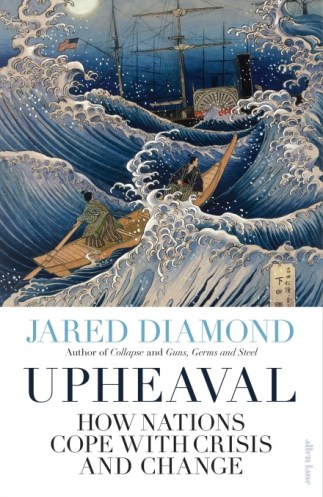
Upheaval, Another Heavy Book For The Reading List

First I had read the Guardian interview with the author, which was good, and made watching the above worthwhile. But when David Wallace-Wells conducts such an interview, it is something altogether more compelling. He knows how to word a title alarmingly. My reading list just got 320 pages longer:

Jared Diamond: There’s a 49 Percent Chance the World As We Know It Will End by 2050

Upheaval.jpgJared Diamond’s new book, Upheaval, addresses itself to a world very obviously in crisis, and tries to lift some lessons for what do about it from the distant past. In that way, it’s not so different from all the other books that have made the UCLA geographer a sort of don of “big think” history and a perennial favorite of people like Steven Pinker and Bill Gates.

Diamond’s life as a public intellectual began with his 1991 book The Third Chimpanzee, a work of evolutionary psychology, but really took off with Guns, Germs, and Steel, published in 1997, which offered a three-word explanation for the rise of the West to the status of global empire in the modern era — and, even published right at the “end of history,” got no little flak from critics who saw in it both geographic determinism and what they might today call a whiff of Western supremacy. In 2005, he published Collapse, a series of case studies about what made ancient civilizations fall into disarray in the face of environmental challenges — a doorstopper that has become a kind of touchstone work for understanding the crisis of climate change today. In The World Until Yesterday, published in 2012, he asked what we can learn from traditional societies; and in his new book, he asks what we can learn from ones more like our own that have faced upheaval but nevertheless endured.

I obviously want to talk about your new book, but I thought it might be useful to start by asking you how you saw it in the context of your life’s work.
Sure. Here’s my answer, and I think you’ll find it banal and more disappointing than what you might have hoped for. Continue reading

When Bill McKibben Speaks to Elizabeth Kolbert, Listen

RebellionDay4_OxfordCircus_VladimirMorozov-akxmedia_180419_6_web_web2.jpg

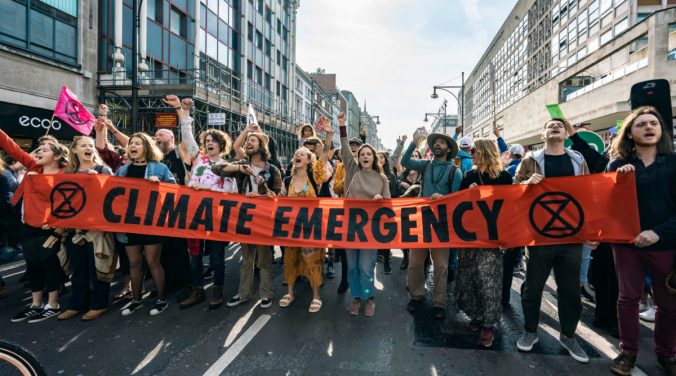
Climate activists block traffic in London’s Oxford Circus on April 19, part of a string of protests organized by Extinction Rebellion. COURTESY OF VLADIMIR MOROZOV/AKX MEDIA

Two luminaries on climate, in conversation:

Why Bill McKibben Sees Rays of Hope in a Grim Climate Picture

end-of-nature.jpgThe world has done little to tackle global warming since Bill McKibben’s landmark book on the subject was published in 1989. In ane360 interview, McKibben talks about the critical time lost and what can be done now to avoid the worst impacts of climate change.

Three decades ago, Bill McKibben published The End of Nature, the first book on climate change aimed at a general audience. McKibben went on to found the international environmental group 350.org, help launch the fossil fuel divestment movement, and write a dozen more non-fiction books, as well as a novel. In 2014, McKibben received the Right Livelihood Award, sometimes referred to as the “alternative Nobel,” for mobilizing popular support for “strong action to counter the threat of global climate change.”

falterbookpage.jpgMcKibben’s latest book, Falter: Has the Human Game Begun to Play Itself Out?, was published this month and debuted last week on the New York Times bestseller list. In an interview with Yale Environment 360 , McKibben talks about why the critical time for action on climate was missed, where he still finds hope, and what the world will look like three decades from now.

“Thirty or 50 years out, the world’s going to run on sun and wind, because they’re free,” McKibben says. “The question is… what kind of world will it be?”

Yale Environment 360: It’s almost exactly 30 years since you published The End of Nature. One way to read that book is as a warning. How you would characterize Falter? Is it also a warning, or are we beyond that?

Bill McKibben: Look, 30 years ago this was all still prospective. You couldn’t really take a picture of climate change yet. Now, having wasted 30 years, we’re at the point where it’s a dominant fact of everyday life for hundreds of millions of people and promising to be the overwhelming fact of our time in the years ahead. It’s too late, obviously, to stop climate change. I hope that the book gets across that it may not be too late to keep it from getting absolutely out of control. It’s not a warning. It’s some combination of a report and a chronicle and a plea, I think. Continue reading

In Case Of Emergency, Plant Trees

Fox-Maple-Woods_Wisconsin_JoshuaMayer_web.jpg

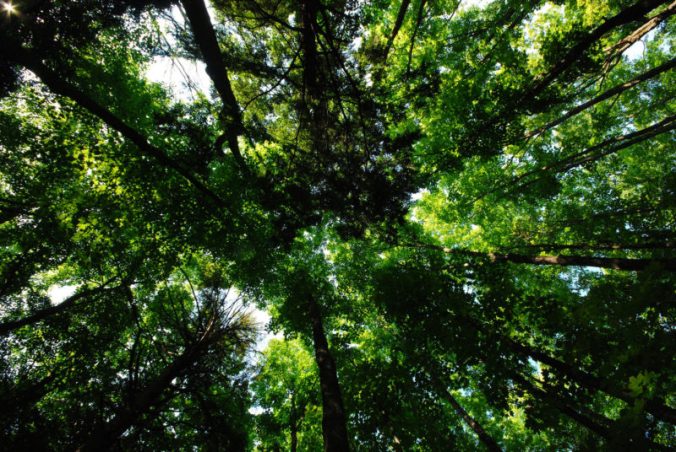
Fox Maple Woods in Wisconsin. JOSHUA MAYER / FLICKR

Emergency? The evidence is clear in the case of the environment, and it is a global emergency with a global solution. Thanks to Yale e360 for this summary of a new finding:

Planting 1.2 Trillion Trees Could Cancel Out a Decade of CO2 Emissions, Scientists Find

There is enough room in the world’s existing parks, forests, and abandoned land to plant 1.2 trillion additional trees, which would have the CO2 storage capacity to cancel out a decade of carbon dioxide emissions, according to a new analysis by ecologist Thomas Crowther and colleagues at ETH Zurich, a Swiss university. Continue reading

The Power Of Panic

merlin_150201243_6e45f17e-9e07-4df5-96e6-a96f9afa878b-jumbo.jpg

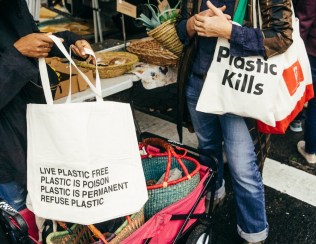
Ms. Cohen favors vendors who don’t use plastic. Credit Adam Amengual for The New York Times

When I started my Saturday morning reading it was just prior to our weekly visit to the farmer’s market and there was visual resonance with our own experience eliminating, or trying to eliminate plastic:

You’re Addicted to Plastic. Can You Go Cold Turkey?

Going plastic free starts with cloth bags and straws. Suddenly, you’re … making your own toothpaste?

merlin_150201240_ff27ccbe-4e4a-4550-81e5-99cbc3e11a81-jumbo.jpg

Reusable cloth bags are a must. Credit Adam Amengual for The New York Times

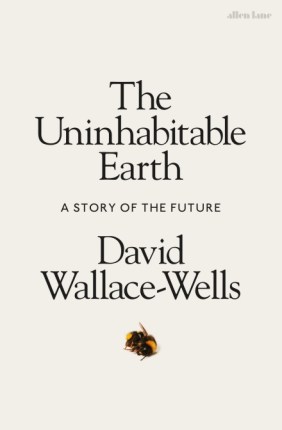
Like most people, resonance is always welcome in my reading. But like a second cup of coffee to really get the day going, there is nothing like cognitive dissonance. I can think eliminating plastic from our lives is a big deal one moment, and then the next it is clear that it is not enough, that it is like tinkering. Or as the punchy cliche puts it, like arranging deck chairs on the Titanic. David Wallace-Wells is a skilled dissonance artist in this vein. He can make your best efforts suddenly seem pathetic; not in a snarky way and if you listen to him explain his work you will realize resistance is futile; you cannot look away from what he is saying, even if you want to.

WellsBook.jpg

‘A profound book, which simultaneously makes me terrified and hopeful about the future’ Jonathan Safran Foer
A Times and FT Most Anticipated Book 2019

His book will not likely be damned by faint praise; its look at our future prospects will more likely draw extreme responses in favor of the intensity of his alarm, and claims of alarmism from the usual suspects. He is catching up to Elizabeth Kolbert in balancing our preference for optimism with extreme realism. His op-ed on Saturday tipped the balance for me quite like a second, maybe third cup of coffee:

The age of climate panic is here. Last summer, a heat wave baked the entire Northern Hemisphere, killing dozens from Quebec to Japan. Some of the most destructive wildfires in California history turned more than a million acres to ash, along the way melting the tires and the sneakers of those trying to escape the flames. Pacific hurricanes forced three million people in China to flee and wiped away almost all of Hawaii’s East Island.

We are living today in a world that has warmed by just one degree Celsius (1.8 degrees Fahrenheit) since the late 1800s, when records began on a global scale. We are adding planet-warming carbon dioxide to the atmosphere at a rate faster than at any point in human history since the beginning of industrialization. Continue reading