The Invention Of Books

We are happy to have reason to return to our love of books, reading, as well as the history and importance of libraries.

Our thanks to Kathryn Hughes at the Guardian for giving us a look into the most recent work of Irene Vallejo:

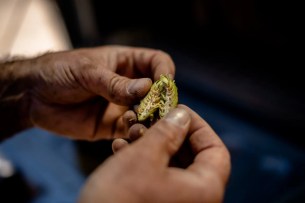
Papyrus by Irene Vallejo review – how books built the world

From Alexandria to Oxford, a kaleidoscopic history of the written word

Reading between the lines … Tianjin Binhai Library in China.

What do you give the queen who has everything? When Mark Antony was wondering how to impress Cleopatra in the run-up to the battle of Actium in 31BC, he knew that jewellery would hardly cut it. The queen of the Ptolemaic kingdom of Egypt had recently dissolved a giant pearl in vinegar and then proceeded to drink it, just because she could. In the face of such exhausted materialism, the Roman general knew that he would have to pull out the stops if he was to win over the woman with whom he was madly in love. So he arrived bearing 200,000 scrolls for the great library at Alexandria. Continue reading

Quiet Catches Criminals

PHOTOGRAPH: JUSTIN SULLIVAN/CAKE

We have always had a soft spot for creative approaches to reducing, if not ending, poaching. And now this, thanks to Andy Jones at Wired:

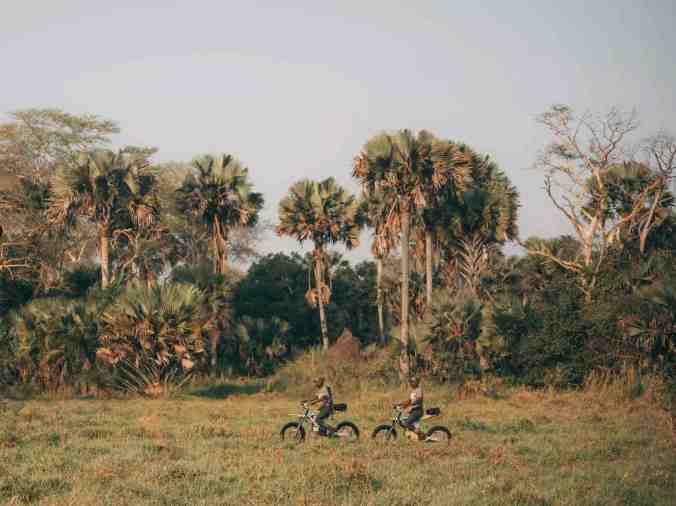
Park Rangers Are Using Silent Ebikes to Catch Poachers

A Swedish electric bike is helping Mozambique’s park rangers protect game and reducing the need for fossil fuel infrastructure in Africa’s remotest areas.

AT THE END of 2021, a group of night poachers in a Mozambique national park—using torchlight to blind antelopes—were suddenly the ones left stunned in the dark. Continue reading
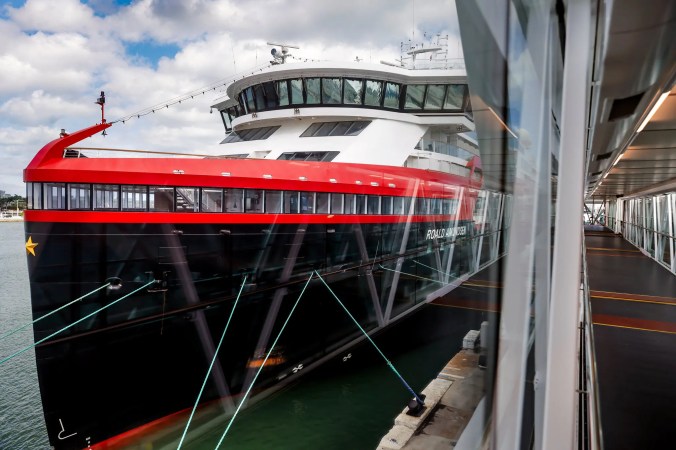
Is Cruise Travel Evolving In A Way That Is Good For The Planet?

Cruise ship tourism is unfortunately not disappearing as we might have hoped. Are the ships evolving to be more environmentally and socially responsible? Our thanks to Maria Cramer for asking and attempting to answer the question:

How Green is Your Cruise?

As cruise companies head into their busiest season, they say they have ambitious plans to curb greenhouse emissions and find cleaner sources of fuel. But critics say the progress is too slow.

In the Caribbean, many cruise companies have bought islands and turned them into private resorts for the exclusive use of cruise passengers who cavort in enormous wave pools, rush down 135-foot water slides with names like Daredevil’s Peak, and zip-line across wide beaches. Continue reading
Wooden Utensils & Kitchen Safety

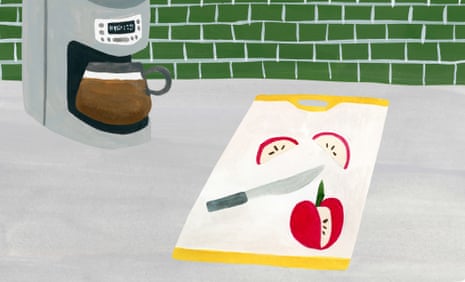
Your cutting board, utensils and coffee maker are among the long list of items in your kitchen that could be leaching dangerous chemicals.

Your cutting board, utensils and coffee maker are among the long list of items in your kitchen that could be leaching dangerous chemicals. Illustration: Julia Louise Pereira/The Guardian

Kitchen safety, per se, is not a topic we have featured in these pages before, even though wooden utensils have been featured:

Wooden spoons and glass mugs: how to avoid toxic chemicals in your kitchen

Tom Perkins has reported widely on the potential risks of toxic chemicals. Here’s his guide to help you find safe alternatives for your kitchen

Chemicals are the invisible guests in our kitchens. You can’t see them but they are everywhere. Continue reading
Whalesong Remix

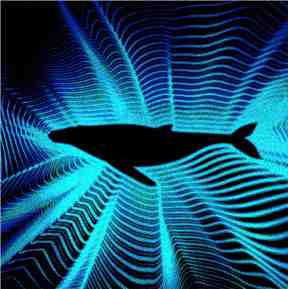
Illustration by Nicholas Konrad / The New Yorker

We thank the New Yorker for this note about Sara Niksic’s whalesong remixing, as described by Matthew Hutson:

How a Marine Biologist Remixed Whalesong

Sara Niksic, a lover of whales and electronic music, has merged her passions.

In 1971, in the journal Science, two scientists, Roger S. Payne and Scott McVay, published a paper titled “Songs of Humpback Whales.” They began by noting how “during the quiet age of sail, under conditions of exceptional calm and proximity, whalers were occasionally able to hear the sounds of whales transmitted faintly through a wooden hull.” Continue reading
Huxley’s Extra Effort

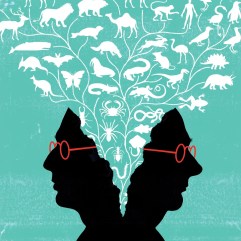
A family of scientist-writers recast religion and ethics in light of evolution. Illustration by Melinda Beck

We are all fortunate that the Huxley family produced no slouches:

How the Huxleys Electrified Evolution

Defending Darwinism from both clerical and scientific opponents, T. H. Huxley and his grandson Julian shaped how we think about the past and future of our species.

Thomas Henry Huxley almost skipped the showdown of his life. It was the fourth day of the 1860 meeting of the British Association for the Advancement of Science. He was tired. Continue reading
Prairie Revival

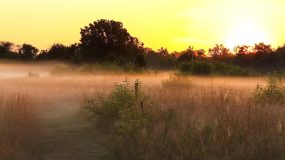
Sunrise at the Hempstead Plains on Long Island, New York. STEVE PFOST / NEWSDAY RM VIA GETTY IMAGES

Thanks to Yale e360’s Janet Martinelli:

Amid the Sprawl, a Long Island Prairie Makes a Quiet Comeback

Tucked into quintessential suburbia, the Hempstead Plains Preserve is a small sliver of the grassland that once covered a vast area of Long Island. New research shows that thoughtfully planted yards and gardens can bolster the biodiversity in such urban wildland fragments.

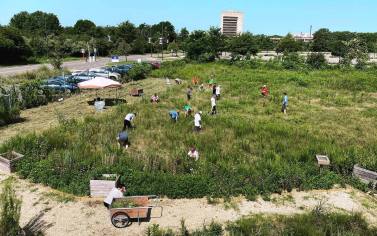
Volunteers remove invasive Chinese bushclover from the Hempstead Plains Preserve at Nassau Community College. FRIENDS OF HEMPSTEAD PLAINS

The Hempstead Plains Preserve is a place where you can imagine the presence of creatures past. Birdfoot violets, now gone, once colored the landscape with a wash of purple in spring. The heath hen, a large grouse that went extinct 90 years ago, performed its elaborate courtship dances on the Plains.

On a late afternoon in October, the slanting autumn sun lit up in a blaze of gold the grasses and wildflowers on this narrow, 19-acre sliver of land — almost all that is left of the tallgrass prairie that once covered more than 50 square miles at the heart of Long Island, New York, a fish-shaped island that stretches east into the Atlantic Ocean. Continue reading

The Box Footprint

Photo illustration by Todd St. John

We have barely scratched the surface on the ecological or the social implications of online retailing’s growing share of the economy. Until now, no attention to the boxes, specifically, so today we are happy to find excellent reporting focused on that. Cardboard is an increasing part of the lives of most of us living in digital economies, so thanks to Matthew Shaer for letting us know more about it:

Where Does All the Cardboard Come From? I Had to Know.

Entire forests and enormous factories running 24/7 can barely keep up with demand. This is how the cardboard economy works.

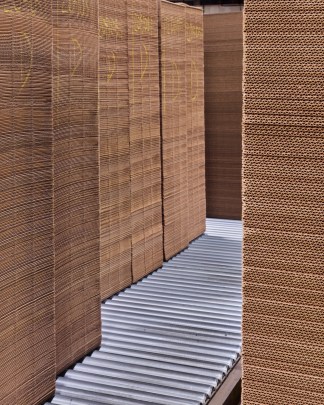
Stacks of unprinted, uncut cardboard at the International Paper factory in Lithonia, Ga. Christopher Payne for The New York Times

Before it was the cardboard on your doorstep, it was coarse brown paper, and before it was paper, it was a river of hot pulp, and before it was a river, it was a tree. Probably a Pinus taeda, or loblolly pine, a slender conifer native to the Southeastern United States. “The wonderful thing about the loblolly,” a forester named Alex Singleton told me this spring, peering out over the fringes of a tree farm in West Georgia, “is that it grows fast and grows pretty much anywhere, including swamps” — hence the non-Latin name for the tree, which comes from an antiquated term for mud pit. “See those oaks over there?” Singleton went on. “Oaks are hardwood, with short fibers. Fine for paper. Book pages. But not fine for packaging, because for packaging, you need the long fibers. A pine will give you that. An oak won’t.”

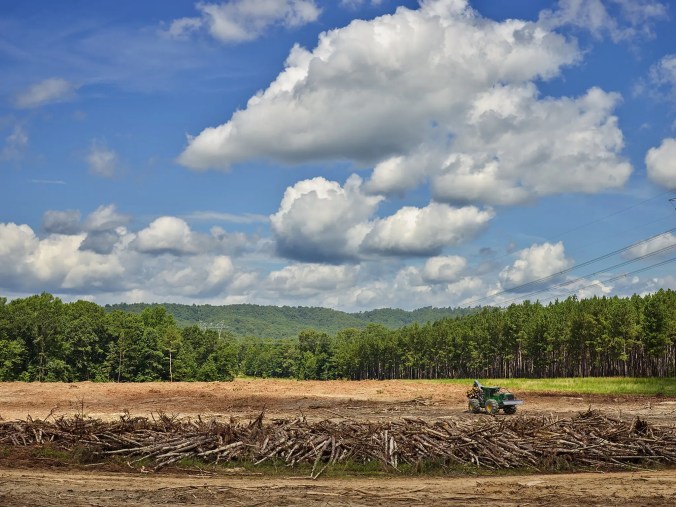
A timber farm in Rome, Ga., that supplies I.P. Christopher Payne for The New York Times

Singleton, who is 54, with a shaved head and graying beard, has spent the past few years as a fiber-supply manager for International Paper, or I.P., a packaging concern headquartered in Memphis. Continue reading
Thwaites & Us

Probes beneath the ice could shed light on the fate of the world’s coastlines. Illustration by Owen D. Pomery

Most of us do not spend much time thinking about what is happening there, but Antarctica’s future is now very much entwined with the future of the rest of the planet.  All of us. So, thanks to David W. Brown for this travelogue:

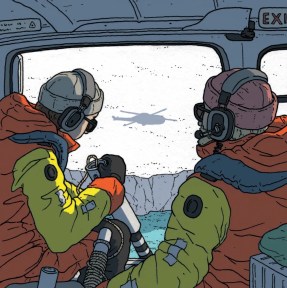
Journey to the Doomsday Glacier

Thwaites could reshape the world’s coastlines. But how do you study one of the world’s most inaccessible places?

I first saw our icebreaker, the RV Araon, when we were due to leave for Antarctica. The largest icebreakers are more than five hundred feet long, but the Araon was only the length of a football field; I wondered how it would handle the waves of the Southern Ocean, and how it would fare against the thick sea ice that guards the last wilderness on Earth. Continue reading

Artificial Islands, Natural Grasses & Wildlife Oases In Urban Waterways

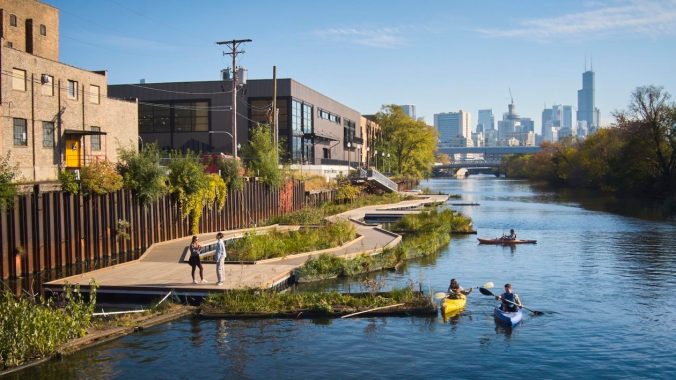
Floating wetlands along the Chicago River’s Wild Mile. DAVE BURK / SOM

Thanks to Susan Cosier and Yale e360 for this:

How Floating Wetlands Are Helping to Clean Up Urban Waters

As cities around the world look to rid their waterways of remaining pollution, researchers are installing artificial islands brimming with grasses and sedges. The islands’ surfaces attract wildlife, while the underwater plant roots absorb contaminants and support aquatic life.

Five small islands roughly the size of backyard swimming pools float next to the concrete riverbank of Bubbly Creek, a stretch of the Chicago River named for the gas that once rose to the surface after stockyards dumped animal waste and byproducts into the waterway. Continue reading

Precision Fermentation’s Implied Potential

Illustration: Eleanor Shakespeare/The Guardian

It is the first time we are seeing these two words together, and George Monbiot has this to say about the potential implied:

Embrace what may be the most important green technology ever. It could save us all

Never mind the yuck factor: precision fermentation could produce new staple foods, and end our reliance on farming

So what do we do now? After 27 summits and no effective action, it seems that the real purpose was to keep us talking. If governments were serious about preventing climate breakdown, there would have been no Cops 2-27. The major issues would have been resolved at Cop1, as the ozone depletion crisis was at a single summit in Montreal. Continue reading

Cover Considered

We link to essays and articles, as well as profiles and book reviews from this magazine constantly, but never previously to a cover and only once, by reference, to cartoons. The cover of this week’s issue merits consideration:

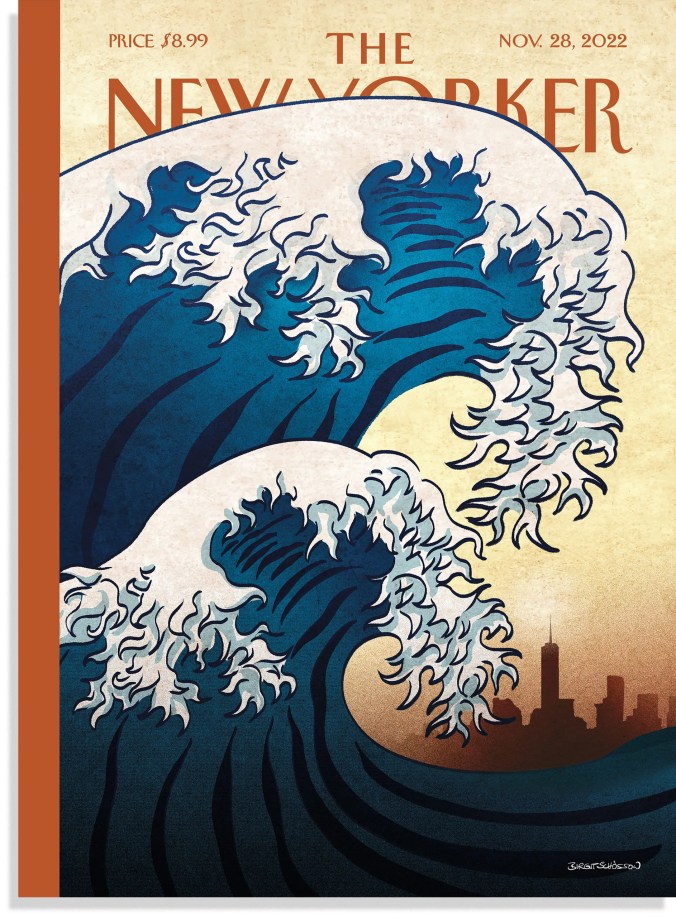
Birgit Schössow’s “The Future Is Here”

The artist talks about incorporating environmental themes in her work, and the historical inspiration behind her cover for the Climate Issue.

Françoise Mouly,  Birgit Schössow

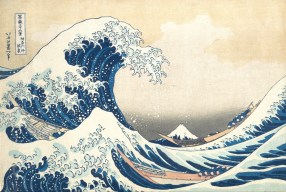
Hokusai’s “Under the Wave off Kanagawa,” circa 1830-32, is said to have inspired Debussy’s piece “La mer” (The Sea) and Rilke’s poem “Der Berg” (The Mountain).

In her new cover, the Germany-based artist Birgit Schössow drew inspiration from an artistic masterpiece. Starting in the late seventeen-hundreds, the Japanese artist Katsushika Hokusai created woodblock prints in a genre called ukiyo-e, part of an artistic movement known as “the floating world.” One of Hokusai’s best-known works is one of a series called “Thirty-six Views of Mount Fuji” that shows a giant wave cresting in the foreground. The wave’s dramatic curve and stature, topped with a skim of frilly foam, are so eye-catching that you might miss the slender fishing boat it’s about to topple onto. Continue reading

Startling Capacities Of Regional Forests

Harvard Forest (pictured) was included in a study that looks at how New England forests can be better utilized in the fight against climate change.
Stephanie Mitchell/Harvard Staff Photographer

We had no clue how much forest area that region has, nor how much capacity to absorb carbon that would translate to:

New England forests, new strategies can offset most regional emissions over 30 years, report says

Study, led by Harvard ecologist, lays out five policies to boost levels of absorption as six states lower emissions

A major new report suggests that with a handful of strategies New England’s 32 million acres of forests, which cover about three-quarters of the region, could eventually come close to absorbing 100 percent of all the carbon produced by the six states. Continue reading

Coral Defying The Odds

Corals in the waters of the Ras Mohammed National Park in the Red Sea near Sharm el Sheikh, Egypt, home to one of the only reefs in the world that can tolerate heat. Sima Diab for The New York Times

Our thanks to Jenny Gross and Vivian Yee reporting from Egypt:

Attendees of the United Nations climate conference took breaks from negotiations to see the corals for themselves.Credit…Mohammed Abed/Agence France-Presse — Getty Images

As warming waters devastate coral around the world, the sea’s stunningly colorful reefs have been remarkably resilient. But pollution, mass tourism and overfishing put them at risk.

SHARM El SHEIKH, Egypt — The vast majority of the world’s coral reefs are likely to be severely damaged in the coming decades if the planet keeps warming at its current rate. Continue reading

Spruce Cone Collecting

Blake Votilla at the top of a spruce tree, collecting cones that will be replanted to help restore forests decimated by wildfires.

Thanks to Hilary Swift (last seen in these pages as a photographer, now also as a writer) and the New York Times for this series:

Seasonal workers climb tree after tree to collect seeds that will eventually help regrow forests, an effort that could get the country closer to its climate goals

Some of the cones collected get sent to a nursery outside of Boise, Idaho, where the seeds from the cones are stored or replanted.

MOAB, Utah — Blake Votilla stared up at the 120-foot spruce tree. He strapped braces with four-inch spurs to his shins and clipped two large red plastic sacks on his climbing harness. Reggaeton blasted from a portable speaker on his hip.

Then he embraced the tree with his gloved hands, sticky from sap, lifting his left leg up first, driving the spur into the cracks of the bark to hoist himself up. Continue reading

Fridays For Future @COP27

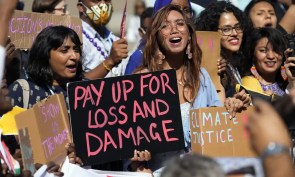
Fridays for Future protest calling for money for climate action at Cop27. Photograph: Peter de Jong/AP

If you wonder what our youth are up to, take a look at what the Guardian’s team of Fiona Harvey, with Adam Morton and Patrick Greenfield is reporting from Sharm el-Sheikh:

Cop27: EU agrees to loss and damage fund to help poor countries amid climate disasters

Change in stance puts spotlight on US and China, which have both objected to fund

A breakthrough looked possible in the deadlocked global climate talks on Friday as the European Union made a dramatic intervention to agree to key developing world demands on financial help for poor countries. Continue reading

New Fracking Science

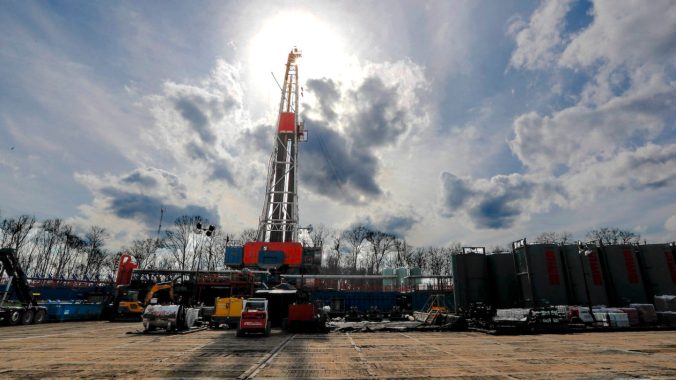
A shale gas drilling rig in St. Marys, Pennsylvania. AP PHOTO / KEITH SRAKOCIC

We thought the science of fracking’s dangers was already sufficiently clear, and now this (read Jon Hurdle’s entire story at Yale e360):

As Evidence Mounts, New Concerns About Fracking and Health

Two decades after the advent of fracking, a growing number of studies are pointing to a link between gas wells and health problems, particularly among children and the elderly. Researchers are now calling for new regulations restricting where wells can be located.

Almost 20 years after the adoption of hydraulic fracturing began to supercharge U.S. production of oil and gas, there’s growing evidence of a correlation between the industry’s activities and an array of health problems ranging from childhood cancer and the premature death of elderly people to respiratory issues and endocrine disruption. Continue reading

Canada’s Best Tide Forward

As Brazil turns the tide to its better environmental self, the New York Times reporter Ian Austen explains how Canada harnesses its best tide for an environmental feat long dreamed of:

The Bay of Fundy’s funnel shape is part of the reason for its exceptional tides. Along its 96 or so miles of length, the bay dramatically narrows and its depth drops, from 765 feet to 147 feet. David Goldman for The New York Times

Who Will Win the Race to Generate Electricity From Ocean Tides?

The Bay of Fundy, between Nova Scotia and New Brunswick, has one of the world’s most powerful tides. Now, engineers and scientists hope to finally turn it into a clean energy source.

ABOARD THE PLAT-I 6.40 GENERATING PLATFORM, Nova Scotia — The Bay of Fundy, off the Canadian provinces of Nova Scotia and New Brunswick, has long tantalized and frustrated engineers hoping to harness its record-setting 50-foot high tide to generate electricity. Continue reading

Turning Around Brazil

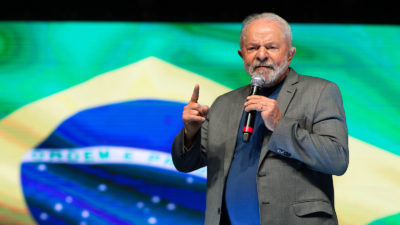
Brazil's president-elect, Luiz Inácio Lula da Silva, at a rally in July.

Brazil’s president-elect, Luiz Inácio Lula da Silva, at a rally in July. ANDRESSA ANHOLETE / GETTY IMAGES

We can only hope the answer is yes:

With Lula Back, Can Brazil Turn the Tide on Amazon Destruction?

With his return as Brazil’s president, Luiz Inácio Lula da Silva is promising to reverse the alarming rate of deforestation in the Amazon. But as he heads to key UN climate talks, his ambitious plans to achieve “zero deforestation” will need to find international support.

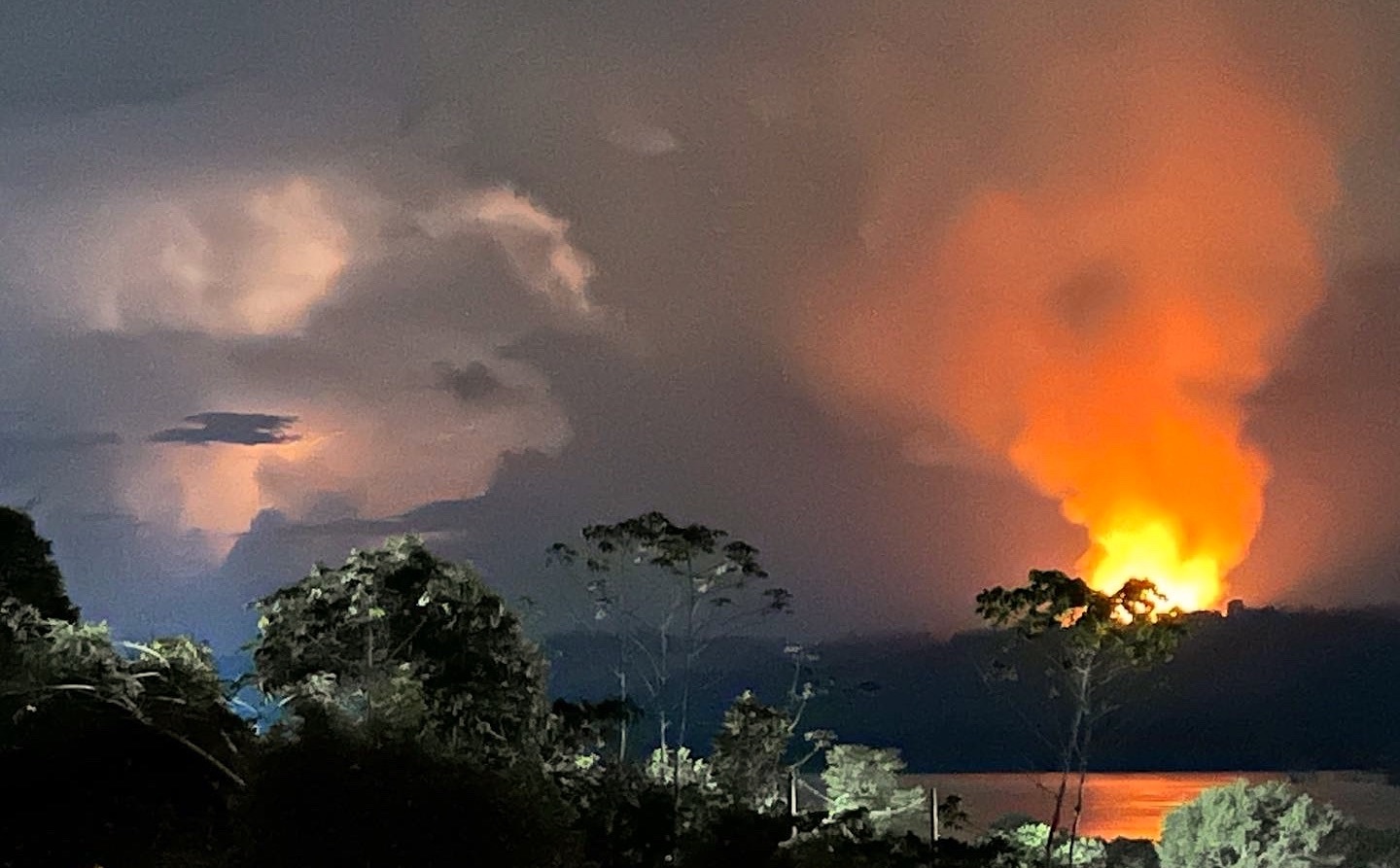
A forest fire burns near the author's home in Altimira, Brazil last month.

A forest fire burns near the author’s home in Altimira, Brazil last month. JON WATTS

The month before Brazil’s October 30 presidential election was the most brutal of Jair Bolsonaro’s term as president. Landowners rushed to illegally clear forest while they could rely on the impunity that had been a characteristic of the Bolsonaro era. From my home in Altamira, I could see flames on the other side of the Xingu River from a blaze large enough to generate its own lightning. Most other days in September and October, my asthmatic lungs tightened and the horizon was shrouded in haze as a consequence of the rushed burn-off. Continue reading

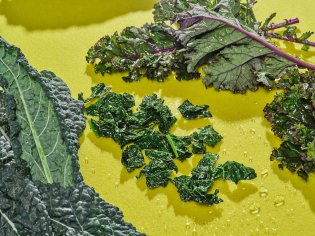
Raw Versus Cooked, The Quiz

Take our quiz to find out.

If you subscribe to the tenets of the raw food diet, or even if you don’t, you may have heard the phrase, “When you cook it, you kill it.” Many people believe that applying heat to vegetables — whether by sautéing, boiling, steaming, frying, roasting or grilling — zaps their nutrition. Continue reading