Ever Green & Restoration Of Abundance

We missed Ever Green when it was published last year, but it came to our attention through this essay by one of its co-authors in the current issue of The Atlantic. The essay is about a path to the restoration of hope:

Our Once-Abundant Earth

Protecting species from extinction is not nearly enough.

When Otis Parrish was a kid in the 1940s, abalone were abundant. Each abalone grows in a single, beautiful opalescent shell, which can get as big as a dinner plate. Parrish’s father showed him how to pry the abalone off the rocky shoreline at low tide with an oak stick or the end of a sharpened leaf spring. Continue reading

Marsh Matters

Coastal marshlands exist in a precarious state: they need enough sediment to stay above water but not so much they get buried. In San Francisco Bay, the US Army Corps of Engineers and others are working to develop a less destructive way of giving marshes the mud they need. Photo by Aerial Archives/Alamy Stock Photo

For the record, marshes matter, so our thanks to Erica Gies, writing for Hakai:

Making a Marsh out of a Mud Pile

In San Francisco Bay, scientists are looking for a better way to rebuild flagging marshland.

The water in California’s San Francisco Bay could rise more than two meters by the year 2100. For the region’s tidal marshes and their inhabitants, such as the endangered Ridgway’s rail and the salt marsh harvest mouse, it’s a potential death sentence. Continue reading

Assisted Evolution

Photo illustration by Lauren Peters-Collaer

If conservation failure is an option, then assisted evolution is a necessary consideration. Emily Anthes walks us through the idea:

When traditional conservation fails, science is using “assisted evolution” to give vulnerable wildlife a chance.

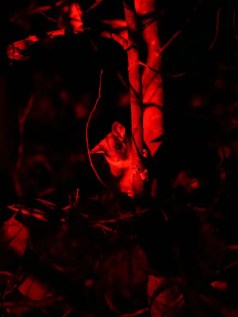
Scientists are trying to save lowland Leadbeater’s possums, tree-dwelling marsupials known as forest fairies, by crossbreeding them with possums from a separate highland population, a strategy known as genetic rescue.

For tens of millions of years, Australia has been a playground for evolution, and the land Down Under lays claim to some of the most remarkable creatures on Earth.

It is the birthplace of songbirds, the land of egg-laying mammals and the world capital of pouch-bearing marsupials, a group that encompasses far more than just koalas and kangaroos. (Behold the bilby and the bettong!) Nearly half of the continent’s birds and roughly 90 percent of its mammals, reptiles and frogs are found nowhere else on the planet.

Australia has also become a case study in what happens when people push biodiversity to the brink. Continue reading

The American Chestnut, Reconsidered

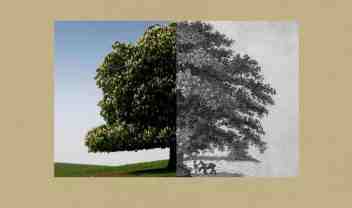
Illustration by The Atlantic. Source: Millennium Images / Gallery Stock; Bettmann/Getty

Katherine J. Wu reminds us of what it means to love something too much, and not enough:

America Lost Its One Perfect Tree

Lumber, shelter, delicious nuts—there was nothing the American chestnut couldn’t provide.

Across the Northeast, forests are haunted by the ghosts of American giants. A little more than a century ago, these woods brimmed with American chestnuts—stately Goliaths that could grow as high as 130 feet tall and more than 10 feet wide. Nicknamed “the redwoods of the East,” some 4 billion American chestnuts dotted the United States’ eastern flank, stretching from the misty coasts of Maine down into the thick humidity of Appalachia. Continue reading

Endangered Eating By Sarah Lohman

The author, culinary historian Sarah Lohman, came to our attention at the time her previous book was being published, and we are happy to see more of her work. From her own website:

American food traditions are in danger of being lost. How do we save them?

Apples, a common New England crop, have been called the United States’ “most endangered food.” The iconic Texas Longhorn Cattle is categorized at “critical” risk for extinction. Unique date palms, found nowhere else on the planet, grow in California’s Coachella Valley —but the family farms that caretake them are shutting down…

And the reviews suggest that the book is every bit as good as the author had hoped it would be.

Frogs, Western Ghats & Science

Sathyabhama Das Biju (from left), James Hanken, Harvard’s Alexander Agassiz Professor of Zoology, and Sonali Garg during a June 2023 field trip to study amphibians in the Western Ghats, a biodiversity hotspot in India. Photo by A.J. Joji

During our seven years living and working in the Western Ghats we came to appreciate frogs through the eyes of our family, those of our staff, as well as travelers and occasional scientific references (the man on the left in the photo to the left having shown up in our pages one of those times). Good to know that the science is being shared for good cause, thanks to Anne J. Manning in this article for the Harvard Gazette:

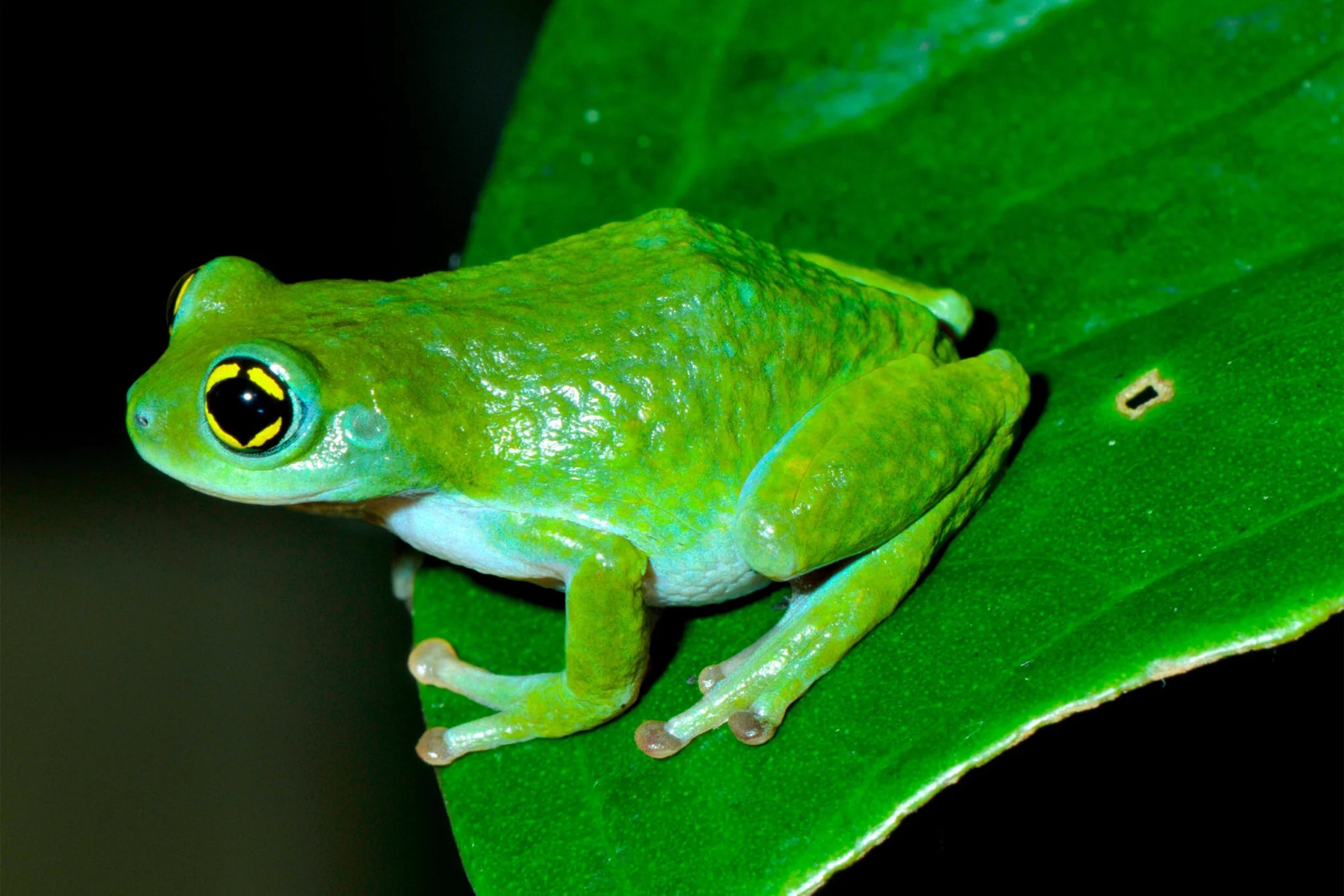
The Indian Purple Frog, first described by Sathyabhama Das Biju in 2003.

Who will fight for the frogs?

Indian herpetologists bring their life’s work to Harvard just as study shows a world increasingly hostile to the fate of amphibians

Having pulled themselves from the water 360 million years ago, amphibians are our ancient forebears, the first vertebrates to inhabit land.
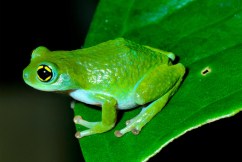
After 136 years from its original description, Günther’s shrub frog was recently rediscovered in the wild. Credit: S.D. Biju and Sonali Garg

Now, this diverse group of animals faces existential threats from climate change, habitat destruction, and disease. Two Harvard-affiliated scientists from India are drawing on decades of study — and an enduring love for the natural world — to sound a call to action to protect amphibians, and in particular, frogs.

Sathyabhama Das Biju, the Hrdy Fellow at Harvard Radcliffe Institute and a professor at the University of Delhi, and his former student Sonali Garg, now a biodiversity postdoctoral fellow at Harvard’s Museum of Comparative Zoology, are co-authors of a sobering new study in Nature, featured on the journal’s print cover, that assesses the global status of amphibians. It is a follow-up to a 2004 study about amphibian declines.
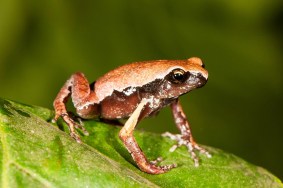
Franky’s narrow-mouthed frog is among the threatened species. Credit: S.D. Biju and Sonali Garg

Biju and Garg are experts in frog biology who specialize in the discovery and description of new species. Through laborious fieldwork, they have documented more than 100 new frog species across India, Sri Lanka, and other parts of the subcontinent.

According to the Nature study, which evaluated more than 8,000 amphibian species worldwide, two out of every five amphibians are now threatened with extinction. Climate change is one of the main drivers. Continue reading

Ancient Amazon Carbon Capture

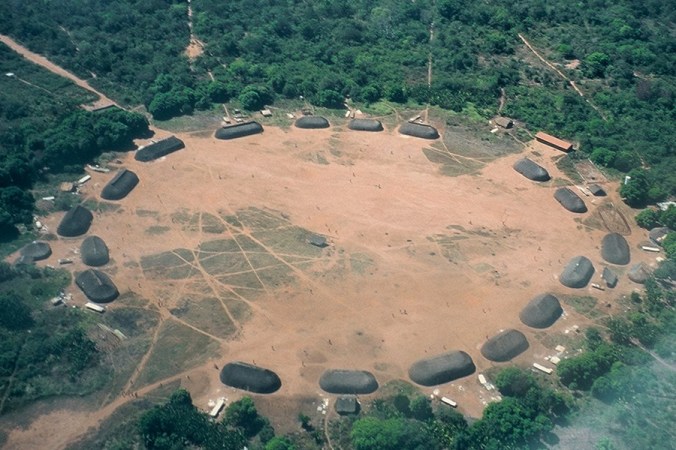
A Kuikuro village in the southeastern Amazon. JOSHUA TONEY

Thanks to Yale e360 for this one:

How Ancient Amazonians Locked Away Thousands of Tons of Carbon in “Dark Earth

A new study reveals how, by cultivating fertile soil for farming, ancient Amazonians locked away thousands of tons of carbon that have stayed in the ground for centuries. Continue reading

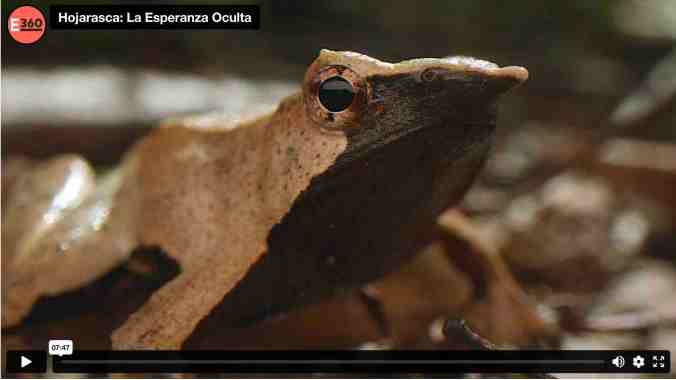
Huilo Huilo’s Hojarasca

We first noticed this film contest three years ago, and have followed it since. The 3rd-place winner of this year’s film contest was made in the Huilo Huilo Biological Reserve, habitat of the endangered species pictured above. In 2009 I was in the middle of a two-year work engagement in southern Chile. During the middle of that year Amie, as well as Seth and Milo, were able to join me for a few months and we spent time in this reserve. I am happy to be reminded:

In a Chilean Forest Reserve, the Remarkable Darwin’s Frog Endures

Four emerging filmmakers from Latin America collaborated to film Darwin’s frog and the biologist who studies the endangered species in Chile’s Huilo Huilo Biological Reserve. “Hojarasca: The Hidden Hope” is the Third-Place Winner of the 2023 Yale Environment 360 Film Contest.

Worldwide, amphibians are going extinct — victims of habitat loss, climate change, pollution, and fungal diseases. Continue reading

Reviving Plants Lost To Time

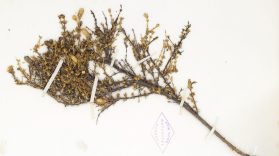
A branch of Blutaparon rigidum, collected on a 1905-1906 expedition to the Galapagos Islands, contains hundreds of potentially viable seeds. NEW YORK BOTANICAL GARDEN

We have touched on the topic of reviving extinct species only a few times previously, and as obvious as it seems we must mention that reviving plant species sounds like a more sound ambition. So, thanks to Janet Marinelli and Yale e360 for this story:

Back from the Dead: New Hope for Resurrecting Extinct Plants

Armed with new technology, botanists are proposing what was once thought impractical: reviving long-lost plant species by using seeds from dried specimens in collections. The challenges remain daunting, but researchers are now searching for the best de-extinction candidates.

In January 1769, botanists Joseph Banks and Daniel Solander found a daisy in Tierra del Fuego, at the southern tip of South America. Continue reading

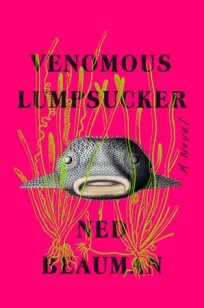
Ned Beauman’s Venomous Lumpsucker

The reviews are  coming in, and especially this one by David Annand in TLS makes Ned Beauman’s new book look worthy of this moment in human history:

Whimsical and cruel

A tale of capitalism, penance and species extinction

In the 1980s the American literary critic Tom LeClair identified what he called the “systems novel”, a genre of fiction concerned with the characters, acts and situations of the conventional novel while simultaneously speculating on the complex social structures – Continue reading

Sensory Loading, Overloading & Unloading

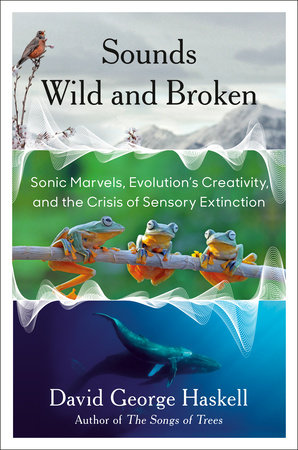
Sounds Wild and Broken by David George Haskell
In early August, 2007 we arrived in a leafy suburb on the north side of Atlanta. We had spent the previous year living on this island, where doors did not have locks and during the daytime the only man-made sounds tended to be those of fishing boats coming and going. At night on that island there were no noises other than nature’s, including small waves hitting the shores and in summertime the crickets. On the first night in Atlanta I opened the window to let in the night air, and the sound of the superhighway, a mile or so away, was distracting enough that I had to close the window to sleep. It’s not that I had not appreciated the quiet of the island, but I was surprised by how much I had adapted to it. The opening of this book review, for these reasons, resonates with my own experience:

Sounds Wild and Broken review – a moving paean to Earth’s fraying soundtrack

David George Haskell’s often wonderful book explores some of the lost frequencies of nature – heard clearly again during Covid’s initial human hush

Lockdown was, among other things, a sudden collective experiment in volume control. Sound waves from the regular rush-hour thrum of cities usually penetrate more than a kilometre below the Earth’s surface. Continue reading

More On Seed Banks

We have featured these banks before, but they are worthy of a more detailed inside look.

So, thanks to by Salomé Gómez-Upegui, Rita Liu and the Guardian. Their article, Seed banks: the last line of defense against a threatening global food crisis is full of images and written descriptions that put these banks in better perspective:

As climate breakdown and worldwide conflict continue to place the food system at risk, seed banks from the Arctic to Lebanon try to safeguard

As the risks from the climate crisis and global conflict increase, seed banks are increasingly considered a priceless resource that could one day prevent a worldwide food crisis. Continue reading

Ivory-billed Woodpeckers In Louisiana

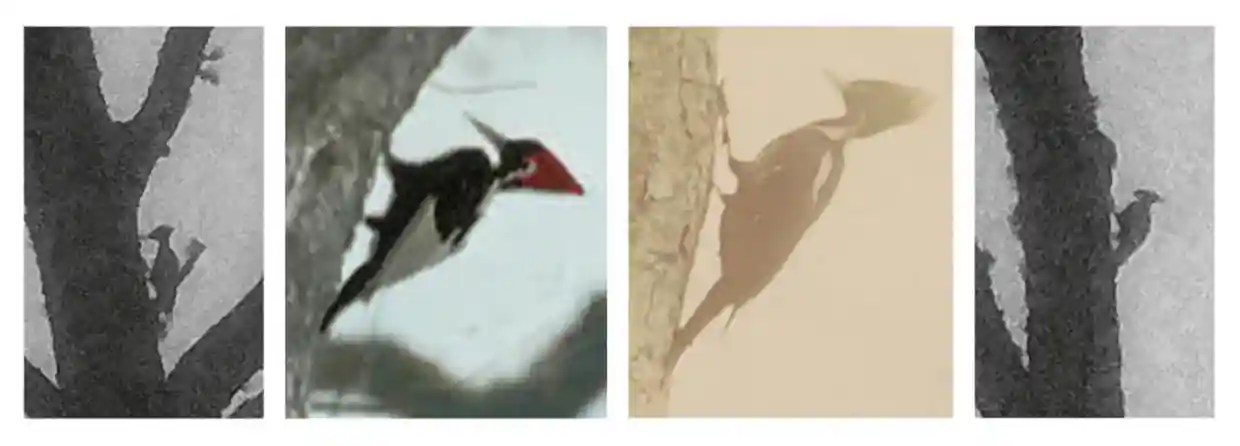
Comparison of photographs taken of apparent ivory-billed woodpeckers in Louisiana from this study (A, D), with a colorized ivory-billed woodpecker, also from Louisiana (B), and a pale-billed woodpecker taken in Central America (C). Photograph: The Guardian

The title of this post should have a question mark at the end of it, or should be considered clickbait. For bird nerds this is likely not even news. But it is important in terms of natural history in general. Ivory-billed woodpeckers have been mentioned a couple of times in our pages; but the chance of seeing one these days was considered to be zero. We can now hope we were wrong about that:

Back from the dead? Elusive ivory-billed woodpecker not extinct, researchers say

An expedition to the forests of Louisiana say extinction of bird, last definitively seen in 1944, has been exaggerated

In terms of elusiveness, it is the Bigfoot or Loch Ness monster of the bird world, so rare and undetectable that the US government declared it extinct last year. But the ivory-billed woodpecker is, in fact, still alive and pecking in the forests of Louisiana, a team of researchers has claimed. Continue reading

Tracking Disappearing Species

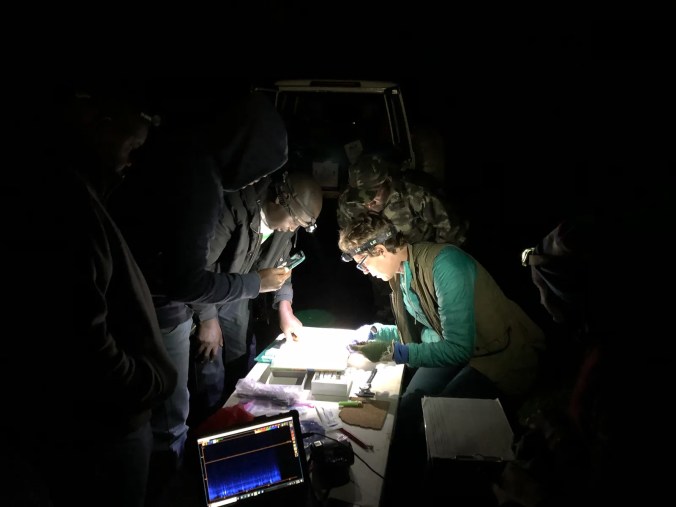
Researchers work through taxonomic keys to determine whether they had just caught a Hills’ horseshoe bat in Rwanda’s Nyungwe National Park.Photograph by Jon Flanders / Courtesy Bat Conservation International

Disappearing species as a topic in these pages has taken many forms. Hunters of disappearing species, less so. My exposure to this topic is limited to one project that Seth participated in. But the fact that Seth also had experience on a different type of project in Rwanda’s Nyungwe National Park made this article particularly of interest. Carolyn Kormann, once again, thank you:

The Hunt for a Lost Bat

The obsessive people who track down disappearing species are their own variety of rare—sparsely found across a wide geographic range, in all sorts of habitats.

In January, 2019, a multinational team of biologists set out into the rain forest of southwestern Rwanda, in search of a near-mythical bat that they thought might be extinct. Continue reading

Stenophylla, A Coffee With Real Potential & Poster Child For Food Diversity

Our thanks to Dan Saladino, a food journalist and author of Eating to Extinction: The World’s Rarest Foods and Why We Need to Save Them as well as recipient of a James Beard Award for food journalism.

He offers an inside look at a relatively unknown coffee varietal with potential, and at the same time, an argument in favor of diversity, in his article Edible Extinction: Why We Need to Revive Global Food Diversity:

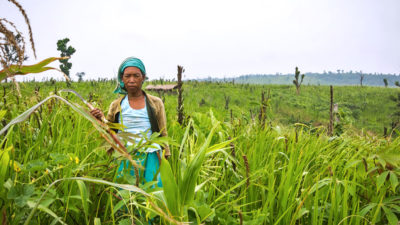
A Khasi farmer growing millet in Meghalaya, India.

A Khasi farmer growing millet in Meghalaya, India. NORTH EAST SLOW FOOD & AGROBIODIVERSITY SOCIETY

The Green Revolution helped feed a surging global population, but at the cost of impoverishing crop diversity. Now, with climate change increasingly threatening food supplies, the need for greater agricultural resilience means restoring endangered crop and food varieties.

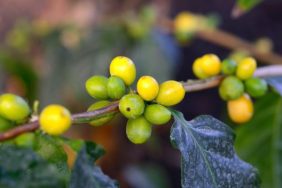
Stenophylla beans up close. RBG KEW; KLAUS STEINKAMP / ALAMY

In August 2020, inside the cupping room of a London roastery, a team of botanists and baristas gathered to taste a coffee species that most believed had been lost forever. It was an important moment. Coffee experts had spent years searching in West Africa for the few remaining trees of this species, even issuing “wanted posters” to farmers asking if they had seen it. Continue reading

New Technology For Anti-Poaching

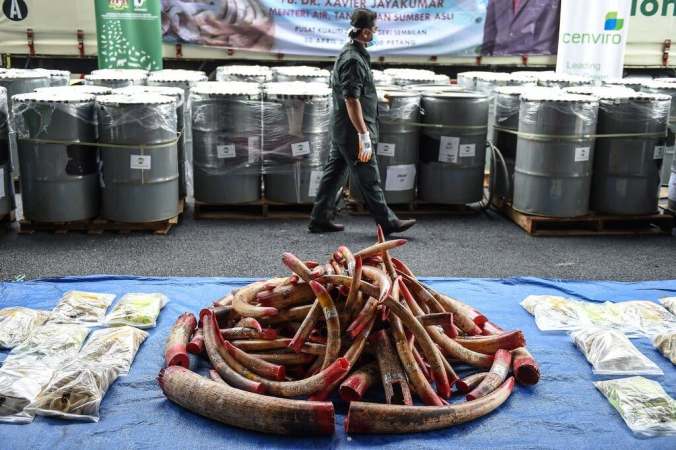
Seized ivory tusks before being destroyed at a waste management center in Port Dickson, Malaysia, in 2019. Mohd Rasfan/Agence France-Presse — Getty Images

Poaching has a puzzling array of culprits as well as victims, and many possible solutions. I have thought over the years that the Tiger Trail approach was replicable for this purpose. But genetic technology might scale more effectively. And with climate change overshadowing other crises, you might think this topic is past its prime, so read the comments section at the end of this article. Thanks to Catherine M. Allchin (how did we miss her prior work?) for this story, and please click through to read it in the New York Times:

It Helped Catch Serial Killers. Can It Stop Elephant and Wildlife Poachers, Too?

Scientists used a genetic investigation technique with the aim of helping turn the tide against illicit hauls of ivory and other animal parts.

Cambodian law enforcement officials received a tip from investigators in the U.S. Department of Homeland Security. Continue reading

Monbiot’s Scrutiny In Perspective

Illustration by Eva Bee

The first I heard of him, nearly a decade ago, I was immediately hooked on his writing, and the ideas he was offering were surprising to read in a mainstream, if progressive, publication. He introduced me to rewilding. If you have not been reading or perhaps listening to George Monbiot during this decade you may not have noticed how his radicalism has evolved. In this editorial ostensibly about the Pandora Papers I learned something about Madeira that I want to read more about:

…A few decades after the Portuguese colonised Madeira in 1420, they developed a system that differed in some respects from anything that had gone before. By felling the forests after which they named the island (madeira is Portuguese for wood), they created, in this uninhabited sphere, a blank slate – a terra nullius – in which a new economy could be built. Continue reading

Bewilderment & Richard Powers In Conversation

When I first linked to the work of Richard Powers it was when his previous book was being reviewed. Now he has a new book out, and from the conversation that follows it sounds like this one is a very good bookend to that one:

Richard Powers on What We Can Learn from Trees

The Pulitzer Prize-winning author asks whether we can reimagine our relationship with the natural world before it’s too late.

There are certain conversations I fear trying to fit into a description.

Continue reading

Healing Earth & Avoiding Amazon

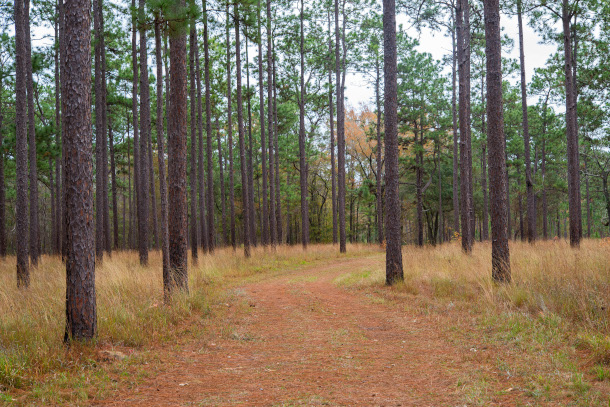
Longleaf pines once covered 90 million acres from Virginia to east Texas but today only about 5 percent of historic range remains intact. Marion Clifton Davis was a modern conservationist who bought tens of thousands of acres in the Florida sandhills and turned them into a private reserve, a project aimed at restoring back the Longleaf pine forest. (Photo: Florida Fish and Wildlife, Flickr, CC BY ND 2.0)

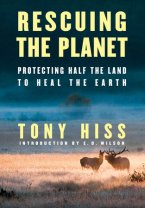
When you have 12 minutes to spare, listen to Tony Hiss talk about his new book on this excellent episode of Living On Earth, and if you decide to buy the book and want to avoid Amazon click the image of the book below:

The Boreal Forest is the world’s largest intact forest ecosystem and is a carbon sink. It’s estimated that if global warming exceeds the 3-5 degree Celsius heat stress and water scarcity could trigger extensive forest death and a dangerous release of the stored carbon dioxide into the atmosphere. (Photo: Kevin Owen, Flickr, CC BY NC ND 2.0)

Climate change is placing stress on plants and animals to rapidly adapt but without intact habitat, that could become impossible for many. Tony Hiss is an award-winning author and joins Host Bobby Bascomb to talk about his book Rescuing the Planet: Protecting Half the Land to Heal the Earth, which looks at several places across North America where communities are already working to protect habitat and biodiversity.

Transcript

BASCOMB: It’s Living on Earth, I’m Bobby Bascomb.

During his first few days in office President Biden announced the goal of protecting 30 percent of US land and water by the year 2030 with a long term goal of 50 percent by 2050. Continue reading

Palm Oil & Us

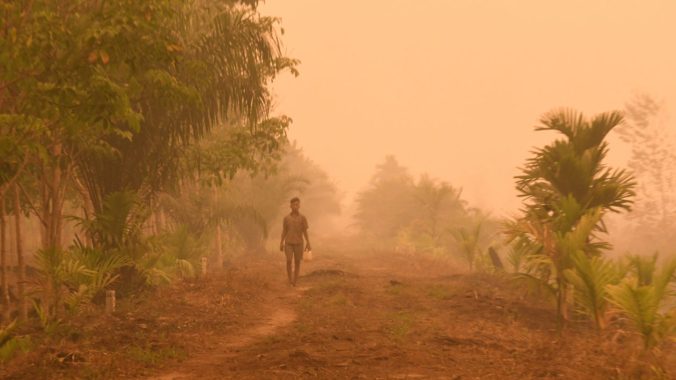
A villager walks through a haze from fires in burned peatland at an oil palm plantation in Sumatra, Indonesia. MUHAMMAD ADIMAJA / GREENPEACE

For all the attention we have given palm oil in the decade of posting links to stories here, strange that Jocelyn Zuckerman only appears once in our pages before today. As with fossil fuels the onus should not be entirely on individuals as consumers; collective action and public policy are essential tools to limiting the damage that corporate palm interests have been causing, relatively unchecked, for too long. We thank her for this clear, strong statement:

The Time Has Come to Rein In the Global Scourge of Palm Oil

The cultivation of palm oil, found in roughly half of U.S. grocery products, has devastated tropical ecosystems, released vast amounts of C02 into the atmosphere, and impoverished rural communities. But efforts are underway that could curb the abuses of this powerful industry.

A few weeks ago, the Sri Lankan president announced that his government would ban all imports of palm oil, with immediate effect, and ordered the country’s plantation companies to begin uprooting their oil-palm monocultures and replacing them with more environmentally friendly crops. Citing concerns about soil erosion, water scarcity, and threats to biodiversity and public health, President Gotabaya Rajapaksa explained that his aim was to “make the country free from oil palm plantations and palm oil consumption.” Continue reading