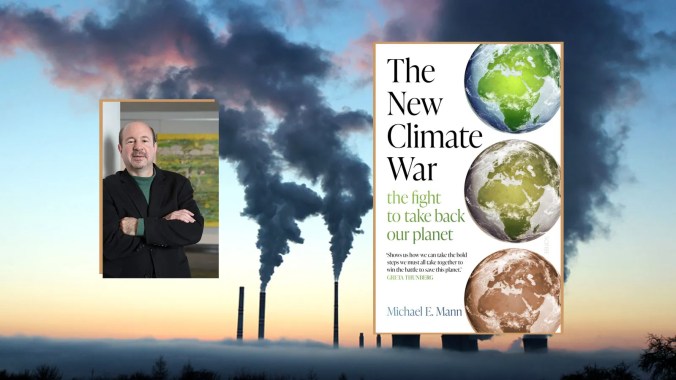
The New Climate War Book Tour Optimism

If you are wondering where the hope comes from, read Eric Schwartzman’s article at Yale Climate Connections:

Climate scientist Michael E Mann PhD, author of The New Climate War signs his book for winemaker Ross Halleck of Halleck Vineyard in Sonoma County, California.

Scientist Michael Mann expresses hope during West Coast book tour

University of Pennsylvania climate scientist says he remains optimistic despite daunting challenges and continued concerns about ‘false’ climate solutions.

CORTE MADERA, CALIFORNIA – Don’t believe the climate crisis doomsayers: We can still achieve a 50% reduction in carbon emissions by 2030. But we have to elect lawmakers with the political will to enact meaningful climate legislation. The atmosphere is warming significantly, just as Exxon Mobil scientists were predicting back in 1982. Continue reading


Really, World Bank?

We knew there were still agents of climate skepticism, and even deniers, in important positions of influence. But the person trusted to lead the World Bank is among the last we would expect to be one of them. Really. Read about it in Bill McKibben’s newsletter:

The Global Banker Who’s Not Sure the Globe is Warming

Biden’s Easiest Climate Call Ever is to Ditch David Malpass

Some essential climate tasks are hard and expensive and take years.

And a few could not be easier. President Biden needs—now—to get rid of David Malpass as the head of the World Bank. Continue reading

Really, Washington Post?

Before we compromise further on planet earth, the question Really? is often a good place to start. Let’s be sure our revered journalists and the publications they work for call apples as apples, and oranges as oranges, says Bill McKibben:

A pipeline is not a windmill

Rally Thursday Against Manchin’s Dirty Deal–and Do Some Lobbying in the Meantime!

The Washington Post, which has done remarkable climate reporting in recent years, had a less successful story in this morning’s paper. Continue reading

England’s Green And Pleasant Land

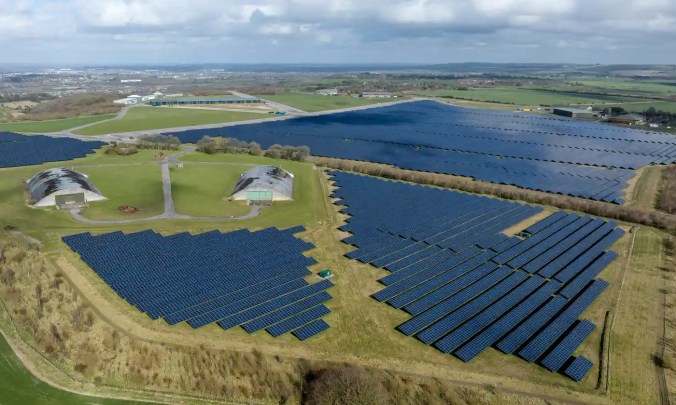
Solar farm in Wroughton, England. Planning permission for 23 solar farms has been refused across England, Wales and Scotland between January 2021 and July 2022. Photograph: Chris Gorman/Getty Images

Nature gets disrupted even by the most sensitively planned green solutions. Here is a parallel story to yesterday’s, with solar replacing wind and England replacing Western USA, illustrating the challenges facing renewable energy:

Exclusive: Projects which would have cut annual electricity bills by £100m turned down

Solar farms are being refused planning permission in Great Britain at the highest rate in five years, analysis has found, with projects which would have cut £100m off annual electricity bills turned down in the past 18 months.

Continue reading

Almost Missed

I have missed plenty of good articles, books and other sources of news and analysis that relate to our goals with this platform. When I am late to see something important, like the book to the right, no regrets. Especially when it comes to my attention through an essay like this one by Daniel Sherrell:

The Democrats’ climate bill is a historic victory. But we can’t stop here

Passage of the Inflation Reduction Act filled me with joy and rage, relief and apprehension, exhaustion and vigilance. We must celebrate, but also mourn, rage and organize

I was at a Mets game when news broke that the climate bill had enough votes to pass in the Senate. It was the bottom of the eighth, and Edwin Díaz had just struck out the heart of the Braves’ lineup. The crowd at Citi Field was feeling good. Everyone could sense a win was at hand.

I read the push notification then sat there stunned for several minutes, watching the Mets clinch the game, waiting for the world-shaping news to register. Continue reading

Save Our Sequioas

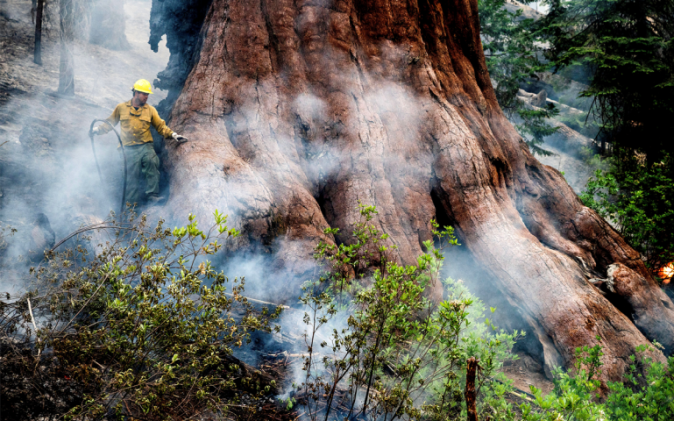
Photo by AP Photo/Noah Berger

Our thanks to Lindsey Botts for this story:

Can the Save Our Sequoias Act Match Up to Its Name?

Dozens of conservation groups push back against a pending forestry bill

As the Washburn Fire last month threatened to scorch the Mariposa Grove of giant sequoias in Yosemite National Park, discussions about how to protect the iconic trees heated up. While most people agree that the trees are treasured monuments that need to be preserved, there is considerable disagreement about how best to do that. Continue reading

McKibben Smiles

Illustration of a smokestack windmills and trees.

Illustration by João Fazenda

When Bill McKibben is frustrated, you know it. Much less frequently you can find evidence of his ability to take a deep breath and sense some progress, however modest, so enjoy it when it comes, and try to smile:

Barbados, Leadership & Climate Action

Sargassum seaweed, which thrives in warming oceans, is overtaking a beach in Barbados. Credit: Erika Larsen/Redux, for The New York Times

The region is likely to bear disproportionate challenges from climate change and this island is not taking it lightly. We appreciate the effort described in this story by Abrahm Lustgarten, published by ProPublica:

Until the recent completion of an infrastructure project, Kenneth Blades was able to keep only part of his farmland watered. Credit: Erika Larsen/Redux, for The New York Times

Barbados Resists Climate Colonialism in an Effort to Survive the Costs of Global Warming

Across the Caribbean, soaring national debt is a hidden but decisive aspect of the climate crisis, hobbling countries’ ability to protect themselves from disaster. One island’s leader is fighting to find a way out.

Late on May 31, 2018, five days after she was sworn in as prime minister of Barbados, Mia Mottley and her top advisers gathered in the windowless anteroom of her administrative office in Bridgetown, the capital, for a call that could determine the fate of her island nation. Continue reading
Unwanted Plastic Renaissance

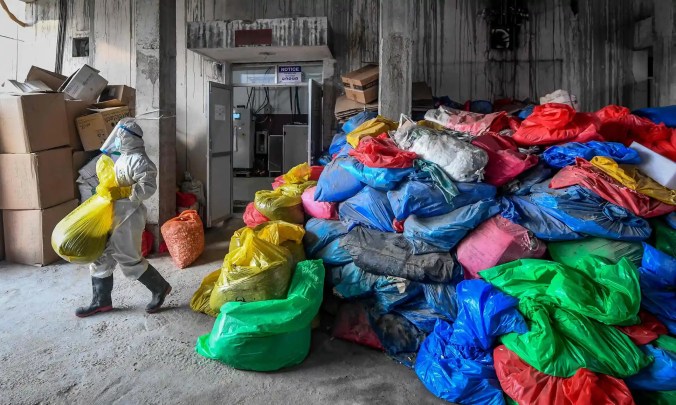
A worker at a hospital in Kathmandu, Nepal, readies bags of Covid-19 waste for treatment, December last year. Photograph: Prakash Mathema/AFP/Getty Images

The plague of plastic has zombie-like revivification capabilities:

How the plastic industry turned the pandemic to its advantage

With its products proving indispensable to combatting Covid-19, the plastics business is reinvigorated. What will it take to bring this major polluter to heel?

There are only two reasons that the plastics industry will change, a polymer scientist once told me: war or legislation. Continue reading

McKibben On The Supreme Court’s EPA Ruling

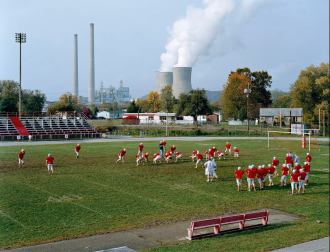
Photographs by Mitch Epstein

When you have found an explainer reliably clear on complicated but important issues, keep reading their essays:

The Supreme Court Tries to Overrule the Climate

A destructive decision in West Virginia v. E.P.A.

Credit where due: the Supreme Court’s 6–3 ruling in West Virginia v. E.P.A. is the culmination of a five-decade effort to make sure that the federal government won’t threaten the business status quo. Lewis Powell’s famous memo, written in 1971, before he joined the Supreme Court—between the enactment of a strong Clean Air Act and a strong Clean Water Act, each with huge popular support—called on “businessmen” to stand up to the tide of voices “from the college campus, the pulpit, the media, the intellectual and literary journals, the arts and sciences, and from politicians” calling for progressive change. Continue reading

Justice For Dom & Bruno

Dom Phillips (center), seen here taking notes as he talks with Indigenous people, reported regularly for the Guardian. Photograph by Joao Laet / AFP / Getty

Only one article by Dom Phillips in our pages, and not a single mention of Bruno Pereira seems wrong, to say the least.  As a rule obituaries are not our thing in these pages, but we have made exceptions.

Bruno Pereira was among the many senior officials and veteran experts at FUNAI who had gained a reputation for a robust defense of the agency’s guidelines in the Javari. Photograph by Daniel Marenco

Two Murders in the Amazon

The disappearance of Dom Phillips and Bruno Araújo Pereira, and the crisis created by Jair Bolsonaro’s policies.

From the moment that Dom Phillips and Bruno Araújo Pereira vanished, on June 5th, in the Brazilian Amazon, there were suspicions of foul play. Phillips was a British freelance journalist dedicated to environmental issues, and Pereira, his friend and guide, was a prominent Brazilian Indigenous-affairs expert.

Photograph by Nelson Almeida / AFP / Getty

He was assisting Phillips with research for a book, tentatively titled “How to Save the Amazon.” Continue reading

Bears Ears Co-Management

Muley Point in Bears Ears National Monument in Utah. Mark Holm for The New York Times

After plenty of contention, a move in the right direction, at last:

Five Native American tribes will work with the Bureau of Land Management to plan and conserve Bears Ears National Monument in Utah, officials said.

Bears Ears National Monument, whose red-rock landscape sprawls across more than 1.3 million acres in southeastern Utah, will be managed jointly by the federal government and Native American tribes in what administration officials said represents a “one-of-a-kind” model of cooperation. Continue reading

Good Journalism, Excellent Environmental Coverage

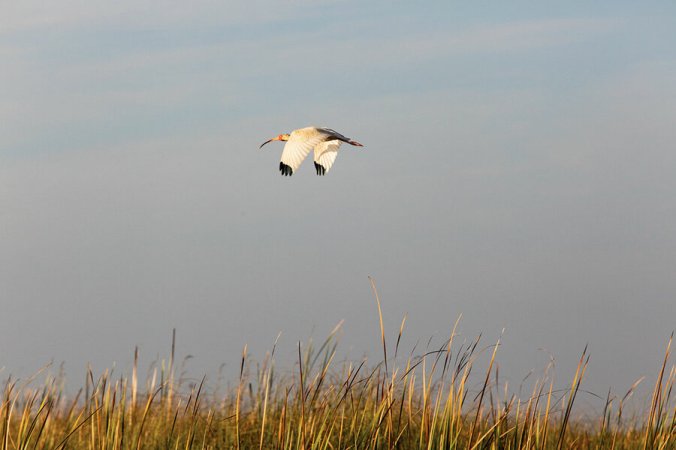
Melanie Stetson Freeman/Staff. A white ibis flies over the Everglades, where many bird species nest each year. Restoration efforts in Florida’s “river of grass” have begun to show signs of progress.

The CS Monitor was the newspaper delivered to our home when I was growing up. Lucky me. These days it still offers good journalism, but is no longer a paper. They made the switch to digital-only in 2008. In earlier years of my monitoring dozens of news sources for this platform it was the source of numerous stories of environmental interest in our pages. But in the last few years, for no particular reason, I failed to monitor their website for stories. And then today, this:

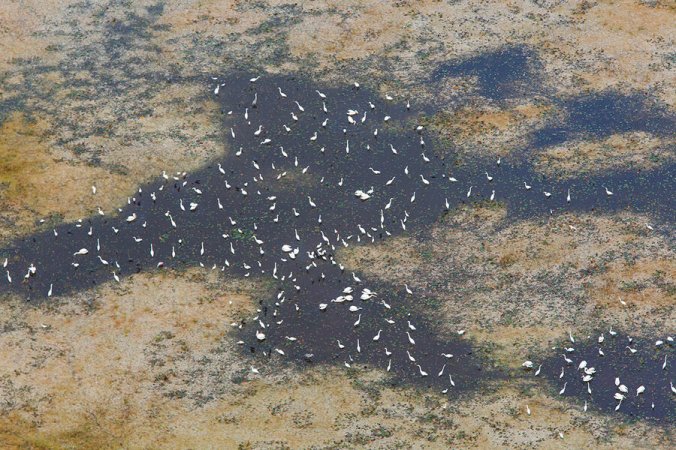
Melanie Stetson Freeman/Staff. Birds look like white flecks from the air.

‘River of Grass’: Inside the quest to restore the Everglades

Richard Mertens Special contributor

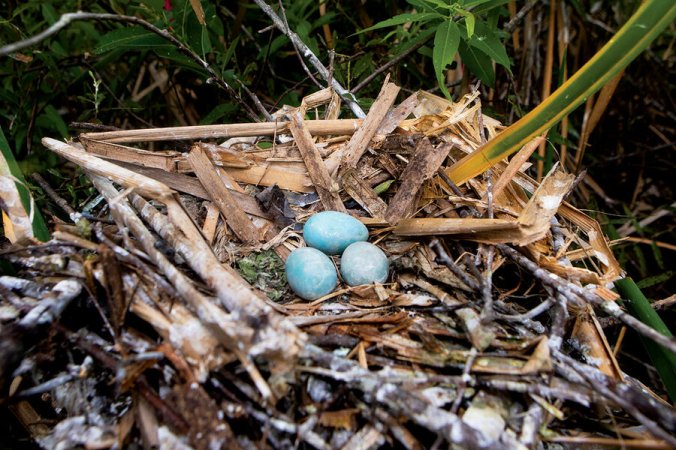
Melanie Stetson Freeman/Staff. Three eggs sit in a nest in the Everglades.

Eight hundred feet up, the helicopter banks hard to the left. The horizon disappears. Mark Cook, an avian biologist, peers out his side window at a small irregular patch of water below. It’s hardly distinguishable from innumerable other patches that lie in every direction, dark and shining amid a ragged expanse of brown marsh grass and green tree islands. Continue reading

Action Is The Thing

ILLUSTRATION: WIRED; GETTY IMAGES

Climate inaction is a theme bookending the first decade of our chronicling news stories and analytical essays. Why, we have stopped bothering to wonder, is inaction so persistent? Whether activism or other forms of action, there is not enough of it relative to the scale of the crisis. We thank Eleanor Cummins, a freelance science journalist and adjunct professor at New York University’s Science, Health, and Environmental Reporting Program for these ideas as published in Wired:

‘Thinkwashing’ Keeps People From Taking Action in Times of Crisis

When it comes to issues like climate change, too many let the perfect become the enemy of the good, while the world burns.

LESS THAN A decade ago, “wait and see” arguments about climate change still circulated. “We often hear that there is a ‘scientific consensus’ about climate change,” physicist Steven E. Koonin wrote in The Wall Street Journal in 2014. “But as far as the computer models go, there isn’t a useful consensus at the level of detail relevant to assessing human influences.” The idea was that the world needed more data before it could respond to the threat posed by global warming—assuming such research indicated a response was even necessary. Continue reading

Adaptation Was Better Than Doing Nothing, But Nowhere Near Good Enough

Katharine Hayhoe warns that if we continue emitting greenhouse gases no adaptation will be possible. Photograph: Courtesy of Dr Katharine Hayhoe

We have been promoting adaptation for about as long as we have been posting here.  Fiona Harvey the Guardian’s Environment correspondent, interviews a scientist who will not soft peddle how far gone we are from those options:

We cannot adapt our way out of climate crisis, warns leading scientist

Katharine Hayhoe says the world is heading for dangers people have not seen in 10,000 years of civilisation

The world cannot adapt its way out of the climate crisis, and counting on adaptation to limit damage is no substitute for urgently cutting greenhouse gases, a leading climate scientist has warned. Continue reading

The Dirty Banking & Fossil Fuel Relationship Seen From Another Angle

We know a bit about dirty banking. While we do not think money is a dirty word, we have seen how dirty it can get when mixed with fossil fuels. So thanks, as always, to Bill McKibben for this further illumination. We are sharing his newsletter, rather than the New Yorker story he references, because as you will see below he encourages sharing Your money is your carbon:

If you’ve got $125k in the financial system, it’s doing as much damage as your cooking and your heating and your flying. These are the most important new climate numbers for many years

Earlier today I published a big story in the New Yorker about how banks are driving the climate crisis. A report from a consortium of environmental groups made clear that for the biggest, richest companies on earth, the cash they keep in the banking system (which gets lent out for pipelines and the like) produces more carbon than their actual, you know, business. Google emits more carbon from its money than its phones, and Netflix from its streaming, and so on. Continue reading

Preservation & Protection Via Gamification

Incentives to behave differently in relation to the environment is a constant topic here, but we have not used the word gamification before. Today is finally the day. Thank you, Lindsey Galloway:

Palau’s world-first ‘good traveller’ incentive

Responsible travellers will be able to unlock exclusive cultural and nature-based experiences (Credit: Colors and shapes of underwater world/Getty Images)

In a world-first initiative, visitors to Palau will be offered exclusive experiences based on how they treat the environment and culture, not by how much they spend.

Despite being home to fewer than 20,000 residents, the Republic of Palau is making an outsized impact to preserve the planet. Not only did the country Continue reading

100% Renewable California Energy Milestone

Solar and wind power projects have been booming in California, like the Pine Tree Wind Farm and Solar Power Plant in the Tehachapi Mountains, but that doesn’t mean fossil fuels are fading away quickly. Irfan Khan/Los Angeles Times via Getty Images

Recovery from a long-term addiction to fossil fuels was never going to be easy. Necessary? Yes. But it will still be a long haul even with milestones like this one in the western USA. Thanks to National Public Radio (USA) for this news:

California just ran on 100% renewable energy, but fossil fuels aren’t fading away yet

On a mild Sunday afternoon, California set a historic milestone in the quest for clean energy. The sun was shining, the wind was blowing and on May 8th, the state produced enough renewable electricity to meet 103% of consumer demand. That broke a record set a week earlier of 99.9%. Continue reading

Lawns Gone, Good Riddance

Jaime Gonzalez of Par 3 Landscape and Maintenance removed grass at a condominium complex in Las Vegas. The lawn is considered “nonfunctional” under a new state law.

In case you have been to the city, or even just heard about how water is flaunted as a key attraction, and wondered how they can justify such use of a limited resource, then Is That an Outlaw Lawn? Las Vegas Has a New Approach to Saving Water may be worth a few minutes of your time. We recently shared news of a voluntary initiative to reconsider lawns for reasons entirely different from those in the story below. Henry Fountain‘s text accompanied by Joe Buglewicz’s photos, tells the story of Las Vegas lawns, where water resources are so limited, this seems a long time coming:

Mr. Donnarumma documented water running off a sidewalk into the curb from sprinkler overspray.

With drought and growth taking a toll on the Colorado River, the source of 90 percent of the region’s water, a new law mandates the removal of turf, patch by patch.

LAS VEGAS — It was a perfectly decent patch of lawn, several hundred square feet of grass in a condominium community on this city’s western edge. But Jaime Gonzalez, a worker with a local landscaping firm, had a job to do. Continue reading

Climate Policies To Cheer On

(Washington Post illustration; Demetrius Freeman/The Washington Post; iStock)

I am heading to Ithaca tomorrow for family reasons, so the third item described in the story that follows is of particular interest. But every one of the items is worth reflecting on, in a news world without enough such stories. Our thanks to the Washington Post Staff who put this list together:

10 recent climate policies that could make a difference

Stories from the past six months that show what local and national policy change can look like

The most recent IPCC report makes it clear: There is no one silver bullet that can address global warming. Instead, nations, businesses, communities and individuals all have a role to play in helping to create a safer and more sustainable future. But without action from the world’s wealthiest countries, the nations and people who are least at fault for fueling climate change will be the ones who suffer the most, the scientists behind the report warn. Continue reading