Reducing Emissions & Living Well

Gauchos at the Pintado wind farm in Corral de Piedra, Uruguay.

Gauchos at the Pintado wind farm in Corral de Piedra, Uruguay. Alessandro Cinque for The New York Times

We normally think of Costa Rica to answer this question, but it is in good company:

No greater challenge faces humanity than reducing emissions without backsliding into preindustrial poverty. One tiny country is leading the way.

Let’s say you live in the typical American household. It doesn’t exist, not in any sense except in a data set, but it’s easy enough to imagine.

“We learn to live with less here,” says a former bank analyst, Ignacio Estrada, who had decided to take a 75 percent pay cut to return home. “And it’s made my life better.”

“We learn to live with less here,” says a former bank analyst, Ignacio Estrada, who had decided to take a 75 percent pay cut to return home. “And it’s made my life better.” Alessandro Cinque for The New York Times

Maybe it’s your aunt’s, or your neighbor’s, or a bit like your own. Since more than half of us live outside big cities, it’s probably in a middle-class suburb, like Fox Lake, north of Chicago.

Uruguay’s national director of energy, Ramón Méndez, at home in Montevideo.

Uruguay’s national director of energy, Ramón Méndez, at home in Montevideo. Alessandro Cinque for The New York Times

You picked it because it’s affordable and not a terrible commute to your job. Your house is about 2,200 square feet — a split-level ranch, perhaps. You’re in your mid-30s and just welcomed your first child. Together with your partner you make about $70,000 a year, some of which goes toward the 11,000 kilowatts of electricity and 37,000 cubic feet of natural gas you use to heat the house, play video games and dry your clothes. You take six or seven plane flights a year, to visit your mom after her surgery or attend a conference, and drive about 25,000 miles, most of which you barely register anymore, as you listen to Joe Rogan or Bad Bunny. Maybe twice a month you stop at Target and pick up six or seven things: double-sided tape, an extra toothbrush, an inflatable mattress. Continue reading

Oysters & Rescue Plans

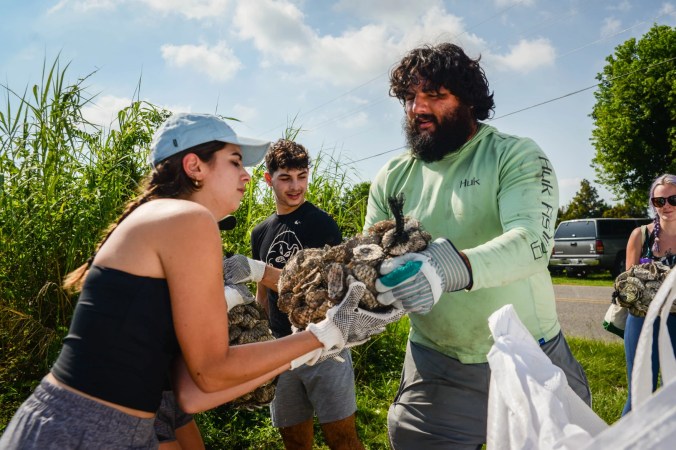
Halle Parker/WWNO. Pointe-au-Chien Indian Tribe member Pete Lebeouf works with volunteers to load bags of oyster shells onto a boat on Saturday, Sept. 24, 2022.

We have enjoyed every instance of oysters being treated with respect, beyond culinary. When indigenous knowhow is part of the story, even better. Our thanks to Halle Parker and WWNO (National Public Radio, USA) for this story:

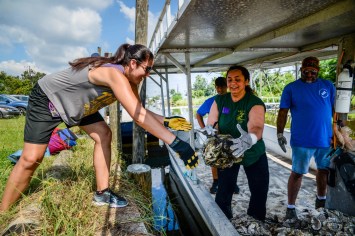
Halle Parker/WWNO.  Pointe-au-Chien Indian Tribe citizens Patty Ferguson-Bohnee and Lori Stewart pass bags of oyster shell and pile it on a boat for transport during a volunteer event on Saturday, Sept. 24, 2022.

A Louisiana tribe is losing cultural sites to coastal erosion. Oyster reefs could help.

For the past six years, the Pointe-au-Chien Indian Tribe has battled to stop its historic earthen Indian mounds from slipping into the sea, looking to the power of oyster shells to protect them. Now, they’ve expanded that effort.

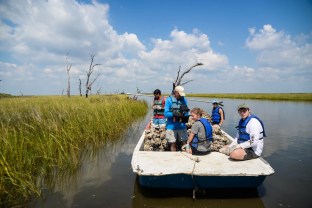
Halle Parker/WWNO. Volunteers boat down to Bernard’s Mound, one of the Pointe-au-Chien Indian Tribe’s historic mounds, to build a new oyster reef that will help slow erosion during an event on Saturday, Sept. 24, 2022.

The tribe has lived in the area for centuries, forced south as Louisiana was colonized, and the mounds that past members built have a range of uses. Some might’ve held homes, others were used for ceremonies and some were burial sites, said Lori Stewart, a member of the tribe.

“The mounds are really significant because we do have some of our ancestors that are buried there, and so we don’t want to see that washed away,” she said. “That’s sacred to us.” Continue reading

Electrify, The Book

Thanks to MIT Press for this preview:

How to Fix Climate Change (A Sneaky Policy Guide)

We may already have a “miracle” fix for climate change: Electrify everything.

Climate change is a planetary emergency. We have to do something now — but what? Saul Griffith, an inventor and renewable electricity advocate (and a recipient of a MacArthur “genius” grant), has a plan. In his book “Electrify,” Griffith lays out a detailed blueprint for fighting climate change while creating millions of new jobs and a healthier environment. Griffith’s plan can be summed up simply: Electrify everything. He explains exactly what it would take to transform our infrastructure, update our grid, and adapt our households to make this possible. Billionaires may contemplate escaping our worn-out planet on a private rocket ship to Mars, but the rest of us, Griffith says, will stay and fight for the future. Continue reading

Pushing Decarbonizing Technology Via Industrial Policy

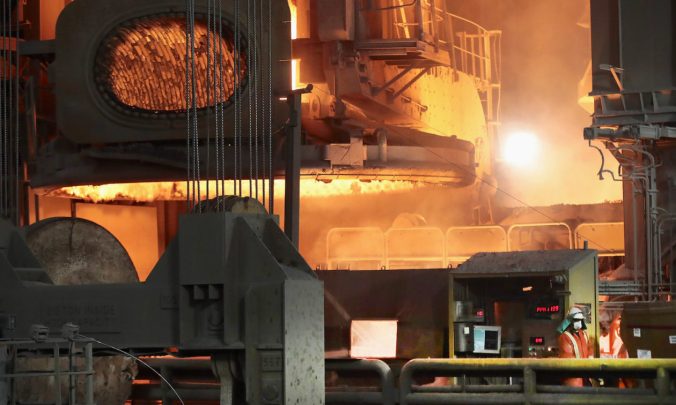
The NLMK mill in Portage, Indiana, which uses a furnace powered by electricity and produces steel from recycled scrap. SCOTT OLSON / GETTY IMAGES

Thanks to Yale e360:

Beyond Biden’s Climate Plan, a New Industrial Revolution Is Needed

The new U.S. climate plan is historic and will pump billions of dollars into advancing the transition away from fossil fuels. But a more far-reaching, innovative approach is needed to push forward the radically new technologies that will be required to decarbonize the economy.

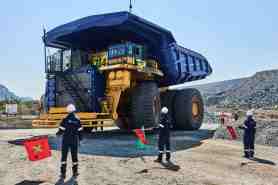
Workers guide a hydrogen-powered truck, part of Anglo American Plc’s NuGen carbon-neutral project, during a moving demonstration at the Anglo American Platinum Ltd. Mogalakwena platinum mine in Mogalakwena, South Africa, on Friday, May 6, 2022. Anglo American unveiled the worlds biggest green-hydrogen powered truck at a platinum mine in northeast South Africa where it aims to replace a fleet of 40 diesel-fueled vehicles that each use about a million liters of the fossil fuel every year. Photographer: Waldo Swiegers/Bloomberg

For all the great news in the Biden administration’s massive new climate spending plan, the hardest work of transforming the economy to stop global warming lies ahead. That’s because nearly all the money in the $369 billion plan will be spent on technologies that American companies already know how to deploy, such as solar farms, making buildings more efficient, and developing networks of electric vehicle charging systems.

Doing a lot more of the same will undoubtedly bring down emissions faster. But deep decarbonization requires a transformation of the American economy that will demand a much more active effort to push the technological frontier and build new industries so emissions can be driven to zero. Continue reading

Tree Core Samples & Age Estimations

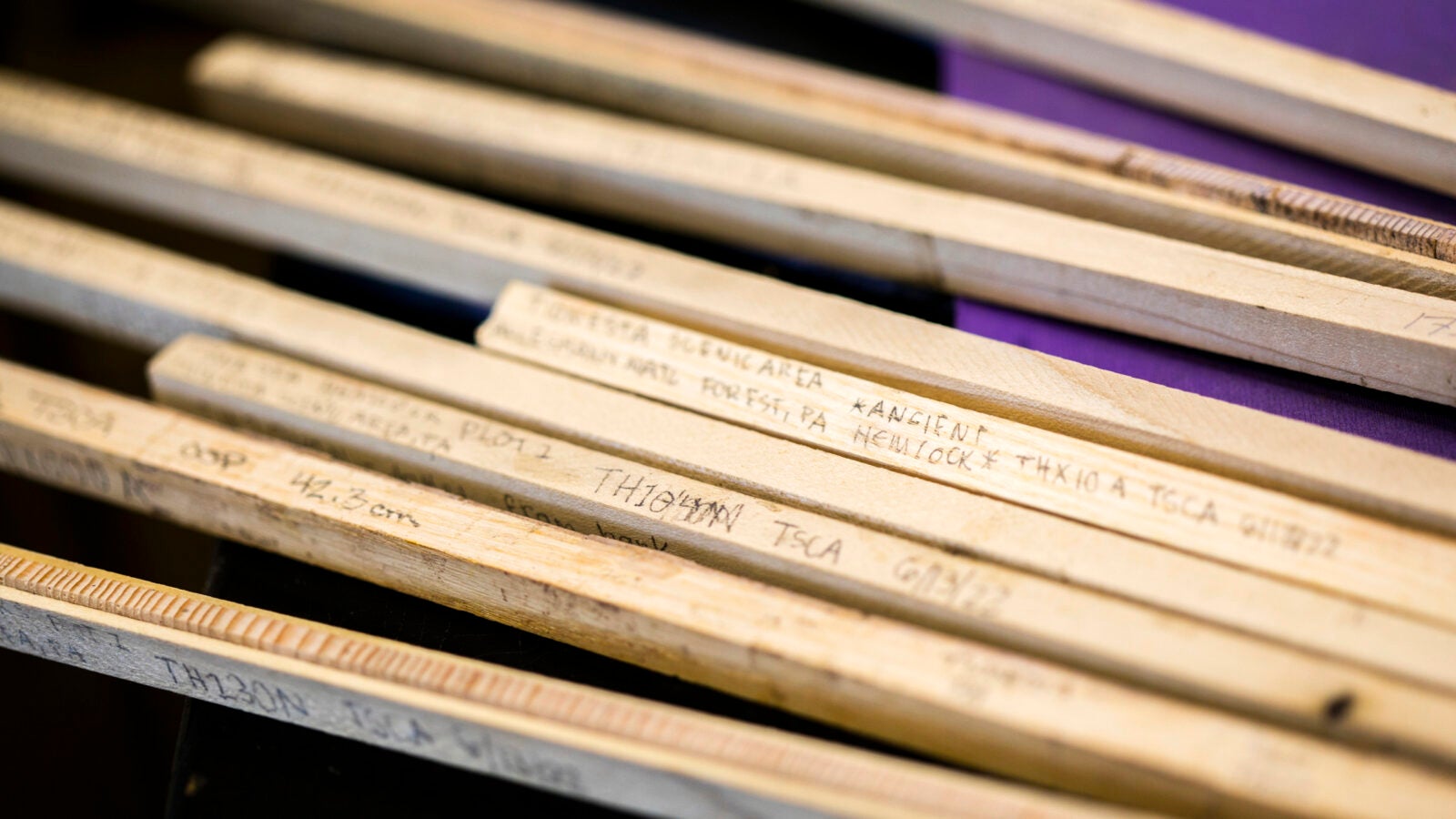
Tree cores Harvard Forest

Core samples may hold clues to a forest’s response to climate change. Photos by Stephanie Mitchell/Harvard Staff Photographer

Juan Siliezar, staff writer for the Harvard Gazette asks and answers a question that we never tire of:

Want to know how cold it was in 1490? Ask a tree

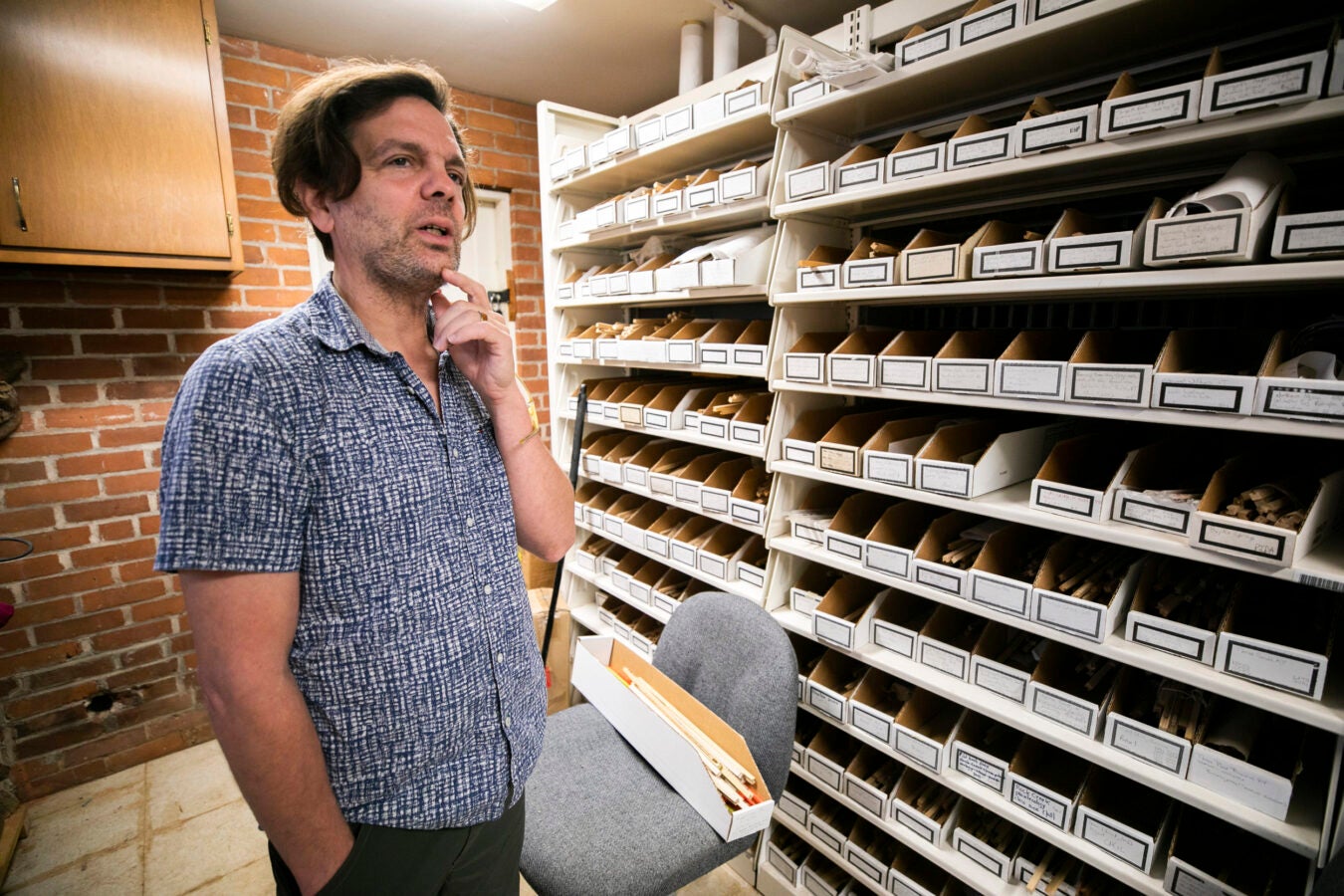
Harvard Forest Senior Ecologist Neil Pederso

“We use tree cores to extract what I’ve been leaning toward calling the memory of the tree,” said Neil Pederson in the lab alongside core samples.

Sometimes getting to where you want to go is a matter of finding the right guide.

Four teams of researchers, led by Harvard Forest ecologists, searched for a patch of ancient trees deep in the woods of western Pennsylvania this summer as part of a project to study how climate changes affected trees over the centuries. One of the scientists had come across them 40 years earlier, but they appeared to have vanished. Just as the group was about to give up and move on they came across someone who gave them a valuable clue. Continue reading

The New Climate War Book Tour Optimism

If you are wondering where the hope comes from, read Eric Schwartzman’s article at Yale Climate Connections:

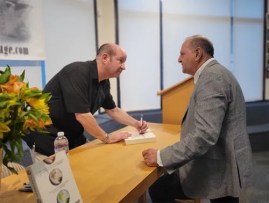
Climate scientist Michael E Mann PhD, author of The New Climate War signs his book for winemaker Ross Halleck of Halleck Vineyard in Sonoma County, California.

Scientist Michael Mann expresses hope during West Coast book tour

University of Pennsylvania climate scientist says he remains optimistic despite daunting challenges and continued concerns about ‘false’ climate solutions.

CORTE MADERA, CALIFORNIA – Don’t believe the climate crisis doomsayers: We can still achieve a 50% reduction in carbon emissions by 2030. But we have to elect lawmakers with the political will to enact meaningful climate legislation. The atmosphere is warming significantly, just as Exxon Mobil scientists were predicting back in 1982. Continue reading

Elephant Seals & Marine Sciences

Thanks to Sierra for this:

When Elephant Seals Become Ocean Researchers

Marine mammals unlock the secrets of climate and the Arctic

By Kate Golden

Illustrations by Masha Foya

ON A FEBRUARY MORNING at Año Nuevo Reserve on the coast of Northern California, hundreds of gray-brown elephant seals lay strewn, lumplike, all over the beach. It was hard to hear anything over the honks and shrieks of status jockeying and sex dramas. The north wind gusted to 35 knots and blew a river of fine sand into everyone’s faces. At a dense seal cluster near the water, researchers and students from the University of California, Santa Cruz, knelt over an 815-pound female whose stern had been labeled “X1” with Clairol bleach. Continue reading

Really, World Bank?

We knew there were still agents of climate skepticism, and even deniers, in important positions of influence. But the person trusted to lead the World Bank is among the last we would expect to be one of them. Really. Read about it in Bill McKibben’s newsletter:

The Global Banker Who’s Not Sure the Globe is Warming

Biden’s Easiest Climate Call Ever is to Ditch David Malpass

Some essential climate tasks are hard and expensive and take years.

And a few could not be easier. President Biden needs—now—to get rid of David Malpass as the head of the World Bank. Continue reading

Essential Lithium & Essential Water

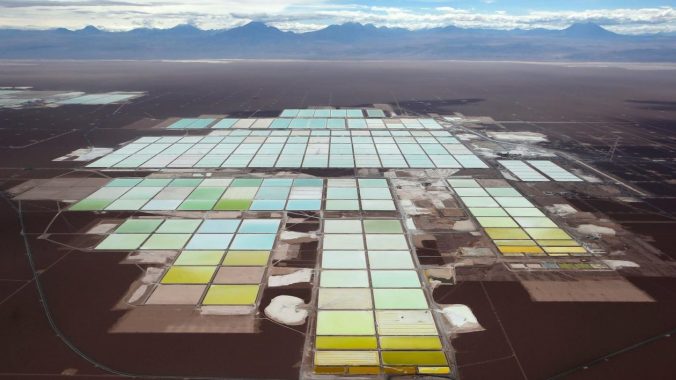
Brine pools at the Soquimich lithium mine on a salt flat in northern Chile. IVAN ALVARADO / REUTERS VIA ALAMY

On my one visit to the Atacama desert in 2009 I had a feeling unlike any I had previously experienced, and it was attributed to the lithium. There is so much, you can feel it. And to put it simply, it feels good. I knew it was being mined, but I assumed it was primarily for pharmaceutical use; no clue it would become so important for batteries. And this set up a sort of zero-sum game, which Fred Pearce helps to understand:

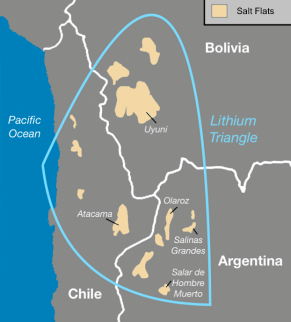
The Lithium Triangle region. YALE ENVIRONMENT 360

Why the Rush to Mine Lithium Could Dry Up the High Andes

The demand for lithium for EV batteries is driving a mining boom in an arid Andes region of Argentina, Chile, and Bolivia, home to half the world’s reserves. Hydrologists are warning the mines could drain vital ecosystems and deprive Indigenous communities of precious water.

What environmental price should the world be willing to pay for the metals needed to switch to electric vehicles? The question is being asked urgently in South America where there are growing fears that what is good for the global climate may be a disaster for some of the world’s rarest and most precious ecosystems — salt flats, wetlands, grazing pastures, and flamingo lakes high in the Andean mountains. Continue reading
Patagonia 2.0

Details of a desk in a Patagonia office with a stack of orange and brown stickers that read “defend bears ears national monument’ on top of stacks of magazines and papers.

Patagonia has become more politically active, going so far as to sue the Trump administration in a bid to protect the Bears Ears National Monument. Laure Joliet for The New York Times

We have mentioned this company multiple times in our pages over the years, because we take inspiration from it, the same way we have taken inspiration from the example set by Chuck Feeney. It is worth noting that I also value everything I have ever bought from Patagonia. The day of this blizzard in New York I took an old beat up backpack in to see if they could repair it in the nearby shop; instead, they gave me a new one.

Good quality products, combined with good service, make the good environmental values of the company all the better:

“Hopefully this will influence a new form of capitalism that doesn’t end up with a few rich people and a bunch of poor people,” said Mr. Chouinard. Meridith Kohut for The New York Times

Billionaire No More: Patagonia Founder Gives Away the Company

Mr. Chouinard filmed an announcement for his employees at home in Wyoming. By giving away the bulk of their assets during their lifetime, the Chouinards have established themselves as among the most charitable families in the country. Natalie Behring for The New York Times

A half century after founding the outdoor apparel maker Patagonia, Yvon Chouinard, the eccentric rock climber who became a reluctant billionaire with his unconventional spin on capitalism, has given the company away.

Rather than selling the company or taking it public, Mr. Chouinard, his wife and two adult children have transferred their ownership of Patagonia, valued at about $3 billion, to a specially designed trust and a nonprofit organization. They were created to preserve the company’s independence and ensure that all of its profits — some $100 million a year — are used to combat climate change and protect undeveloped land around the globe. Continue reading

Solar@School, Win-Win-Win

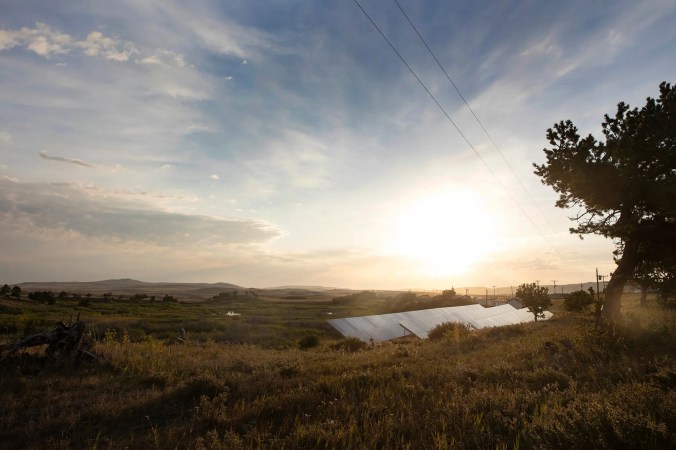
Solar panels installed near the Heart-Butte schools in Montana. Janie Osborne for The New York Times

Two elementary school students stand at table covered in papers, markers and other school materials, and face a wall with a poster map of Montana, divided by tribal territories. The child at left uses an orange marker to point at an area called “Blackfeet & Gros Ventre.”

Students at Heart-Butte School exploring their area of the world on a map in the “Blackfeet Immersion” classroom. Janie Osborne for The New York Times

In the USA it has become normal to think that partisan divisions prevent collaboration on issues of common interest. The partisan divisions are real, and then some; but there are silver linings here and there.  Cara Buckley, a climate reporter, continues to demonstrate a talent for finding cases where communities benefit from collective action in the act of taking better care of the environment:

Black and white goats frolic in grass on a field, which is fenced off and behind which is a series of solar panels angled at the sun. Trees line the horizon.

Goats cared for by Batesville High School’s 4-H students, next to the school’s solar panels. “If you’re conservative, we didn’t ask you for more taxes, if you’re liberal, you love the green concept,” Dr. Hester said. Terra Fondriest for The New York Times

Facing Budget Shortfalls, These Schools Are Turning to the Sun

Public schools are increasingly using savings from solar energy to upgrade facilities, help their communities, and give teachers raises — often with no cost to taxpayers.

One school district was able to give pay raises to its teachers as big as 30 percent. Another bought new heating and ventilation systems, all the better to help students and educators breathe easier in these times. The improvements didn’t cost taxpayers a cent, and were paid for by an endlessly renewable source — the sun.

Mike Tatsey, in jeans and a light blue plaid short sleeve shirt, his thumbs hooked into his jean pockets, stands in a field with solar panes in the background. Brush partially obscures the foreground.

Mike Tatsey, superintendent of schools in Heart-Butte, believes that freeing up extra money for staples like groceries and shoes could have a ripple effect in classrooms. Janie Osborne for The New York Times

As solar energy gains traction across the country, one beneficiary have been schools, particularly those in cash-strapped districts contending with dwindling tax bases.

From New Jersey to California, nearly one in 10 K-12 public and private schools across the country were using solar energy by early 2022, according to data released Thursday by Generation180, a nonprofit that promotes and tracks clean energy. That’s twice as many as existed in 2015. Continue reading

Cornell Botanic Gardens & Promises Fulfilled

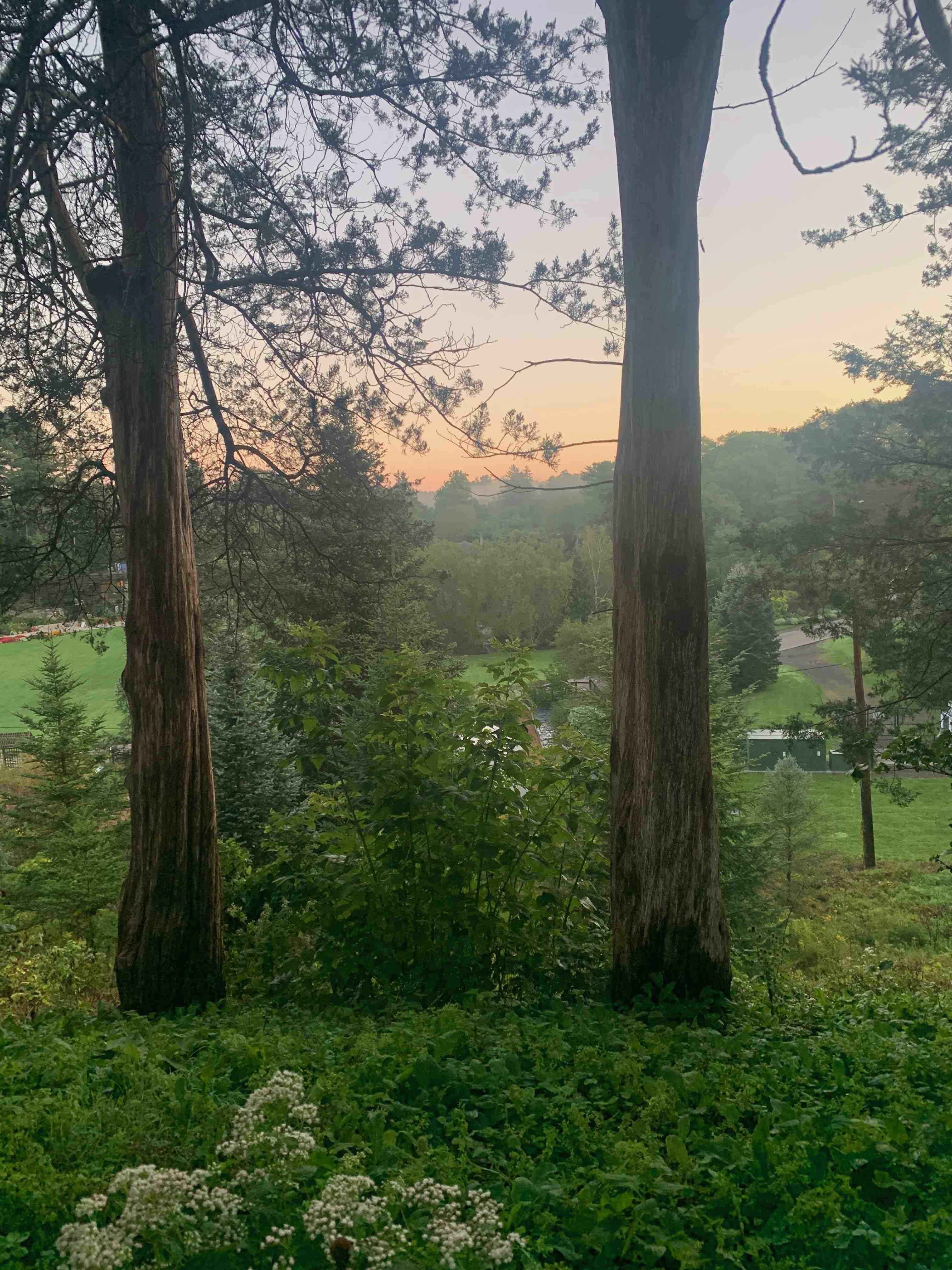
Picking up where I left off yesterday, this group of photos captures the essence of my morning walk. Destination: the Botanic Gardens on the campus of Cornell University. The photo above is from one of the main campus roads, looking down onto my destination. Continue reading

Olives, Farmers, Beauty & Beastly Heat

Emilio Parra Doiztua for The New York Times

My thoughts today start with the people who farm olives in this location deprived of the water needed to sustain their livelihoods. Because my mother was born on an olive-producing farm in an olive-privileged region of Greece, my eye is always drawn to stories about olive farmers.

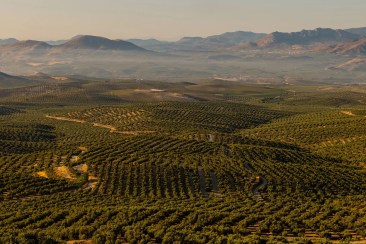
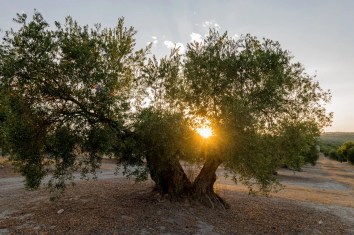
Jaén, a province of Andalusia, has over 67 million olive trees. Emilio Parra Doiztua for The New York Times

When there are photos of olive trees, I am in for the whole story. My strongest, earliest memories are of the olive trees surrounding the terrace of the farmhouse my mother grew up in. Stories about olive farmers challenged by climate change are more difficult to read without sympathy pain, but I do so knowing that olive trees are survivors.

Panacite, a store in Ubeda, sells a range of variants of oil production from the region. Emilio Parra Doiztua for The New York Times

David Segal and José Bautista have reported this story with compassion and clarity:

Spain’s Jaén Province, home to one fifth of the world’s supply of “green gold,” copes with climate change and threats to its way of life.

The branch, plucked from one of thousands of trees in this densely packed olive grove, has browning leaves and a few tiny, desiccated buds that are bunched near the end. To Agustín Bautista, the branch tells a story and the story is about a harvest that is doomed. Continue reading
Unintended Consequences Of A Green Energy Strategy

This multimedia story explains powerfully how one of Europe’s green energy strategies went awry:

Europe Is Sacrificing Its Ancient Forests for Energy

Governments bet billions on burning timber for green power. The Times went deep into one of the continent’s oldest woodlands to track the hidden cost.

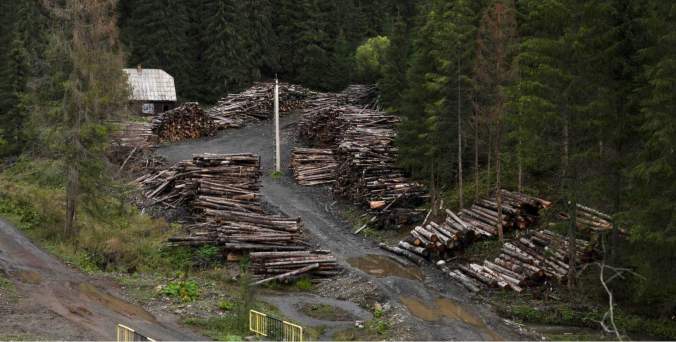
Burning wood was never supposed to be the cornerstone of the European Union’s green energy strategy.

When the bloc began subsidizing wood burning over a decade ago, it was seen as a quick boost for renewable fuel and an incentive to move homes and power plants away from coal and gas. Chips and pellets were marketed as a way to turn sawdust waste into green power. Continue reading
Really, Washington Post?

Before we compromise further on planet earth, the question Really? is often a good place to start. Let’s be sure our revered journalists and the publications they work for call apples as apples, and oranges as oranges, says Bill McKibben:

A pipeline is not a windmill

Rally Thursday Against Manchin’s Dirty Deal–and Do Some Lobbying in the Meantime!

The Washington Post, which has done remarkable climate reporting in recent years, had a less successful story in this morning’s paper. Continue reading
Alaska, Goosefoot Farm & The New Frontier

Either before or after reading the article below, please click on the image to the right. If it is early morning where you are, it will get you started on the right foot. If it is the middle of the day, the website will refresh you. And if it is night time, sweet dreams will almost certainly follow.

Our coffee CSA, combined with our regenerative activities, are only a  couple of reasons why this article is of personal interest to me. Work in Yakutia increased my wanting to visit Alaska, which started with the fact that my wife Amie was born there. Most of all, it is Alaska! The reasons are compounding, but time is not. Many thanks to Yasmin Tayag for this article in the New Yorker:

The Surreal Abundance of Alaska’s Permafrost Farms

Illustration by Nicholas Konrad / The New Yorker

In a place where the summer sun shines for twenty-one hours a day, climate change is helping to turn frozen ground into farmland.

In 2010, Brad St. Pierre and his wife, Christine, moved from California to Fairbanks, Alaska, to work as farmers. “People thought we were crazy,” Brad said. “They were, like, ‘You can grow things in Alaska?’ ” Their new home, not far from where Christine grew up, was as far north as Reykjavík, Iceland, and receives about sixty inches of snow each year. Continue reading

Ending Lawn Sprawl

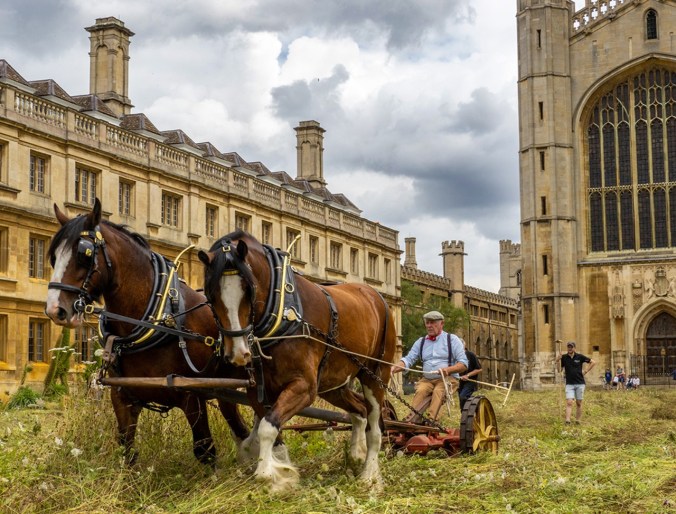
Grow wild Ordinarily only academics can walk on the grass courts of Cambridge’s colleges. Peter Dench

Tom Banham’s article in 1843, a masterpiece of longform writing on the topic of lawns, is preaching to the converted (me, at least). I live in a location with abundant rain and grass is more of a pest than the mainstay of beautifully manicured sprawling lawns (for which I am a sucker as much as anyone is).

We just planted the first couple dozen of 1,000+ coffee saplings and the grass on the hills where they are being planted plays a role in soil retention but we want the soil’s nutrients focused on the coffee. But there are plenty of more important reasons to be concerned about grass sprawl elsewhere:

The going gets turf: do lawns have a future in the age of drought?

Our gardens are sterile deserts that guzzle water and chemicals. Perhaps it’s time to let them be

The harvesting in August 2021 of the wildflower meadow planted at King’s College, Cambridge. Peter Dench

The lawns at Tusmore House, a neo-Palladian mansion 15 miles north of Oxford, are so perfectly flat and exactingly shorn that they induce a kind of vertigo. Continue reading
Carbon Burial Venturing

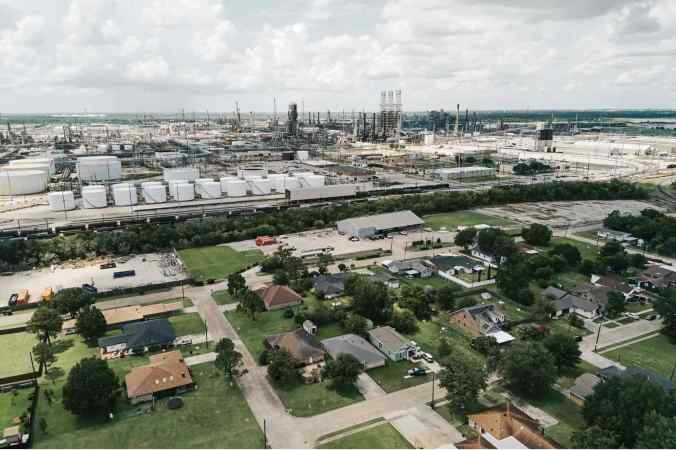
Port Arthur’s Motiva Oil Refinery.PHOTOGRAPH: KATIE THOMPSON

The capturing of carbon is a concept we have been working to understand, but questions about where it goes  and how it is stored, have been fuzzy until now (thanks to Jeffrey Ball at Wired):

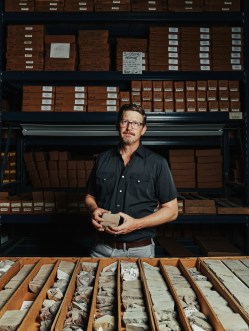
Tip Meckel holds a sandstone sample. PHOTOGRAPH: KATIE THOMPSON

The Big Business of Burying Carbon

The porous rock beneath the Gulf Coast launched the petroleum age. Now entrepreneurs want to turn it into a gigantic sponge for storing CO2.

SOMETIME AFTER THE dinosaurs died, sediment started pouring into the Gulf of Mexico. Hour after hour the rivers brought it in—sand from the infant Rockies, the mucky stuff of ecosystems. Year after year the layers of sand hardened into strata of sandstone, pushed down ever deeper into the terrestrial pressure cooker. Continue reading

England’s Green And Pleasant Land

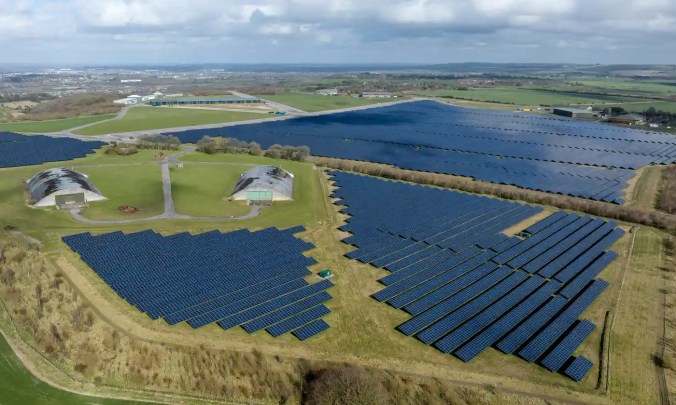
Solar farm in Wroughton, England. Planning permission for 23 solar farms has been refused across England, Wales and Scotland between January 2021 and July 2022. Photograph: Chris Gorman/Getty Images

Nature gets disrupted even by the most sensitively planned green solutions. Here is a parallel story to yesterday’s, with solar replacing wind and England replacing Western USA, illustrating the challenges facing renewable energy:

Exclusive: Projects which would have cut annual electricity bills by £100m turned down

Solar farms are being refused planning permission in Great Britain at the highest rate in five years, analysis has found, with projects which would have cut £100m off annual electricity bills turned down in the past 18 months.

Continue reading

Western Wind Power’s Impacts

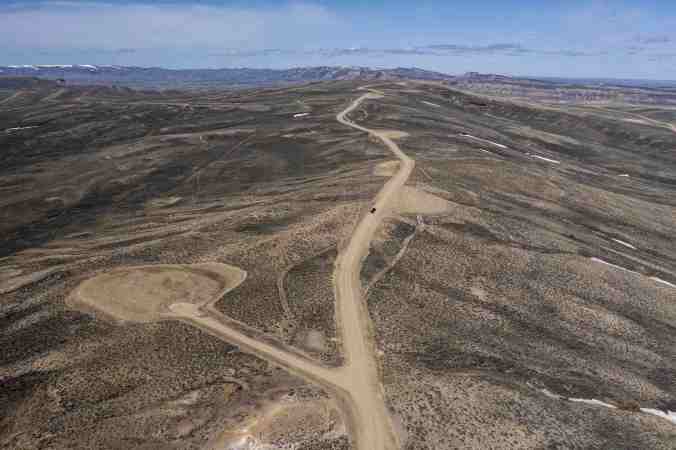
Pads have been cleared in preparation for massive wind turbines at Overland Trail Ranch. (Robert Gauthier / Los Angeles Times)

Wind power is part of our future. Full stop. But it is worth thinking about how the infrastructure for that power will change places of vast beauty and tradition.
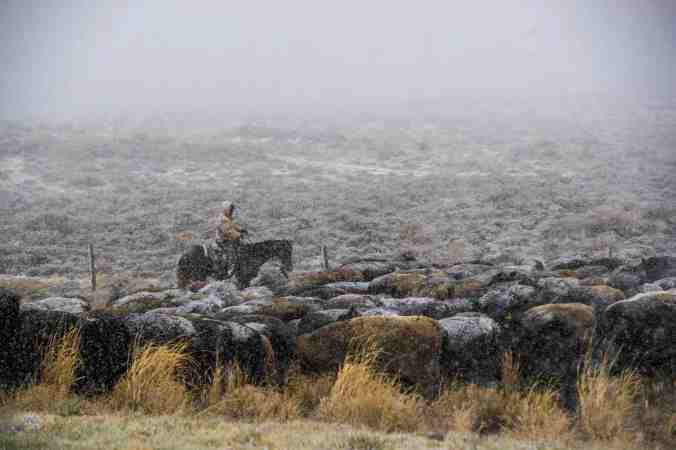
A worker herds cattle at Overland Trail Ranch as a snowstorm moves in. (Robert Gauthier / Los Angeles Times)

This article by Sammy Roth, with photography by Robert Gauthier, is a worthy thought piece on what we gain, what we give up, and who decides how and where wind energy comes to town:

This power line could save California — and forever change the American West

PacifiCorp’s Ekola Flats wind farm has 63 turbines, most of them rated at 4.3 megawatts — almost six times as much power as some of the old steel-lattice wind towers in the California desert outside Palm Springs. (Robert Gauthier / Los Angeles Times)

I know the wind turbine blades aren’t going to kill me. At least, I’m pretty sure.
No matter how many times I watch the slender arms swoop down toward me — packing as much punch as 20 Ford F-150 pickup trucks — it’s hard to shake the feeling they’re going to knock me off my feet. They sweep within a few dozen feet of the ground before launching back toward the heavens, reaching nearly 500 feet above my head — higher than the highest redwood.
They’re eerily quiet, emitting only a low hum. But in the howling wind, the tips could be barreling past at 183 mph. Continue reading