Animal-Free Meat & Racing The Clock

BlueNalu’s fried cell-cultured yellowtail amberjack fish taco. Photograph: Courtesy of BlueNalu

Whether the meat you eat is from land animals or from the ocean, the chances are high that you will be eating man-made versions sooner rather than later:

‘Fishless fish’: the next big trend in the seafood industry

‘Alternative seafood’ is having a moment, with the rise of companies like BlueNalu and Wildtype, which has the backing of Leonardo DiCaprio

In the middle of San Francisco, there’s a pilot production plant for Wildtype, one of a handful of cell-cultivated seafood companies in the US. Inside, it’s growing sushi-grade coho salmon in tanks similar to those found in breweries – no fishing or farming required. Continue reading

A Decade Of Reading Yale e360 & A Monday Perspective

The Philadelphia skyline and Benjamin Franklin Bridge reflected in the Delaware River. PAUL BRADY / ALAMY

Monday mornings often have had their own theme in these pages. Fresh perspective to start the new work week on a new track. So here is my Monday morning contribution. For a brief history to immerse you in the bleak dark, I could send you here; but not today.

Following is an article that does something different, and more difficult to find recently. A look at five decades’ accomplishment on one environmental issue in one country, and a takeaway worthy of the photo above: complex, but inspiring. Our thanks as always after a decade relying on Yale e360 for environmental stories, and advocacy; in this case also for introducing us to Andrew S. Lewis, who will now be on our radar:

The Clean Water Act at 50: Big Successes, More to Be Done

Sparked by the 1970s environmental movement, the Clean Water Act — which marks its 50th anniversary this month — transformed America’s polluted rivers. The Delaware, once an industrial cesspool, is one of the success stories, but its urban stretches remain a work in progress.

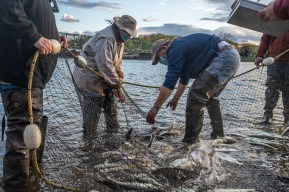
Steve Meserve (second from right) is a fourth-generation shad fisherman who operates the Lewis Fishery, the last commercial shad operation on the Delaware. ANDREW S. LEWIS

When Steve Meserve’s great-grandfather, Bill Lewis, started the Lewis Fishery in 1888, it was one of dozens of commercial outfits scattered up and down the Delaware River that seined for American shad during the spring spawn. At the time, the Delaware’s shad fishery hauled 3 to 4 million of the hard-fighting fish from the river and its tributaries every year. But, soon enough, Lewis discovered that he had gotten into the business just as the river — along with the species it supported — was entering a period of catastrophic decline. Continue reading

Memo From Mr. Gates

We have only rarely linked to stories featuring or mentioning Mr. Gates.

This is not because we do not value his opinions; we think he is the smart money on multiple fronts. Climate change is one of them.

Even if we consider McKibben the more reliable scribe, and even if we give Malmo his due, this is still smart money territory:

The state of the energy transition

My annual memo about the journey to zero emissions.

When I first started learning about climate change 15 years ago, I came to three conclusions. First, avoiding a climate disaster would be the hardest challenge people had ever faced. Second, the only way to do it was to invest aggressively in clean-energy innovation and deployment. And third, we needed to get going. Continue reading

Banana Genome Science

Imagine if you had all of these bananas to pick from every day. Beatrice Sirinuntananon/Shutterstock

We did not search for banana ancestors while living in India. We just found as many varietals as we could to support the genetic stock. I have remained interested in doing the same ever since. They are more versatile than most people are aware, so the outcome of this scientific search matters:

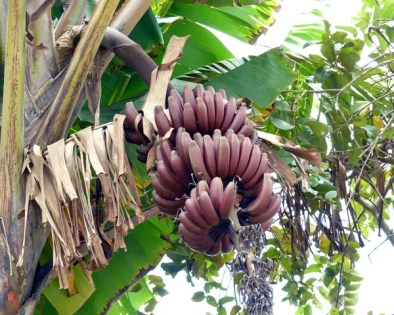
Red or blue, squat or bulbous, seeded or seedless: Bananas have a lot of diversity and scientists have identified genetic signals of varieties that have not yet been found in the wild. guentermanaus/Shutterstock

The Search Is on for Mysterious Banana Ancestors

A new study shows that domesticated bananas have genetic markers tying them to three types of wild bananas that have not yet been found.

Bananas, it turns out, are not what we thought they were.

Sure, most, when ripe, are yellow and sweet and delicious slathered in peanut butter. Continue reading

Sunscreen For Roads

(Photo credit: Jonathan Cutrer / CC BY-NC 2.0)

Our thanks to Sarah Kennedy/ChavoBart Digital Media and Molly Matthews Multedo via Yale Climate Connections for keeping us ahead of the curve:

Titanium dioxide coating could keep roads and bike paths cooler

Like mineral sunscreen, it works by reflecting UVA and UVB rays from the sun.

Biking or walking on a hot day can make you feel like you’re in an oven because dark pavement absorbs and retains heat. But applying a special coating to streets and bike paths could help cool them off. Continue reading

Music For A Monday

The music critic Jon Pareles gives Brian Eno’s album its due respect, but saying that the “musician and producer’s new songs meditate on folly and annihilation” does not really make you want to listen to it. This interview title from Wired has a different effect, at least on me:

Brian Eno on Why He Wrote a Climate Album With Deepfake Birdsongs

The ambient music pioneer is back with ForeverAndEverNoMore, an album that wants to get you in touch with your climate emergency feelings.

THE TITLE OF Brian Eno’s new album ForeverAndEverNoMore sounds fairly doom and gloom. Continue reading

Ecotage Made Plain

I first heard an interview with Andreas Malm last year, and listening to more on the subject I found his argument understandable, and compelling enough to read a bit further. But, I did not read the book. I let it go, the way one lets any taboo thought recede from memory. His book came back to my attention today with this essay. And I realize that by not sharing on this platform I was denying what is compelling about his basic argument. At the very least, I can share what the publisher says about the book:

Why resisting climate change means combatting the fossil fuel industry

The science on climate change has been clear for a very long time now.  Yet despite decades of appeals, mass street protests, petition campaigns, and peaceful demonstrations, we are still facing a booming fossil fuel industry, rising seas, rising emission levels, and a rising temperature. With the stakes so high, why haven’t we moved beyond peaceful protest? Continue reading

Plus De Ce Méfait, S’il Vous Plaît

As an energy crisis looms, Paris officials have taken steps to reduce nighttime lights, as have conservation-minded Parkour practitioners. Mauricio Lima for The New York Times

We cannot presume to cheer this type of mischief anywhere else, but considering the origin story of parkour, and the incentives for activism, it seems fitting for the City of Lights:

With Leaps and Bounds, Parkour Athletes Turn Off the Lights in Paris

As an energy crisis looms, nimble young activists are using superhero-like moves to switch off wasteful lights that stores leave on all night.

Kevin Ha extinguishing a store’s lights last month. Mauricio Lima for The New York Times

Paris— After taking a few steps back to get a running start, Hadj Benhalima dashed toward the building, pushed against its wall with his foot, propelled himself upward and stretched out his arm.

At the peak of his leap, he flipped off a light switch, more than 10 feet off the ground. A click sound rang out, and the bright lights of a nearby barbershop went off instantly.

“Oooh,” his friends cheered, as Mr. Benhalima, a thin 21-year-old dressed all in black, landed back on the sidewalk. It was the second store sign he had turned off on a recent nighttime tour across Paris’s upscale neighborhoods. Many more would follow as he soared up and dropped back down across the city. Continue reading

If You Happen To Be In New York City

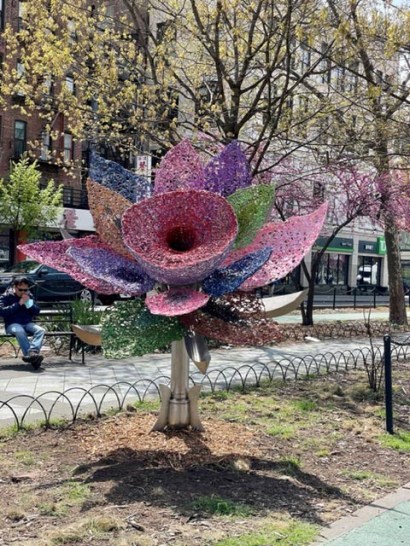
Installed in several locations on the Allen Street Malls between Broome and Hester Streets, this group exhibition features four artworks by five artists addressing themes of nature. Artists include Elizabeth Knowles and Eric David Laxman, Elaine Lorenz, Judith Peck, and Michael Wolf.

While at Cornell University last month I got my fill of early autumn florals and educational signage. While in the Botanic Gardens I was struck by a floral sculpture, a type of art I am not often moved by. But that one worked. And so, looking through the Art in the Parks section  of the New York City Department of Parks & Recreation  website,  the  image to the right caught my  attention.  And scrolling further through that collection I saw the image  below, which on a day after hurricane-driven rains  in  Costa  Rica,  with  the  morning sky clear of clouds,  hits the spot:

Naomi Lawrence, Tierra Fragil

September 25, 2022 to September 10, 2023
Morningside Park, Manhattan

Description:Tierra Fragil, depicts endangered insects and birds with the flowers and plants imperative to their survival. The mural informs and encourages the preservation of familiar species whose presence we may have taken for granted.

Tierra Fragil is made possible in part with public funds from Creative Engagement a regrant program supported by the New York City Department of Cultural Affairs in partnership with the City Council and the New York State Council on the Arts with support of the office of the Governor and the New York State Legislature, UMEZ Arts Engagement a regrant program supported by the Upper Manhattan Empowerment Zone Development Corporation and administered by LMCC. Additional funding was provided by the Friends of Morningside Park.

Challenges In Getting To A Trillion Trees

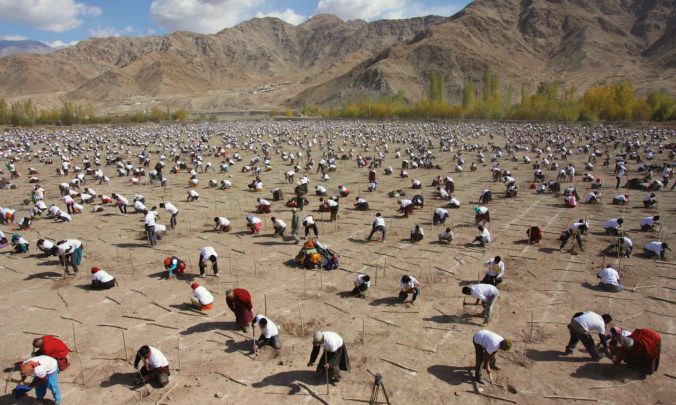
More than 9,000 people in Leh, India planted more than 50,000 tree saplings in under an hour on October 10, 2010. DRUKPA PUBLICATIONS VIA WIKIPEDIA

Fred Pearce has helped us understand the complexity in the relationship between trees and climate change, and this new story takes it to a logical extreme:

Phantom Forests: Why Ambitious Tree Planting Projects Are Failing

High-profile initiatives to plant millions of trees are being touted by governments around the world as major contributions to fighting climate change. But scientists say many of these projects are ill-conceived and poorly managed and often fail to grow any forests at all.

It was perhaps the most spectacular failed tree planting project ever. Certainly the fastest. Continue reading

Previously Unheralded Climate Policy Good News

(David McNew / Getty)

Robinson Meyer‘s newsletter this week is the most positive in its history, so if only for that read it and click the banner above to sign up:

America’s Climate Bill Looks Even Better Than Before

Late last month, analysts at the investment bank Credit Suisse published a research note about America’s new climate law that went nearly unnoticed. The Inflation Reduction Act, the bank argued, is even more important than has been recognized so far: The IRA will “will have a profound effect across industries in the next decade and beyond” and could ultimately shape the direction of the American economy, the bank said. Continue reading

Oysters & Rescue Plans

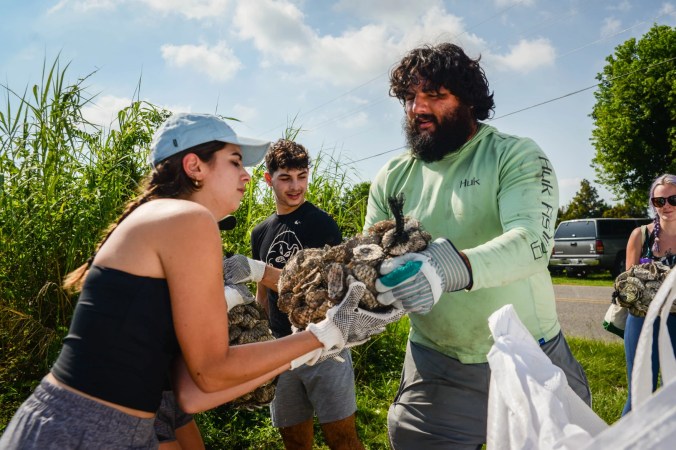
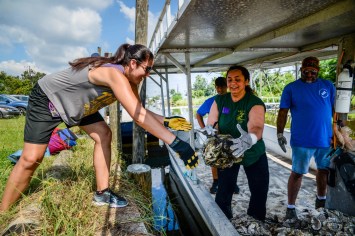
Halle Parker/WWNO. Pointe-au-Chien Indian Tribe member Pete Lebeouf works with volunteers to load bags of oyster shells onto a boat on Saturday, Sept. 24, 2022.

We have enjoyed every instance of oysters being treated with respect, beyond culinary. When indigenous knowhow is part of the story, even better. Our thanks to Halle Parker and WWNO (National Public Radio, USA) for this story:

Halle Parker/WWNO.  Pointe-au-Chien Indian Tribe citizens Patty Ferguson-Bohnee and Lori Stewart pass bags of oyster shell and pile it on a boat for transport during a volunteer event on Saturday, Sept. 24, 2022.

A Louisiana tribe is losing cultural sites to coastal erosion. Oyster reefs could help.

For the past six years, the Pointe-au-Chien Indian Tribe has battled to stop its historic earthen Indian mounds from slipping into the sea, looking to the power of oyster shells to protect them. Now, they’ve expanded that effort.

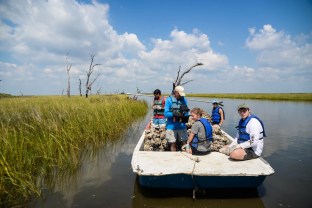
Halle Parker/WWNO. Volunteers boat down to Bernard’s Mound, one of the Pointe-au-Chien Indian Tribe’s historic mounds, to build a new oyster reef that will help slow erosion during an event on Saturday, Sept. 24, 2022.

The tribe has lived in the area for centuries, forced south as Louisiana was colonized, and the mounds that past members built have a range of uses. Some might’ve held homes, others were used for ceremonies and some were burial sites, said Lori Stewart, a member of the tribe.

“The mounds are really significant because we do have some of our ancestors that are buried there, and so we don’t want to see that washed away,” she said. “That’s sacred to us.” Continue reading

Pushing Decarbonizing Technology Via Industrial Policy

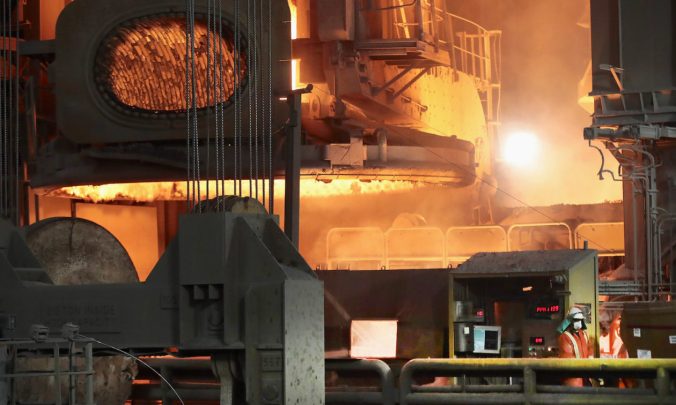
The NLMK mill in Portage, Indiana, which uses a furnace powered by electricity and produces steel from recycled scrap. SCOTT OLSON / GETTY IMAGES

Thanks to Yale e360:

Beyond Biden’s Climate Plan, a New Industrial Revolution Is Needed

The new U.S. climate plan is historic and will pump billions of dollars into advancing the transition away from fossil fuels. But a more far-reaching, innovative approach is needed to push forward the radically new technologies that will be required to decarbonize the economy.

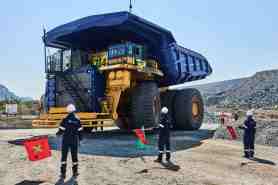
Workers guide a hydrogen-powered truck, part of Anglo American Plc’s NuGen carbon-neutral project, during a moving demonstration at the Anglo American Platinum Ltd. Mogalakwena platinum mine in Mogalakwena, South Africa, on Friday, May 6, 2022. Anglo American unveiled the worlds biggest green-hydrogen powered truck at a platinum mine in northeast South Africa where it aims to replace a fleet of 40 diesel-fueled vehicles that each use about a million liters of the fossil fuel every year. Photographer: Waldo Swiegers/Bloomberg

For all the great news in the Biden administration’s massive new climate spending plan, the hardest work of transforming the economy to stop global warming lies ahead. That’s because nearly all the money in the $369 billion plan will be spent on technologies that American companies already know how to deploy, such as solar farms, making buildings more efficient, and developing networks of electric vehicle charging systems.

Doing a lot more of the same will undoubtedly bring down emissions faster. But deep decarbonization requires a transformation of the American economy that will demand a much more active effort to push the technological frontier and build new industries so emissions can be driven to zero. Continue reading

Bee Bus Spots

A living roof in Cardiff planted with pollinator friendly plants. Photograph: Clear Channel

Phoebe Weston brightens our day with this story:

Planting at one of 30 bee bus stops in Leicester. Photograph: Clear Channel

Buzz stops: bus shelter roofs turned into gardens for bees and butterflies

Bee bus stops first appeared in the Dutch city of Utrecht. Now the UK is planning for more than 1,000 and there is growing interest across Europe and in Canada and Australia

Butterflies and bees are getting their own transport network as “bee bus stops” start to pop up around UK cities and across Europe. Humble bus shelter roofs are being turned into riots of colour, with the number of miniature gardens – full of pollinator-friendly flora such as wild strawberries, poppies and pansies – set to increase by 50% in the UK by the end of this year. Continue reading

Tree Core Samples & Age Estimations

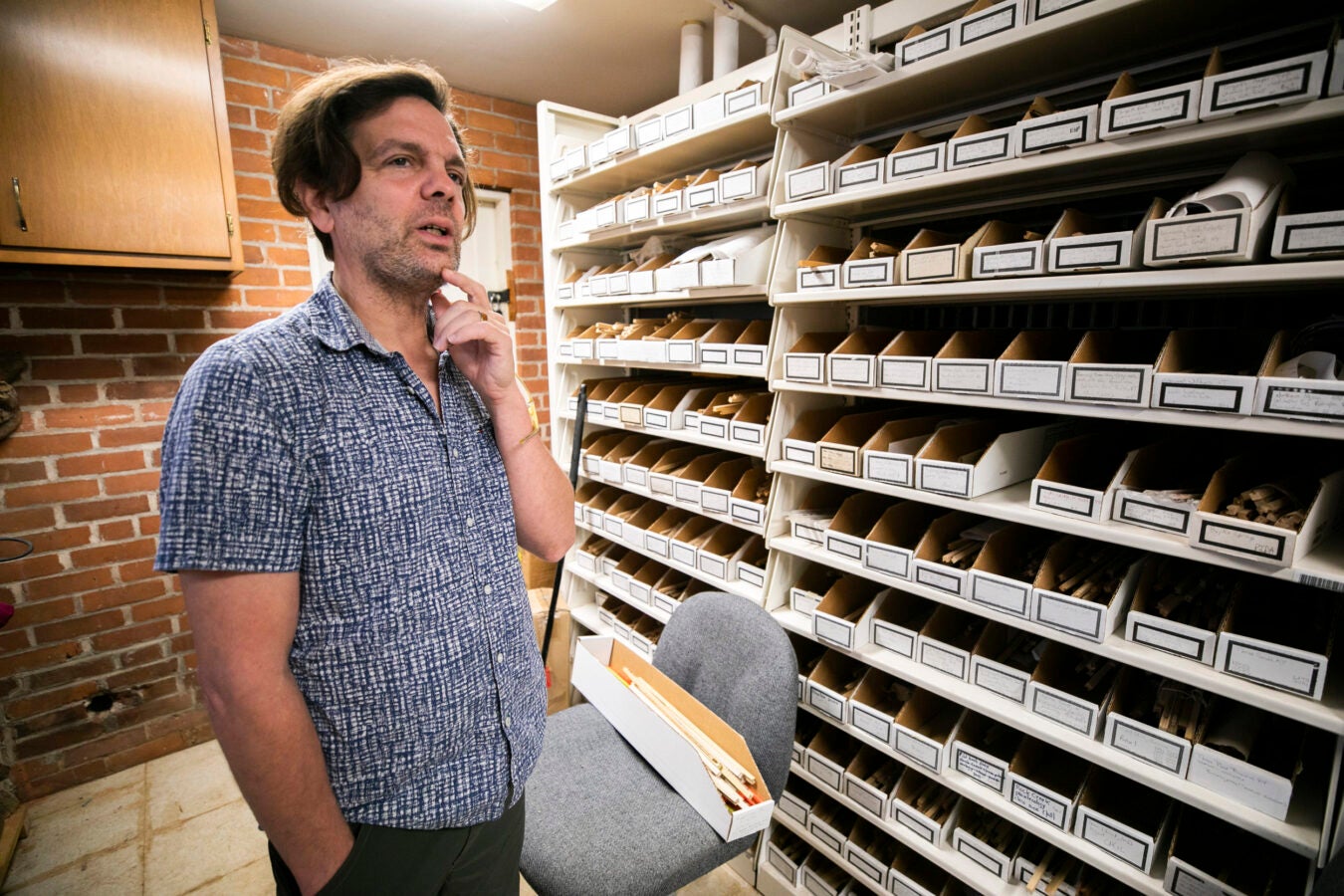
Tree cores Harvard Forest

Core samples may hold clues to a forest’s response to climate change. Photos by Stephanie Mitchell/Harvard Staff Photographer

Juan Siliezar, staff writer for the Harvard Gazette asks and answers a question that we never tire of:

Want to know how cold it was in 1490? Ask a tree

Harvard Forest Senior Ecologist Neil Pederso

“We use tree cores to extract what I’ve been leaning toward calling the memory of the tree,” said Neil Pederson in the lab alongside core samples.

Sometimes getting to where you want to go is a matter of finding the right guide.

Four teams of researchers, led by Harvard Forest ecologists, searched for a patch of ancient trees deep in the woods of western Pennsylvania this summer as part of a project to study how climate changes affected trees over the centuries. One of the scientists had come across them 40 years earlier, but they appeared to have vanished. Just as the group was about to give up and move on they came across someone who gave them a valuable clue. Continue reading

Elephant Seals & Marine Sciences

Thanks to Sierra for this:

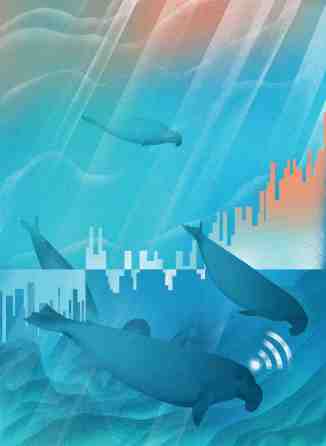
When Elephant Seals Become Ocean Researchers

Marine mammals unlock the secrets of climate and the Arctic

By Kate Golden

Illustrations by Masha Foya

ON A FEBRUARY MORNING at Año Nuevo Reserve on the coast of Northern California, hundreds of gray-brown elephant seals lay strewn, lumplike, all over the beach. It was hard to hear anything over the honks and shrieks of status jockeying and sex dramas. The north wind gusted to 35 knots and blew a river of fine sand into everyone’s faces. At a dense seal cluster near the water, researchers and students from the University of California, Santa Cruz, knelt over an 815-pound female whose stern had been labeled “X1” with Clairol bleach. Continue reading

Ant Mass Calculation

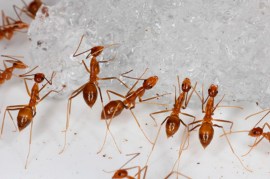
In this photo provided by the U.S. Fish and Wildlife Service, yellow crazy ants are seen in a bait testing efficacy trial at the Johnston Atoll National Wildlife Refuge in December, 2015. An invasive species known as the yellow crazy ant has been eradicated from the remote U.S. atoll in the Pacific. Robert Peck/AP

The mass of ants on earth is not a topic we have considered, but there is not too much surprise at reading this news:

The number of ants on Earth has a mass greater than all birds and mammals combined

For every human on Earth, there are estimated to be about 2.5 million ants — or 20 quadrillion in total.

A new study published by researchers at both the University of Hong Kong and University of Würzburg in Germany attempts to count the total number of ground-dwelling and tree-dwelling ants. Continue reading

Patagonia 2.0

Details of a desk in a Patagonia office with a stack of orange and brown stickers that read “defend bears ears national monument’ on top of stacks of magazines and papers.

Patagonia has become more politically active, going so far as to sue the Trump administration in a bid to protect the Bears Ears National Monument. Laure Joliet for The New York Times

We have mentioned this company multiple times in our pages over the years, because we take inspiration from it, the same way we have taken inspiration from the example set by Chuck Feeney. It is worth noting that I also value everything I have ever bought from Patagonia. The day of this blizzard in New York I took an old beat up backpack in to see if they could repair it in the nearby shop; instead, they gave me a new one.

Good quality products, combined with good service, make the good environmental values of the company all the better:

“Hopefully this will influence a new form of capitalism that doesn’t end up with a few rich people and a bunch of poor people,” said Mr. Chouinard. Meridith Kohut for The New York Times

Billionaire No More: Patagonia Founder Gives Away the Company

Mr. Chouinard filmed an announcement for his employees at home in Wyoming. By giving away the bulk of their assets during their lifetime, the Chouinards have established themselves as among the most charitable families in the country. Natalie Behring for The New York Times

A half century after founding the outdoor apparel maker Patagonia, Yvon Chouinard, the eccentric rock climber who became a reluctant billionaire with his unconventional spin on capitalism, has given the company away.

Rather than selling the company or taking it public, Mr. Chouinard, his wife and two adult children have transferred their ownership of Patagonia, valued at about $3 billion, to a specially designed trust and a nonprofit organization. They were created to preserve the company’s independence and ensure that all of its profits — some $100 million a year — are used to combat climate change and protect undeveloped land around the globe. Continue reading

Solar@School, Win-Win-Win

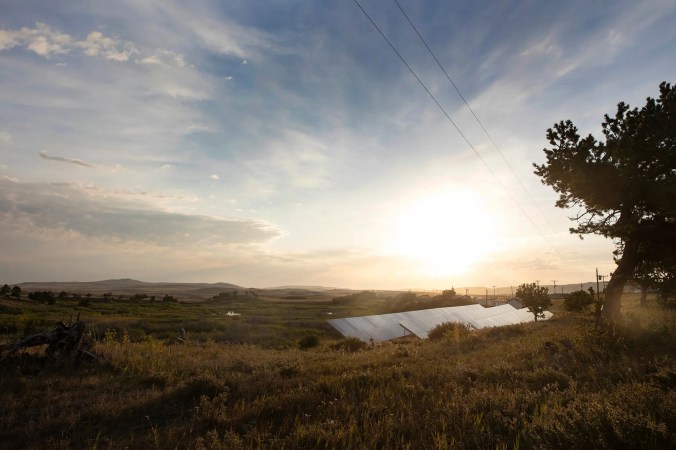
Solar panels installed near the Heart-Butte schools in Montana. Janie Osborne for The New York Times

Two elementary school students stand at table covered in papers, markers and other school materials, and face a wall with a poster map of Montana, divided by tribal territories. The child at left uses an orange marker to point at an area called “Blackfeet & Gros Ventre.”

Students at Heart-Butte School exploring their area of the world on a map in the “Blackfeet Immersion” classroom. Janie Osborne for The New York Times

In the USA it has become normal to think that partisan divisions prevent collaboration on issues of common interest. The partisan divisions are real, and then some; but there are silver linings here and there.  Cara Buckley, a climate reporter, continues to demonstrate a talent for finding cases where communities benefit from collective action in the act of taking better care of the environment:

Black and white goats frolic in grass on a field, which is fenced off and behind which is a series of solar panels angled at the sun. Trees line the horizon.

Goats cared for by Batesville High School’s 4-H students, next to the school’s solar panels. “If you’re conservative, we didn’t ask you for more taxes, if you’re liberal, you love the green concept,” Dr. Hester said. Terra Fondriest for The New York Times

Facing Budget Shortfalls, These Schools Are Turning to the Sun

Public schools are increasingly using savings from solar energy to upgrade facilities, help their communities, and give teachers raises — often with no cost to taxpayers.

One school district was able to give pay raises to its teachers as big as 30 percent. Another bought new heating and ventilation systems, all the better to help students and educators breathe easier in these times. The improvements didn’t cost taxpayers a cent, and were paid for by an endlessly renewable source — the sun.

Mike Tatsey, in jeans and a light blue plaid short sleeve shirt, his thumbs hooked into his jean pockets, stands in a field with solar panes in the background. Brush partially obscures the foreground.

Mike Tatsey, superintendent of schools in Heart-Butte, believes that freeing up extra money for staples like groceries and shoes could have a ripple effect in classrooms. Janie Osborne for The New York Times

As solar energy gains traction across the country, one beneficiary have been schools, particularly those in cash-strapped districts contending with dwindling tax bases.

From New Jersey to California, nearly one in 10 K-12 public and private schools across the country were using solar energy by early 2022, according to data released Thursday by Generation180, a nonprofit that promotes and tracks clean energy. That’s twice as many as existed in 2015. Continue reading

Lionfish, Competition & The Big Tournament

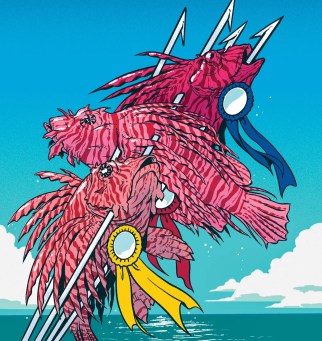
“What you’re hunting isn’t prey,” a lionfish diver told me. “It’s the enemy.”Illustrations by Johnny Dombrowski

D. T. Max has vividly sketched humans in competitive mode, harnessing tournament rules to address the aggressions of this introduced species. In the decades-long perspective, lionfish are winning the bigger tournament by adapting and expanding their range; but we admire the drive to end that success:

Killing Invasive Species Is Now a Competitive Sport

In the Panhandle, where swarms of lionfish gobble up native species, a tournament offers cash prizes to divers skilled at spearing one predator after another.

Rachel Bowman is a diver who specializes in the hunting, catching, and killing of lionfish, a species native to Indo-Pacific waters. Continue reading