What Cruise Ships Do In Plain Sight

Cruise ship with smoke pouring from funnel

A cruise ship leaving the port of Victoria in British Columbia, Canada, where environmental laws are less stringent than in the neighbouring US states of Washington and Alaska. Wildlife put at risk by cruise ships dumping waste include sea otters and orcas. Photograph: Shaun Cunningham/Alamy

If you enjoy cruise ship experiences, our intent is not to offend you by sharing this. Just to be sure you are aware of what cruise ship operators routinely do with waste:

US cruise ships using Canada as a ‘toilet bowl’ for polluted waste

Lax Canadian regulations create ‘perverse incentive’ for US cruise ships en route to Alaska to discharge toxic mix of chemicals and wastewater off British Columbia, report says

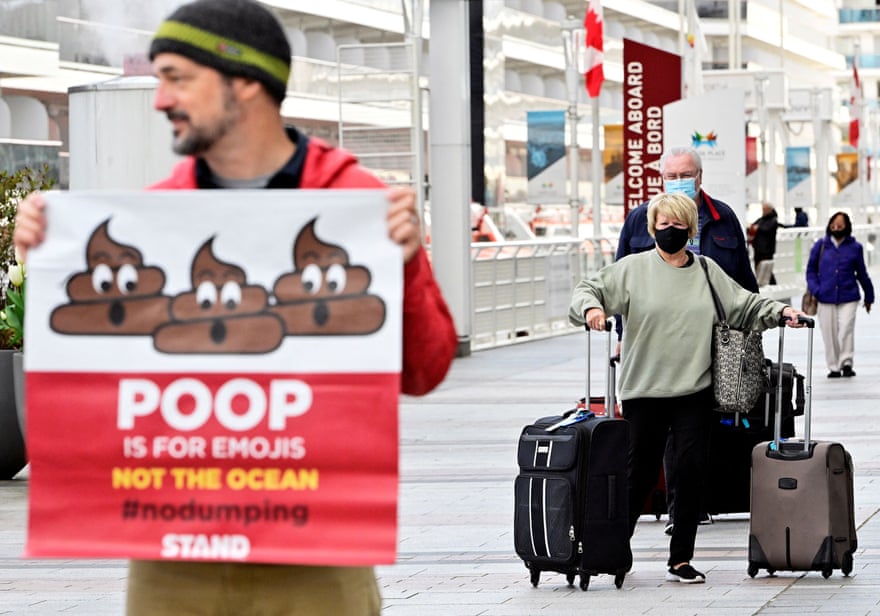
Man stands in front of cruise ship holding sign that reads ‘Poop is for emojis, not the oceans’. Passengers with luggage can be seen behind him.

A protest in April against the dumping of sewage by cruise ships arriving in Vancouver. Photograph: Jennifer Gauthier/Reuters

From the comfort of cruise ships, a typical trip to Alaska offers magnificent views of glaciers and untamed national parks, and visits to quaint seaside towns. For years, these draws have made cruises to Alaska the most booked US holiday.

But the journey to those pristine areas, which involves sailing along Canada’s west coast for two or three days, is leaving behind a trail of toxic waste, including within marine protected areas (MPAs), according to new research. Continue reading →
Trees & Careful Planting

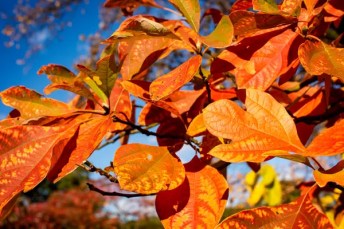
Fast-to-establish sassafras (Sassafras albidum), an Eastern native tree, has distinctively shaped leaves that fire up brilliantly in autumn. Michael Stewart/Courtesy Brooklyn Botanic Garden

One of the minor downsides to life in the tropics is decades of missed autumn leaves. But that downside is counterbalanced by so many upsides that the loss is trivial. And we have photos like the one to the right, as well as the possibility of travel (including to the botanical gardens featured in the story below), plus plenty of writing on the science of those colors, to dissipate the trivia.

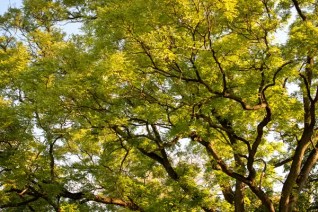
Mr. Roddick is often asked to open up a tree’s canopy to let in more light. His answer is based on the tree’s species, its health and its age. “Better to train a young tree to fit into a garden as opposed to trying to change an old tree,” he said. Michael Stewart/Courtesy Brooklyn Botanic Garden

Besides, our trees are awesome for reasons other than color. They grow fast. Some of them fix nitrogen. And most of those we have been planting have a shading responsibility specific to the coffee we are planting. So this article resonates even if some of the particulars are not relevant to our land, trees, and related growing conditions. Margaret Roach has been a constant companion reminding me of all this, through her writings mainly on gardens in the north.

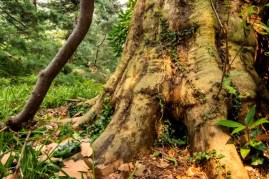
The base of an old London plane tree at Brooklyn Botanic Garden. Tree roots on most landscape trees are shallow and prone to injury, yet we often fail to consider how our gardening and home-improvement projects will affect them. Michael Stewart/Courtesy Brooklyn Botanic Garden

Trees can take a lot of punishment, but they have their limits. Here’s how to work around them safely.

If trees could talk, they’d probably start by saying, “Enough with the insults already.”

In more than 30 years of working with trees, Christopher Roddick has made it a practice to listen to their unspoken language — and to show respect for some of the largest and oldest organisms among us. Continue reading →
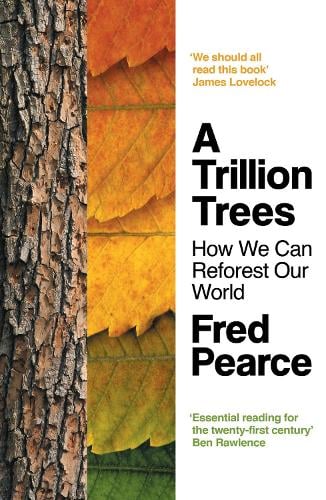
A Trillion Trees, The Book

A Trillion Trees: How We Can Reforest Our World (Paperback)We have linked to so many of his essays and articles over the years, we are slightly jealous of a friend writing from England that she attended an event where he was discussing this book yesterday. Published last year, the concept is familiar, but if Fred Pearce offers a book treatment of a complex topic, read it:

**A Book of the Year in The Times and The Sunday Times ** Trees are essential, for nature and for us. Yet we are cutting and burning them at such a rate that we are fast approaching a tipping point. But there is still hope. Continue reading →
Fin Whales Doing Well Down South

Some gatherings were so large that spray from the whales’ blowholes resembled a fog on the ocean surface.

Some gatherings were so large that spray from the whales’ blowholes resembled a fog on the ocean surface. Dan Beecham

Happy whale news is not easy to come by. Winston Choi-Schagrin, a reporter covering climate and the environment for the New York Times, shares some:

A Whale Feeding Frenzy in Antarctica Signals a Conservation Success

Once hunted to the brink of extinction, fin whales in the Southern Ocean have rebounded and returned to their historic feeding grounds, according to a new survey.

From a distance, it looked like thick fog across the horizon. Continue reading →
How Important Is Plant-Based Meat?

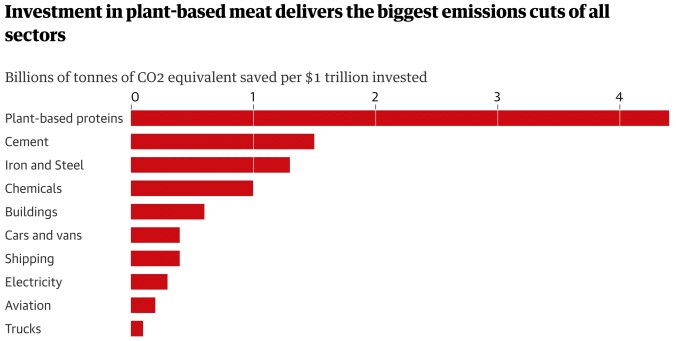
Guardian graphic | Source: Boston Consulting Group

We were already convinced by testing (our own and others) that this product category would be important, but this study shows the importance to be practically off the charts in terms of reduced carbon footprint per dollar invested. Our thanks to Damian Carrington, the Guardian’s Environment editor, for bringing this to our attention:

Malte Clausen, a partner at BCG: ‘Widespread adoption of alternative proteins can play a critical role tackling climate change.’ Photograph: Nathaniel Noir/Alamy

Plant-based meat by far the best climate investment, report finds

Exclusive: Non-animal proteins can play critical role tackling climate crisis, says Boston Consulting Group

Investments in plant-based alternatives to meat lead to far greater cuts in climate-heating emissions than other green investments, according to one of the world’s biggest consultancy firms.

The report from the Boston Consulting Group (BCG) found that, for each dollar, investment in improving and scaling up the production of meat and dairy alternatives resulted in three times more greenhouse gas reductions Continue reading →
The Parthenon Marbles, Back Where They Belong

The Parthenon in 1875.

The Parthenon in 1875. Interfoto/Alamy

The Elgin Room of the British Museum in an undated photograph taken during the Victorian era.

The Elgin Room of the British Museum in an undated photograph taken during the Victorian era. Keasbury-Gordon Photograph Archive, via Alamy

The original Parthenon marbles belong back in Athens, in the museum built for them. With all due respect to my British friends, my opinion is informed partly by my mother being from Greece, but mostly by an impartial logic.

That logic is expressed in the article below, which also happens to lay out an interesting sideshow:

Robots at the Marmi di Carra marble workshop in Italy carved a replica of a horse head, the original of which sits in the British Museum in London.

Robots at the Marmi di Carra marble workshop in Italy carved a replica of a horse head, the original of which sits in the British Museum in London.

Few cultural disputes inflame British passions more than the disposition of the Parthenon Marbles. Public debate about the statuary has raged since the early 1800s, when the sculptures and bas-reliefs, which date from 447 B.C. to 432 B.C., were stripped from the Parthenon and other Classical Greek temples on the Acropolis of Athens by agents of Thomas Bruce, a Scottish statesman and seventh earl of Elgin. The marbles were purchased — some say looted — by Elgin during his time as ambassador to the Ottoman Empire, the occupying power; they have resided in the British Museum since 1817. Continue reading →
New World Rewilding

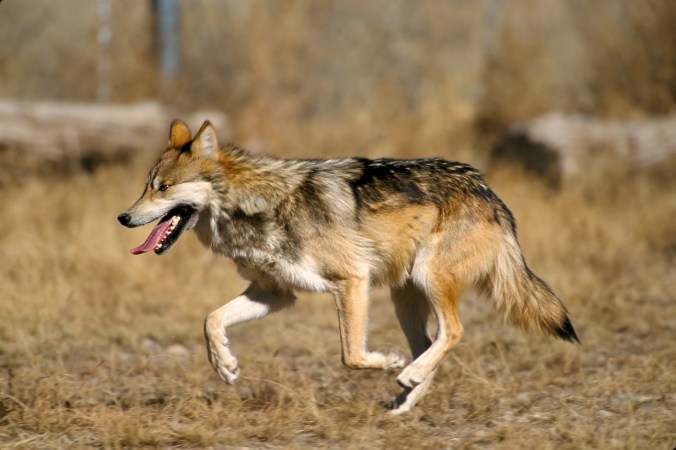
Mexican gray wolves have been reintroduced to Arizona and New Mexico over the last two decades. JIM CLARK / U.S. FISH AND WILDLIFE SERVICE

We have been posting about rewilding for nearly a decade, and it sees fair to say that the idea has developed traction worldwide:

T0GFFN Bison or Bufalo within prairie and pasture in protected natural area. Rancho el Uno, a space dedicated to the conservation of this species in Janos, Chihuahua. This fishery was reintroduced by the organization The Nature Conservancy, TNC. Janos Biosphere Reserve
  (© Photo: LuisGutierrez / NortePhoto.com

Bringing Back the Beasts: Global Rewilding Plans Take Shape

With a growing number of studies demonstrating the importance of large mammals to healthy ecosystems, scientists are proposing concrete plans to reintroduce these animals to the wild. The return of just 20 species to native habitats, they say, could be a boon to biodiversity.

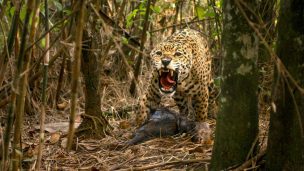
A jaguar guards its prey, a white-lipped peccary, in Goiás, Brazil. OCTAVIO CAMPOS SALLES / ALAMY STOCK PHOTO

For thousands of years, bison herds thundered freely throughout the Chihuahuan Desert on both sides of what is now the U.S.-Mexico border. In November 2009, after three frantic months of chasing down the required permits, Rurik List and Nélida Barajas watched as 23 bison from Wind Cave National Park in South Dakota arrived by tractor-trailer at the Santa Teresa international cattle crossing in southeastern New Mexico.

The animals, 20 females and three males, galloped through the dusty stockyards, across the border, and into the state of Chihuahua. Continue reading →
Alt-Leather, Vegan & Otherwise

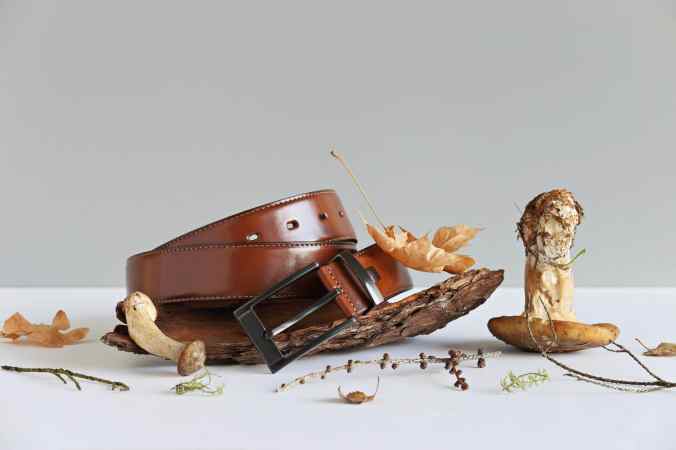
Innovative vegan leather belt made from mycelium fiber, fungal spores and plant fibers. los_angela / iStock / Getty Images Plus

Our thanks to Linnea Harris for the latest news in alt-leather, which is best when vegan, except for when it is not:

The Future of Leather: How Pineapple Leaves, Cacti, and Mycelium Are Revolutionizing the Industry

Leather is everywhere – in our shoes, our purses and luggage, our winter jackets and stylish furniture – but its effect is seen globally.

To create the leather for our clothing, homewares, and other purposes, billions of cows are slaughtered each year. Continue reading →
McKibben On The Supreme Court’s EPA Ruling

Photographs by Mitch Epstein

When you have found an explainer reliably clear on complicated but important issues, keep reading their essays:

The Supreme Court Tries to Overrule the Climate

A destructive decision in West Virginia v. E.P.A.

Credit where due: the Supreme Court’s 6–3 ruling in West Virginia v. E.P.A. is the culmination of a five-decade effort to make sure that the federal government won’t threaten the business status quo. Lewis Powell’s famous memo, written in 1971, before he joined the Supreme Court—between the enactment of a strong Clean Air Act and a strong Clean Water Act, each with huge popular support—called on “businessmen” to stand up to the tide of voices “from the college campus, the pulpit, the media, the intellectual and literary journals, the arts and sciences, and from politicians” calling for progressive change. Continue reading →

215 Pounds Of Burmese Python

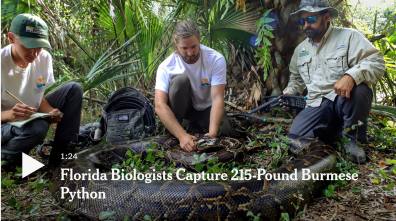
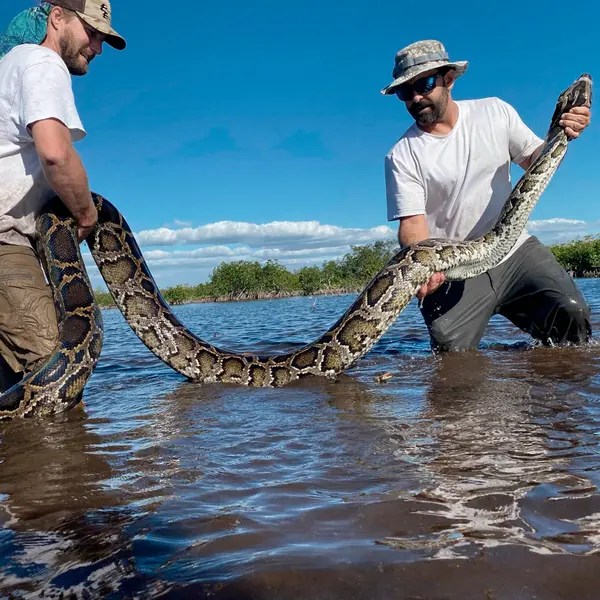
The Conservancy of Southwest Florida, which tracks and studies invasive Burmese pythons harming the state’s native ecosystem, said the nearly 18-foot female python was the largest to have been found in the Everglades. Jc Findley/Conservancy of Southwest Florida, via Associated Press

Since reading and sharing one article about invasive species we have been particularly attentive to the challenges of pythons introduced in the Everglades. We have linked to plenty of stories about the creative approaches to solving this problem.

But we never tire of the theme.

This article

Ian Easterling, left, and Ian Bartoszek, both biologists, removing a 14-foot female Burmese python captured in March in a mangrove in Southwest Florida. Conservancy of Southwest Florida, via Associated Press

To Catch a Snake: Largest Python Found in Everglades Signals a Threat

The Burmese python caught by a team of trackers breaks a record and shows the invasive species surviving in Florida’s ecosystem despite efforts to remove those snakes.

A team searching under dense vegetation in the pine flatwoods of the Everglades late last year came upon a slithering sight, the likes of which no one had found before in those parts: 215 pounds of snake. Continue reading →