Laguna Lagarto Lodge, Costa Rica
Proto-Peat In The Arctic
We have posted enough times about the importance of protecting peat, but this is the first we hear the question Carbon-Rich Peat Is Disappearing. But Is It Also Growing? Our thanks to Matt Simon at Wired for this one:
Scientists have discovered “proto-peat” forming in the Arctic as the Earth naturally sequesters carbon, but it could take centuries to mature.
THANK PEAT FOR that scotchy flavor of Scotch whisky: The muck forms in Scotland’s bogs, when layer after layer of dead vegetation resists decay and compresses into fuel, which is burned during scotch distillation. But you can also thank peat for helping keep our planet relatively cool, as all that muck—which is particularly common across the Arctic—traps a tremendous amount of carbon that would otherwise heat the atmosphere. Continue reading
Bird of the Day: Tickell’s Blue Flycatcher
The World’s Largest Living Thing

The world’s largest living thing is a stealthy parasite that lives mostly underground and beneath the bark of infected trees in a pale, stringy fungal network. COURTESY MIKE MCWILLIAMS
Thanks to Milo‘s interest in fungi, which we found infectious, we learned years ago what the world’s largest living thing is. We used to feature more stories from Atlas Obscura, but this is the first in a few years:
What the World’s Largest Organism Reveals About Fires and Forest Health
The Humongous Fungus is most visible when it produces the edible and tasty honey mushroom, but the season is brief and doesn’t happen every year. PETER PEARSALL, USFWS/PUBLIC DOMAIN
In Oregon, the Humongous Fungus plays a complex role in an ecosystem reshaped by humans.
UNDER THE BLUE MOUNTAINS OF Oregon lurks something massive and prehistoric. Yet the largest recorded organism on Earth, weighing more than 200 blue whales and dwarfing even Pando, Utah’s famous grove of quaking aspens, is nearly invisible to the untrained eye. It’s a single, genetically identifiable specimen of honey mushroom, or Armillaria ostoyae, that has been growing for thousands of years. Continue reading
Bird of the Day: Goldman’s Warbler
Learning To Appreciate Wasps
Wasps are one of the least appreciated creatures on the planet, but we have always suspected they deserve some respect. We just never investigated why that might be the case. So, our thanks to the Guardian for bringing this book to our attention in an article titled Why we should all love wasps:
Wasps have always had a bad press. But Dr Seirian Sumner, who has spent her life studying them, argues they are sophisticated, socially complex and essential to the environment
In The Wasp Woman, a 1959 B-movie directed by Roger Corman, the owner of a failing cosmetics company becomes the test subject for a novel anti-ageing formula manufactured from the royal jelly of wasps. Continue reading
Bird of the Day: Wood Stork
El Paredon, Guatemala
Technology Put To Good Use
Jim O’Donnell and Cullen Heater tell an essentially hopeful story from our neighbor to the south:
Panama’s Indigenous Groups Wage High-Tech Fight for Their Lands
With help from U.S. organizations, Panama’s Indigenous people are using satellite images and other technologies to identify illegal logging and incursions by ranchers on their territory. But spotting the violations is the easy part — getting the government to act is far harder.
On a blazing February morning, the Indigenous Wounaan territorial monitoring coordinator, two forest technicians, and a local farmer climbed into the mountains outside the fishing and farming community of Majé, near Panama’s Pacific coast. Continue reading
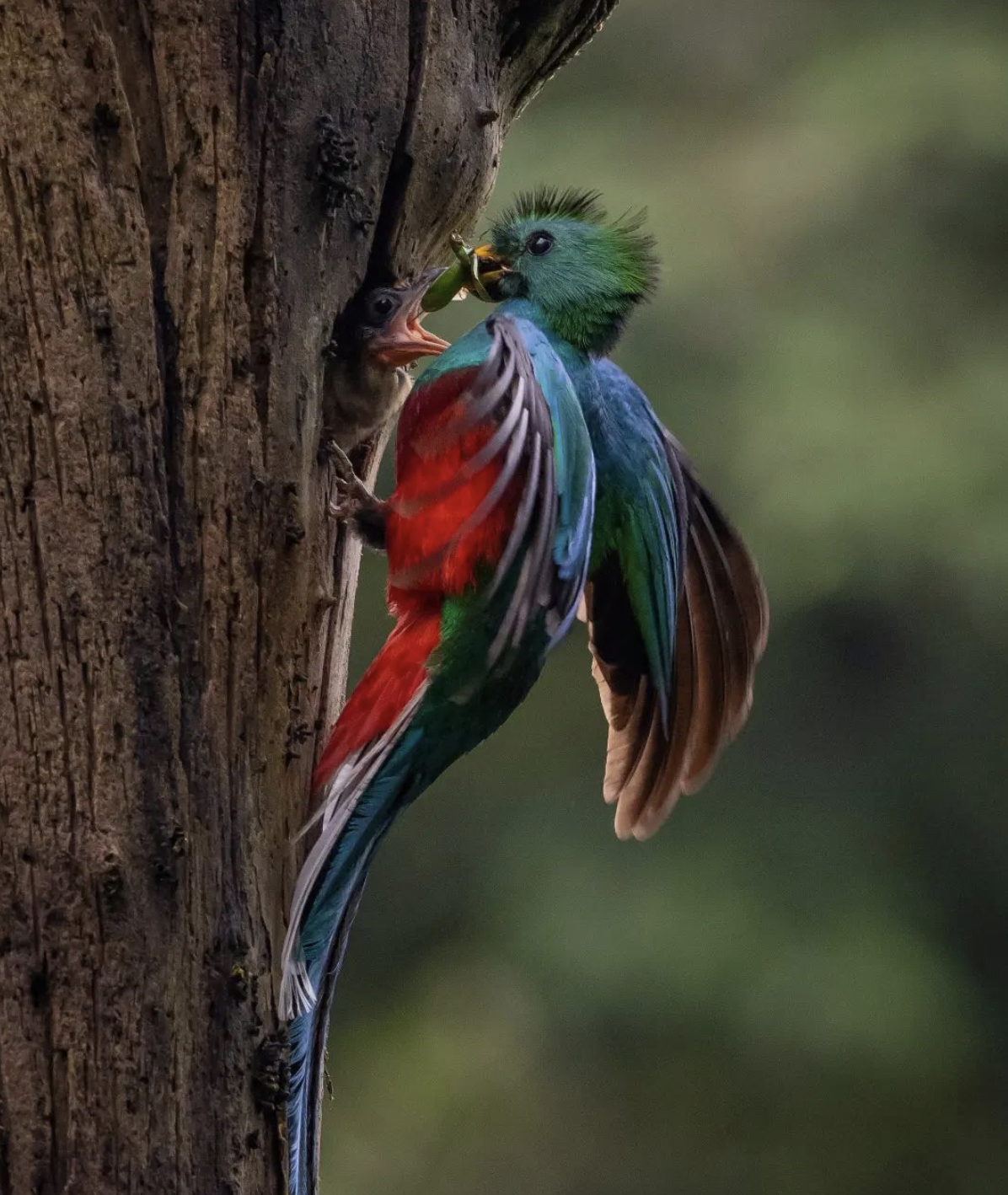
Bird of the Day: Himalayan Black-lored Tit
The Dirty Banking & Fossil Fuel Relationship Seen From Another Angle
We know a bit about dirty banking. While we do not think money is a dirty word, we have seen how dirty it can get when mixed with fossil fuels. So thanks, as always, to Bill McKibben for this further illumination. We are sharing his newsletter, rather than the New Yorker story he references, because as you will see below he encourages sharing Your money is your carbon:
If you’ve got $125k in the financial system, it’s doing as much damage as your cooking and your heating and your flying. These are the most important new climate numbers for many years
Earlier today I published a big story in the New Yorker about how banks are driving the climate crisis. A report from a consortium of environmental groups made clear that for the biggest, richest companies on earth, the cash they keep in the banking system (which gets lent out for pipelines and the like) produces more carbon than their actual, you know, business. Google emits more carbon from its money than its phones, and Netflix from its streaming, and so on. Continue reading
Bird of the Day: Rufous-naped Wren
Preservation & Protection Via Gamification
Incentives to behave differently in relation to the environment is a constant topic here, but we have not used the word gamification before. Today is finally the day. Thank you, Lindsey Galloway:
Palau’s world-first ‘good traveller’ incentive
Responsible travellers will be able to unlock exclusive cultural and nature-based experiences (Credit: Colors and shapes of underwater world/Getty Images)
In a world-first initiative, visitors to Palau will be offered exclusive experiences based on how they treat the environment and culture, not by how much they spend.
Despite being home to fewer than 20,000 residents, the Republic of Palau is making an outsized impact to preserve the planet. Not only did the country Continue reading
Bird of the Day: Golden-cheeked Warbler
P-22 & Other Cats In The Santa Monicas

Near the location of the future Wallis Annenberg Wildlife Crossing, a volunteer for the National Wildlife Federation carries a cardboard cutout of a mountain lion known as P-22. Photograph by Mel Melcon / Los Angeles Times / Shutterstock
When we linked to earlier stories about mountain lions in urban California, P-22 was already the it-cat. And the story below, by Emily Witt, shares some anecdotes about P-22’s less fortunate wider family. But mainly it is about one hopeful initiative that P-22 seems to have unwittingly helped make happen:
An Urban Wildlife Bridge Is Coming to California
The crossing will span Route 101, providing safe passage for mountain lions and other animals hemmed in by the freeways that surround the Santa Monica Mountains.
It was just after midnight on April 21st when the radio collar of P-97, an eighteen-month-old mountain lion, sent its last signal. P-97 had only recently separated from his mother, setting out east in the Santa Monica Mountains in search of territory to call his own. (The “P” stands for puma; the number, 97, marks how many mountain lions the National Park Service had tagged when he received the designation.) Continue reading
Bird of the Day: Blue-throated Motmot
A Bit About The Origins Of Clean The World

Shawn Siepler, the founder of Clean the World, with used hotel soap before it will be recycled for those in need. Todd Anderson for The New York Times
Reusing things versus wasting them has been a major theme in these pages, especially in relation to travel and hospitality. Looking back at posts about washing hands for a cleaner world and then another about soap making for the same, it is not surprising we had already featured Clean The World in a couple earlier posts. Thanks to Victoria M. Walker for this conversation with the founder:
Getting the World Clean, One Recycled Bar of Soap at a Time
Meet Shawn Siepler, the founder of Clean the World. The nonprofit recycles partially used soap left behind from hotel guests for those in need.
When hotel or motel guests check into their rooms, they expect at the very least to be greeted with a clean space, a made-up bed and in the bathroom, soap.
But what happens when you leave that soap behind? Continue reading
Bird of the Day: Mrs. Gould’s Sunbird
Questions About Forests As Carbon Sinks
We have featured articles about forests so many times for multiple reasons. Even when we hint that we do so just out of pure love, it is almost always about the value of forests to our future on the planet. As always, when a Yale e360 article can help illuminate further on a topic, here goes:
Climate Change Will Limit How Much Carbon Forests Take Up, New Research Shows
Governments are increasingly looking to forests to draw down carbon pollution, but worsening droughts threaten to stunt tree growth, while larger wildfires and insect infestations risk decimating woodlands, two new studies show. Continue reading
Bird of the Day: Greater Flamingos
Guided Forest-Bathing In The Loire Valley

The tree houses at Loire Valley Lodges are spread out throughout the forest and each is decorated by a different artist. Joann Pai for The New York Times
After several days of heavier fare, today’s recommended reading leans to the escapist:
Beyond the Châteaux: New Escapes in France’s Loire Valley
Rethinking what the region’s travel should be has meant expanding the focus from fairy tale castle crawls to experiences anchored more firmly in nature, food and the arts.
The Loire Valley is a UNESCO Heritage-protected region, and drew in 9 million yearly visitors to its cultural sites before the pandemic. Joann Pai for The New York Times
On my last prepandemic trip to the Loire Valley, in 2018, I found myself in a familiar place.
Ten years after my first road trip on the region’s castle route, I was back at the 500-year-old Château de Chambord, joining a small group of European and American tourists on a guided tour. Within seconds of convening in the inner courtyard, we were craning our necks to marvel at the structure’s ornamental bell towers as our guide rattled off facts and dates about King Francis I and his former hunting lodge. When she ushered us up to the towers, chiding us for not listening, a feeling of deja-vu washed over me. Continue reading