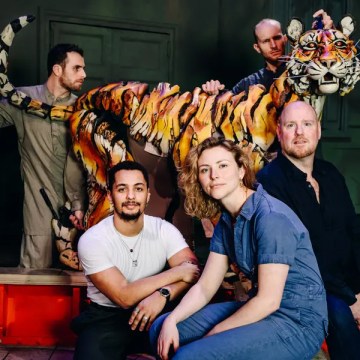
Foreground, from left: Fred Davis, Scarlet Wilderink and Finn Caldwell. Behind the tiger, from left: Andrew Wilson and Rowan Ian Seamus Magee. Nina Westervelt for The New York Times
Puppetry is a rare topic in these pages, but as cultural heritage goes, this ever-evolving form is worth at least a few minutes of reading time related to this new production:
Puppetry So Lifelike, Even Their Deaths Look Real
Members of the puppetry team for “Life of Pi” discuss making the show’s animals seem all-too-real on a very crowded lifeboat.
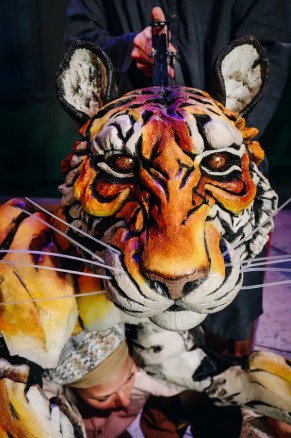
Richard Parker, the Royal Bengal tiger in “Life of Pi” takes three puppeteers (including Celia Mei Rubin, bottom left) to operate in the production opening at the Gerald Schoenfeld Theater on March 30. Nina Westervelt for The New York Times
Fair warning: This article is riddled with spoilers about puppet deaths in “Life of Pi,” the stage adaptation of Yann Martel’s best-selling novel about a shipwrecked teenager adrift on the Pacific Ocean. He shares his lifeboat first with a menagerie of animals from his family’s zoo in India — large-scale puppets all, requiring a gaggle of puppeteers — and eventually just with a magnificent, ravenous Royal Bengal tiger named Richard Parker that takes three puppeteers to operate.
Now in previews on Broadway, where it is slated to open on March 30 at the Gerald Schoenfeld Theater, the play picked up five Olivier Awards in London last year. Puppetry design by the longtime collaborators Nick Barnes and Finn Caldwell was included with Tim Hatley’s set in one award, and, unprecedentedly, a team of puppeteers won an acting Olivier for playing Richard Parker. Continue reading →


























 Organikos