Taking Inspiration From Smallhold Farms In Africa

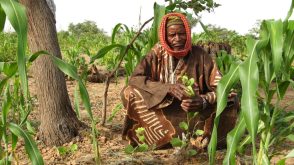
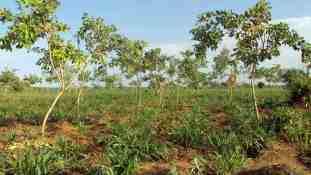
A farmer in Niger tends to a tree sprout growing among his millet crop. TONY RINAUDO / WORLD VISION AUSTRALIA

I am nearing the point where I can offer an update on the trees we have planted in advance of 1,000+ coffee plants going into the ground in their shade. Thanks to Fred Pearce, reporting in Yale E360, I have some inspiration coming from across the Atlantic on the broader value of those trees:

Dooki (Combretum glutinosum) trees grow on a millet field in Niger. P. SAVADOGO / ICRAF

As Africa Loses Forest, Its Small Farmers Are Bringing Back Trees

The loss of forests across Africa has long been documented. But recent studies show that small farmers from Senegal to Ethiopia to Malawi are allowing trees to regenerate on their lands, resulting in improved crop yields, productive fruit harvests, and a boost for carbon storage.

For decades, there have been reports of the deforestation of Africa. And they are true — the continent’s forests are disappearing, lost mainly to expanding agriculture, logging, and charcoal-making. But the trees? Continue reading
Costa Rica’s Ceramic Craft

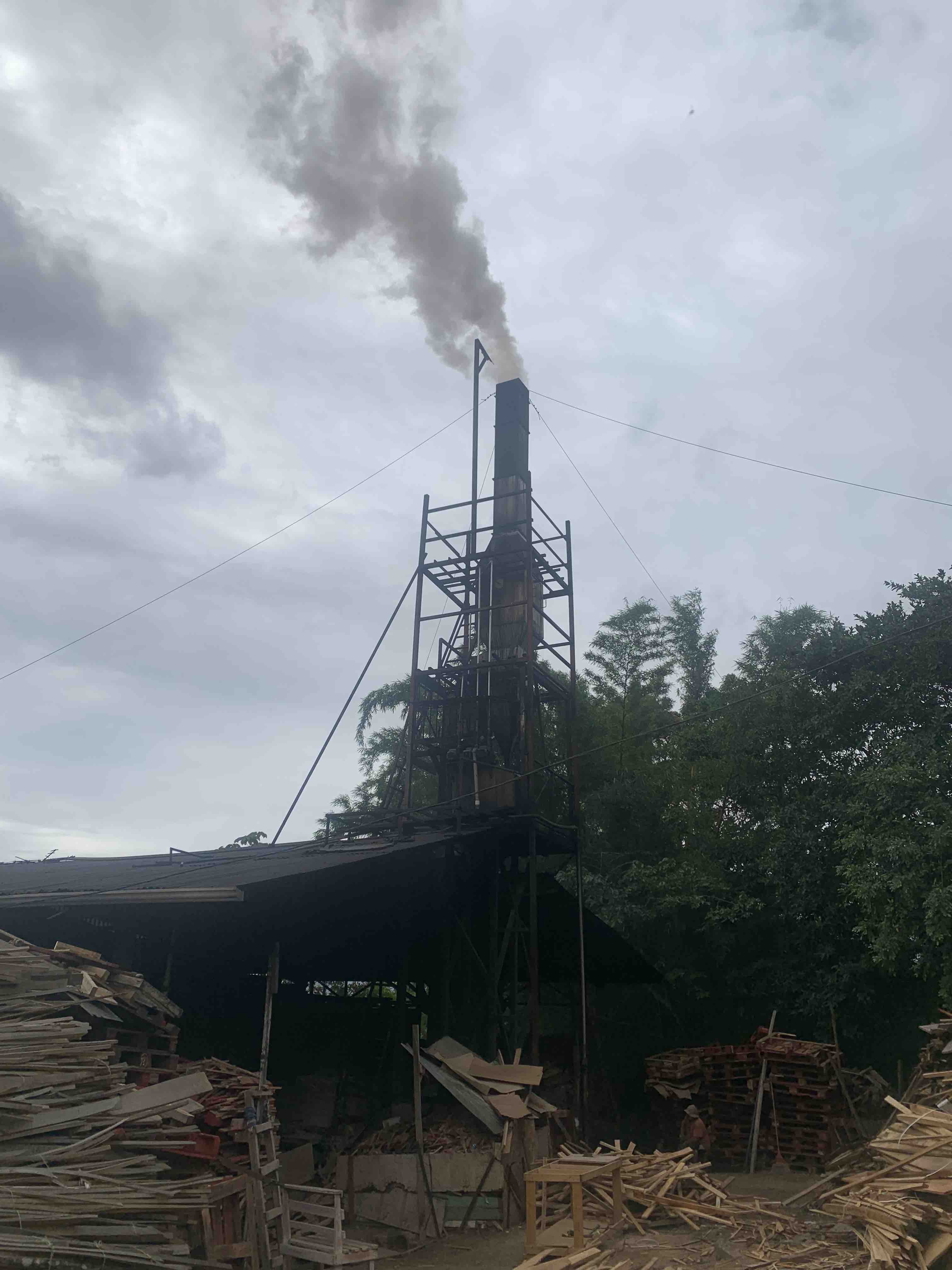
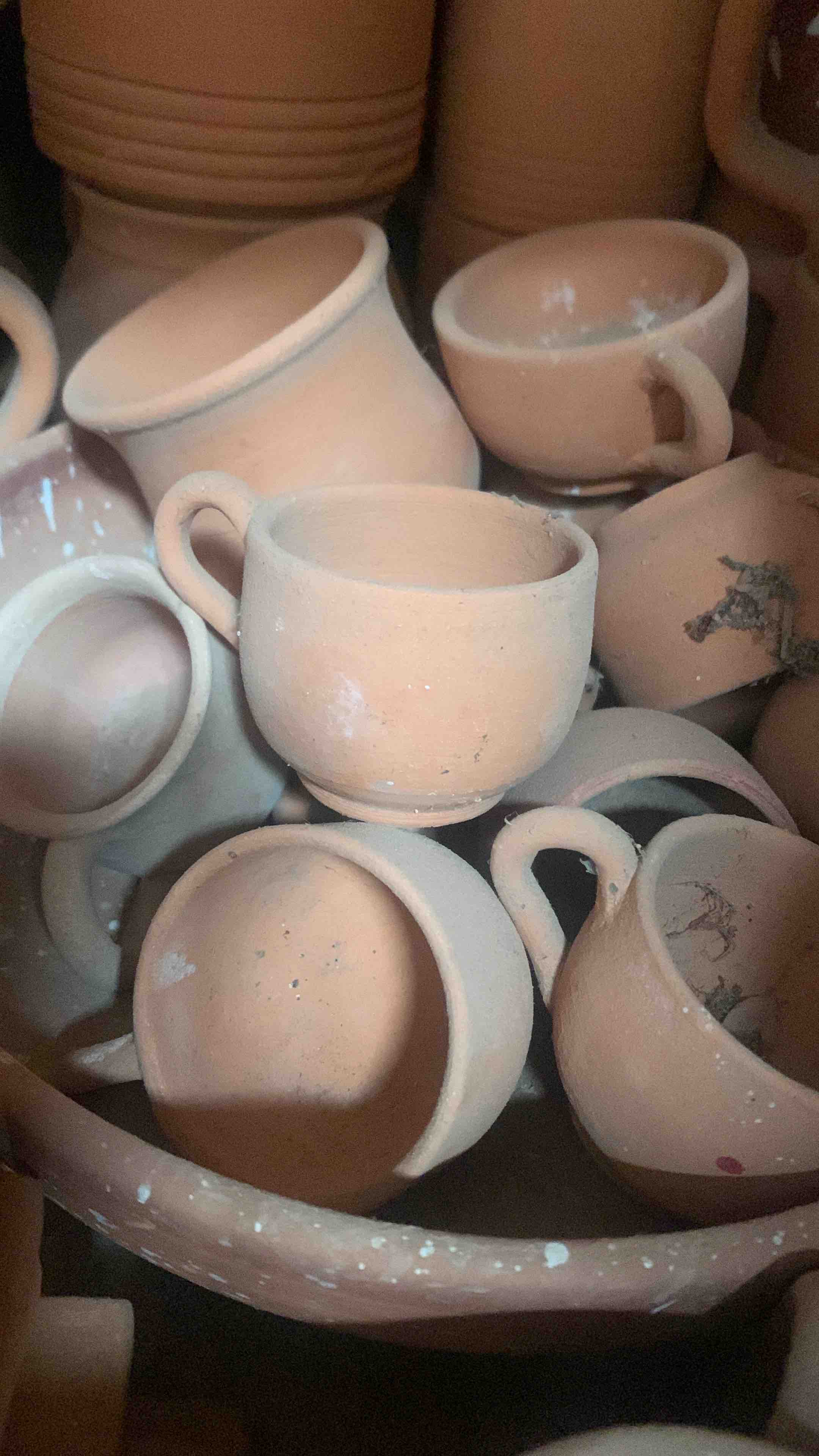
Amie and I work together, but most of my days are consumed by coffee. Especially in the March to May period, when coffee harvests are finishing and the first cuppings of the new crops are possible, my time for other activities is limited. But in June, there is more time. For the past 4+ years our shared work has included my joining her to meet artisans whose work our shops might carry. This work never disappoints, even if we conclude that the product is not a good fit for Authentica. Recently we had an afternoon together with a ceramicist we knew about, but had not yet had the opportunity to spend time with. The biggest surprise was seeing this smoke stack in the photo below.

It is rustic, and at first sight not much to look at. But listening to him tell its history you can appreciate how often in history artisans lead the way that industrialists eventually follow. This was the first smokestack in Costa Rica using technology that reduces carbon and particulate emissions. Continue reading

More On Merlin Sheldrake, Fungi & Related Matters

Merlin Sheldrake, author of the best-selling book “Entangled Life.” Alexander Coggin for The New York Times

We are grateful to any publication that gives this topic its due attention, in this case the New York Times and a particular thanks to Jennifer Kahn for such a thoughtfully written profile:

A vast fungal web braids together life on Earth. Merlin Sheldrake wants to help us see it.

One evening last winter, Merlin Sheldrake, the mycologist and author of the best-selling book “Entangled Life,” was headlining an event in London’s Soho. The night was billed as a “salon,” and the crowd, which included the novelist Edward St. Aubyn, was elegant and arty, with lots of leggy women in black tights and men in perfectly draped camel’s-hair coats. “Entangled Life” is a scientific study of all things fungal that reads like a fairy tale, and since the book’s publication in 2020, Sheldrake has become a coveted speaker.

A pied bleu (Lepista personata), also known as the field blewit. Alexander Coggin for The New York Times

At talks like these, Sheldrake is sometimes asked to answer a question he poses in the first chapter of his book: What is it like to be a fungus? The answer, at least according to Sheldrake, is at once alien and wondrous. “If you had no head, no heart, no center of operations,” he began. “If you could taste with your whole body. If you could take a fragment of your toe or your hair and it would grow into a new you — and hundreds of these new yous could fuse together into some impossibly large togetherness. And when you wanted to get around, you would produce spores, this little condensed part of you that could travel in the air.” There were nods. In the audience, the woman next to me gave a long, affirming hum. Continue reading

Lehua Kamalu Captains Hōkūleʻa,

This half hour podcast episode may be your best gateway to a weekend of healthy distraction:

She Sails the Seas Without Maps or Compasses

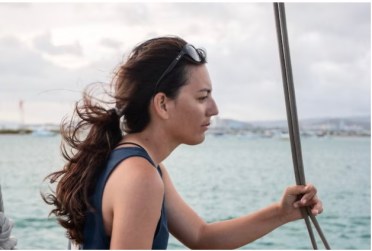
For nearly 50 years, a group of Hawaiians have been sailing on traditional voyaging canoes using the methods that early Polynesian explorers relied on to navigate the Pacific Ocean—without maps and modern instruments, and relying on the stars, ocean waves, birds, and other natural elements to guide them. We meet National Geographic Explorer Lehua Kamalu, the first woman to captain a long-distance voyage on Hōkūleʻa, a double-hulled Polynesian canoe that was built in Hawaii in the 1970s. She describes what it’s like to navigate in incredibly rough waters, what it means to keep Polynesian navigation alive in the 21st century, and about her next big adventure: a four-year circumnavigation of the Pacific Ocean.

When Disney became the owner of Fox Entertainment’s assets, National Geographic Partners was part of the deal. We never appreciated National Geographic’s association with Fox Entertainment, nor do we think Disney is much better a fit, but we can still appreciate when they do something right.

When In A Hole, Stop Digging

For many Americans, cars are as potent a symbol of freedom as guns are, even if they have similarly destructive consequences. Photograph by René Burri / Magnum

An interview with the author of one of the books reviewed in the linked essay below is effective motivation to read the entire review of both books:

How to Quit Cars

They crowd streets, belch carbon, bifurcate communities, and destroy the urban fabric. Will we ever overcome our addiction?

The Honeymooners” (1955-56), the greatest American television comedy, is—to a degree more evident now than then—essentially a series about public transportation in New York. Ralph Kramden (Jackie Gleason) is a New York City bus driver, deeply proud to be so and drawing a salary sufficient to support a nonworking wife in a Brooklyn apartment, not to mention a place in a thriving bowling league and membership in the Loyal Order of Raccoon Lodge. Continue reading

Auchan 2000 & Authentica 2023

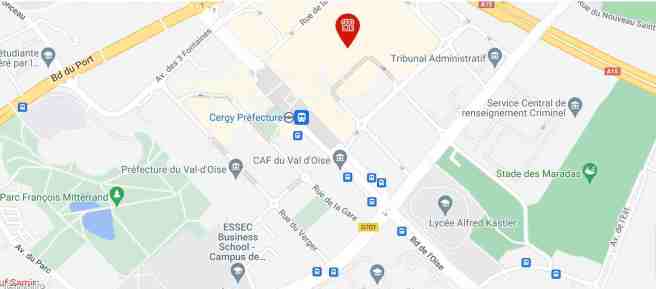
The Auchan hypermarche in Cergy is at the location of the red balloon in the image above. It is a short walk from the ESSEC campus (lower center of map). Click to go to the map on Auchan’s website

On each of the occasions I have read articles about Annie Ernaux I have been reminded of the first of my five years teaching at ESSEC. During the 2000-2003 academic years I lived on campus for extended periods away from home and family in Costa Rica. My grocery shopping was at the same Auchan elegantly dissected by the woman who last year won the Nobel Prize in Literature.  During my fourth year teaching there I was completing work on a project in Montenegro that made it more convenient for our family to be based in Paris for 12 months. This turned out to be one of the most culturally enriching experiences our family ever had together. And relevant to life now.

Adrienne Raphel’s article in The Paris Review begins with her own “big retail” experience, and at first read it connects dots between our Paris time and our retail life now. For the last 4+ years we have been waking up each day looking for novel ways to succeed without following the “pile it high and watch it fly” model. So, if that resonates with you for any reason, read on:

INTERIOR OF THE WAL-MART SUPERCENTER IN ALBANY. PHOTOGRAPH BY MATT WADE, COURTESY OF WIKIMEDIA COMMONS. LICENSED UNDER CCO 3.0.

“The Dead Silence of Goods”: Annie Ernaux and the Superstore

The first and only time I went to the Walmart in Iowa City was surreal. When I was in high school, my parents’ business-oriented small press had published a book called The Case Against Walmart that called for a national consumer boycott of the company; the author denounced everything from the superstore’s destruction of environmentally protected lands to its sweatshop labor to its knockoff merchandise. So by the time I made a pilgrimage out to the superstore at age twenty-one, I hadn’t stepped in a Walmart for nearly a decade, and it had acquired this transgressive power—the very act of crossing the threshold was as shameful as it was thrilling…

Libreria Bookshop & Review Of Once Upon A Prime

Click above to visit an independent bookshop whose platform for selling books online is a welcome distraction. Below, the owner of that shop (a character worth contemplating) writes a great book review. Oddly enough, we could not find, or figure out how to find, this book on his bookshop’s website.

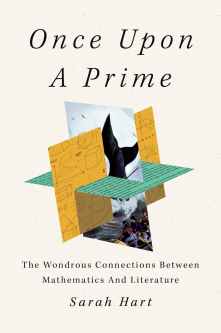
But nevermind that, we have linked to the publisher’s blurb on the book to the left:

Once Upon a Prime review – why maths and literature make a winning formula

Prof Sarah Hart’s exuberant study of the enduring conversation between mathematics and literature is fascinating

The universe (which others call the Library) is composed of an indefinite, perhaps infinite number of hexagonal galleries.” That’s how Jorge Luis Borges starts The Library of Babel, beloved by maths geeks and book nerds alike for the way it toys with the mathematical concept of infinity. Continue reading

The Forest Gives Much

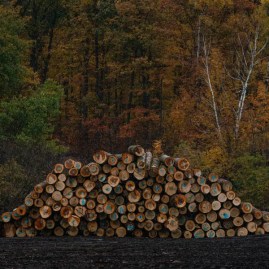
Freshly harvested logs from the Menominee Forest in Keshena, Wis., marked with color to indicate each log’s grade.

Sustainable forestry is a long-running topic in these pages over the years. The previous times we have linked to Cara Buckley stories we have been enriched by the humanity in environmental stories, so here we combine her unique talent to the topic of forestry:

The Giving Forest

The Menominee tribe has sustainably logged its forest in Wisconsin for 160 years. But that careful balance faces a crisis: too many trees and too few loggers.

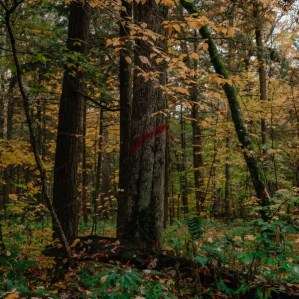
A tree marked for cutting. The Menominee harvest only trees that are sick and dying or those that have fallen naturally

MENOMINEE COUNTY, Wis. — Amid the sprawling farmlands of northeast Wisconsin, the Menominee forest feels like an elixir, and a marvel. Its trees press in, towering and close, softening the air, a dense emerald wilderness that’s home to wolves, bears, otters, warblers and hawks, and that shows little hint of human hands.

Yet over the last 160 years, much of this forest has been chopped down and regrown nearly three times. The Menominee Tribe of Wisconsin, its stewards, have pulled nearly two hundred million cubic feet of timber from this land since 1854 — white pine cut into museum displays and hard maple made into basketball courts for the Olympics. Continue reading

Planting For Foraging

Picking too many fiddleheads from a single ostrich fern plant can reduce its productivity. Jared Rosenbaum, a field botanist, never harvests more than one or two from any individual plant. (Also, cooking with fiddleheads can be toxic, so be sure to wash them well and never eat them raw: Always boil them before you sauté or cook them in any other way.) Jared Rosenbaum/Wild Ridge Plants

Margaret Roach delivers the goods when we need a dose of useful plant life information:

Why It’s Better to Plant Wild Greens Than to Forage for Them

This spring, don’t forage for wild edible plants. Instead, welcome them into your garden.

Jared Rosenbaum knows the primal thrill of foraging — a sense of interdependence with the natural world that he wants his son to experience, too.

But as a field botanist, he also understands that foraging is one of the many pressures on native-plant populations. And he has a proposition for gardeners: What if we gave back to the wild edible plants that tempt us on our springtime woodland hikes, by welcoming them into the landscapes we cultivate?

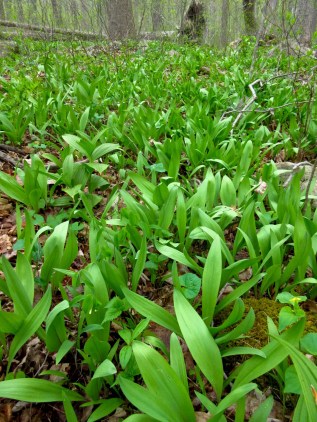
For a fleeting moment each spring, wild leeks (otherwise known as ramps) are a star of restaurant menus, creating a demand that has intensified the pressure on wild populations. Jared Rosenbaum/Wild Ridge Plants

It’s one layer of the habitat restoration and ecological design inspiration that he and his wife, Rachel Mackow, provide to clients of Wild Ridge Plants, in rural Pohatcong Township, N.J. And it’s reflected in many of their mail-order nursery’s plant choices, too.

In Mr. Rosenbaum’s recent book, “Wild Plant Culture: A Guide to Restoring Edible and Medicinal Native Plant Communities,” he revisits that idea: “The time has come to reconnect with our habitats, right where we live, work, and play,” he writes. “Not as museum pieces, but as vital, sustaining elements in our lives, livelihoods, and lifeways.”

That includes our gardens. Continue reading

Spirit Catcher and Lumen-Less Lantern, An Art Intervention by Willie Cole

Willie Cole in his artist-in-residence studio at Express Newark, where he has been assembling chandeliers made from thousands of used plastic bottles. Rachel Vanni for The New York Times

Recycling has been a key theme in these pages since we started. Sometimes upcycle has been the term. Of course, reuse is also interesting.

All of these are worth our attention and support.

Our thanks to Laura van Straaten and the New York Times for bringing Willie Cole’s exhibition into view:

The artist invited the community in Newark to reimagine objects that would otherwise be destined for a landfill — to look at them in a fresh, imaginative way.

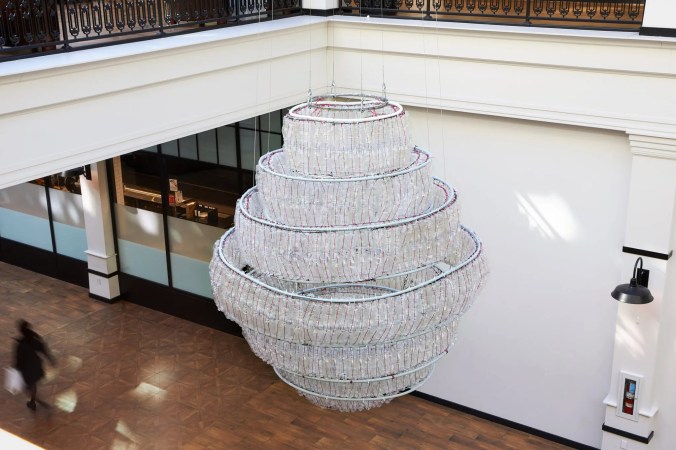
“Spirit Catcher” by Willie Cole is made of thousands of water bottles held together with metal wire and sculpted to resemble a chandelier. Rachel Vanni for The New York Times

NEWARK — The artist Willie Cole has created two colossal new sculptures and generated a provocative group exhibition stemming from an unusual open call asking artists to transform objects destined for landfill into something imaginative and new. Continue reading

Brilliance Up North

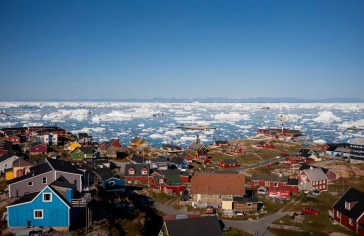
Ilulissat’s icy fjord, a UNESCO World Heritage site, is one of Greenland’s main tourist destinations even though its airport is currently too small to accommodate large jets. Carsten Snejbjerg for The New York Times

Setting limits at the outset, what a brilliant idea:

The Arctic island, renowned for its glaciers and fjords, is expanding airports and hotels to energize its economy, even as it tries to avoid the pitfalls of overtourism.

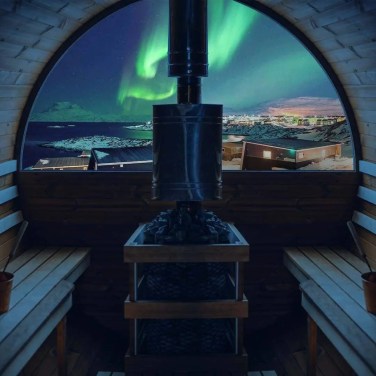
A sauna with a view of Nuuk and, at left, in the distance, the nearly 4,000-foot mountain Sermitsiaq. Inuk Travel

“The weather decides”: It could almost be the motto of Greenland. Visitors drawn to this North Atlantic island to see its powder blue glaciers, iceberg-clogged fjords and breathtakingly stark landscapes quickly learn to respect the elements, and they’re sometimes rewarded for it.

One cold December day, I was waiting for a delayed flight in Kangerlussuaq, a former U.S. military base just above the Arctic Circle, when a friendly Air Greenland pilot named Stale asked if I’d like to join him on a drive to the harbor to “pick up some musk ox heads.” The offer seemed very Greenlandic, so how could I refuse? Continue reading
Bravo, Bobbi Wilson!

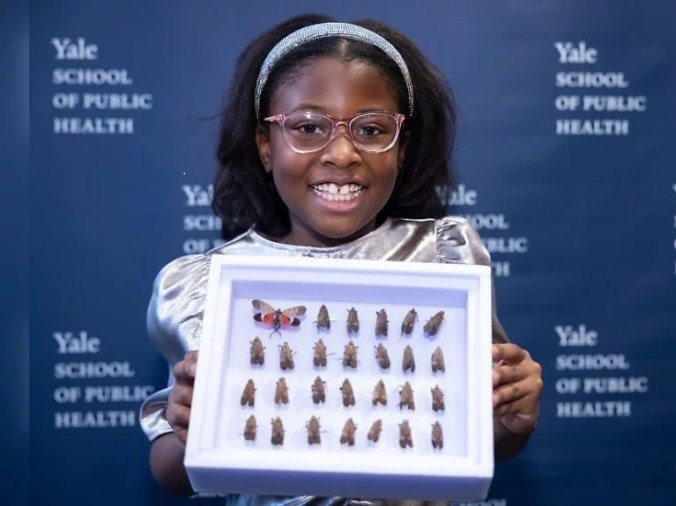
Bobbi Wilson holds her collection of spotted lanternflies as she is honored at the Yale School of Public Health on Jan. 20. Andrew Hurley/Yale University

A young person doing their part, on their own, to help with an environmental scourge. Hats off to that. The unneighborly act aside, this is a story to celebrate (thanks to National Public Radio, USA) and an extra bravo to Yale University for their part in it:

Yale honors the work of a 9-year-old Black girl whose neighbor reported her to police

Nine-year-old Bobbi Wilson may be in the fourth grade, but last month the Yale School of Public Health held a ceremony honoring the budding scientist’s recent work. Continue reading

American Prairie & American Bison

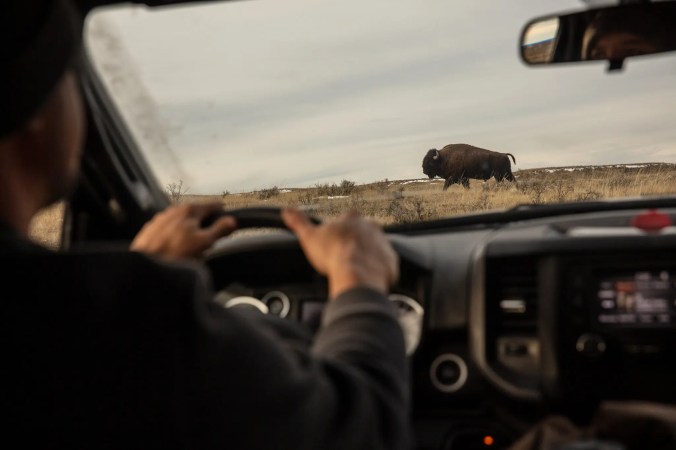
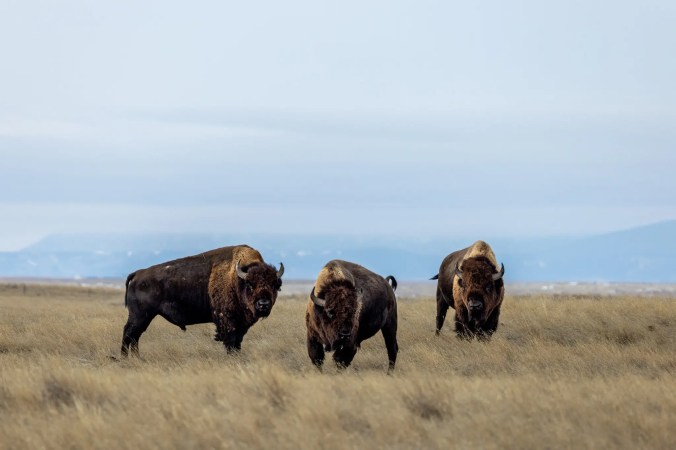
Scott Heidebrink, the director of bison restoration for the American Prairie Reserve in northeast Montana, checks on a herd. “There are ways that bison were impacting the landscape that we haven’t even thought about,” he said.

Bison restoration has been on our radar, primarily stories from the western USA, but also from the European context, where there has been considerable progress in recent years. Here is a good look at a conservation organization focused on habitat restoration, and the multi-species benefits:

Where the Bison Could Roam

Bison once numbered in the tens of millions in the United States. Now, a nonprofit is working to restore the shortgrass prairie, where the American icons and their ecosystem can thrive again.

MALTA, Mont. — Around 200 chocolate-brown bison raise their heads, following the low growl of a pickup truck slowly motoring across the sagebrush-studded prairie. Continue reading
What To Do With A Tenner

‘In the woods, there will be much more fungi and even more colour: scarlet elf cup (above), orange witches’ butter, yellow stagshorn, green elf cup, blue roundheads.’ Photograph: fotoco-istock/Getty Images/iStockphoto

This recommendation from Lucy Jones is as good as any we might otherwise recommend:

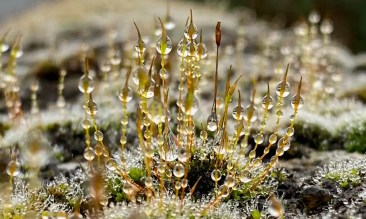
‘Wet weather makes for particularly juicy moss.’ Water droplets on moss on a wall. Photograph: Niall Carson/PA

The winter world may seem gloomy – but look closely, and you’ll see nature casting a spell

For less than a tenner, do as I do: buy a hand lens, head outside and discover fungi and moulds lighting up the darkness

‘You won’t believe how exquisite slime moulds are.’ Photograph: Alastair Hotchkiss/Woodland Trust/PA

The profound therapeutic benefits of connecting with nature and spending time outside are well known. But in winter? When it’s cold, gloomy and everything looks dead? In fact, especially in the winter, when we are susceptible to fatigue, illness and seasonal low mood. And actually there is plenty of life, beauty and wonder right outside our doors, if we look closely.

Come and take a short walk with me in my nearest wild patch – an urban cemetery, a common environment across the British Isles. Continue reading
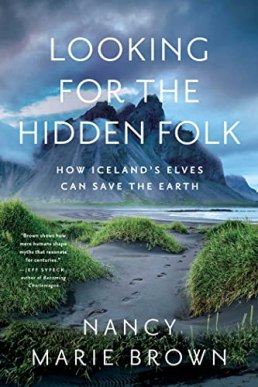
Icelandic Elf-Curious Attitudes

Toni Demuro

In a world that is full of climate denial nonsense, where responsibilities to nature are abandoned by many, what harm could possibly come from Icelanders believing their own peculiar sort of nonsense? We will take any help we can get if it helps us and helps our protection of nature:

In “Looking for the Hidden Folk,” Nancy Marie Brown makes a strong case for everyday wonder.

For 70 summers, children have boated to an island in the Adirondack wilderness to seek out a cluster of tiny wooden houses and leave messages for the fairies who are said to live there. Sometimes the fairies write back — on slips of birch bark, tucked into the crevice of a log for children to find and exult over. The adult go-betweens behind the letters can’t resist feeding the children’s faith that the natural world reciprocates their interest.

Of course, they don’t believe in fairies themselves. In “Looking for the Hidden Folk,” the cultural historian Nancy Marie Brown asks: Why not? “Why should disbelief be our default? Why should we deride our sense of wonder? Why do we allow our world to be disenchanted?” Continue reading
The Little Countries That Could

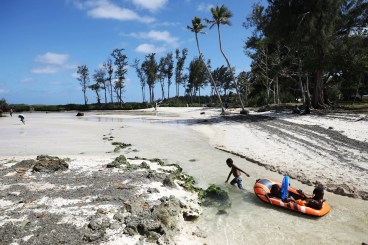
The atoll nation of Vanuatu is threatened by rising seas. “We had to learn how to manage our unimportance,” its president said. Mario Tama/Getty Images

This story has a familiar ring to it, if you are familiar with the history of Costa Rica going back to colonial times. Never a particularly “important” part of the empire, it thereby avoided many pitfalls typical of other countries in Latin America, and evolved into a stable democracy with progressive ideas and goals and achievements. We wish this little country in the Pacific comparable success by thinking outside the box, as its president says:

Emergency supplies being distributed after Cyclone Harold in 2020. International Federation of Red Cross, via Agence France-Presse — Getty Images

It wants a top international court to weigh in on whether nations are legally bound to protect against climate risks.

Nikenike Vurobaravu presides over a tiny country with a large hand in climate diplomacy.

Rising sea levels threaten the very existence of his Pacific Island nation of Vanuatu and its population of just over 300,000 people. Its best defense, he says, it to raise its voice creatively in international diplomatic talks. Continue reading
Giving A Bread Its Due Honor

President Emmanuel Macron of France described the baguette as “250 grams of magic and perfection in our daily lives.” Eric Gaillard/Reuters

When the baguette was a daily part of our family’s life, we were fortunate to have a personal connection to the best guide, whose photo in the story below is as fitting as the photo above:

Steven Kaplan, perhaps the baguette’s most dedicated historian, says the bread has “little sites of memories” that “testify to a sensuality.” Daniel Janin/Agence France-Presse — Getty Images

A Slice of France, the Baguette Is Granted World Heritage Status

More than six billion baguettes are sold every year in France. But the bread is under threat, with bakeries vanishing in rural areas.

PARIS— It is more French than, perhaps, the Eiffel Tower or the Seine. It is carried home by millions each day under arms or strapped to the back of bicycles. It is the baguette, the bread that has set the pace for life in France for decades and has become an essential part of French identity.

On Wednesday, UNESCO, the United Nations heritage agency, named the baguette something worthy of humanity’s preservation, adding it to its exalted “intangible cultural heritage” list. Continue reading
Startling Capacities Of Regional Forests

Harvard Forest (pictured) was included in a study that looks at how New England forests can be better utilized in the fight against climate change.
Stephanie Mitchell/Harvard Staff Photographer

We had no clue how much forest area that region has, nor how much capacity to absorb carbon that would translate to:

New England forests, new strategies can offset most regional emissions over 30 years, report says

Study, led by Harvard ecologist, lays out five policies to boost levels of absorption as six states lower emissions

A major new report suggests that with a handful of strategies New England’s 32 million acres of forests, which cover about three-quarters of the region, could eventually come close to absorbing 100 percent of all the carbon produced by the six states. Continue reading

Nepal’s Community Forests

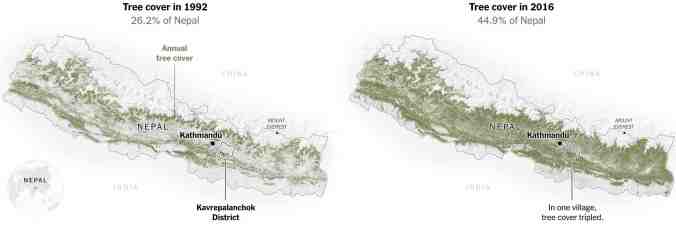
Note: Green areas show land that is mostly covered by trees, based on an analysis of satellite imagery. Source: Jefferson Fox, Jamon Van Den Hoek, Kaspar Hurni, Alexander Smith and Sumeet Saksena.By Pablo Robles

We have shared plenty of stories about Nepal, but until now no story about Nepal involving trees or forests. We welcome this one:

The community forests in Khairahani, Nepal, stretching over several tree-capped hills in March. Karan Deep Singh/The New York Times

An effort decades in the making is showing results in Nepal, a rare success story in a world of cascading climate disasters and despair

KANKALI COMMUNITY FOREST, Nepal — The old man moved gingerly, hill after hill, cutting dry shrubs until he was surrounded by trees that had grown from seedlings he had planted two decades ago. He pointed to a row of low peaks above the Kathmandu valley that were covered with dense foliage. Continue reading

McKibben From COP 27 & A Rare Smile

You can read the daily news from COP27 on the official website, and it is useful information but not fully contextualized; for that we have our most reliable scribe who today is giving us one of his rare smiles:

Has the fever broken just a bit?

The view from Egypt: Trumpism, Putinism, Bolsonaroism finally on the defensive

Those of us who have been faithful in bringing the world bad news are perhaps excused if we seize occasionally on the the promising straws in the wind (though always aware that ill winds continue blowing, and not just in Florida where a rare November hurricane made landfall today). I’m thinking globally this afternoon, because I’m at the climate summit in Sharm al Sheikh in Egypt, where dozens of countries have pavilions (it’s the Epcot of carbon mitigation.) And the planet looks just a little better than it did a month ago. Continue reading