Running Tide’s Buoys


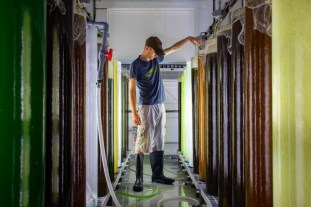
An image of a man in boots in a kelp hatchery
Since kelp grows as fast as two feet per day, it absorbs a huge amount of carbon through photosynthesis. (Jamie Walter / Running Tide)

Kelp  has featured in our pages frequently enough to be considered an important topic. It will be a partial solution to something big. Thanks, as always, to Robinson Meyer for the weekly newsletter that sometimes depresses the spirit but on other occasions, like this one, titled How to Fight Climate Change With Buoys That Look Like Ramen Noodles, points a small ray of hope in an unexpected direction:
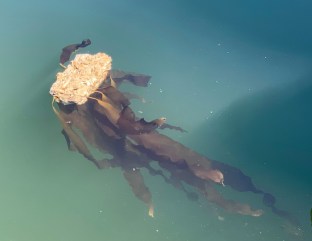
Running Tide’s buoys are made of reclaimed waste wood, limestone, and kelp seedlings. (Jamie Walter / Running Tide)

Last month, somewhere off the coast of Maine, a small group of researchers and engineers released a series of tiny, floating objects into the water. The team called them “buoys,” but they looked more like a packet of uncooked ramen noodles glued to a green party streamer than anything of the navigational or weather-observing variety. These odd jellyfish had one role in life: to go away and never be seen again. With any luck, their successors would soon be released into the open ocean, where they would float away, absorb a small amount of carbon from the atmosphere, then sink to the bottom of the seafloor, where their residue would remain for thousands of years. Continue reading
Proto-Peat In The Arctic

PHOTOGRAPH: SANNA PIILO

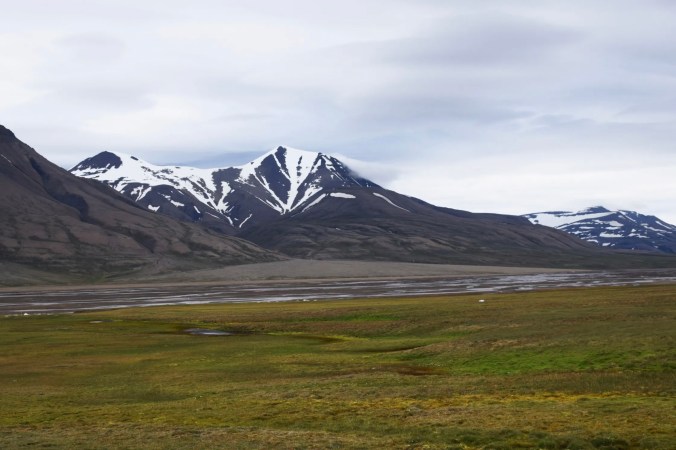
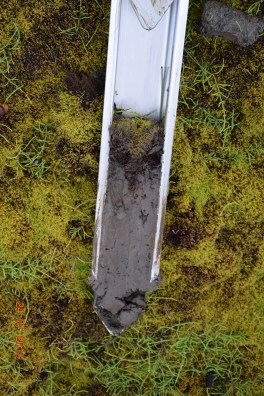
We have posted enough times about the importance of protecting peat, but this is the first we hear the question Carbon-Rich Peat Is Disappearing. But Is It Also Growing? Our thanks to Matt Simon at Wired for this one:

PHOTOGRAPH: SANNA PIILO

Scientists have discovered “proto-peat” forming in the Arctic as the Earth naturally sequesters carbon, but it could take centuries to mature.

THANK PEAT FOR that scotchy flavor of Scotch whisky: The muck forms in Scotland’s bogs, when layer after layer of dead vegetation resists decay and compresses into fuel, which is burned during scotch distillation. But you can also thank peat for helping keep our planet relatively cool, as all that muck—which is particularly common across the Arctic—traps a tremendous amount of carbon that would otherwise heat the atmosphere. Continue reading

The World’s Largest Living Thing

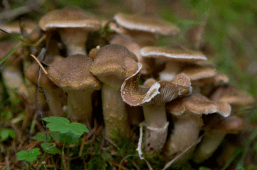
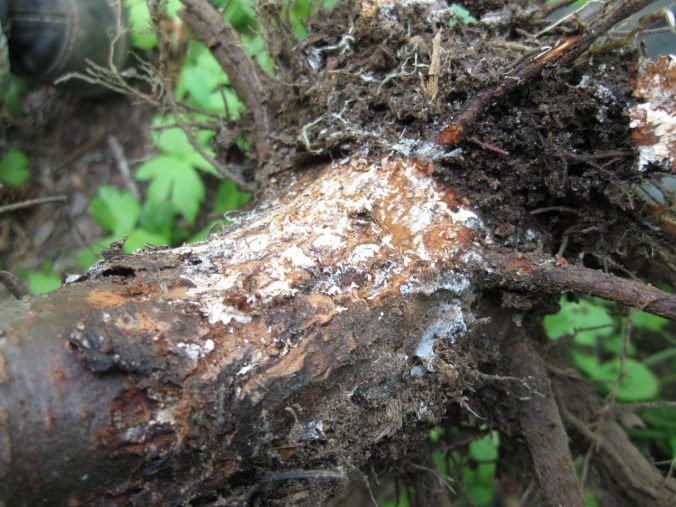
The world’s largest living thing is a stealthy parasite that lives mostly underground and beneath the bark of infected trees in a pale, stringy fungal network. COURTESY MIKE MCWILLIAMS

Thanks to Milo‘s interest in fungi, which we found infectious, we learned years ago what the world’s largest living thing is. We used to feature more stories from Atlas Obscura, but this is the first in a few years:

What the World’s Largest Organism Reveals About Fires and Forest Health

The Humongous Fungus is most visible when it produces the edible and tasty honey mushroom, but the season is brief and doesn’t happen every year. PETER PEARSALL, USFWS/PUBLIC DOMAIN

In Oregon, the Humongous Fungus plays a complex role in an ecosystem reshaped by humans.

UNDER THE BLUE MOUNTAINS OF Oregon lurks something massive and prehistoric. Yet the largest recorded organism on Earth, weighing more than 200 blue whales and dwarfing even Pando, Utah’s famous grove of quaking aspens, is nearly invisible to the untrained eye. It’s a single, genetically identifiable specimen of honey mushroom, or Armillaria ostoyae, that has been growing for thousands of years. Continue reading
Technology Put To Good Use

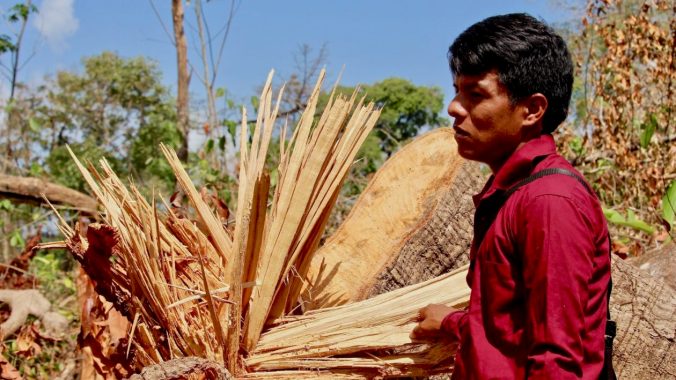
A Wounaan forest technician inspects an illegal clearcut in Indigenous territory. CULLEN HEATER

Jim O’Donnell and Cullen Heater tell an essentially hopeful story from our neighbor to the south:

Panama’s Indigenous Groups Wage High-Tech Fight for Their Lands

With help from U.S. organizations, Panama’s Indigenous people are using satellite images and other technologies to identify illegal logging and incursions by ranchers on their territory. But spotting the violations is the easy part — getting the government to act is far harder.

On a blazing February morning, the Indigenous Wounaan territorial monitoring coordinator, two forest technicians, and a local farmer climbed into the mountains outside the fishing and farming community of Majé, near Panama’s Pacific coast. Continue reading

P-22 & Other Cats In The Santa Monicas

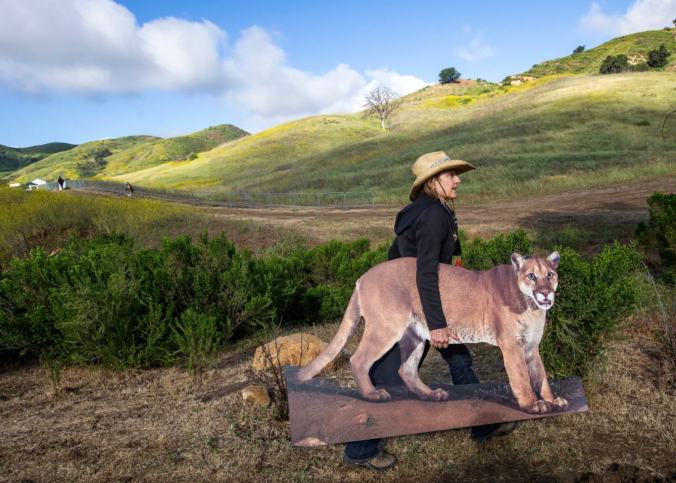
Near the location of the future Wallis Annenberg Wildlife Crossing, a volunteer for the National Wildlife Federation carries a cardboard cutout of a mountain lion known as P-22. Photograph by Mel Melcon / Los Angeles Times / Shutterstock

When we linked to earlier stories about mountain lions in urban California, P-22 was already the it-cat. And the story below, by Emily Witt, shares some anecdotes about P-22’s less fortunate wider family. But mainly it is about one hopeful initiative that P-22 seems to have unwittingly helped make happen:

An Urban Wildlife Bridge Is Coming to California

The crossing will span Route 101, providing safe passage for mountain lions and other animals hemmed in by the freeways that surround the Santa Monica Mountains.

It was just after midnight on April 21st when the radio collar of P-97, an eighteen-month-old mountain lion, sent its last signal. P-97 had only recently separated from his mother, setting out east in the Santa Monica Mountains in search of territory to call his own. (The “P” stands for puma; the number, 97, marks how many mountain lions the National Park Service had tagged when he received the designation.) Continue reading

A Bit About The Origins Of Clean The World

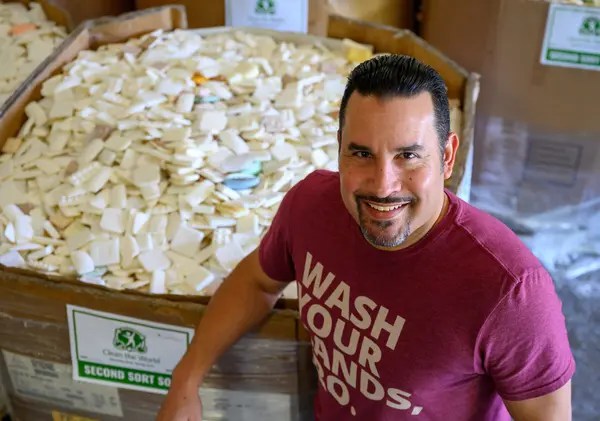
Shawn Siepler, the founder of Clean the World, with used hotel soap before it will be recycled for those in need. Todd Anderson for The New York Times

Reusing things versus wasting them has been a major theme in these pages, especially in relation to travel and hospitality. Looking back at posts about washing hands for a cleaner world and then another about soap making for the same, it is not surprising we had already featured Clean The World in a couple earlier posts. Thanks to Victoria M. Walker for this conversation with the founder:

Getting the World Clean, One Recycled Bar of Soap at a Time

Meet Shawn Siepler, the founder of Clean the World. The nonprofit recycles partially used soap left behind from hotel guests for those in need.

When hotel or motel guests check into their rooms, they expect at the very least to be greeted with a clean space, a made-up bed and in the bathroom, soap.

But what happens when you leave that soap behind? Continue reading

Questions About Forests As Carbon Sinks

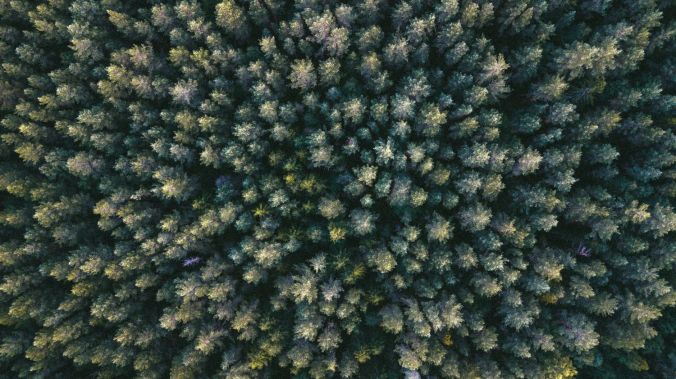
PEXELS

We have featured articles about forests so many times for multiple reasons. Even when we hint that we do so just out of pure love, it is almost always about the value of forests to our future on the planet. As always, when a Yale e360 article can help illuminate further on a topic, here goes:

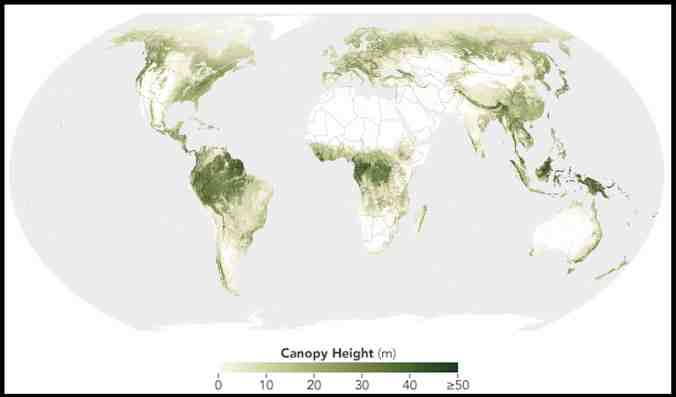
This map shows the height of forests worldwide. Taller forests typically store more carbon. NASA

Climate Change Will Limit How Much Carbon Forests Take Up, New Research Shows

Governments are increasingly looking to forests to draw down carbon pollution, but worsening droughts threaten to stunt tree growth, while larger wildfires and insect infestations risk decimating woodlands, two new studies show. Continue reading

Guided Forest-Bathing In The Loire Valley

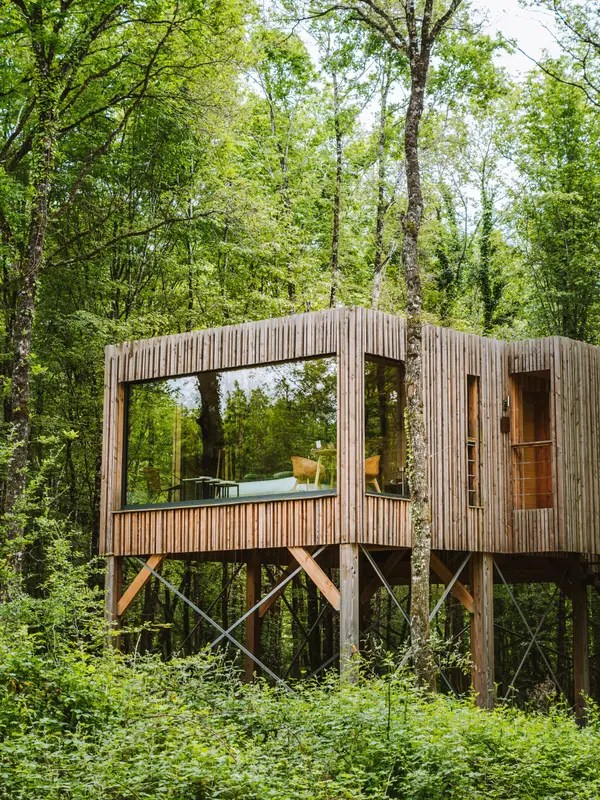
The tree houses at Loire Valley Lodges are spread out throughout the forest and each is decorated by a different artist. Joann Pai for The New York Times

After several days of heavier fare, today’s recommended reading leans to the escapist:

Beyond the Châteaux: New Escapes in France’s Loire Valley

Rethinking what the region’s travel should be has meant expanding the focus from fairy tale castle crawls to experiences anchored more firmly in nature, food and the arts.

The Loire Valley is a UNESCO Heritage-protected region, and drew in 9 million yearly visitors to its cultural sites before the pandemic. Joann Pai for The New York Times

On my last prepandemic trip to the Loire Valley, in 2018, I found myself in a familiar place.

Ten years after my first road trip on the region’s castle route, I was back at the 500-year-old Château de Chambord, joining a small group of European and American tourists on a guided tour. Within seconds of convening in the inner courtyard, we were craning our necks to marvel at the structure’s ornamental bell towers as our guide rattled off facts and dates about King Francis I and his former hunting lodge. When she ushered us up to the towers, chiding us for not listening, a feeling of deja-vu washed over me. Continue reading

Desalination’s Discontents

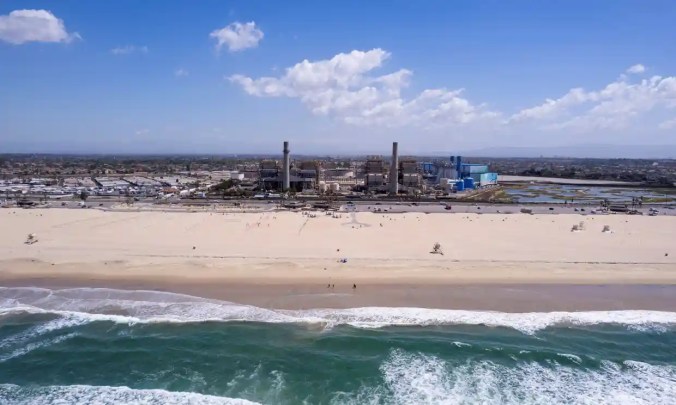
The commissioner of the panel said: ‘The ocean is under attack … I cannot say in good conscience that this amount of damage is OK.’ Photograph: Mike Blake/Reuters

Desalination, which we celebrated multiple times over the years, might not be all as good we thought it was:

Joy for environmentalists as California blocks bid for $1.4bn desalination plant

Poseidon Water sought to turn seawater into drinking water but activists said plan would devastate ecosystem on Pacific coast

California coastal panel on Thursday rejected a longstanding proposal to build a $1.4bn seawater desalination plant to turn Pacific Ocean water into drinking water as the state grapples with persistent drought that is expected to worsen in coming years with climate change. Continue reading

The Effects Of Fire Suppression

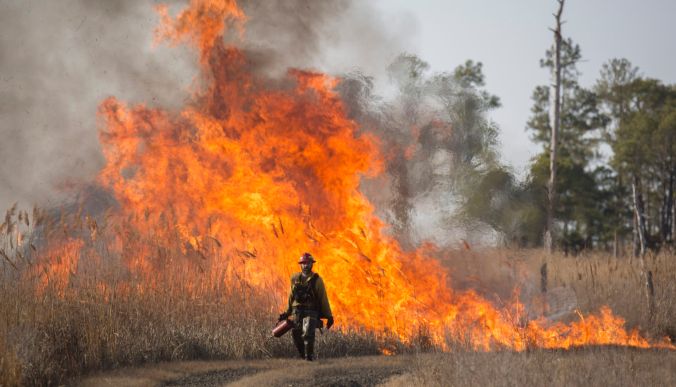
A controlled burn near the Blackwater National Wildlife Refuge in Maryland. SARAH BAKER

We have linked to many stories about wildfires over the years, noting their relationship to climate change. Our working assumption seems to have been that fire is always problematic, but here is reason to reconsider that, thanks to Gabriel Popkin and Yale e360:

Bringing Back Fire: How Burning Can Help Restore Eastern Lands

For millennia, North American ecosystems benefited from fire, mostly set by Indigenous people. Now, a movement is growing, particularly in the eastern U.S., to reintroduce controlled burns to forests and grasslands and restore the role of fire in creating biodiverse landscapes.

It’s an apocalyptic scene that has become all too familiar in recent years. Continue reading
Lawns Gone, Good Riddance

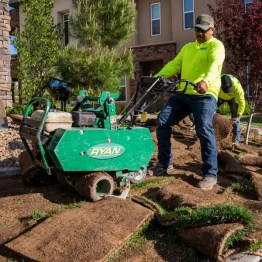
Jaime Gonzalez of Par 3 Landscape and Maintenance removed grass at a condominium complex in Las Vegas. The lawn is considered “nonfunctional” under a new state law.

In case you have been to the city, or even just heard about how water is flaunted as a key attraction, and wondered how they can justify such use of a limited resource, then Is That an Outlaw Lawn? Las Vegas Has a New Approach to Saving Water may be worth a few minutes of your time. We recently shared news of a voluntary initiative to reconsider lawns for reasons entirely different from those in the story below. Henry Fountain‘s text accompanied by Joe Buglewicz’s photos, tells the story of Las Vegas lawns, where water resources are so limited, this seems a long time coming:

Mr. Donnarumma documented water running off a sidewalk into the curb from sprinkler overspray.

With drought and growth taking a toll on the Colorado River, the source of 90 percent of the region’s water, a new law mandates the removal of turf, patch by patch.

LAS VEGAS — It was a perfectly decent patch of lawn, several hundred square feet of grass in a condominium community on this city’s western edge. But Jaime Gonzalez, a worker with a local landscaping firm, had a job to do. Continue reading

Personal Approaches To Carbon Footprint Reduction

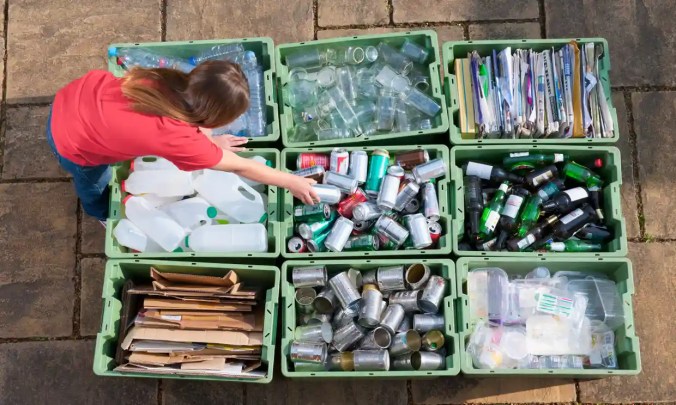
Recycle to save the planet? Photograph: Jacobs Stock Photography Ltd/Getty Images

A public service request for your input, from the Guardian:

What is the single most effective thing I could do to reduce my carbon footprint?

The long-running series in which readers answer other readers’ questions on subjects ranging from trivial flights of fancy to profound scientific and philosophical concepts

What is the single most effective thing I could do to reduce my carbon footprint? Without dying, preferably. Andrew Hufnagel, Caithness

Post your answers (and new questions) below or send them to nq@theguardian.com. A selection will be published on Sunday.

First Drafts Of History

First reading of the day was this essay by a historian linked to once and referred to one time previously. And next up, the conscience of our generation compounds the idea, or rather pounds the idea home about who is writing the first draft of what will become our history, by defining reality as we see it today. I have listened to conversations with Daniel Yergin twice recently, and acknowledge being sucked into his expert definition of how to understand the fossil fuel world. I appreciate McKibben’s cold water on my face:

Who gets to define reality?

A search for the climate high ground

“Realism” is the high ground in politics—a high ground from which to rain down artillery fire on new ideas.

To wit, this week the New York Times profiled Canadian energy analyst Vaclav Smil, who—alongside others like Daniel Yergin—has long insisted that the transformation from fossil fuels to hydrocarbons must take a long time. Smil is a good writer and a smart historian; he’s documented the many-decades-long transitions from, say, wood to coal, and coal to oil as dominant energy sources. Continue reading
Sensory Loading, Overloading & Unloading

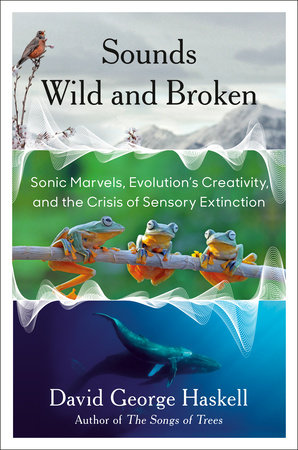
Sounds Wild and Broken by David George Haskell
In early August, 2007 we arrived in a leafy suburb on the north side of Atlanta. We had spent the previous year living on this island, where doors did not have locks and during the daytime the only man-made sounds tended to be those of fishing boats coming and going. At night on that island there were no noises other than nature’s, including small waves hitting the shores and in summertime the crickets. On the first night in Atlanta I opened the window to let in the night air, and the sound of the superhighway, a mile or so away, was distracting enough that I had to close the window to sleep. It’s not that I had not appreciated the quiet of the island, but I was surprised by how much I had adapted to it. The opening of this book review, for these reasons, resonates with my own experience:

Sounds Wild and Broken review – a moving paean to Earth’s fraying soundtrack

David George Haskell’s often wonderful book explores some of the lost frequencies of nature – heard clearly again during Covid’s initial human hush

Lockdown was, among other things, a sudden collective experiment in volume control. Sound waves from the regular rush-hour thrum of cities usually penetrate more than a kilometre below the Earth’s surface. Continue reading
Unexpectedly Amazing In Kerala

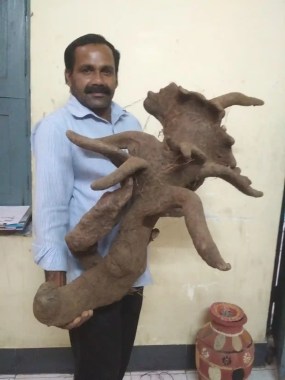
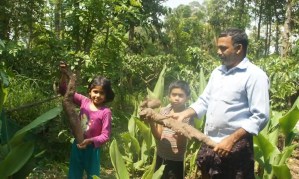
Shaji has a prized collection of more than 200 varieties of tubers. Photograph: Shaji NM

In our Kerala days we visited Wayanad many times, but I would remember if I had met Shaji. We would have sought his advice to expand on the agricultural initiatives at the properties we developed and managed.  Monika Mondal’s story ‘The tuber man of Kerala’ on a quest to champion India’s rare and indigenous crops brings back memories of unassuming neighbors doing unexpectedly amazing things:

Shaji NM has devoted his life to collecting and farming tubers such as yam, cassava and taro, and promoting them across the country

Shaji NM has spent the past two decades travelling across India to collect rare indigenous tubers. Photograph: Shaji NM

Known as “the tuber man of Kerala”, Shaji NM has travelled throughout India over the past two decades, sometimes inspecting bushes in tribal villages, at other times studying the ground of forests closer to home among the green hills of Wayanad in Kerala. His one purpose, and what earned him his title, is to collect rare indigenous varieties of tuber crops.

“People call me crazy, but it’s for the love of tubers that I do what I do,” says Shaji. “I have developed an emotional relationship with the tuber. When we did not have anything to eat, we had tubers.” Continue reading
Climate Policies To Cheer On

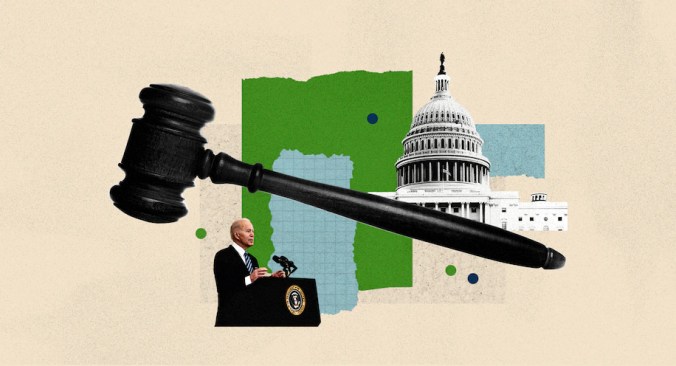
(Washington Post illustration; Demetrius Freeman/The Washington Post; iStock)

I am heading to Ithaca tomorrow for family reasons, so the third item described in the story that follows is of particular interest. But every one of the items is worth reflecting on, in a news world without enough such stories. Our thanks to the Washington Post Staff who put this list together:

10 recent climate policies that could make a difference

Stories from the past six months that show what local and national policy change can look like

The most recent IPCC report makes it clear: There is no one silver bullet that can address global warming. Instead, nations, businesses, communities and individuals all have a role to play in helping to create a safer and more sustainable future. But without action from the world’s wealthiest countries, the nations and people who are least at fault for fueling climate change will be the ones who suffer the most, the scientists behind the report warn. Continue reading
Tidal Power

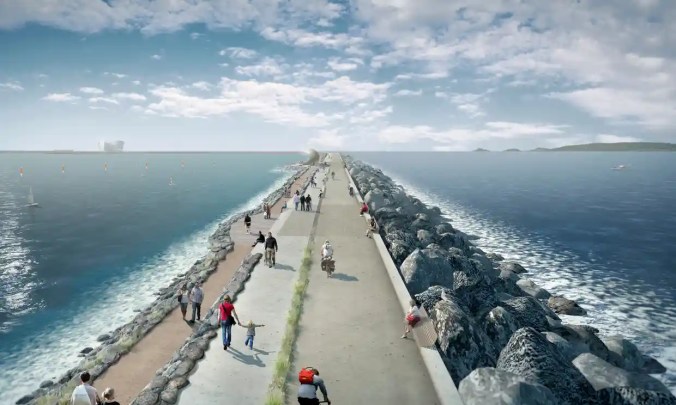
An impression of a £1.3bn tidal lagoon project, which the government refused to back in 2018. Photograph: Tidal Lagoon Power/PA

Most of our attention to ocean water is focused on the climate,  and the few renewable energy stories with oceans featured have been about offshore wind projects. Today’s news corrects the deficit of attention to the power of tidal waves:

Could Anglesey’s tidal energy project drive a new energy revolution?

Experts say Wales has huge potential for generating renewable marine power, yet, so far, ambitious schemes have been ignored

South Stack lighthouse on Holy Island, north Wales: construction on the island’s tidal stream project has just begun. Photograph: Getty Images

On the stunning and craggy coastline of Holy Island in north Wales, work has started on a construction project to generate energy from one of the world’s greatest untapped energy resources: tidal power.

The Morlais project, on the small island off the west of Anglesey has benefited from £31m in what is likely to be the last large grant for Wales from the European Union’s regional funding programme. It will install turbines at what will be one of the largest tidal stream energy sites in the world, covering 13 square miles of the seabed. Continue reading

Old Growth Forest Protection Schemes

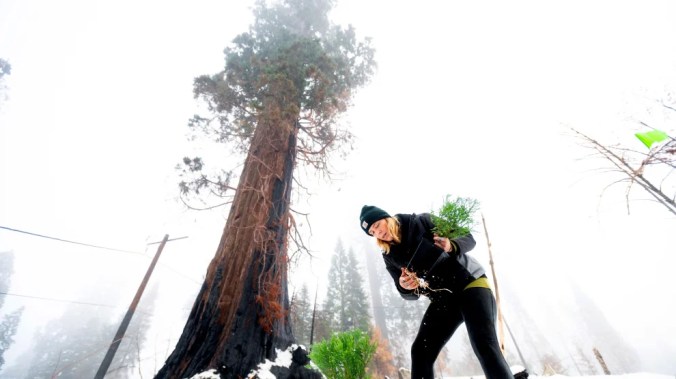
Caryssa Rouser, a propagation specialist with Archangel Ancient Tree Archive, plants a sequoia tree in October, 2021, in Sequoia Crest, California. Noah Berger/AP

Old growth forests matter for so many reasons. Not least, biophilic reasons. But at this moment, we rightly pay more attention to their value with regard to urgent climate issues. Maddie Oatman makes a good case in this Mother Jones essay:

Why Old-Growth Forests Matter So Much in the Fight Against Climate Change

Biden’s executive order to preserve ancient trees is a big deal—but it could have gone further.

Few experiences have rendered me as awestruck as the winter morning I spent wandering through a grove of ancient sequoias, their sienna bark glowing against the snowy ground. Continue reading
More On Seed Banks

We have featured these banks before, but they are worthy of a more detailed inside look.

So, thanks to by Salomé Gómez-Upegui, Rita Liu and the Guardian. Their article, Seed banks: the last line of defense against a threatening global food crisis is full of images and written descriptions that put these banks in better perspective:

As climate breakdown and worldwide conflict continue to place the food system at risk, seed banks from the Arctic to Lebanon try to safeguard

As the risks from the climate crisis and global conflict increase, seed banks are increasingly considered a priceless resource that could one day prevent a worldwide food crisis. Continue reading

Cold Brew Coffee, 2022

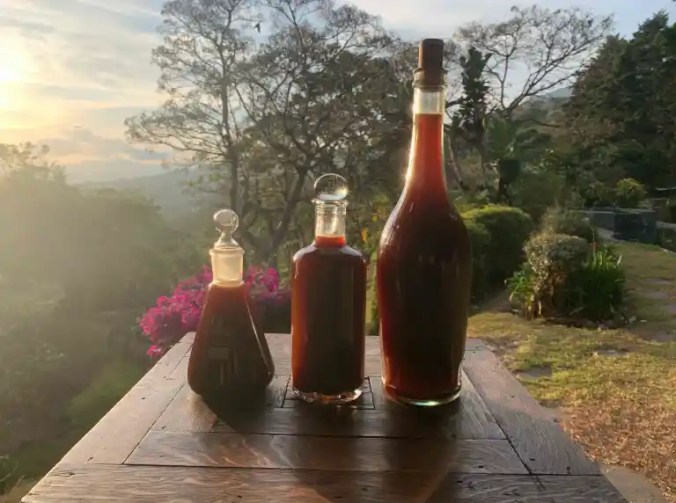
Cold brew coffee experimentation, April 2020

Two years ago, when the pandemic had shut down the airports in Costa Rica and we had no clue how long that would last, we wondered how the artisans and the farmers who supplied our recently opened Authentica shops would fare. We had to ask ourselves what we were going to do with the roughly 7,000 pounds of coffee beans we had contracted to buy from that year’s harvest. The most obvious move was to start roasting in the USA, so we could deliver to customers who had bought from us in Costa Rica and wanted to continue buying.

Cold brew coffee was a brief experiment at the time, but with sufficiently robust results to convince us that when travelers returned we would offer samples. The time has come.