Carbon Cowboys

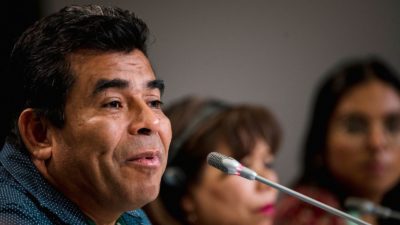
Levi Sucre Romero at the UN biodiversity conference in Montreal last week.

Levi Sucre Romero at the UN biodiversity conference in Montreal last week. ANDREJ IVANOV / AFP VIA GETTY IMAGES

Carbon credit brokers are busier than ever, and that is welcome news, but Levi Sucre Romero’s concerns give pause:

Forest Equity: What Indigenous People Want from Carbon Credits

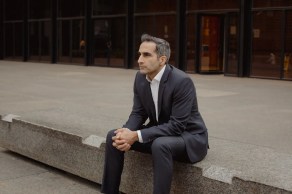
To Indigenous leader Levi Sucre Romero, carbon credit markets have failed to respect Indigenous people and their key role in protecting their lands. In an e360 interview, he talks about how carbon brokers have taken advantage of local communities and why that must change.

Indigenous protesters at the opening ceremony of the UN biodiversity conference in Montreal this month.

Indigenous protesters at the opening ceremony of the UN biodiversity conference in Montreal this month. ANDREJ IVANOV / AFP VIA GETTY IMAGES

In a world where carbon credit markets are taking advantage of Indigenous people and their forests, the United Nation is losing its leadership on combating climate change, says Indigenous leader Levi Sucre Romero.

In an interview with Yale Environment 360, Romero, who is from Costa Rica and is coordinator of the Mesoamerican Alliance of Peoples and Forests, calls out the “carbon cowboys” — the brokers who he says are wrecking efforts to allow Indigenous communities to have ownership of the carbon credits generated on their land, and who, by acting unscrupulously and secretively, are undermining global hopes of using nature to mitigate climate change. Continue reading

Great EV Expectations

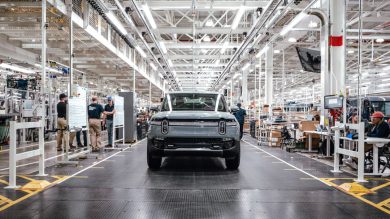
A Rivian R1T electric pickup truck at the company’s factory in Normal, Illinois. JAMIE KELTER DAVIS / BLOOMBERG VIA GETTY IMAGES

I had no reason to bet against Tesla until now, but I did wonder whether it was good for anyone (other than its shareholders) for that one company to dominate its market over the longer term. Now, happily, it looks like the market will do what we need it to do, which is get robust:

For U.S. Companies, the Race for the New EV Battery Is On

Spurred by federal mandates and incentives, U.S. manufacturers are pushing forward with developing new battery technologies for electric vehicles. The holy grail is a battery that is safer, costs less, provides longer driving range, and doesn’t use imported “conflict” minerals.

Sixteen years have passed since engineer Martin Eberhard unveiled his futuristic custom-designed sports car before a crowd of investors, journalists, and potential buyers in a Santa Monica Airport hangar. Continue reading

Why Waste Western Water?

A woman walks along a cliff top near Lake Powell, the second biggest reservoir in the U.S., where climate-change-driven drought continues to lower water levels. Photograph by David McNew / Getty

The management of water in the western USA has been an occasional topic in these pages and Rachel Monroe adds to our understanding:

The Water Wranglers of the West Are Struggling to Save the Colorado River

Farmers, bureaucrats, and water negotiators converged on Caesars Palace, in Las Vegas, to fight over the future of the drought-stricken Southwest.

In mid-December, I drove to Lake Mead, the nation’s largest reservoir, to see its infamous bathtub ring. The bathtub, in this metaphor, is Lake Mead, on the border between Nevada and Arizona; the ring is a chalk-white coating of minerals that its receding waters have left behind. The Southwest, which includes the Colorado River Basin, has been in a protracted drought since 2000; climate change has made it worse. Continue reading

Virtue Signaling Versus Virtue Versus Wrong

Laurence D. Fink, who runs BlackRock, has urged companies to adopt socially conscious practices. Winnie Au for The New York Times

We have no access to Mr. Fink’s motives or those of the firm he runs, or to how he and his colleagues make decisions–only to some of the actions they have taken. Our view on him and his firm may be simplistic, in that we respect their initial leadership on ESG but fault them now for not doing more. Even if they have only been virtue-signaling, and even if they fall short on true virtue, what they have done is obviously much better than those who are wrong on climate change:

BlackRock’s Pitch for Socially Conscious Investing Antagonizes All Sides

Right-wing officials are attacking BlackRock for overstepping. Those on the left say the world’s biggest asset manager is not doing enough.

Environmental, social and governance — or E.S.G. — investing, “to some degree, is a smoke screen,” said Tariq Fancy, a former BlackRock executive. Chloe Ellingson for The New York Times

It was a clarion call to chief executives everywhere.

In 2018, Laurence D. Fink, the longtime chief executive of BlackRock, the world’s largest asset manager, urged corporate leaders to assess the societal impact of their businesses, embrace diversity and consider how climate change could affect long-term growth.

“Companies,” Mr. Fink wrote in his annual letter to chief executives, “must ask themselves: What role do we play in the community? How are we managing our impact on the environment? Are we working to create a diverse work force? Are we adapting to technological change?” Continue reading

Land Use By Food Type, Data For Thought

The Conversation

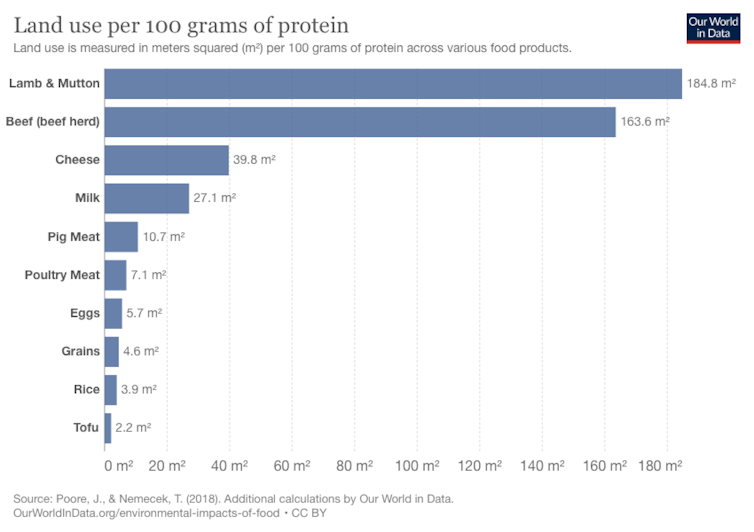
Chart of land use per 100g of protein for different foodsThe Conversation is “a news organization dedicated to facts and evidence” and with the tag line “Academic rigor, journalistic flair”. Our kind of reading. The graph to the left illustrates this article’s point; the photo below to the right is too composed for rigor:

Brazil’s enormous soy farms mostly produce food for animals, not humans. lourencolf / shutterstock

New food technologies could release 80% of the world’s farmland back to nature

Here’s the basic problem for conservation at a global level: food production, biodiversity and carbon storage in ecosystems are competing for the same land. Continue reading
Embracing Anthropocene

Image credits: Alamy; David Guttenfelder for The New York Times; Getty Images; Ashley Gilbertson for The New York Times; Michael Probst/Associated Press; Getty Images; NASA

We have been using this terminology already for more than a decade, thinking it was apt enough to be official:

For Planet Earth, This Might Be the Start of a New Age

A panel of experts has spent more than a decade deliberating on how, and whether, to mark a momentous new epoch in geologic time: our own.

The official timeline of Earth’s history — from the oldest rocks to the‌ dinosaurs to the rise of primates, from the Paleozoic to the Jurassic and all points before and since — could soon include the age of nuclear weapons, human-caused climate change and the proliferation of plastics, garbage and concrete across the planet. Continue reading

Tokyo’s Rooftop Solar

A rooftop solar installation in Yokohama, near Tokyo. COCREATR VIA FLICKR

Our hats off to Japan’s largest city for this requirement:

Tokyo to Mandate Rooftop Solar Panels on New Homes

Tokyo is mandating that all new homes in the city be built with rooftop solar panels starting in 2025. Continue reading

Fusion Hoopla

A reason that the breakthrough is causing such hoopla is that it implicitly promises that we could use fusion to run the world in almost its current form. Photograph courtesy Lawrence Livermore National Laboratory

Without the expertise to fully appreciate the science, the hoopla can be overlooked too easily. McKibben’s comment helps clarify:

The Fusion Breakthrough Suggests That Maybe Someday We’ll Have a Second Sun

In the meantime, we need to use the sun we’ve already got.

On Tuesday, the Department of Energy is expected to announce a breakthrough in fusion energy: according to early reports, scientists at the government’s Lawrence Livermore National Laboratory, in California, have succeeded for the first time in making their complex and expensive machinery produce more power than it uses, if only for an instant. Continue reading

Biodiversity, Montreal & Us

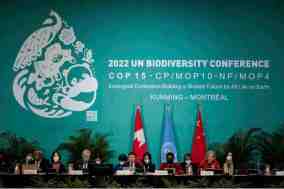
The opening plenary of the U.N. biodiversity conference in Montreal. Photograph by Andrej Ivanov / AFP / Getty

We continue, as a species, to document our impact on other species. The warning signs keep getting clearer. It is not pleasant reading, but it is documented for a reason; it is about us. It is about our responsibilities. Our thanks, as always, to Elizabeth Kolbert:

Can the U.N. Save the World from Ecological Collapse?

At this week’s summit, delegates will consider ambitious new conservation targets—even though the old ones have yet to be achieved.

The Red List of Threatened Species might best be described as a lack-of-progress report. Continue reading

Climate Science Is Getting Old

Scientist Roger Revelle, an adviser who warned Lyndon Johnson about climate change in 1965, greets the president in the Oval Office. Roger Revelle papers/Special Collections Archives/UC San Diego

In keeping with a theme–that the science of climate risk has been around for a couple generations now–we have linked to each time there are new revelations:

What Big Oil Knew About Its Products’ Climate Risks—and When

A long-forgotten report sheds light on a high-stakes liability question.

Carroll Muffett began wondering in 2008 when the world’s biggest oil companies had first understood the science of climate change and their product’s role in causing it. Continue reading
The Little Countries That Could

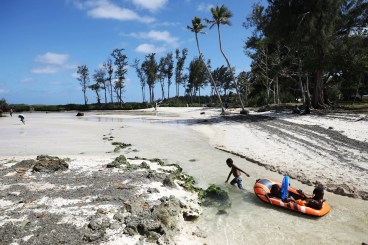
The atoll nation of Vanuatu is threatened by rising seas. “We had to learn how to manage our unimportance,” its president said. Mario Tama/Getty Images

This story has a familiar ring to it, if you are familiar with the history of Costa Rica going back to colonial times. Never a particularly “important” part of the empire, it thereby avoided many pitfalls typical of other countries in Latin America, and evolved into a stable democracy with progressive ideas and goals and achievements. We wish this little country in the Pacific comparable success by thinking outside the box, as its president says:

Emergency supplies being distributed after Cyclone Harold in 2020. International Federation of Red Cross, via Agence France-Presse — Getty Images

It wants a top international court to weigh in on whether nations are legally bound to protect against climate risks.

Nikenike Vurobaravu presides over a tiny country with a large hand in climate diplomacy.

Rising sea levels threaten the very existence of his Pacific Island nation of Vanuatu and its population of just over 300,000 people. Its best defense, he says, it to raise its voice creatively in international diplomatic talks. Continue reading

Is Cruise Travel Evolving In A Way That Is Good For The Planet?

Cruise ship tourism is unfortunately not disappearing as we might have hoped. Are the ships evolving to be more environmentally and socially responsible? Our thanks to Maria Cramer for asking and attempting to answer the question:

How Green is Your Cruise?

As cruise companies head into their busiest season, they say they have ambitious plans to curb greenhouse emissions and find cleaner sources of fuel. But critics say the progress is too slow.

In the Caribbean, many cruise companies have bought islands and turned them into private resorts for the exclusive use of cruise passengers who cavort in enormous wave pools, rush down 135-foot water slides with names like Daredevil’s Peak, and zip-line across wide beaches. Continue reading

Thwaites & Us

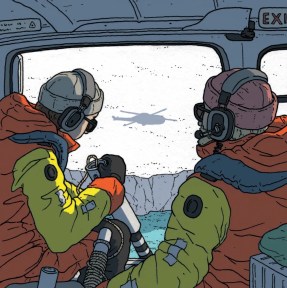
Probes beneath the ice could shed light on the fate of the world’s coastlines. Illustration by Owen D. Pomery

Most of us do not spend much time thinking about what is happening there, but Antarctica’s future is now very much entwined with the future of the rest of the planet.  All of us. So, thanks to David W. Brown for this travelogue:

Journey to the Doomsday Glacier

Thwaites could reshape the world’s coastlines. But how do you study one of the world’s most inaccessible places?

I first saw our icebreaker, the RV Araon, when we were due to leave for Antarctica. The largest icebreakers are more than five hundred feet long, but the Araon was only the length of a football field; I wondered how it would handle the waves of the Southern Ocean, and how it would fare against the thick sea ice that guards the last wilderness on Earth. Continue reading

Imposing On Pastoral Beauty To Capture Wind’s Power

Pinnacle turbines dot the skyline in Keyser, West Virginia, where, according to Andrew Cosner, a twenty-one-year-old technician, some residents remain hostile to the new wind farm: “They say it ruins the landscape and it’s ugly.”

It is to each of us whether we find the view attractive or not, and there was a time when I found large man-made structures an imposition on pastoral beauty.

Smith stands in the nacelle of one of the turbines just before daybreak.

As time passes I find myself drawn more to such a view as that in the photo above as a signal of progress.  It is not because the view is in a place far away from me– on the mountain ridge above where I live there is a row of such turbines and I am constantly gazing at that horizon. Published in the print edition of the November 28, 2022, issue of the New Yorker, with the headline “Blade Runners,” D.T. Max provides some context, but the photos do the heavy lifting:

THE BLADE RUNNERS POWERING A WIND FARM

In West Virginia, a crew of five watches over twenty-three giant turbines.

The Pinnacle wind-power plant extends for roughly four miles in the northeastern corner of West Virginia. Continue reading

Precision Fermentation’s Implied Potential

Illustration: Eleanor Shakespeare/The Guardian

It is the first time we are seeing these two words together, and George Monbiot has this to say about the potential implied:

Embrace what may be the most important green technology ever. It could save us all

Never mind the yuck factor: precision fermentation could produce new staple foods, and end our reliance on farming

So what do we do now? After 27 summits and no effective action, it seems that the real purpose was to keep us talking. If governments were serious about preventing climate breakdown, there would have been no Cops 2-27. The major issues would have been resolved at Cop1, as the ozone depletion crisis was at a single summit in Montreal. Continue reading

Cover Considered

We link to essays and articles, as well as profiles and book reviews from this magazine constantly, but never previously to a cover and only once, by reference, to cartoons. The cover of this week’s issue merits consideration:

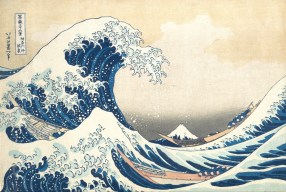
Birgit Schössow’s “The Future Is Here”

The artist talks about incorporating environmental themes in her work, and the historical inspiration behind her cover for the Climate Issue.

Françoise Mouly,  Birgit Schössow

Hokusai’s “Under the Wave off Kanagawa,” circa 1830-32, is said to have inspired Debussy’s piece “La mer” (The Sea) and Rilke’s poem “Der Berg” (The Mountain).

In her new cover, the Germany-based artist Birgit Schössow drew inspiration from an artistic masterpiece. Starting in the late seventeen-hundreds, the Japanese artist Katsushika Hokusai created woodblock prints in a genre called ukiyo-e, part of an artistic movement known as “the floating world.” One of Hokusai’s best-known works is one of a series called “Thirty-six Views of Mount Fuji” that shows a giant wave cresting in the foreground. The wave’s dramatic curve and stature, topped with a skim of frilly foam, are so eye-catching that you might miss the slender fishing boat it’s about to topple onto. Continue reading

Startling Capacities Of Regional Forests

Harvard Forest (pictured) was included in a study that looks at how New England forests can be better utilized in the fight against climate change.
Stephanie Mitchell/Harvard Staff Photographer

We had no clue how much forest area that region has, nor how much capacity to absorb carbon that would translate to:

New England forests, new strategies can offset most regional emissions over 30 years, report says

Study, led by Harvard ecologist, lays out five policies to boost levels of absorption as six states lower emissions

A major new report suggests that with a handful of strategies New England’s 32 million acres of forests, which cover about three-quarters of the region, could eventually come close to absorbing 100 percent of all the carbon produced by the six states. Continue reading

Coral Defying The Odds

Corals in the waters of the Ras Mohammed National Park in the Red Sea near Sharm el Sheikh, Egypt, home to one of the only reefs in the world that can tolerate heat. Sima Diab for The New York Times

Our thanks to Jenny Gross and Vivian Yee reporting from Egypt:

Attendees of the United Nations climate conference took breaks from negotiations to see the corals for themselves.Credit…Mohammed Abed/Agence France-Presse — Getty Images

As warming waters devastate coral around the world, the sea’s stunningly colorful reefs have been remarkably resilient. But pollution, mass tourism and overfishing put them at risk.

SHARM El SHEIKH, Egypt — The vast majority of the world’s coral reefs are likely to be severely damaged in the coming decades if the planet keeps warming at its current rate. Continue reading

Fridays For Future @COP27

Fridays for Future protest calling for money for climate action at Cop27. Photograph: Peter de Jong/AP

If you wonder what our youth are up to, take a look at what the Guardian’s team of Fiona Harvey, with Adam Morton and Patrick Greenfield is reporting from Sharm el-Sheikh:

Cop27: EU agrees to loss and damage fund to help poor countries amid climate disasters

Change in stance puts spotlight on US and China, which have both objected to fund

A breakthrough looked possible in the deadlocked global climate talks on Friday as the European Union made a dramatic intervention to agree to key developing world demands on financial help for poor countries. Continue reading

Canada’s Best Tide Forward

As Brazil turns the tide to its better environmental self, the New York Times reporter Ian Austen explains how Canada harnesses its best tide for an environmental feat long dreamed of:

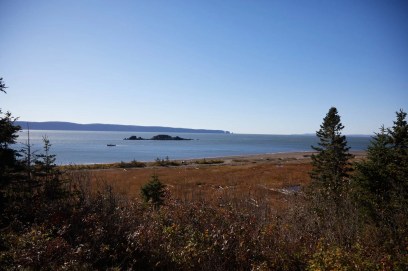
The Bay of Fundy’s funnel shape is part of the reason for its exceptional tides. Along its 96 or so miles of length, the bay dramatically narrows and its depth drops, from 765 feet to 147 feet. David Goldman for The New York Times

Who Will Win the Race to Generate Electricity From Ocean Tides?

The Bay of Fundy, between Nova Scotia and New Brunswick, has one of the world’s most powerful tides. Now, engineers and scientists hope to finally turn it into a clean energy source.

ABOARD THE PLAT-I 6.40 GENERATING PLATFORM, Nova Scotia — The Bay of Fundy, off the Canadian provinces of Nova Scotia and New Brunswick, has long tantalized and frustrated engineers hoping to harness its record-setting 50-foot high tide to generate electricity. Continue reading